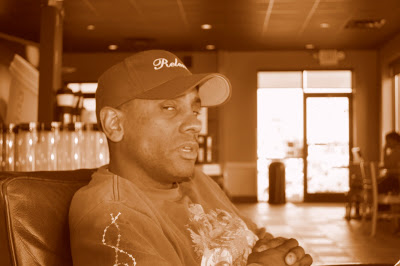
I’ve written about love, lust, and loyalty for over two decades. But I never wrote about the hardest part: becoming the man who deserves it.
That sentence took a long time to land. Because it’s easier to write characters.
Easier to give Dre in Sugar Daddy the complexity I wasn’t ready to own. Easier to map the tension in Extra Marital Affairs than face the pattern underneath my own choices. Easier to write Single With Benefits and call it fiction when parts of it were confessions wearing a disguise.
This piece isn’t a how-to. It’s a reckoning.
If you’ve been rocking with Relentless long enough, you already know the difference.
The Man Who Wrote the Rules Had to Unlearn Them
Here’s the irony nobody names.
I built a catalog around desire, dysfunction, and street love — the complicated spaces where Black people live, feel, and choose each other. Sugar Daddy. Extra Marital Affairs. Single With Benefits. Books that hit because they were mirrors, not fairy tales. They reflected real patterns. Real pain. Real people I either knew intimately or was, on some version of some Tuesday.
Street literature has always done that. Donald Goines did it. Sister Souljah did it. Wahida Clark did it. Our genre is one of the only literary traditions that depicted Black love as both dangerous and sacred at the same time. Mainstream romance never had the guts for that duality. Our readers live in it. They don’t need protection from complexity. They need someone honest enough to name it.
I named it in the books. What I didn’t do — not for a long time — was name it in myself.
Writing about something doesn’t mean you’ve mastered it. Sometimes it means you’re still working it out on paper. Many times, I don’t even know how an ending is gonna play out and I’m pulled in by the story itself. And I think thats good fiction, a story that tells the author what to write, and then he knows how to get it done. Sometimes the novel is the therapy you couldn’t afford. Sometimes the character gets to make different choices while the real you keeps running the same play.
I was deep in the game. Building. Hustling legacy. Moving at a speed that left no room for the stillness a real relationship demands. I wrote about it brilliantly. But brilliance on the page doesn’t translate to readiness in real life. Those are two different currencies.
The man who wrote the rules eventually had to sit down and unlearn them.

What ‘Proposal-Worthy’ Actually Means — And It Ain’t a Ring
Let’s kill the myth right now.
Proposal-worthy is not about the ring. Not the bank account, the status, the car, or whether your name has equity attached. Those things matter — don’t let anyone tell you they don’t — but they are not the foundation. They’re furniture. And furniture in a house with no walls is just stuff sitting in the weather.
Building a proposal-worthy life is about emotional architecture. What you’ve constructed underneath the surface before she ever sees the question coming.
A real woman reads all of it — mental, physical, spiritual, logistical. She reads whether you sleep with chaos or with peace. She reads how you respond when a deal falls through. She reads whether your mornings have intention or just momentum. She reads your environment — not decorating advice, but what your space says about the version of yourself you’ve decided to become.
I call it the Fortress deliberately. The Atlanta home. The creative sanctuary. The life built with intention rather than accident. The Fortress is the infrastructure of a man who has decided, consciously, that he is done building in survival mode and ready to build for legacy.
That shift — from surviving to legacy-building — is what proposal-worthy looks like from the inside.
And here’s what the culture never says: the ‘proposal-worthy’ framing has almost exclusively been applied to women. Entire industries coach women on being more marriageable. Books, courses, podcasts, whole empires built around telling her what to fix, soften, and prove.
Flipping that lens onto a man — asking what he has to dismantle, rebuild, and demonstrate to himself before he earns the right to ask someone to bet their future on him — that’s the conversation we’re actually having here.

The Patterns I Had to Break to Get Here
I’m not airing anyone out. That’s not what this is.
But I’ll own my role. That’s the only part I control.
Ego is quiet. That’s what makes it dangerous. It doesn’t announce itself. It shows up as I’m just focused. It shows up as she knows what I’m building. It shows up as presence in the room but absence in the relationship — body there, attention gone.
Hustle addiction is real. In the streets — whether that’s actual streets, the creative grind, or the empire-building mentality — it gets celebrated. Nobody pulls you aside and says, You’re using productivity to avoid intimacy. They just watch your numbers climb and call you inspired.
Avoidant attachment isn’t a diagnosis most men in our communities ever receive. But the research is clear: men who grew up in high-conflict or absent-father households develop relational patterns that look like strength from the outside and feel like distance from the inside. The armor that protected you in childhood becomes the wall that isolates you in adulthood. The work of rewiring that — what psychologists call relational inventory — is work most men are never coached to take on.
I had to take it on anyway. Without a coach calling the drill.
There’s a concept in Fire & Desire — passion without peace is just burning. Eventually, you run out of fuel. I’ve lived that. I’ve been the man on fire — creatively, professionally, relationally — and I’ve felt what it is to burn through everything, including the people who were just trying to love you right.
Breaking the pattern doesn’t happen in a moment. It happens in a thousand small decisions to choose differently. To stay in the discomfort instead of outrunning it. To let someone see the unfinished version instead of always performing the polished one.
Unglamorous. Necessary. Real.
What a Real Woman Sees Before She Says Yes
Stop asking how to propose. Start asking what she’s already evaluating.
She’s been watching long before you got to one knee. That’s not suspicion — that’s intelligence. A woman who has lived through disappointment, who has read books like mine and recognized herself in them, who has loved men who had everything except the capacity to be present — she is not passive in this process. She is studying.
She watches how you handle pressure. Not the pressure you perform for — the pressure that catches you off guard at 11pm when something goes sideways and nobody’s watching. She watches how you move through disappointment. How you talk about money when it’s tight. How you treat people who can do nothing for you. How you show up on a regular Tuesday with no occasion attached.
Consistency is the currency. Presence is the language. Safety is the foundation.
There’s a Lady First energy to this. The woman who deserves a proposal isn’t waiting on a question. She’s waiting for evidence. She’s building her own case study of who you are under normal conditions, under stress, under joy, under grief. And she’s cross-referencing it against what you claim to be.
A 2022 Howard University study found 68% of Black women ranked emotional availability above income and physical attraction when evaluating long-term partnership potential. Sixty-eight percent. Yet only 19% of Black men in relationships reported ever being explicitly taught what emotional availability looks like in practice.
That gap — between what she’s looking for and what we were ever taught to give — that’s where relationships fracture. Not from lack of love. From lack of language. From lack of modeling. From lack of someone sitting a young Black man down and saying: being present, being vulnerable, being consistent — that’s not weakness. That’s the whole assignment.
Building a proposal-worthy life means closing that gap. On purpose. Every day.
Building the Life, Not Just the Moment
The proposal is punctuation. Not the sentence.
The sentence is the life you’re already living — or building toward. The question isn’t whether the moment is perfect. The question is whether the life is real.
Research from the Institute for Family Studies shows men who marry after 35 have a 24% lower divorce rate than men who marry before 30. Not because older men are inherently better partners. But when delay is used as growth time rather than avoidance, identity formation is more complete. The who am I becoming? tension that quietly destroys younger marriages gets worked through — or at least named and faced.
I’m not in my 20s. I’m grateful for that.
The version of me in my 20s — brilliant, hungry, relentless, and emotionally unavailable in ways I couldn’t have articulated — would have taken a good woman into a great relationship and slowly made it small. Not from cruelty. From incompleteness.
The work of the Fortress has been intentional. Restructuring time, creative output, how I occupy space physically and emotionally. Making room for a real partnership isn’t just clearing a drawer in the nightstand. It’s clearing space in your priorities, your calendar, your nervous system, and your identity.
Men who engaged in structured self-reflection — journaling, therapy, mentorship, faith-based accountability — were 3.2 times more likely to describe their relationships as intentional rather than circumstantial. I’ve lived both versions. Circumstantial relationships happen to you. Intentional ones get built by you.
Nipsey didn’t just talk about building in the community. He demonstrated a partnership with Lauren London that became a cultural reference point because it was visible and it was real. We watched a man lead with both ambition and accountability. We watched the evolution. When we lost him, we grieved not just the artist — but the example.
Legacy isn’t only what you leave in catalogs and catalogued music. It’s what you model. The stability. The love. The way you show up. That gets passed down too.
Building a proposal-worthy life is building something worth inheriting.

The Next Chapter Is Already Being Written
Jay-Z dropped 4:44 in 2017 and the culture sat with it for months.
Not because it was an apology record. Because it was an accounting. A high-status Black man documenting his own relational failures — and Black women rewarded that radical honesty with deep, sustained loyalty. Because they recognized it. Because they’d been waiting for it. Real accountability — not performance — is rare enough to be revolutionary.
Kevin Powell wrote about his history of violence toward women in The Education of Kevin Powell and became one of the most cited examples of a Black male public figure doing visible transformation work. He proved naming the pattern publicly is often the first act of real change.
I’m not comparing notes with Jay or Kevin. I’m saying: this tradition of Black men telling the truth on themselves — it matters. It moves things. It gives other men permission to do the same inventory work in private, even if they never publish a word of it.
This piece is my version of that. Not a performance. Accountability out loud.
The man who told other people’s stories in PUSH, The Last Kingpin, Single With Benefits, and Extra Marital Affairs is now living a story worth telling. The difference between those books and this moment? I’m not hiding behind a character. I am the character. Working it out in real time. In the Fortress. On the page. In the mirror.
Street lit readers are uniquely built for this. They’ve been reading morally complex protagonists since Goines. They don’t need a hero. They need a real character doing real work. That’s an emotional sophistication most self-help content completely underestimates — and wastes.
You don’t need me to be perfect. You need me to be honest.
So here’s the honest question:
What does your proposal-worthy life look like — not hers, not the fantasy, not what you’d say on a first date — but the actual, current, infrastructural reality of who you are becoming?
Are you building it? Or just talking about it?
The next chapter doesn’t write itself. And the woman who deserves it — real, whole, and watching — she can already tell the difference.
Relentless.
The books came from real life. The real life is still being written. If you’ve been rocking with Relentless through Sugar Daddy, Extra Marital Affairs, Single With Benefits, and everything in between — you know this story hits different. Grab the full catalog at [beacons.ai/gorelentless](https://beacons.ai/gorelentless) and stay locked in for what’s coming next.