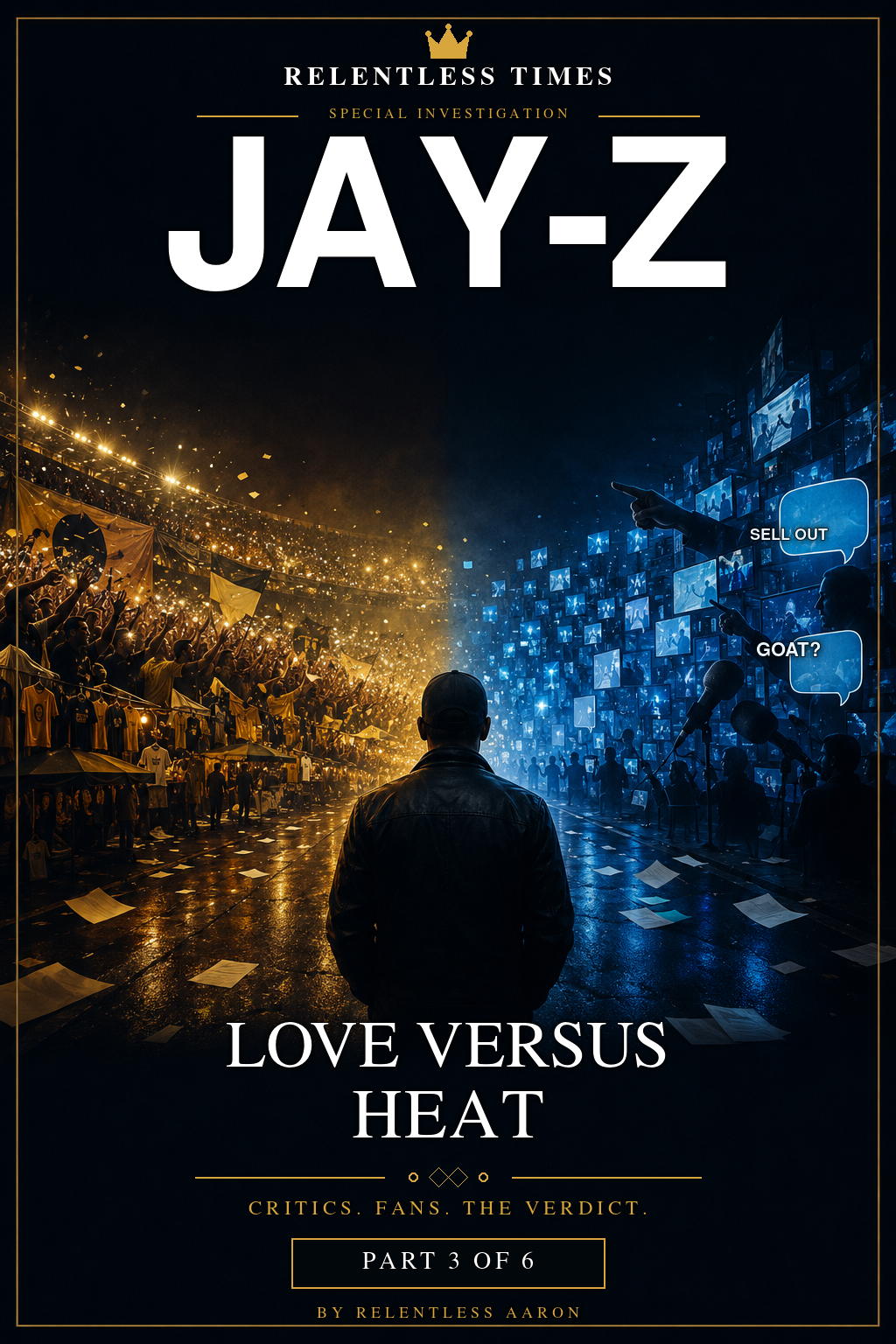
Four kinds of people came for Jay-Z this summer. Only one of them deserves a real answer.
This is the anatomy of criticism in the age of the algorithm, and the question underneath it all: does America believe in redemption, or does it just enjoy the word?
By Relentless Aaron
Part Three of a Six-Part Relentless Times Investigation
The bear cut his hair.
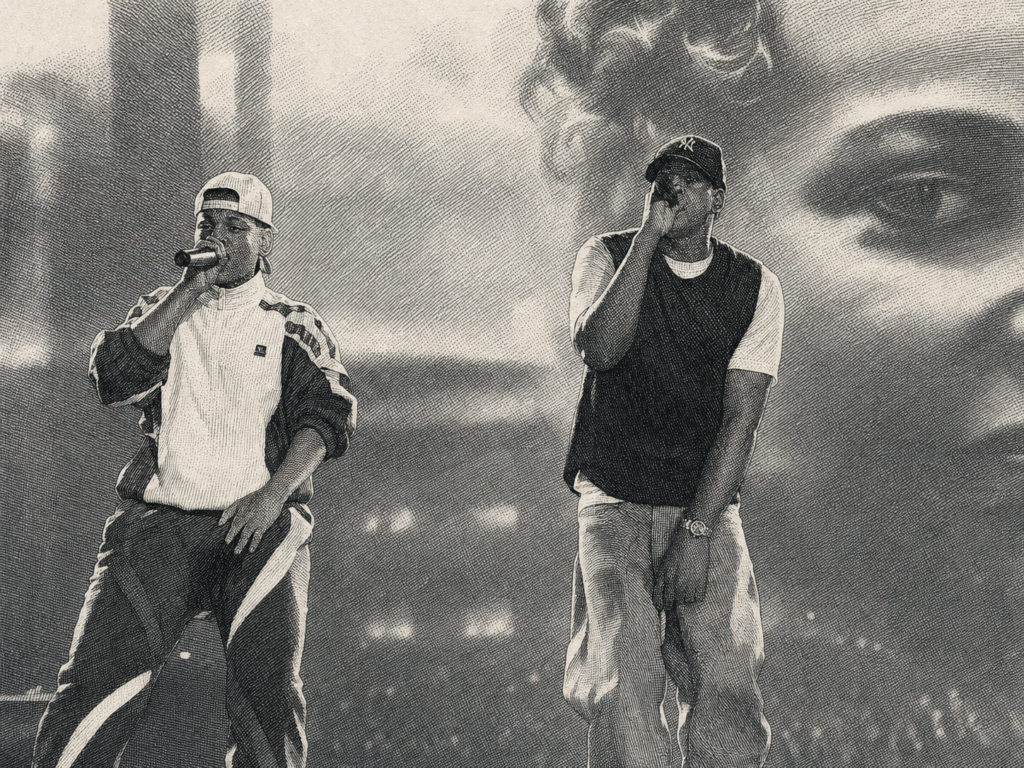
That was Pharrell, onstage at Yankee Stadium, grinning into a microphone: “They poked the bear, and the bear cut his hair. He got on his helmet. He’s about to go to war. I hope you kill all of them. Y’all know who I’m talking about.”
He never said a name. He didn’t have to.
The internet had already noticed the transformation. Trim. Fit. The hair gone. One commentator floated a theory I like: he was shedding a layer, getting back to the 1996 silhouette to match the anniversary. Maybe. Or maybe Pharrell told us the real reason. You don’t get in fighting shape for a celebration. You get in fighting shape for a fight.
So today we walk into the fight. All of it. The chart debates, the age jokes, the boycott arguments, the structural critiques, the rage-bait economy. I collected the commentary myself, the defenders and the detractors, the extremists and the thoughtful ones, because a real investigation doesn’t cherry-pick its witnesses.
What I found is that “Jay-Z hater” is not one species. There are four. And they do not deserve the same response.
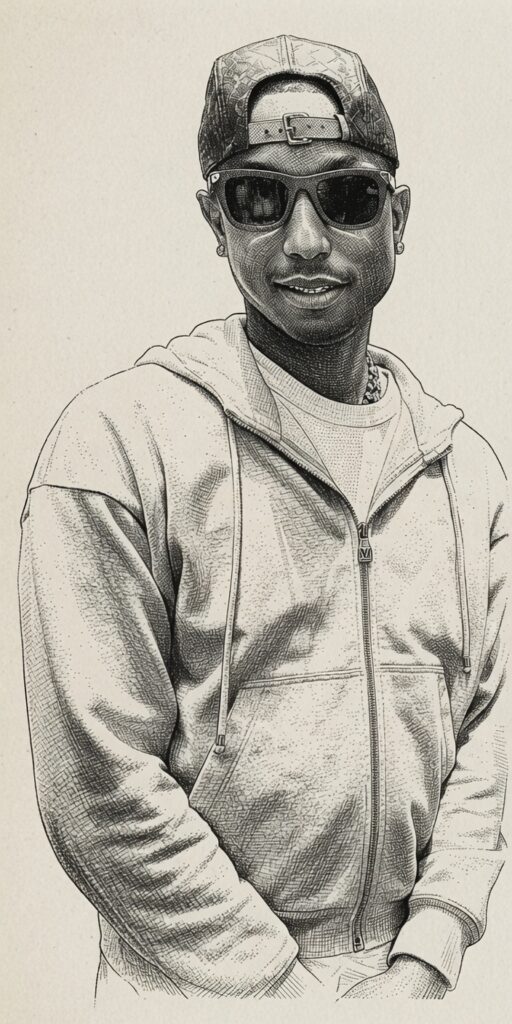
Pharrell Williams
First, the bars everyone is arguing about
Before we sort the critics, put the evidence on the table. The freestyle, delivered a cappella, the poems he composes in his head with no pen in sight:
They say I sold out. Yeah, I did sell out. Three nights, I sold Yankee Stadium the hell out. I’m a target, you ain’t, don’t miss that target. No exclusive they only doing with Apple, more money. You shopping at Amazon or you boycott? You post it on Instagram, that’s Meta, boy. Stop it. Y’all know Google owns YouTube. You picking and choosing, the politicking as usual.
Look at the construction. The first move flips the accusation into the achievement: sold out becomes sold out. The second move is a triple: Target the retailer, the target on his back, and the aim of the people shooting. Then the closing run walks through the average critic’s own daily life, Amazon delivery, Instagram post, YouTube video, and asks a question nobody enjoys sitting with: if participation in corporate America is the sin, who among us is clean?
Two honest readings exist, and I heard both in the commentary I gathered.
Reading one: he’s mocking working people. A billionaire with infinite options laughing at consumers who have none, telling them their boycott is hypocrisy because they still order diapers online. That reading has teeth. When you have the power to choose any distribution partner on earth, “everybody’s compromised” lands differently than it does coming from a man with rent due.
Reading two: he’s naming something true and uncomfortable. A handful of corporations own the plumbing of modern life. Moral purity through consumption is close to impossible, and selective outrage picks its targets by convenience. Under this reading, the bars aren’t a defense of his Target deal. (More on that in a future article), but… They’re an argument that purity tests measure theater, not principle.
I’m not going to pick your reading for you. I’m going to do something the algorithm won’t: hold both, and move to the people making each one.
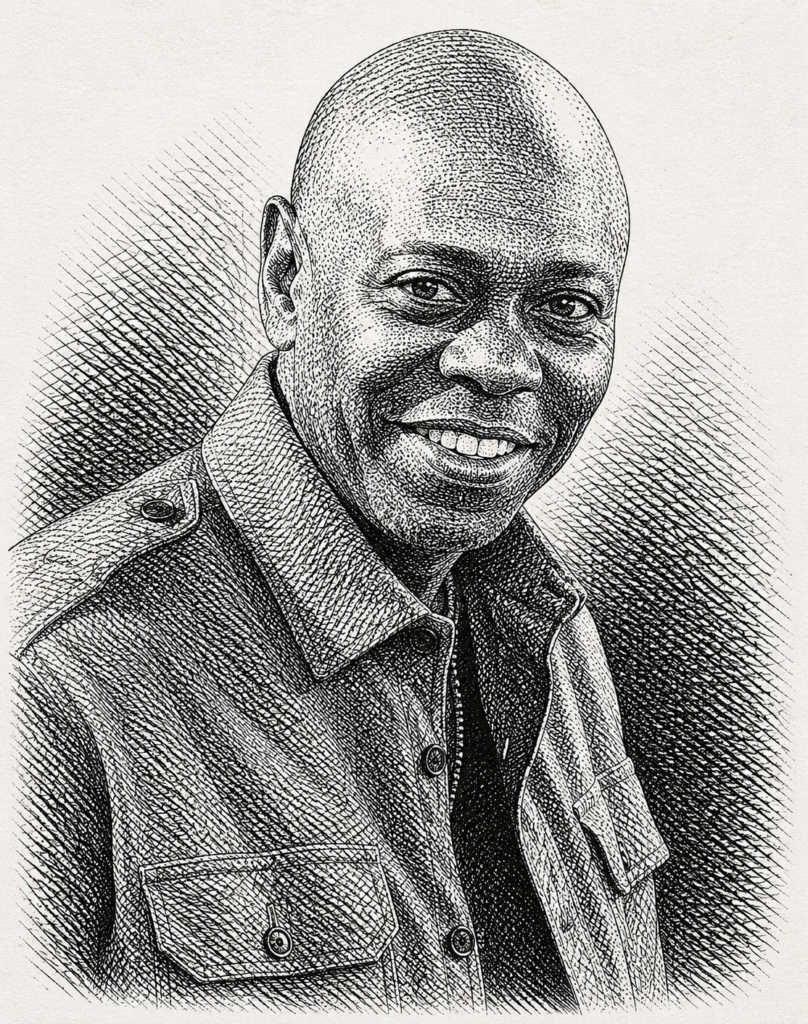
If it’s culturally relevant & important, Dave will be there.
Critic type one: the curious skeptic
A young man posted a question that traveled: how is Jay-Z the GOAT when he’s never had a solo Billboard Hot 100 song, when the big hits lean on Rihanna, Beyoncé and Alicia Keys? He even said, and I believe him: “I’m not trying to hate at all. I just wanna know.”
Respect the honesty. Now correct the record, because the claim as stated is simply wrong. Jay-Z has charted solo on the Hot 100 many times across three decades. The defensible version of that critique is narrower: his career-defining chart peaks often came on collaborations. That’s a real conversation. The version that went viral is not.
And here’s what a defender fired back, and the core of it holds: measuring hip-hop greatness by pop chart position is using the wrong ruler. But the sharper point was this. The features argument eats itself. Rihanna was signed to Def Jam while Jay ran the label. The artists cited as his crutches are artists whose careers ran through infrastructure he built or led. Now, when that defender claimed Beyoncé is “only Beyoncé because of Jay-Z,” that’s fan hyperbole and I won’t carry it: Destiny’s Child made Beyoncé a star before those two ever linked. Keep the strong core, drop the overreach. That’s how grown people argue.
The curious skeptic deserves engagement, sources and patience. He said he never dove deep into the discography. Somebody hand him The Blueprint and let the music do what it did to a stadium.
Critic type two: the comedy hater
Then there’s the voice declaring that nobody will ever make “a 60-year-old rapper the hottest in the genre,” that 2004 is never coming back, that the whole thing is a topic of comedy.
Two problems. First, the math: Jay-Z was born in December of 1969. He spent that weekend at Yankee Stadium at 56, not 60. If you’re going to age a man out of relevance, at least age him accurately.
Second, the facts, which a debate opponent delivered on the spot: the run was announced as two nights. Demand detonated the ticketing so completely that a third night was added. That’s how the weekend became a weekend. People flew in from other cities. Hotels ran out of rooms. One commentator called it “almost as if it was a national holiday weekend in New York.”
You cannot argue a man is irrelevant during the week he is the single most relevant thing in American entertainment. The comedy hater doesn’t need a rebuttal. He needs a window.
Critic type three: the structural critic
Now the serious one. And I’m going to give it to you at full strength, because this argument deserves better than a strawman.
The critique goes like this. The NFL has 32 ownership groups, overwhelmingly white and wealthy, holding stakes passed through families and networks that Black Americans were legally barred from building for most of this country’s history. The commissioner’s office, the broadcast deals with Fox, CBS, NBC, ESPN and Amazon, the stadium financing, the construction contracts, the naming rights, the concessions, the insurance on every player on every roster: white dominated, top to bottom. Billions moving every season through infrastructure Black people were excluded from constructing.
So when Jay-Z sits at that table, the critic says, he is not negotiating collective Black empowerment. He is helping the machine run smoother. And worse: power loves him precisely because he is the exception to the rule. Keep one Marcy-to-billionaire story in the spotlight and a generation chases a door that admits one person per era. The critic’s closing line was cold: keep your money, you don’t need dinner with Jay-Z.
Sit with that. Don’t flinch past it. Parts of it are simply true. The ownership demographics are true. The historical exclusion is true. The Kaepernick wound underneath the whole NFL partnership is real, and the settlement’s silence still costs Jay credibility with people who wanted the league to pay in more than money. And the exception-to-the-rule mechanism is one of the oldest tricks in American life: elevate one, and call the ladder a staircase.
But here’s where I part ways with the conclusion. The critique assumes a seat at the table can only serve the table. History offers another possibility: that access can be leveraged, imperfectly, incrementally, for things a boycott never touches. Tomorrow’s article puts that theory on trial with the actual record: the prison reform work, the Kalief Browder documentary, the bail fights, the justice cases nobody streams. Maybe the record answers the critique. Maybe it doesn’t. But the verdict should come from evidence, not vibes, and Thursday we hold court.
One more honest note: the critic claims Jay works to ensure nobody becomes the next him except his own children. That’s a mind-reading claim. Nobody can print what’s in another man’s heart. What we can print is what his money and institutions have done, and that’s exactly what Part Four is for.
Critic type four: the outrage industry
And then there’s the fourth species, which isn’t criticism at all. It’s a business model.
Blank profile. Microphone. Wi-Fi. Daily accusations, zero accountability, revenue tied to rage. These accounts don’t want answers to their questions because answers end the content stream. One die-hard fan put the counter-case with more color than I’ll reproduce in full, but his core point stands even shaved of its insults: a lot of the rage-bait isn’t engaging what Jay said. It’s engaging what a screenshot of a screenshot said he said.
Here’s the irony that never stops paying: every attack circulates the name. Every angry video plays the music. Every takedown sends a new listener to the original freestyle to check the crime and half of them stay for the catalog. Outrage is unpaid promotion unless it surfaces conduct heavy enough to crack a foundation.
Three sold-out nights say the foundation is holding.
The criminal who refused to remain one
Underneath all four critic types sits the same unspoken tension, and it’s time to say it plainly.
Jay-Z survived the life America expected to kill or imprison him. He has never hidden the years in the street drug economy. He turned that history into confession, warning, mythology and craft, and he carried Marcy Projects into boardrooms that were never built to receive it.
That does not settle every account. Wealth doesn’t launder harm, and his own catalog says as much in its honest moments.
But it forces the question this whole series keeps circling: does America believe in rehabilitation, or does it just enjoy the word? Because watch the pattern. Some people admire the escape. And some people will never forgive him for escaping, because his existence complicates a story they need to keep telling, whether that story is “the system always wins” or “success means selling out.” A free, wealthy, unbought-and-unbossed-or-maybe-bought-depending-who-you-ask Jay-Z is inconvenient to everybody’s clean narrative.
Good. Inconvenient men are how narratives get retired.
Now the love, because the love is the bigger data set
I promised you I collected everything, extremists included. So let me tell you what actually dominated the commentary. It wasn’t hate. It wasn’t even close.
It was a fan who went to Nights Two and Three refusing to rank them: “It’s a package deal. Three different shows in one weekend. That’s fire in itself.” It was the awe at Eminem, who as she put it barely comes out of the house, arriving in full Eminem uniform, hoodie, glasses, cap, to give “Renegade” its first live airing in years. It was the one wish that would’ve made it perfect: Takeover, with Nas walking out to do Ether “for the culture,” two grown men laughing at the war that once defined them.
And it was one monologue that stopped me cold, because it said what this whole series has been reaching for. The speaker was reflecting on Reasonable Doubt at 30, and he said: we know how to celebrate people who die young. T-shirts. Murals. Word to my mans and them. But somewhere along the way we forgot how to celebrate the people who made it through.
Surviving has its own kind of wisdom, he said. Jay isn’t trying to recreate 1996. He’s showing us what 2026 looks like after you survived 1996. We’ve gotten good at asking who’s next. We don’t ask often enough who’s still here.
That’s the answer to the heat, and it didn’t come from me. The culture doesn’t get stronger just by producing the next talent. It gets stronger when the next generation still sees value in the people who carried the thing long enough to hand it over.
The critics ask what Jay-Z’s success costs us.
That voice asked what his survival teaches us.
Both questions are legitimate. Only one of them builds anything.
Tomorrow we audit the receipts
The structural critic said the seat at the table serves the table. Tomorrow we open the books and check: Kalief Browder. Trayvon Martin. The bail fights. The wrongful convictions. The Brooklyn library. The films. The political capital, spent and unspent. Whether the public has seen the complete record or a cropped photo.
The bear cut his hair and put on a helmet.
Turns out the war was never against the critics.
It’s against being reduced to somebody else’s headline. And so far, he’s undefeated.
Thursday: The Work Beyond the Mic. Part Four of the Relentless Times investigation.