Bonus article. Two stories that never fit anywhere else in the series, and it turns out they were the same story: how the biggest empire in music schedules its miracles, and how one Harlem mother walked into one.
By Relentless Aaron
A Relentless Times Bonus. The Epilogue to the Six-Part Investigation.
The series is done. Six articles, one empire, every angle I promised.
But two pieces of what I collected never fit anywhere, and they’ve been sitting in my notes like splinters. One came from the top of the mountain. One came from the sidewalk. Hold them together and they explain each other, and they explain something about your life too.
Start at the top.
The question from the mountain
Monique Pressley, attorney, speaker, self-described Galveston girl and Beyoncé stan forever, watched the Yankee Stadium rollout from her phone like most of the planet. But she wasn’t breaking down the setlists or the beefs. She was staring at something almost nobody talks about.
The calendar.
She was imagining what it must take to schedule those lives. The years of forethought stacked behind one weekend. Cowboy Carter’s rollout, the world tour routed around it, the anniversary campaign slotted behind that, an album drop here, a company launch there, family vacations threaded between empires, and then, on three specific July nights, all of it converging in the Bronx like planes landing in sequence.
Then she turned the camera around on her audience and asked the question that stopped me cold:
How seriously do you take your life?
Hold that question. Now come down the mountain with me, all the way to a sidewalk in Harlem.
The sidewalk
There’s a reason people still call New York the city of dreams. Not because dreams are guaranteed. Because sometimes they show up where nobody expects them.
A Harlem mother was walking with her two sons on an ordinary afternoon when a stranger approached. No talent agent. No casting website. No viral video. Just a woman on the sidewalk, and a parent’s first instinct doing its job: Who are you? Why are you talking to my children?
The stranger explained she was a street scout, casting families for a film featuring a legendary New York rapper. No name given. She asked if she could photograph the family.
The mother asked her questions, weighed the moment, and said yes.
Days later, a casting director called for more information. Then came the question that turned interesting into believable: “Do your kids have work permits?” Anybody who knows production knows why that question matters. You can’t legally put children on a professional set without documentation. That one sentence separated a real production from somebody fishing for content.
The set was in the Bronx. Her husband came along, determined to verify everything before his children stepped in front of a camera. What the family found wasn’t chaos. It was professionalism: school-year filming meant licensed classroom instruction on set before the cameras rolled, wardrobe after the schoolwork, every regulation kept. The mother was cast as a nurse. The boys filmed scenes in Mott Haven.
Weeks later, the family wasn’t inside Yankee Stadium. Like thousands of others, they watched online as the lights dropped and the massive opening film rolled.
And there were their sons, on the enormous stadium screen, in front of tens of thousands of people, inside the opening of one of the biggest live music productions of the year.
An ordinary afternoon in Harlem, projected forty feet tall in the Bronx.
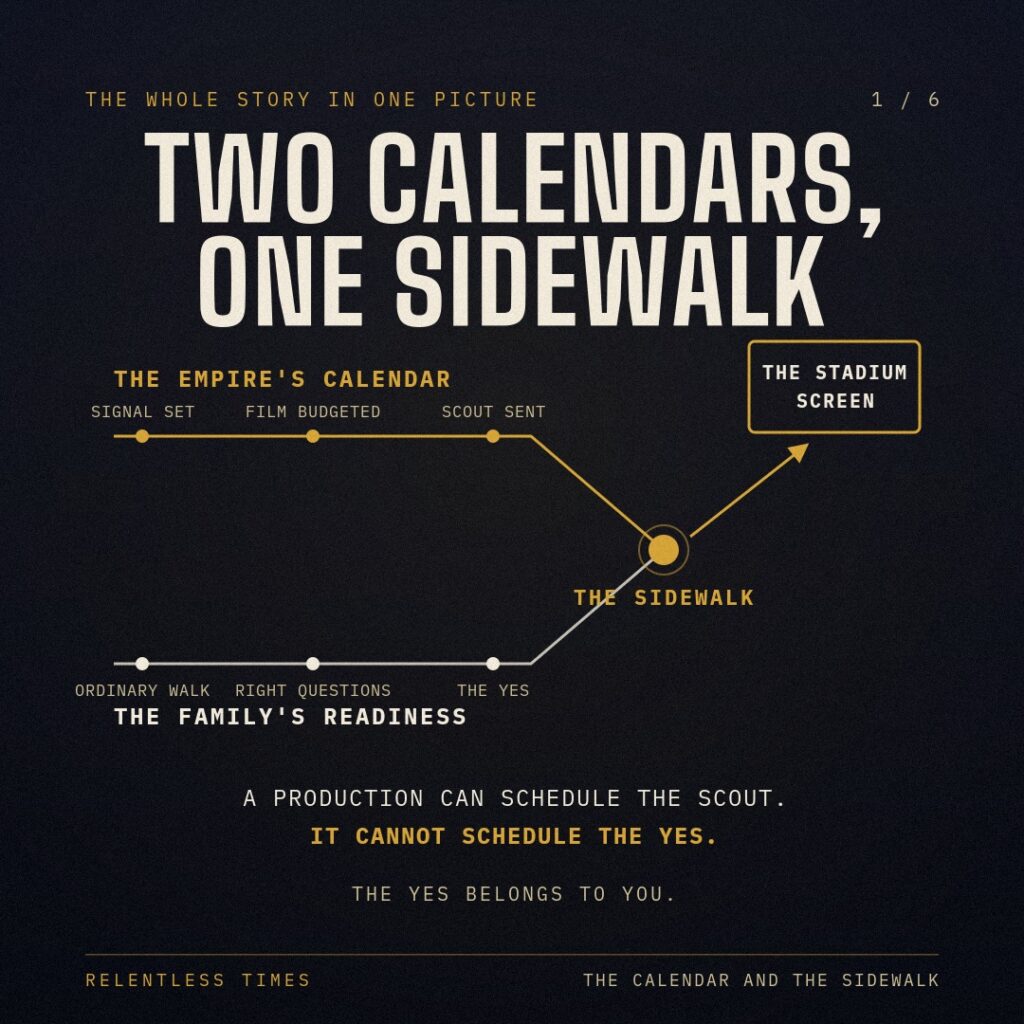
Two calendars met on that sidewalk
Now put the two stories together, because here’s what almost everybody will miss.
That sidewalk moment feels like luck. Pure lightning. The city of dreams doing its random magic.
It wasn’t random. Not from the other side.
Somebody inside that production opened a calendar months before the show and scheduled street scouts to walk Harlem. Somebody budgeted for casting real families instead of agency kids, because the opening film for Reasonable Doubt at 30 needed real New York faces, and the empire we spent six articles investigating does not leave “real” to chance. The work permits, the on-set schooling, the shuttles, the wardrobe department: every detail the family found so reassuring was a calendar entry made long before a scout ever said hello.
Pressley looked at the rollout and saw years of planning converging on three July nights. That mother and her sons ARE what that planning looks like when it reaches the street. The scout on the sidewalk was the empire’s calendar, out taking a walk.
But here’s the other half, and it’s the half that belongs to you.
The production scheduled the scout. It could not schedule the yes.
That belonged entirely to a mother who did what serious people do: asked the right questions, protected what was hers, verified everything, and then, when the moment proved itself, said yes instead of shrinking. Her husband checked the set. She checked the paperwork. Caution and courage, working together. That’s not luck. That’s readiness wearing street clothes.
Every success story contains a moment that almost didn’t happen. A door almost not opened. A phone almost not answered. A stranger almost waved off. The opportunity wasn’t hiding in an algorithm. It wasn’t sitting in an inbox. It was standing on a Harlem sidewalk, and it recognized a family that was ready for it.
Sometimes preparation looks ordinary until opportunity recognizes it.
The machine you watched all week
Because understand: everything this series documented was, underneath the spectacle, a calendar.
The umlaut over the Y didn’t appear randomly. It was a scheduled signal, the opening move of a sequence somebody mapped long before you saw it. The GQ interview, the Roots Picnic freestyle, the subway wrap, the pop-ups, the Target vinyl, the library cards, the three nights, the four cities, the HBO documentary that will keep paying off for years after the confetti got swept. Part Two called it a 360 campaign. Call it what it really is: a life, calendared years deep.
“All offense, all 2026” wasn’t a mood. It was a fiscal year with a theme.
And here’s the detail people miss. Pressley said it herself: this isn’t one brain doing this. It’s a machine, a team, a whole apparatus. True. But machines don’t build themselves. Somebody had to take their own future seriously enough, early enough, to deserve a machine. Nobody assigns you an apparatus. You earn one by treating your own future like it’s worth scheduling.
Alicia Keys is on a yacht one week and closing Night One with Empire State of Mind the next. That’s not luck catching her in town. That’s interdependent planning between serious people, calendars negotiating with calendars, years out.
What the seat of your pants actually costs
Now the mirror, because Pressley aimed her question at you and I’m going to keep it aimed.
Are you flying by the seat of your pants? One day at a time, not because you chose presence but because you never chose anything? Making it to the end of the month and calling that a plan?
I know that mode. I’m not talking down to anybody. There are seasons where survival is the whole calendar, and if you’re in one, no shame, hold on. I wrote a whole series about a man whose first plan was simply to not die on a corner, and I told you in the finale about the years when my own planning horizon was a count time and a commissary list.
But here’s what those years taught me, and it’s the whole reason this bonus article exists.
The calendar works behind walls too. Thirty novels didn’t happen to me. I scheduled them. Page counts per day, manuscripts per season, an inventory built years before I had any market to sell it in, because I decided my release date was a launch date. I was calendaring a publishing company from a federal dormitory. Nobody knew. The calendar didn’t care that nobody knew. That’s the beautiful thing about it: the calendar is the one piece of empire equipment they sell at the dollar store.
Jay-Z planned Reasonable Doubt’s thirtieth anniversary. I promise you he wasn’t thinking about 2026 in 1996. But he was doing something better: building a catalog worth celebrating, one decision at a time, so that when the future arrived there was something to schedule. That’s the two-layer secret. Short game: make things worth compounding. Long game: calendar the compounding.
The five-year products
Pressley’s commentary ended with a challenge I want to sharpen into a blade.
Are you creating products, or engineering parts of your life, that will take five years to come to fruition?
Sit with how rare that thinking is. The whole internet economy trains you for the opposite: post today, spike today, die today, repeat. Meanwhile every durable thing in this series ran on five-year clocks or longer. The catalog: thirty years of compounding. The Roc network: decades of held-down relationships that surfaced onstage as “surprise” guests. The documentary: shot now, airing later, licensing forever. Blue Ivy at the piano: an eighteen-year succession plan disguised as a sweet moment.
Even the beefs resolved on schedule. Nas and Jay needed years to turn a war into a treaty worth staging. Some products take that long. Forgiveness is a five-year product. So is a reputation. So is a body of work. So is a child who knows the family business from the piano bench.
So, practically, because I don’t write sermons without homework:
Pick the year. Not “someday.” A number. Where is your name supposed to be in five years, and what is it doing there? Write it where you’ll see it.
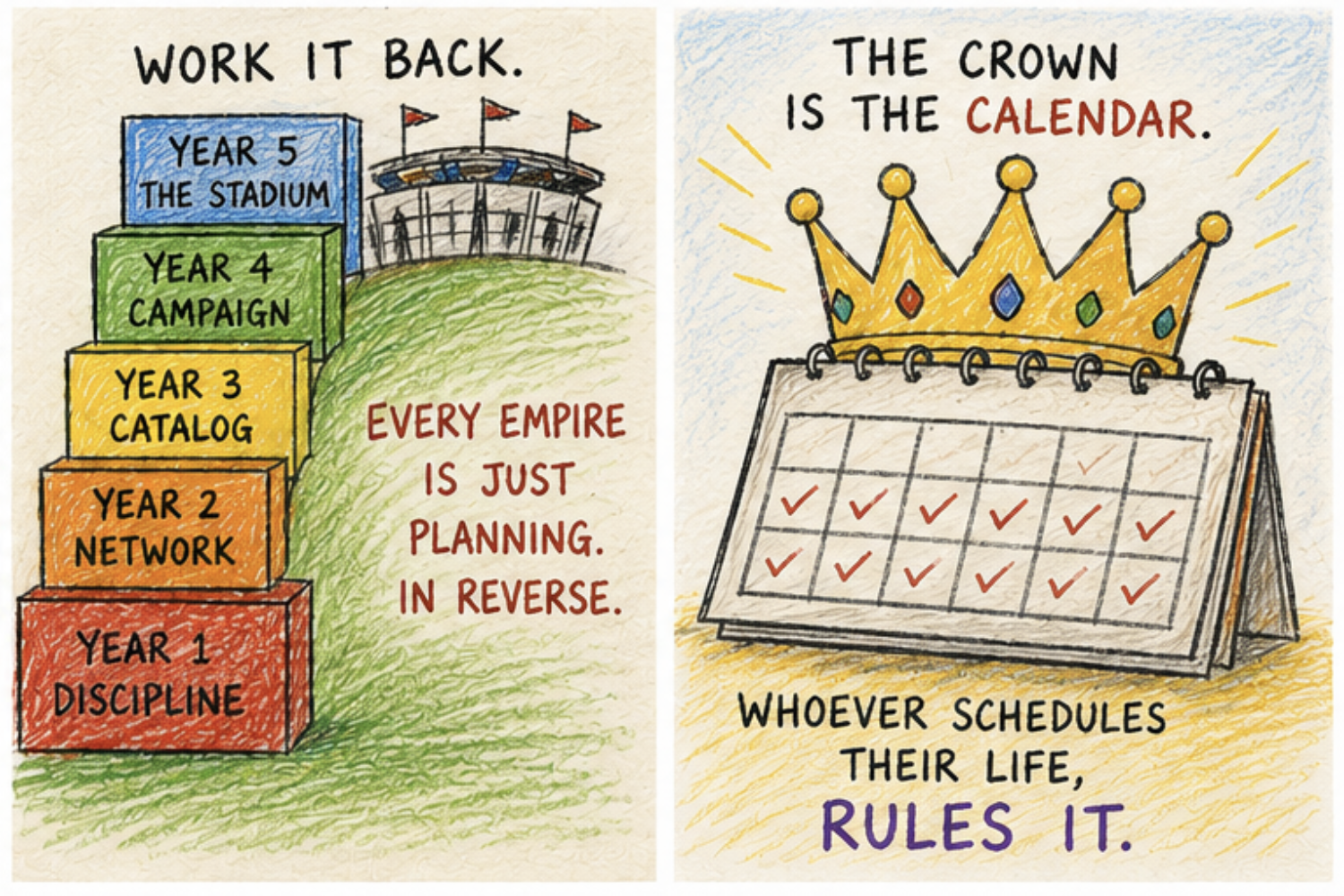
Work backward. If year five is the stadium, what’s year four’s campaign, year three’s catalog, year two’s network, year one’s discipline? The Jay-Z 30 rollout is just this exercise executed with money. The exercise itself is free.
Put real dates on it. “This year I will” is a wish. “By March 31 I will” is a calendar entry. The empire you watched in the Bronx is ten thousand calendar entries deep, kept by people who kept them.
Build inventory before you have a market. My thirty manuscripts. His hundred unreleased verses. Her rehearsed-under-a-tent surprises. Every “overnight moment” this series covered was inventory meeting its scheduled hour.
Protect the compounding. The critics from Part Three, the outrage industry, the noise? None of it ever knocked a single date off that calendar. The stadiums filled anyway. Discipline doesn’t argue. It ships.
And keep walking. This one comes from Harlem. You cannot schedule the stranger on the sidewalk. You can only schedule being the kind of ready that says yes when she arrives: questions asked, paperwork straight, family protected, courage on call. The scout is on somebody’s calendar right now. The yes has to be on yours.
Only one of you
Pressley said there’s only one Beyoncé, one Jay-Z, one whoever. Then she said the part people scroll past: including one of you.
That’s not a greeting-card line. It’s an asset statement. You hold a monopoly on being you, and monopolies are the most valuable structures in any economy, and most people run theirs with no calendar, no campaign, no five-year product, no succession plan. The most valuable thing you will ever own, managed like a junk drawer.
The empire we spent six articles investigating started with a man who refused to run his monopoly that way. And the sweetest moment of its biggest weekend belonged to two boys from Harlem whose mother ran hers with her eyes open on an ordinary afternoon.
So here’s the whole investigation, compressed to its final finding:
The crown was never the jewelry. The crown is the calendar. And the calendar’s favorite meeting place is an ordinary sidewalk, where somebody’s years of planning finally crosses paths with somebody’s readiness.
Whoever schedules their life, rules it.
Whoever stays ready, gets found.
How seriously do you take yours?
Class dismissed. Series closed. Get your pen. And keep walking.
This bonus concludes the Relentless Times coverage of the Jay-Z experience in 2026. All six parts plus this epilogue are available now. The Fort Dix story is coming. Stay close.