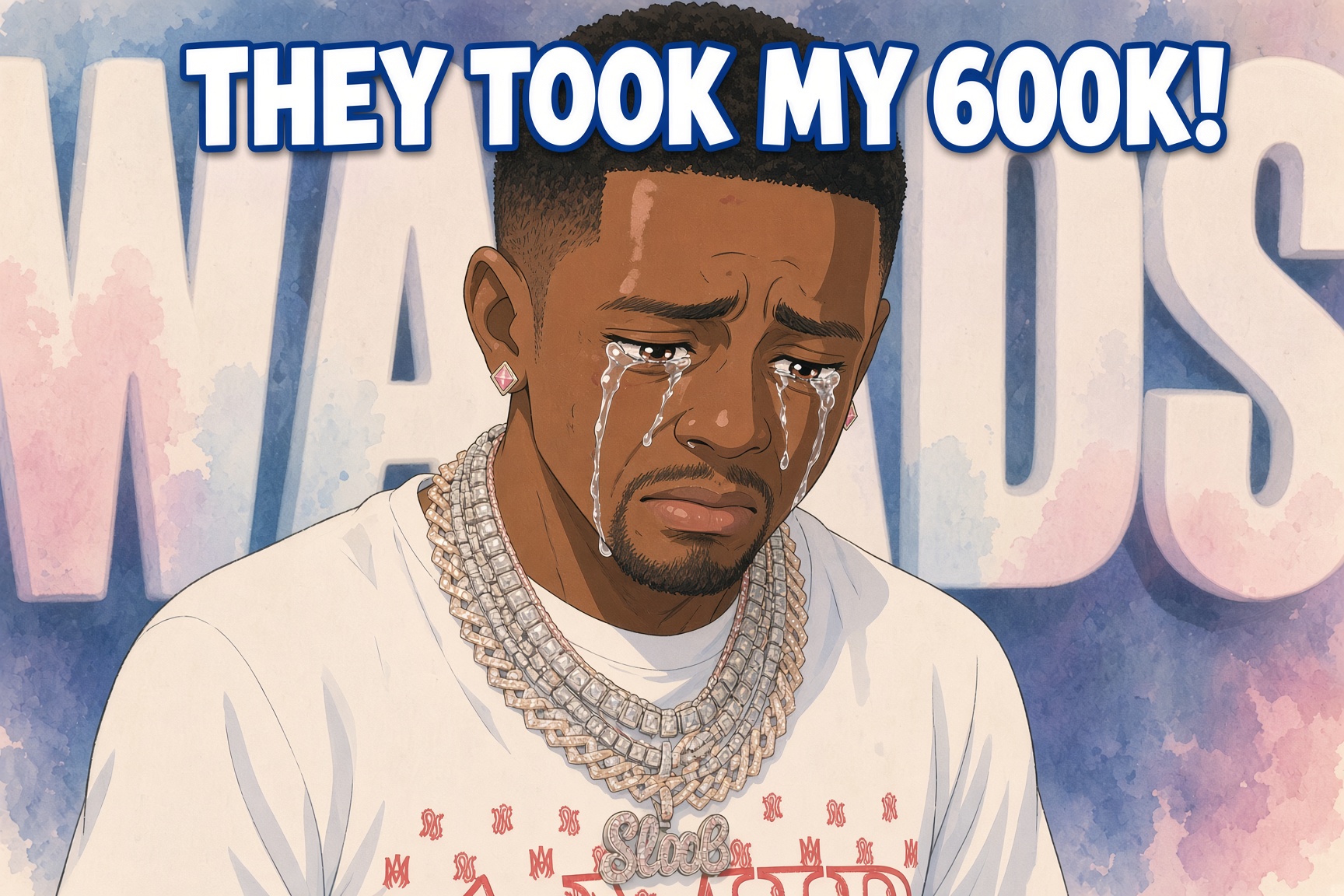
Boosie Was Easy Money: Why a $600,000 Pardon Pitch May Have Been Too Tempting to Pass Up
By Relentless Aaron | Relentless Times Commentary
Boosie BadAzz says he was done wrong.
After appearing on 60 Minutes to discuss the $600,000 he paid two political operatives to help secure a presidential pardon, Boosie says viewers still did not get the whole story.
And maybe that missing context matters.
But there’s another part of this story that jumps out at me.
Boosie may have looked like easy money.
Not because he’s stupid. Not because he’s a rapper. But because he is a successful entertainer operating in an industry where wealth is often displayed publicly, legal troubles can follow an artist for decades, and removing some of the consequences attached to a federal conviction could potentially be worth far more than $600,000 over the course of a career.
CBS reported that Boosie, whose legal name is Torrence Hatch, paid Jack Burkman and Jacob Wohl $600,000 after being led to believe they could help obtain a presidential pardon. Boosie told Lesley Stahl he understood the arrangement to mean that bringing the money would result in a pardon. The pardon never came. He is now seeking to recover money through legal action. Burkman and Wohl dispute his claims and maintain that their dealings were legitimate. citeturn459609search3turn459609search7
That’s where this gets interesting.
THE BUSINESS VALUE OF A CLEANER IMAGE
A rapper isn’t simply selling records anymore.
He’s selling appearances.
Corporate partnerships.
Festivals.
Television opportunities.
Community events.
Speaking engagements.
Youth programs.
School appearances.
Brand deals.
International opportunities.
And when somebody has spent years being introduced with his criminal history attached to his name, I can understand why the possibility of a presidential pardon would have tremendous value.
Let’s be precise here. A presidential pardon would not erase Boosie’s conviction or make the criminal record disappear. The Justice Department specifically says a pardoned conviction remains on the record alongside the pardon.
But a pardon can remove certain legal disabilities, reduce some of the stigma associated with a conviction and potentially help a person seeking employment, licensing or other opportunities. citeturn783591search0
For somebody whose name itself is a business, that matters.
Imagine Boosie trying to expand beyond clubs and concerts into schools, colleges, motivational speaking, youth organizations and corporate settings.
The difference between:
“Convicted felon Boosie BadAzz”
and
“Presidentially pardoned recording artist Boosie BadAzz”
could have enormous marketing value, even though legally the conviction would still exist.
That doesn’t mean every school would suddenly book him. It doesn’t mean every background check disappears. It means the pardon itself could become part of a rehabilitation story.
That’s a potentially valuable asset.
THEN COMES THE $600,000
Boosie pleaded guilty in his federal firearm case and in January 2026 was sentenced to three years of supervised release, 300 hours of community service and a $50,000 fine. citeturn292793search0
According to CBS, he later said he believed paying $600,000 to the two lobbyists would get his pardon effort across the finish line.
CBS also displayed messages allegedly sent to Boosie’s attorney naming politically connected people the brokers claimed could assist. Representatives for several people named in those messages denied participating in Boosie’s pardon effort. citeturn459609search3turn459609search7
Importantly, there is no evidence presented by CBS that Boosie’s $600,000 was paid to President Trump or to the White House. The money at issue was paid to private individuals who said they could lobby for a pardon.
That’s an important distinction.
My question is what those people saw when Boosie walked through the door.
Did they see a complicated federal clemency case?
Or did they see a famous rapper with money, urgency and an enormous incentive to change the narrative attached to his criminal record?
Because in entertainment, everybody knows the image.
Jewelry.
Cars.
Houses.
Cash.
“Ballin’.”
Hip-hop has spent decades turning visible wealth into part of the show. Sometimes that image becomes an advertisement to everybody watching, including people trying to figure out how much they can charge you.
When someone believes the thing you’re selling could protect his freedom, protect his career or open doors worth millions of dollars, $600,000 can suddenly sound like an investment instead of an outrageous fee.
That’s what makes this story bigger than Boosie.
BOOSIE SAYS THE PUBLIC DIDN’T HEAR EVERYTHING
After the broadcast, Boosie complained that his roughly hour-long interview had been reduced to only part of his story.
He said one omitted detail was that he had previously discussed his situation with a White House pardon official, and he argued that other circumstances surrounding his criminal case and pardon request deserved more attention. citeturn292793search1turn292793search7
That’s television.
An hour-long interview gets edited into minutes.
But if the missing portions contain evidence relevant to his dispute with the people he paid, that’s not simply about television editing anymore.
That’s evidence for lawyers, arbitrators and courts to examine.
THERE’S A LESSON HERE BIGGER THAN BOOSIE
Money attracts people who promise access.
Celebrity attracts people who claim connections.
Desperation can make expensive promises sound reasonable.
Put all three together and you’ve created a marketplace.
And that may be the most important part of Boosie’s story.
Whether you’re a rapper, athlete, businessman or anybody else carrying around an old conviction, the desire to get your life completely back is understandable.
But access is not the same thing as a guarantee.
A lobbyist can advocate.
A lawyer can argue.
A political contact can make a phone call.
Only the President can grant a federal presidential pardon.
Boosie put $600,000 on the table believing people could help deliver something extraordinarily valuable to him.
They didn’t deliver the pardon.
Now the fight is over who should be holding the money.
And somewhere inside that dispute is an expensive lesson about fame, access and the people who show up promising they know exactly which door your money can open.
Relentless Times Commentary