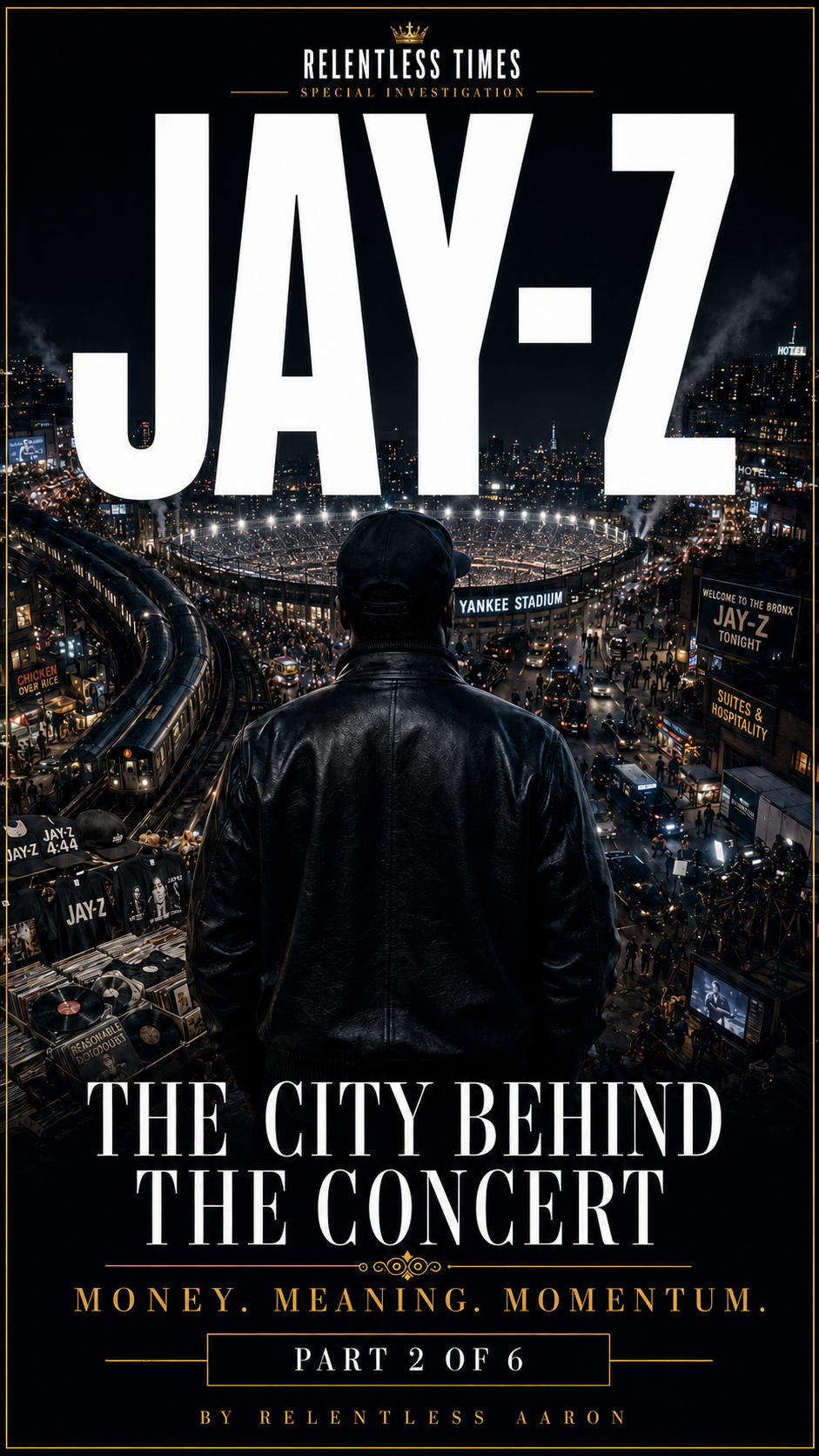
3 nights in the BX looked like a concert. Follow the money and you find a functioning economy with its own districts, its own workforce, and its own currency.
By Relentless Aaron
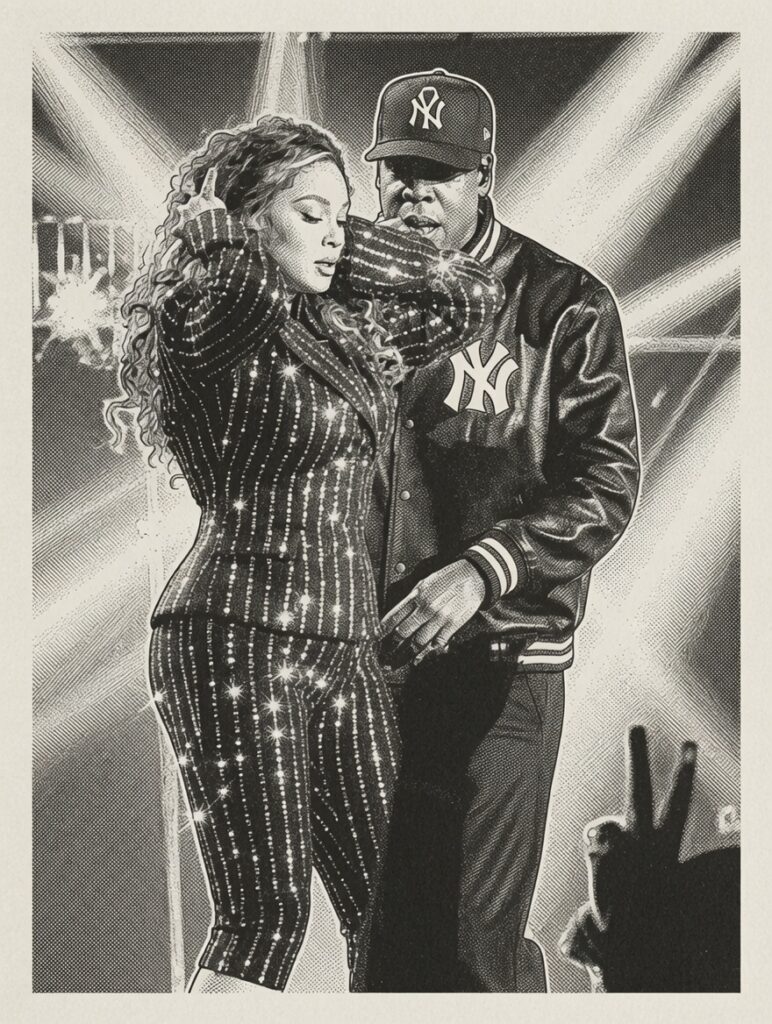
Part Two of a Six-Part Relentless Times Investigation
Yesterday I told you the concert was never just a concert.
Today I prove it.
Stand outside Yankee Stadium on any of those three nights and look past the lights. What you’re seeing is not an event. It’s a city that assembled itself for one purpose, ran at full capacity, and dissolved before sunrise. It had residents. It had commerce. It had imports and exports. It had a government of sorts, sitting somewhere behind the stage with a headset on.
And like any city, the real story isn’t the skyline. It’s the plumbing.
Two dots started all of this
Before a single ticket went on sale, before one subway car got wrapped, the campaign opened with punctuation.
Jay put the umlaut back over the Y in his name. Two dots, the way he spelled it in the 90s, back when Reasonable Doubt was a prayer and not a monument. No press release. No announcement. Just the dots.
And the people who were supposed to notice, noticed. Longtime fans read it like a flare over the harbor. Something was coming.
Think about what that actually is, from a business standpoint. The cheapest marketing asset in the entire campaign was two dots over a letter, and it worked because thirty years of brand equity made those dots legible. You cannot buy that. You can only build it, year over year, until your punctuation has meaning.
Then came the GQ sit-down with Frazier Tharpe, where Jay laid out his posture for the year in four words: all offense, all 2026.
That’s not an interview quote. That’s a mission statement. And everything that followed executed it.
The machine, piece by piece
Here’s what “all offense” looked like when it deployed.
The Roots Picnic appearance came first. For many people, this was the first full Jay performance they’d seen in years, and he used it to debut the freestyle answering everything the internet had been saying about him. We’ll spend all of tomorrow inside those bars. For today, just note the placement: he reintroduced himself at a festival built by The Roots, going back to his roots, before the vlog cross-promo dropped under the name The Blueprint. The wordplay stacks two and three layers deep, and none of it is accidental.
Spotify wrapped subway cars with the Roc sign and almost no copy. Read that again. Almost no words. The diamond alone carried the message, because after three decades the symbol needs no caption. The tagline, where one appeared at all, was clean: 96 and Forever.
Pop-up stores opened in Dumbo and in Manhattan. The J, M and Z trains, the lines that run through the Brooklyn he actually comes from, got woven into the storytelling. The transit map itself became a brand asset. New York wasn’t the backdrop for this campaign. New York was a character in it.
Apple Music tied into the live experiences. D’USSÉ poured the cocktail parties, turning an anniversary into an occasion you could hold in your hand. Target carried the exclusive Reasonable Doubt vinyl, a decision that generated its own controversy, which tomorrow’s article will meet head-on. The Brooklyn Public Library issued limited edition library cards, the same civic move that worked during the Book of HOV. iHeart ran a sweepstakes. A collector’s box set gave the superfans something to shelve. A microsite gathered the archives into one hub, a museum you could visit from your phone.
And HBO announced an eight-part documentary with Jay-Z and Rick Rubin. That’s the piece that converts three nights of live experience into years of screen life. I reported the HBO project as the credible rumor in Part One. It’s now confirmed, and the Rubin pairing tells you the ambition: this is being framed as craft history, not celebrity content.
Look at the architecture of it. The subway wrap makes it feel like New York. The library cards bring the civic layer. The pop-ups make it physical. The vinyl makes it collectible. D’USSÉ makes it celebratory. HBO makes it permanent. And the stadium shows sit in the center of the wheel, with every spoke feeding inward and every spoke fed in return.
One more stroke worth naming: the anniversaries themselves were stacked. Reasonable Doubt at 30. The Blueprint at 25. Two milestones fused into one moment, so the campaign could celebrate the origin and the coronation on back-to-back nights in the same building.
That’s not a rollout. That’s world-building. You tell your old stories in a way that constructs a world, then you invite people inside and show them the rooms they missed.
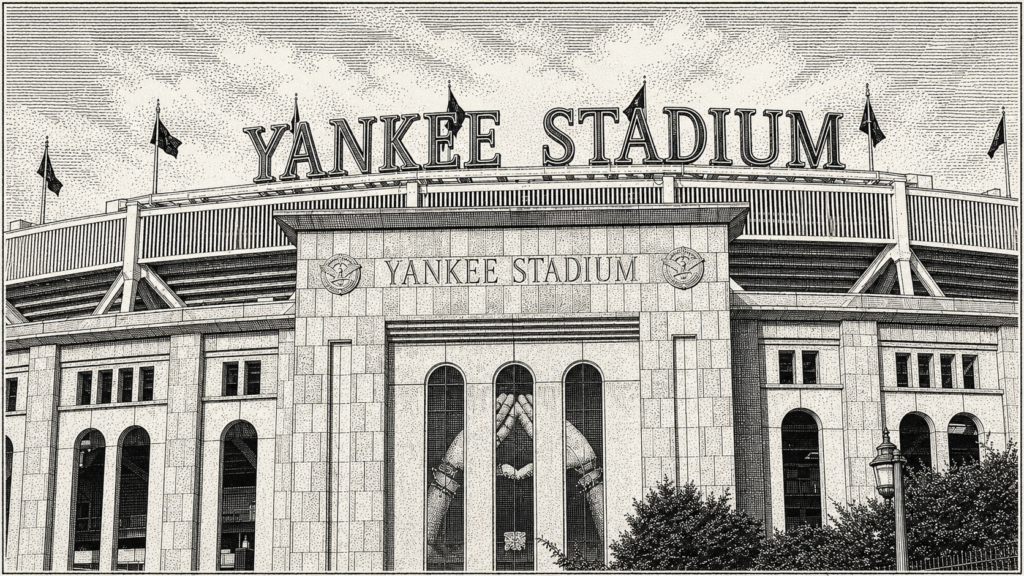
Now follow the money through the turnstiles
Ticket revenue is the number everybody quotes because it’s the number easiest to imagine. It’s also the smallest part of the story worth telling.
Start on the sidewalk. Street vendors moved water, food, shirts and bootleg memories to a crowd of tens of thousands, three nights running. None of that appears in any official gross.
Step back a ring. Rideshare drivers worked the surrounding blocks until sunrise, and on Night Three, when the show ran past 3 a.m., sunrise wasn’t a figure of speech. Parking garages collected. Restaurants fed the pre-show crowd and bars caught them coming out. The neighborhood ate for three days.
Step back again. Hotels filled rooms with fans who flew and trained in from everywhere, because when a show only happens in one city, the fans travel to the show. Airlines moved them. Amtrak moved them. Every one of those bookings is stadium money that never touches the stadium.
Now go inside. Stadium workers earned wages. Security companies staffed up, and after the gate-rush on Night Three, earned every dollar. Photographers, stylists, makeup artists, editors and content creators all billed against the moment.
Then the merchandise, official and otherwise. Vinyl, jerseys, books, hats, pins, box sets, pop-up inventory. And here’s the detail I love most, because it says more than any sales figure: the fans started manufacturing their own. A designer’s hat went viral for reworking the Yankees logo so it reads Jay-Z. People showed up in custom Brooklyn jerseys with their own numbers and Jay’s name across the back. Paper Planes gear everywhere, old and new.
When your customers start producing their own merchandise, you’ve crossed out of commerce into culture. Nobody makes a bootleg jersey for a brand they merely like.
Then the catalog woke up. Songs cut decades ago pulled fresh streams. Old videos recirculated. Kids met the records their parents lived through. Media companies filed stories, influencers cut reels, critics posted takedowns, supporters posted tributes, and the haters generated outrage that functioned, as it always does, as free distribution.
Everybody ate. Including the people attacking the table.
That’s spillage. The direct revenue is one stream. The full organism includes local spending, sponsorship exposure, merchandise, media impressions, streaming growth, catalog appreciation, future licensing, and intellectual property that now has a confirmed eight-part home on HBO.
Could the whole international run add up to a billion-dollar attention-and-money ecosystem? Possibly. But keep the claim honest, the way I framed it yesterday: an ecosystem that size gets distributed across companies, workers, vendors, artists, governments and every business within walking distance of a stadium. That is a different statement than one man depositing a billion dollars. Precision is respect, for the reader and for the truth.
The tiger and the man riding it
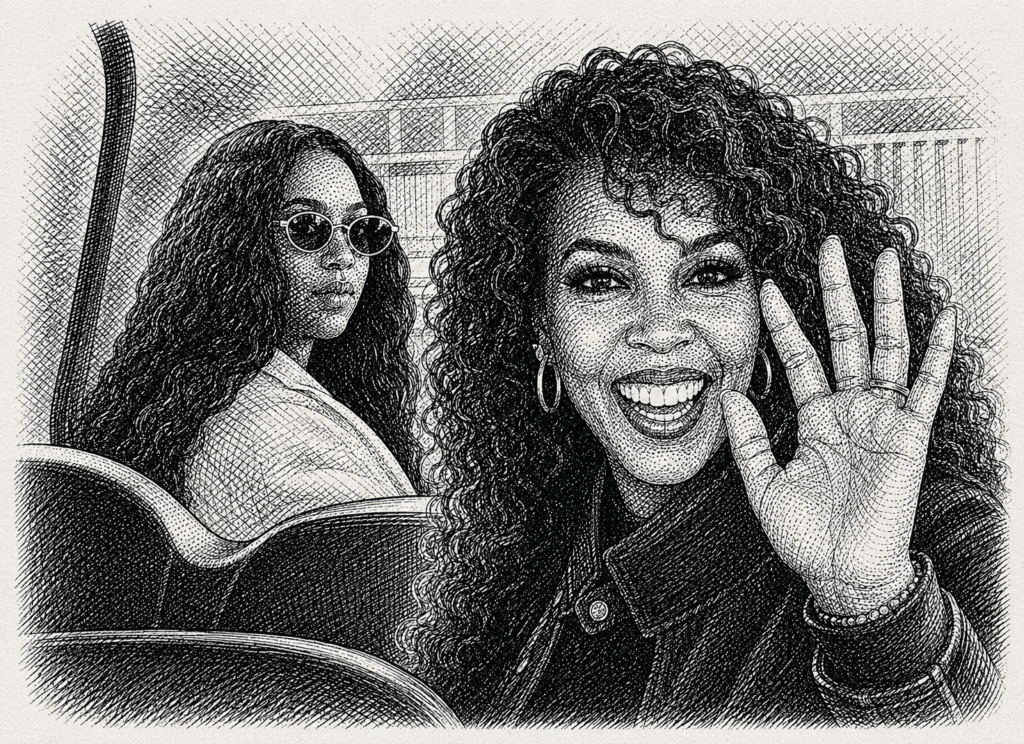
Now let’s talk about DJ Khaled, because he’s the clearest live demonstration of a principle I’ve been teaching for years.
I call it Riding the Tiger.
When you’re close to something more powerful than you, you have two options. You can compete with its power, which is how people get eaten. Or you can align with it, add real value to it, and let some of its momentum carry your platform further than your own legs could take you.
Khaled rode. He moved through those three nights with a level of access most attendees couldn’t dream about, cameras rolling, content flowing, building an entire media stream out of the stadium, the surrounding spaces and the celebrity ecosystem orbiting the event. Was the access friendship, partnership, sponsorship, or some blend? Nobody has confirmed it publicly, and I won’t guess in print. What’s confirmed is the output: he converted proximity into media, and media into reach.
Here’s what makes it instructive rather than opportunistic. The tiger benefits too. Every piece of Khaled content amplified the event. Every clip was another window into a party most of the world couldn’t attend. Jay’s machine got coverage. Khaled’s platform got fuel. That’s the difference between riding the tiger and clinging to its tail: the rider adds value on the way.
The same principle, at a quieter volume, explains half the building. Brands attached themselves to the moment. Influencers attached themselves to the moment. The library attached a civic institution to the moment. Even the city’s transit system ended up inside the story. A tiger that big has room for many riders, and the smart ones understood that alignment beats imitation every single time.
Scarcity is the whole design
Hold all of this against the touring model everybody else uses, and the strategy snaps into focus.
The standard play is volume. Fifty cities, a hundred shows, the same production rebuilt every other night in another market until the artist is exhausted and the demand is diluted.
Jay is running the opposite play. Live Nation currently lists three more dates: Tottenham Hotspur Stadium in London on September 4, Stade de France in Paris on September 10, and SoFi Stadium in Los Angeles on October 23. The confirmed dates are here.
Four cities. That’s the tour.
I named this yesterday and I’ll deepen it today: scarcity architecture. When the show exists in only a handful of places, every date becomes an appointment and every city becomes a pilgrimage. The fans travel, which exports the economic spillage to every market they leave from. The celebrities concentrate, which turns the audience into a second stage. The sponsors get a bigger platform per date, which raises what each partnership is worth. And the production can be more ambitious precisely because it doesn’t have to fold itself into a truck every 48 hours.
Three nights in New York out-talked what thirty ordinary tour stops could have generated, and the campaign around it was built to catch every drop of that conversation: the pop-ups caught the foot traffic, the vinyl caught the collectors, the microsite caught the curious, the sweepstakes caught the hopeful, and HBO will catch everyone who missed it entirely.
Memphis Bleek, standing on that stage for the first time in years, put the feeling in one word during a television interview after Night Three: a takeover. He meant the summer. He was describing the business model.
What the city leaves behind
Every city, even a temporary one, leaves infrastructure when it goes.
This one leaves a documentary in production. A catalog running hotter than it has in years. A set of brand partnerships with fresh proof of concept. A generation of fans who now own a physical piece of the moment, whether Target sold it to them or they stitched it themselves. Three international dates carrying the model abroad. And a template that every artist with a catalog and a birthday is going to study, and most will fail to copy, because the asset underneath it all took thirty years to build and cannot be licensed.
The dots over the Y worked because of 1996. The empty subway ads worked because of everything since. You can rent attention. You cannot rent meaning.
Tomorrow we walk into the fire. The Target vinyl and the boycott. The NFL and Colin Kaepernick. The freestyle, bar by bar, and the question underneath all of it: whether America enjoys the word redemption more than it believes in the thing itself.
The city has been counted.
Now we meet its critics.
Wednesday: Love Versus Heat. Part Three of the Relentless Times investigation.