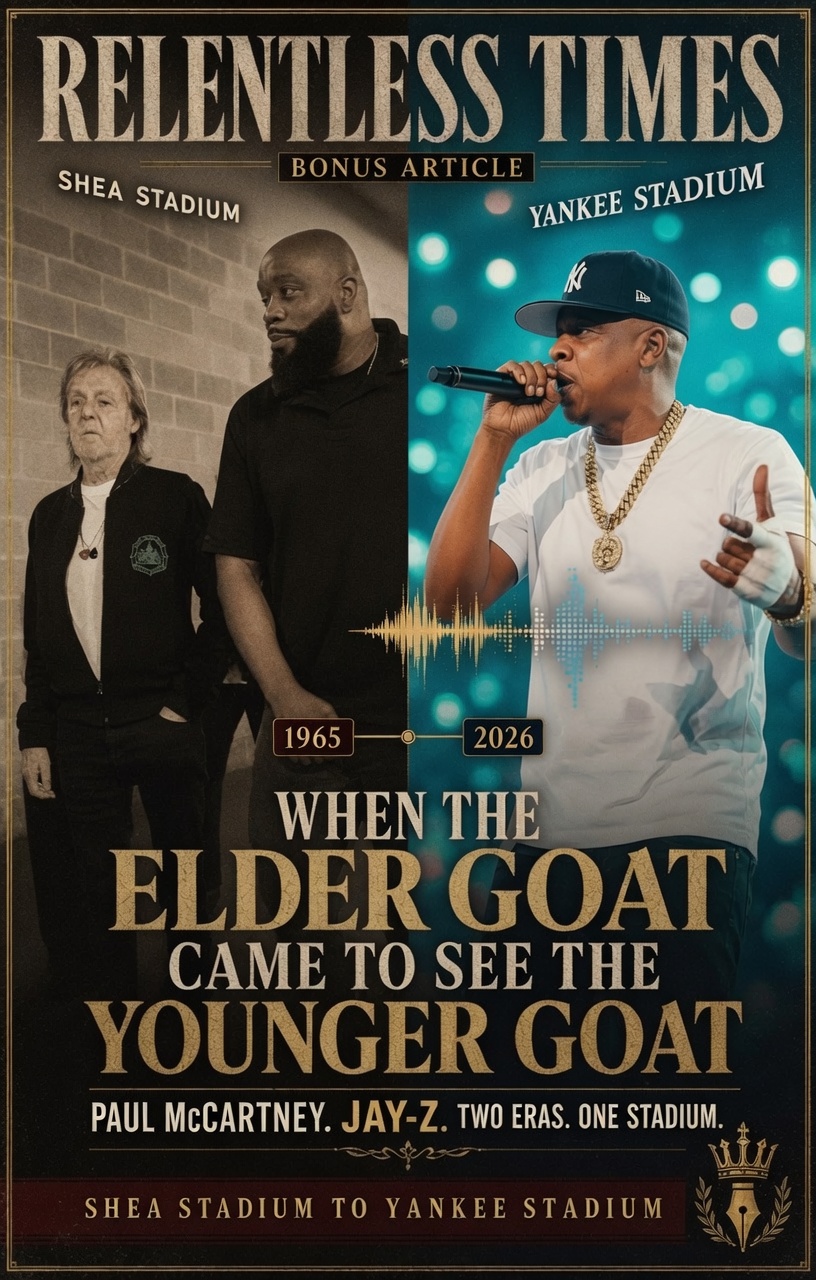
Paul McCartney, Jay-Z and the night two eras of music met inside Yankee Stadium
Paul McCartney did not need to walk onto the stage at Yankee Stadium for his presence to matter.
He did not need an introduction. He did not need a spotlight. He did not need Jay-Z to stop the show and tell the audience who had entered the building.
Paul McCartney simply being there was enough.
I keep wondering how many people inside that stadium understood the weight of what they were witnessing. They saw celebrities. They saw athletes, actors, influencers, executives and cultural figures. They saw Beyoncé, Rihanna, Eminem, Nas, Usher, Pharrell, Blue Ivy Carter and a lineup that could have filled several festivals.
But Paul McCartney represented something different.
He represented the beginning of the modern stadium concert.
He represented an era when four young men from Liverpool helped prove that popular music could fill a baseball stadium, overwhelm a city and generate an entirely new category of entertainment economics.
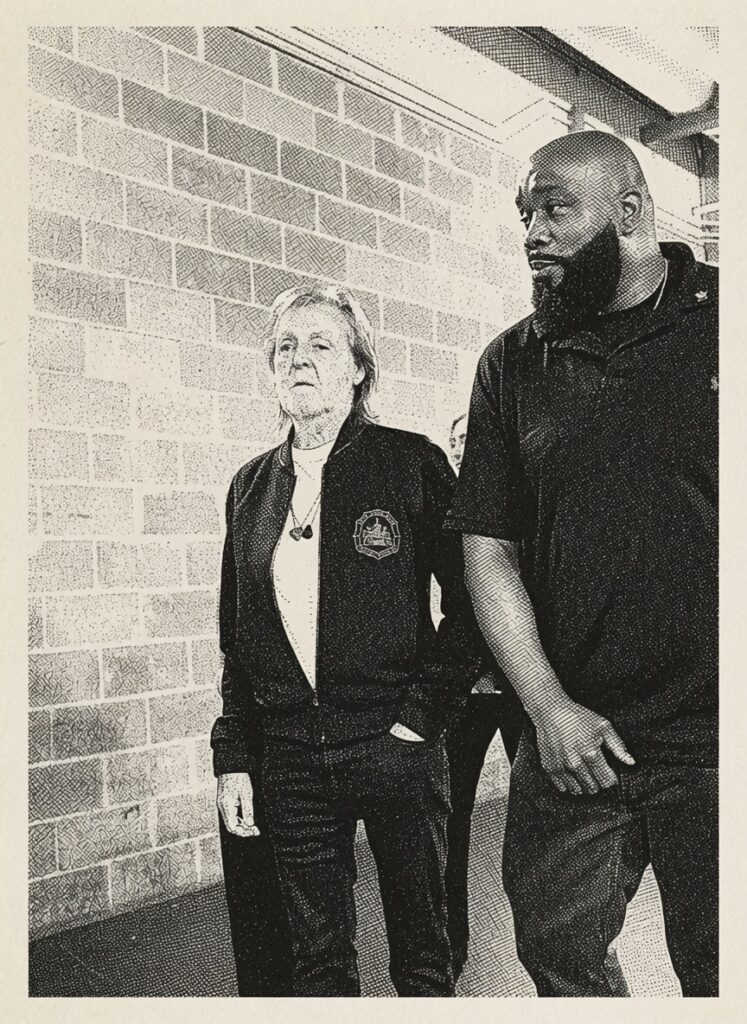
THE GOAT, PAUL MC CARTNEY
ENTERS THE BUILDING.
Jay-Z represented what came next.
Not immediately next, of course. There were decades of music, death, invention, exploitation, rebellion and reinvention between them. That is precisely what made McCartney’s presence feel so powerful.
Before Yankee Stadium, There Was Shea
On August 15, 1965, The Beatles performed at Shea Stadium before approximately 55,600 people. The concert set records for attendance and revenue and is widely recognized as the first major rock concert staged inside a stadium. The promoter behind that historic night was Sid Bernstein. The Associated Press describes the concert as a landmark that helped establish the stadium show as a viable cultural and commercial institution.
The sound system was primitive compared with what artists use today. The screaming was so intense that the musicians could barely hear themselves. The Beatles played for roughly 30 minutes.
Yet the performance changed the business.
It demonstrated that one act could pull tens of thousands of people into one location, turn anticipation into urgency and transform a concert into a global news event.
That formula now seems normal. In 1965, it was revolutionary.
Paul did not merely witness that revolution. He helped cause it.
He would eventually return to the same ground. McCartney appeared with Billy Joel during the final concert at Shea Stadium in 2008. He later played the inaugural concerts at Citi Field in 2009. In 2011, he performed two concerts at Yankee Stadium.
New York’s stadium history already carries his fingerprints.
That is why seeing him attend Jay-Z’s celebration created a circle few people seemed prepared to recognize.
Everything That Happened Between Them
Sixty-one years separate The Beatles at Shea Stadium and Jay-Z’s 2026 residency at Yankee Stadium.
Those years contain entire civilizations of music.
The Beatles broke apart. John Lennon was murdered. George Harrison died. Paul lost his wife Linda and continued creating through grief. Vinyl surrendered territory to eight-tracks, cassettes, CDs, downloads and streaming. Radio lost some of its gatekeeping power. Television became cable. Cable became the internet. Music videos became social media clips. Record stores became apps.
Hip-hop was born in the Bronx, initially dismissed as a temporary neighborhood phenomenon. It survived moral panics, censorship campaigns, corporate exploitation and predictions that it would disappear.
Then Shawn Carter emerged.
Jay-Z began inside a culture that America treated as disposable. He carried the language of street economics into recording studios, fashion companies, streaming platforms, sports management, film production and corporate boardrooms.
His rise cannot be separated from his proximity to criminal life. He has never pretended that he emerged from comfort or institutional approval. The difference is that he escaped the permanency that traps so many people.
For many men, that life ends in a prison cell, a grave or permanent exclusion from legitimate opportunity.
Jay crossed the line into legitimacy and stayed there.
He converted survival intelligence into business intelligence. He turned the lessons of corners, negotiations, loyalty, betrayal and risk into an operating system. That does not sanitize the past. It demonstrates that a past does not have to become a life sentence.
By 2026, the man who once struggled to secure a major record deal could choose to perform three enormous New York shows instead of exhausting himself across 50 cities.
That is not simply popularity. That is leverage.
The Stadium Became the Product
Jay-Z’s Yankee Stadium weekend was not merely three concerts. It was a destination economy.
More than 45,000 people attended the opening night, and the residency brought together music, merchandise, hospitality, transportation, food, media, sponsors and celebrity influence. The shows celebrated the thirtieth anniversary of Reasonable Doubt and the twenty-fifth anniversary of The Blueprint, followed by the expanded Extra Innings finale. Pitchfork documented the scale of the residency and its parade of collaborators.
Fans purchased tickets, hotel rooms, flights, food, parking, clothing and limited merchandise. Restaurants benefited. Drivers benefited. Vendors benefited. Media pages benefited. Influencers created content. Sponsors gained proximity to the spectacle.
Even people who never entered the stadium found a way to participate in its economy.
That is the modern version of what Shea Stadium helped introduce in 1965.
The difference is that Jay’s version operates across far more layers. The concert is now simultaneously a live performance, media production, branding platform, networking convention, fashion event, historical archive and potential streaming property.
Paul helped pioneer the stadium concert.
Jay is helping turn the stadium residency into a concentrated cultural package.
The Fred Astaire Moment
The comparison that keeps returning to me is Fred Astaire and Michael Jackson.
After Michael Jackson performed “Billie Jean” during Motown 25, Astaire called him and praised what he had seen. Jackson’s performance introduced the moonwalk to an enormous television audience and announced that a new standard of performance had arrived. Astaire, one of the most important dancers of the previous generation, reportedly recognized it immediately. Accounts of the performance confirm that Astaire personally called Jackson the following day.
That recognition mattered because greatness does not always welcome its successor.
Sometimes the previous generation dismisses the new language. Sometimes it cannot understand the clothes, the rhythms, the technology or the attitude. Sometimes elders spend their remaining years explaining why everything after them is inferior.
The more meaningful response is recognition.
I am not suggesting that Paul McCartney formally crowned Jay-Z or publicly declared him a successor. His attendance carried its own symbolism.
The elder statesman came to witness the younger statesman.
The man whose group helped invent the stadium concert sat inside a stadium filled by a rapper from Brooklyn.
The genre changed. The technology changed. The ownership structures changed. The audience changed. The fundamental power remained.
One artist created enough gravity to pull the world into one building.
Greatness Recognizes Greatness
There were many GOATs inside Yankee Stadium.
There were recording legends onstage. There were movie stars and athletes in the audience. There were billionaires, executives, influencers and future stars watching from suites and stadium seats.
But Paul McCartney carried more than celebrity.
He carried history.
He carried Shea Stadium, Beatlemania, Lennon and McCartney, the British Invasion, the collapse of a legendary group, the deaths of friends, the transition into a solo career and more than six decades of industry transformation.
Jay-Z carried Marcy, Brooklyn, Reasonable Doubt, The Blueprint, Roc-A-Fella, Roc Nation, criminal proximity, corporate evolution, marriage, fatherhood, political influence and the burden of becoming bigger than the category that first introduced him.
Paul was not there because Jay-Z needed validation.
Jay-Z’s catalog, audience and commercial power had already supplied that.
Paul’s presence mattered because it made the timeline visible.
Shea Stadium led to Yankee Stadium.
Rock helped create the stadium economy. Hip-hop inherited it, expanded it and made it speak another language.
This was not one GOAT bowing to another.
It was one era acknowledging that greatness survived the transition.
The elder GOAT came to see the younger GOAT.
For one weekend in New York, the entire history of the modern stadium concert seemed to occupy the same building.
And that may have been the biggest guest appearance of them all.