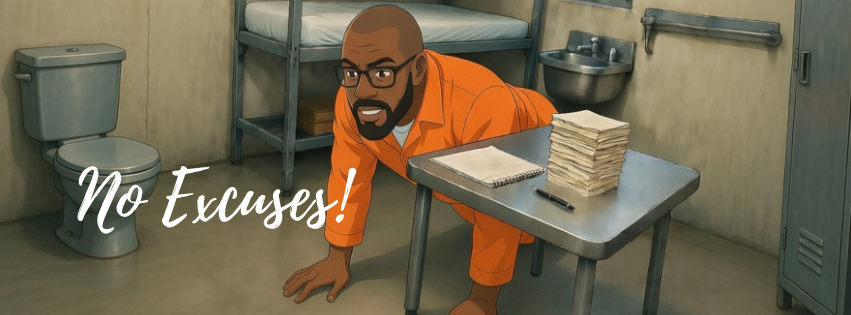



The day I walked out of federal prison, I was more free than I’d ever been in my life.
That should terrify you.
Not because prison is good. It isn’t. Not because the system is just. It isn’t that either.
But what happened inside those walls — what got stripped away, what grew back — was something money couldn’t buy, success couldn’t manufacture, and comfort would never have forced me to find.
This is not inspiration porn. I’m not romanticizing incarceration or telling you suffering is a gift. I’m telling you the truth.
The truth is: most people walking around with their freedom intact are more imprisoned than I was in a federal facility. At least I knew what my walls looked like.
The Lie They Sell You About Freedom
You know the picture. No handcuffs. Nice car. Bank account with enough zeros you stop counting. A platform. A brand. The appearance of options — which they call freedom.
That’s the lie.
Most people walking free are enslaved to things with no name on the door. Enslaved to debt they took on to impress people they don’t like. Enslaved to a version of themselves they’ve been performing so long they forgot it was a performance. Enslaved to fear — of failure, of irrelevance, of what happens if they stop moving long enough to hear themselves think.
That’s not freedom. That’s a cage with better lighting.
I know what prison taught me about freedom because I lived on both sides of it. Before the cell, I was running. Hustling. Building. But I was also chasing — validation, money, momentum, proof. Proof I was enough. Proof the life I came from didn’t define the life I was building.
Success came eventually. And it brought its own chains.
But before the success, there was the silence. The silence is where everything real began.
What They Actually Take From You
Let me tell you what intake feels like.
They take your clothes first. Then your name — not officially, but effectively. You get a number. A uniform. A bunk in a room with men you don’t know, inside a system designed to remind you at every turn: you are not a person. You are property. A case number. A statistic.
Black Americans already know something about that erasure. We represent 38% of the U.S. prison population while making up 13% of the general population. Approximately 1.9 million Americans were caged as of 2023. That math isn’t random. The system was built on a particular kind of targeting — and everybody in that intake room knew it.
But here’s what they cannot take.
They cannot take your mind. They cannot take your manuscript. They cannot take your memory or your ability to make meaning from madness. Every asset I built inside that facility proved one unbreakable principle: the only truly sovereign wealth is internal. Money, reputation, platform, network — all of it is confiscatable. Your mind is not.
Malcolm X understood this before I was born. He sat in Norfolk Prison Colony and copied the entire dictionary by hand. Not because anyone told him to. Because he understood his mind was the only thing in that building that fully belonged to him. He came out one of the most disciplined, well-read, rhetorically devastating intellectuals of the 20th century. Prison didn’t interrupt his greatness. It created it.
The first night inside, the noise stops. Just stops. No distractions. No performances. No hustle to run. Just you — and the question most people spend every dollar they earn trying to avoid:
Who are you when nobody’s watching?
Most people die without answering it.
I had to answer it. And the answer became PUSH.
That book — the one that started everything — was born in that silence. I had no publisher, no laptop, no literary agent, no co-sign. I had time, truth, and the decision to use both. The story came out because there was finally nowhere left to hide from it.
The Education You Can’t Get Anywhere Else
Prison is an involuntary monastery. Nobody puts that in the sentencing guidelines.
Forced stillness. Forced confrontation with self. Forced reading — because what else do you do with twenty-three hours in a cell?
I studied law. Business. Storytelling. Human nature. I watched men who were brilliant, men who were broken, and men who were brilliantly broken — and I learned more about how systems work, how power moves through rooms and institutions and relationships, than any MBA program ever designed.
Viktor Frankl survived Nazi concentration camps and built an entire psychological framework — logotherapy — on one idea: radical constraint forces a human being to discover what they actually value versus what they were told to value. Strip everything away, and what’s left is the real you. Not the constructed you. Not the performance. The actual thing underneath.
That’s what I found inside.
The men worth studying in that facility were a masterclass. THE LAST KINGPIN wasn’t invented at a comfortable desk. Those characters were observed. The way a man carries power in a room where power should be impossible. The way loyalty gets tested when the stakes are real. The way intelligence that never got a legitimate outlet finds its own path — always. I watched it. I wrote it down.
The discipline I built inside — waking early, writing daily, moving pages through the system with no guarantee they’d arrive — that same discipline later drove millions in book sales. Talent is common. Discipline built in a place with nothing to do but build it? That’s rare.
Constraints don’t kill creativity. Comfort does.
Building a Publishing Empire From a Prison Cell
Let me be precise, because people hear this and nod without absorbing it.
I built a publishing empire from inside a federal prison cell. Handwritten manuscripts. Pages moved through channels that required creativity, persistence, and relationships. A reader base built without internet, without social media, without a single algorithm working in my favor.
Before most independent authors figured out how to get a book on a shelf, I had a catalog, a distribution model, and an audience — built hand to hand, story to story, truth to truth.
FREEZE. TRIPLE THREAT. PLATINUM DOLLS. Written in conditions most people would use as a permanent excuse to quit. Not as exceptions. As the work.
Chester Himes started writing seriously while serving time at Ohio State Penitentiary in the 1930s. Prison didn’t derail his literary career — it created it. His Coffin Ed series influenced generations of urban fiction writers. That lineage is real: Black men, caged, finding the one cell they couldn’t lock was where the stories lived.
Here’s the deeper truth. Before startup accelerators, angel investors, or LinkedIn profiles, incarcerated Black men were building distribution networks, brands, and loyal audiences from inside cages. No capital. No legal protection. No safety net. Just human ingenuity under maximum pressure.
That is the Black entrepreneurial spirit. Not the sanitized version. The real one — born from impossibility, from the margins, from the decision to build anyway because waiting for permission was never an option.
A 2019 study in the Journal of Offender Rehabilitation found 68% of formerly incarcerated people reported that prison forced them to develop a clearer sense of personal identity and values than they had before. That’s the monastery effect. That’s what happens when the noise stops and the real work begins.
The most constrained environment of my life produced the most creative output of my life. I’ve never fully replicated that volume, that focus, or that clarity since — because outside those walls, the distractions came back. And with them, a different kind of cage.
What Success Did That Prison Couldn’t
The money came. The recognition came. The interviews, the features, the validation — all of it came.
And it felt like freedom. For a minute.
Then the contracts came. Some asked me to sand down my edges. Make the stories more palatable. Translate Black life for an audience that wanted the aesthetic without the truth. Perform a version of Relentless Aaron that fit neatly in a box somebody else designed.
New cages don’t look like steel. They look like opportunity.
Public perception becomes its own warden. You start making decisions based on how they’ll land instead of what you actually believe. Partnerships that compromise your voice get justified as strategy. The performance of success — brand maintenance, image management, the constant noise of building and protecting and projecting — quietly replaces your internal compass with external noise.
I wrote SUGAR DADDY and EXTRA MARITAL AFFAIRS because I understood something true about men who get what they think they want: the hunger doesn’t go away. It shifts. Get the money and realize the money wasn’t the thing. Get the recognition and realize that wasn’t it either.
The real question — the one prison forced me to sit with in the dark — is the one success tries to bury under noise and momentum:
What do YOU actually want?
Not what the market wants from you. Not what your audience expects. Not what makes the next deal easier. What do you want — for your life, your legacy, the story you leave behind.
Post-traumatic growth research shows between 30% and 70% of trauma survivors report positive psychological change following adversity. The strongest growth happens in people who had the most to reconstruct about their worldview. That’s the key phrase: reconstruct their worldview. Success lets you renovate the same old structure. Prison burns it down. What you build from ash is something else entirely.
The Real Definition of Freedom
Freedom is not the absence of walls.
Read that again.
Freedom is the presence of self-knowledge. Knowing your values are not for sale. Your story is not for whitewashing. Your voice is not for rent — not for any contract, any platform, any publisher who wants the flavor without the fire.
The Fortress in Atlanta is not just a home. It’s what gets built when a man decides his walls are on his own terms — he chooses what gets in and what stays out, what he builds inside and who he lets witness it. It’s the physical manifestation of what prison stripped me down to and what I chose to construct in its place.
The brand mission was never hustle for hustle’s sake. It was always documentation. Documenting Black life as it actually is — not as mainstream culture wants to package it, not as respectability politics demands we present it, but as it lives in the streets, in the relationships, in the impossible choices and brilliant adaptations and love stories that happen in apartments and corner stores and federal facilities where the world said we didn’t matter.
Generational wealth doesn’t just mean money. It means stories. It means your children and their children having access to a record of who we were, how we moved, what we built, what it cost, and what we refused to surrender even when everything else was taken.
So here’s the mirror. Not a checklist. Not a five-step plan. A mirror.
What is your definition of freedom?
Are you living it?
Or are you running a performance of freedom — the car, the caption, the carefully curated version of yourself that looks unconfined — while the real you sits in a cell you built yourself, waiting for permission that’s never coming?
The permission never comes from outside. It was never going to. I learned that in a place where outside was not an option.
The lucky ones — and I use that word knowing the full weight of the contradiction — learn it while they still have time to build from it.
The Stories That Carry the Truth Forward
Street fiction — urban fiction, whatever the mainstream wants to call it to keep it at arm’s length — is documentation. A record of lives that mainstream publishing decided weren’t worth shelf space. History written by the people who lived it instead of the people who studied it from a safe distance.
PUSH was written inside a system designed to erase me and came out as proof the erasure didn’t take. THE LAST KINGPIN documented power structures and survival strategies that don’t appear in business school curricula but operate in every community that’s been systematically underfunded and over-policed. BUMRUSH captured the chaos, the hunger, and the creativity of a culture building itself without a roadmap. LADY FIRST and SINGLE WITH BENEFITS told stories of Black women navigating love, power, and independence in ways Harlequin wasn’t interested in and the streets were hungry for. FIRE & DESIRE understood that Black desire — Black love, Black lust, Black longing — is as complex and worthy of literature as anything on a Pulitzer longlist.
These are not products. They are records.
If you grew up in the margins. If you know what it means to build from nothing. If you’ve been told your story wasn’t worth telling or your experience wasn’t sophisticated enough for serious literature. If you’ve ever sat in a room — a cell, a housing project, a car with the seats leaned back at 2am — and felt the weight of a life nobody was writing down.
Somebody wrote it down.
I wrote it down.
Because nobody else was going to. Because the silence of that cell taught me that the stories we don’t tell die with us. Because what prison taught me about freedom includes this: the most revolutionary act available to a Black man in America is to document his own truth so thoroughly, so relentlessly, so without apology, that the system that tried to erase him becomes a footnote in his own story.
PUSH. The Last Kingpin. FREEZE. Triple Threat. Platinum Dolls. Bumrush. Lady First. Single With Benefits. Fire & Desire. Sugar Daddy. Extra Marital Affairs. Topless. Rapper R in Danger.
The whole catalog — built from nothing but truth and time.
Grab every title at [beacons.ai/gorelentless](https://beacons.ai/gorelentless).
Because the story doesn’t stop.
It never stopped.
— Relentless