




Reliance Partners, an insurance agency in the US, runs a 150-person team that averages around 30,000 calls per month. Sales reps dial out to prospects using local area codes to increase answer rates. Service agents handle inbound claims and quotes via auto attendants, routing callers to the right department.
Reliance didn’t just need a dialer. They needed outbound calling, inbound routing, a mobile app for remote staff, analytics for team productivity, and local presence numbers — all under one roof.
That story matters here because it mirrors the real decision behind comparing CloudTalk vs. Nextiva. The comparison comes down to a simple question: do you need a calling tool or a complete customer experience platform?
I’m Jack Kosakowski, SVP of Marketing at Nextiva. I spent nearly a decade running a B2B demand agency before joining this team, so I know what it looks like when tools either accelerate or slow productivity. I’ll be upfront about where I sit, but I’ll be equally upfront about where each platform fits and where it doesn’t.
This guide to CloudTalk vs. Nextiva breaks down both options so you can decide based on your operating reality.
CloudTalk vs. Nextiva: An Overview
Before getting into the details, here’s a side-by-side snapshot of both platforms. The sections after this table dig into each area.
| Category | CloudTalk | Nextiva |
|---|---|---|
| Founded | 2016, Bratislava, Slovakia | 2008, Scottsdale, Arizona |
| Customers | 4,000+ businesses | 150,000+ businesses, 1 million+ users |
| Primary focus | Cloud calling for sales and support | Unified customer experience management |
| Channels | Voice, SMS, WhatsApp | Voice, SMS, video, email, chat, social, reviews |
| AI | CeTe AI voice agents (per-minute billing); conversation intelligence | XBert AI receptionist ($99 per month); platform-level AI across channels |
| CRM integrations | HubSpot, Salesforce, Pipedrive, Zendesk | Salesforce, HubSpot, MS Teams, Zendesk, and 30+ integrations |
| Video conferencing | Not offered | Built-in on Core plan and above |
| Uptime SLA | Not publicly specified at the same level | Strives for 99.999%, eight redundant data centers |
| Free trial | A free trial is available | No public free trial; guided demos available |
| 24/7 support | Chat/email on all plans | Phone, chat, email on all plans (US-based) |
| G2 rating | 4.4/5 (1,732 reviews) | 4.5/5 (3,443 reviews) |
| Industry recognition | Gartner Peer Insights: 4.4/5 for CCaaS | #1 in 13 G2 Winter 2025 reports; Gartner Strong Performer for CCaaS |
Sources: CloudTalk.io; Nextiva; G2 CloudTalk; G2 Nextiva
What jumps out from this table is a structural difference. CloudTalk is a calling platform with strong outbound tools. Nextiva is a broader, multichannel customer experience platform that includes calling.
Why does that matter? Because it changes what you’re shopping for. If you need a dialer, you’re comparing features. If you need a communications operating system, you’re comparing architectures. This guide covers both, but knowing which decision you’re making will save you a lot of time.
What is CloudTalk?
CloudTalk is a cloud-based call center platform and VoIP phone system built for sales and support teams. It focuses on telephony-first workflows with strong international reach. The company offers local phone numbers in over 160 countries, making it especially attractive for teams running global outbound campaigns.
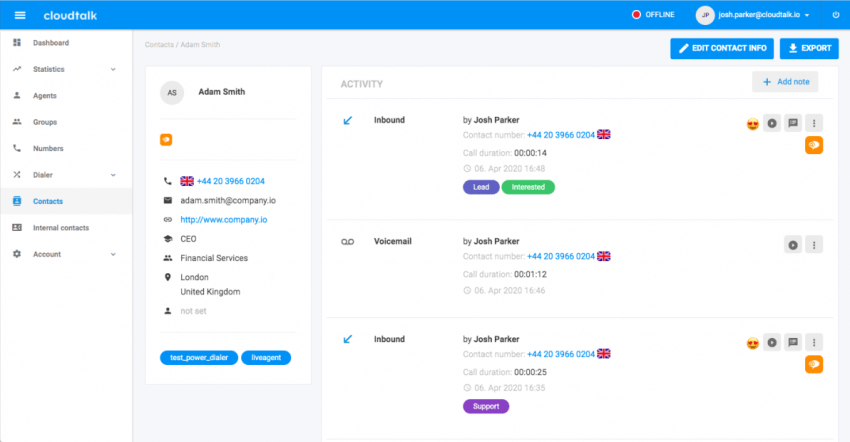
At its core, CloudTalk is about keeping reps on the phone and keeping CRM data clean. If your team lives in HubSpot or Salesforce and needs a tool that automatically logs calls, syncs data back to the CRM, and lets them power through a call list without friction, CloudTalk is built for that. It integrates with over 35 tools, including Pipedrive, Zendesk, Intercom, and Shopify.
CloudTalk also offers AI capabilities. Its AI voice agent, CeTe, handles both inbound and outbound calls autonomously. CeTe qualifies leads, books appointments, answers FAQs, and transfers to human agents when needed. Conversation intelligence features include call summaries and transcripts.
What CloudTalk is not:
CloudTalk is not a unified communications platform. It does not offer video conferencing, team messaging, and other features relevant to the unified communications as a service use case. If your team needs those capabilities, they’ll come from separate vendors. That’s not a flaw in CloudTalk’s design; it’s a reflection of its focus.
What is Nextiva?
Nextiva is a unified customer experience management platform. Where CloudTalk focuses on voice, Nextiva orchestrates conversations across voice, SMS, email, live chat, social media, and video conferencing through a single system. The platform functions as both a call center software solution and a unified communications hub.
Founded in 2008, Nextiva serves over 150,000 businesses and powers more than 1 million users.
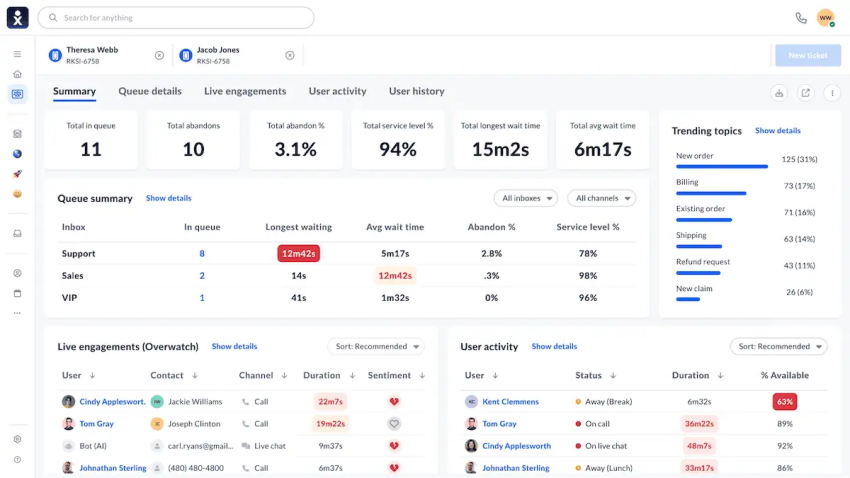
The idea behind Nextiva is simple: stop paying for five tools when one can do the job. Instead of managing separate vendors for your phone system, helpdesk, chat, and social media, Nextiva brings those channels into a single platform with shared routing, analytics, and automation.
AI runs across the platform. XBert, Nextiva’s AI receptionist, handles calls, texts, and chats around the clock, booking appointments, capturing leads, and routing complex requests to human agents with full context. On top of that, AI voicemail transcription, sentiment analysis, and chatbots are built into certain plans.
Nextiva strives for 99.999% uptime with eight geographically redundant data centers and provides 24/7 phone, chat, and email customer support across all plans, staffed by a US-based team.
What Nextiva is not:
Nextiva is not just a niche dialer tool. It doesn’t position itself as a single-channel calling product with bolt-on extras. Nextiva offers different auto dialers, but the real value shows up when your team needs shared context, routing, and analytics to connect conversations.
CloudTalk vs. Nextiva: Pricing and Total Cost of Ownership
Both platforms charge per user, but the sticker price only tells part of the story. What matters is what’s included and what costs extra. If you’re evaluating CloudTalk alternatives, understanding the total cost of ownership is the first step.
CloudTalk pricing structure
CloudTalk offers tiered plans with annual billing. Pricing varies by region, so the figures below reflect US-based annual billing:
| Plan | Annual Price (per user per month) | Key Inclusions |
|---|---|---|
| Lite | $19 | Click-to-call, call recording, ACD, call queuing, basic analytics, desktop/mobile apps, unlimited US/CA minutes or EU/UK/Iceland/Norway minutes, voicemail |
| Essential | $29 | IVR, skill-based routing, SMS/MMS, real-time analytics, integrations, APIs, and data sync |
| Expert | $49 | Power dialer, smart dialer, Salesforce integration, call monitoring, VIP queues, SSO |
Source: CloudTalk pricing; GetVoIP CloudTalk pricing
A custom plan with enterprise security, unlimited outbound calls, and custom onboarding is available on a quote basis.
Here’s where the real cost starts adding up:
- Dialer access requires Expert: The power dialer and parallel dialer, both central to CloudTalk’s outbound story, only unlock at $15 per user per month and $39 per user per month, respectively. A team that signs up on the Lite plan expecting outbound productivity will need to upgrade. These features are available on the Essential plan as an add-on. Power dialer is included in the Expert plan.
- AI voice agents are usage-based: AI conversation intelligence costs $9 per user per month. AI voice agents start at $350 for 1,000 minutes of monthly use.
- International numbers carry additional fees: While CloudTalk supports 160+ countries, local numbers in many regions come with per-number charges beyond the base plan. Branded numbers start at $0.07 per call.
- Conversation intelligence packaging: AI call summaries, sentiment analysis, and topic extraction are available depending on your plan tier. Verify which AI features come standard or as add-ons.
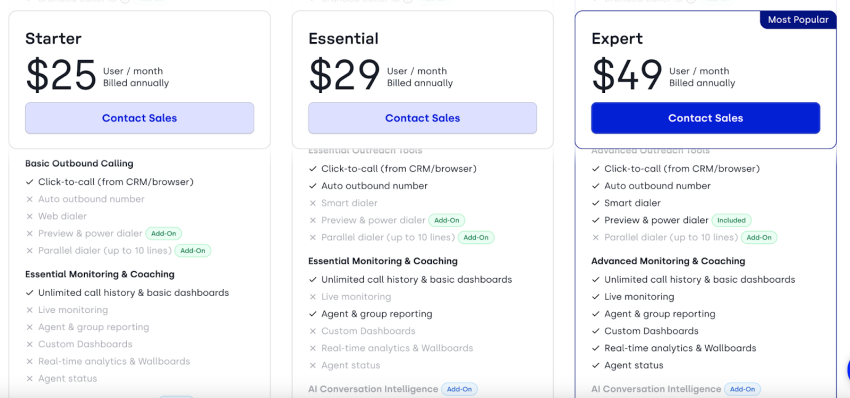
If you’re a sales leader, you’re likely looking at CloudTalk for the power dialer feature. It’s important to note that this is an add-on for the $19 Lite plan. To get the dialer and the Salesforce integration, you must move to the Expert tier at $49 per user per month.
By the time you add AI conversation intelligence ($9 per user per month) and branded numbers, your seemingly affordable dialer is costing you over $60 per month per rep. This is where Nextiva’s Power Suite ($75 per user per month) starts to look significantly more attractive, as it bundles those AI features and multichannel routing into the base price.
Nextiva pricing structure
Nextiva offers small business plans built around channel breadth and platform depth. These figures reflect the most recent publicly available pricing:
| Plan | Annual Price (per user/month) | Key Inclusions |
|---|---|---|
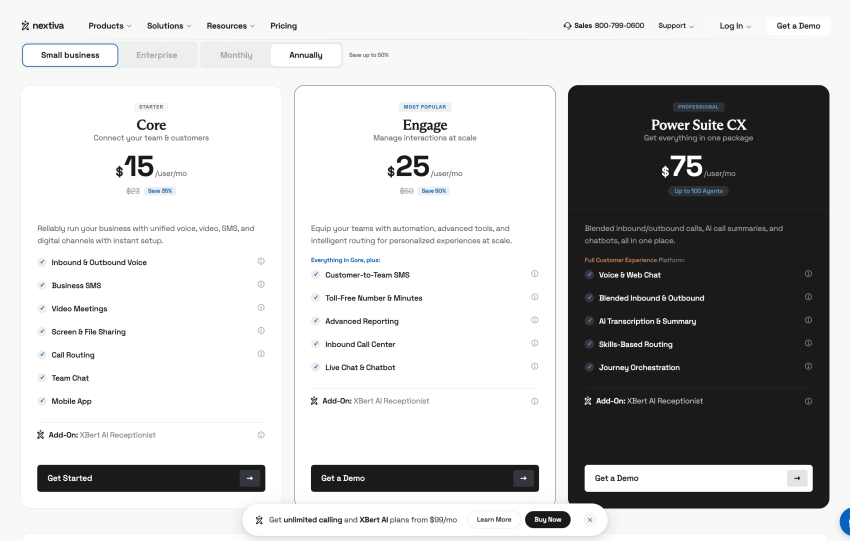
| Core | $15 | Features: Inbound and outbound voice Business SMS Video meetings Screenshare and file share Call routing Team chat and collaboration Mobile app Add-on: XBert AI Receptionist |
| Engage | $25 | Includes everything in Core, plus: Customer-to-team SMS messaging Toll-free number and minutes Advanced reporting Inbound sales and service call center (fees may apply) Web chat: Live and bot Add-on: XBert AI Receptionist |
| Power Suite | $75 | Features: Voice and web chat Blended inbound and outbound calling AI transcription and summarization Workforce management Customizable, intelligent, and skills-based routing Support for up to 100 agents Add-on: XBert AI Receptionist |

Monthly billing runs 35% higher for the Core plan and 50% higher for the Engage plan. Enterprise plans with concurrent pricing, usage-based models, and advanced security are available separately for larger operations.
Here’s what stands out about Nextiva’s pricing:
Nextiva’s Core plan at $15 per user per month bundles voice calling, video conferencing, team chat, SMS, social media management, and basic interactive voice response (IVR). For teams currently paying separately for a phone system, chat, and experience-related capabilities, the combined cost often favors Nextiva, even when the seat price is similar to CloudTalk’s.
Don’t just compare seat prices. Count how many subscriptions Nextiva can replace across your stack. That’s where the math changes.
| Cedar Financial consolidated from seven vendors down to one with Nextiva and saw a 471% increase in agent call volume. Read the full story. |
Core Calling and Routing Capabilities
CloudTalk and Nextiva both cover the basics: cloud-based calling with a contact center application, mobile app access (iOS and Android), call recording, transfers, queues, and reporting. Where they split is how far the experience extends beyond the call itself.
Where CloudTalk stands out
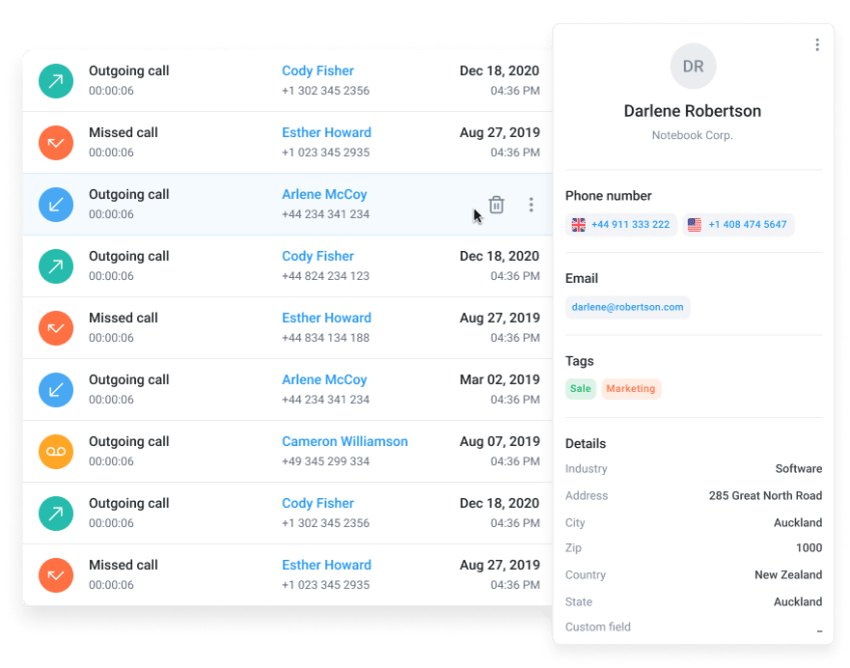
CloudTalk’s calling infrastructure is good for global reach. With local phone numbers in 160+ countries, it helps teams run international outbound campaigns. If your sales motion depends on local presence dialing across European, APAC, or LATAM markets, CloudTalk simplifies it.
It’s a practical fit for:
- High-volume outbound teams where connect rate and list throughput are primary metrics. A BDR team calling into Germany, the UK, and Brazil can use local numbers in each market from a single platform.
- CRM-first calling workflows where reps need calls logged automatically in HubSpot or Salesforce without manual data entry.
CloudTalk’s country coverage is impressive, but it’s rarely all-in. While they offer the numbers, many regions carry separate monthly rental fees and higher per-minute outbound rates. If your global operations are primarily in the US, Canada, the UK, and Ireland, Nextiva’s bundled minutes often result in a lower total bill at the end of the month. Always ask for a projected usage quote before signing up.
Where Nextiva stands out
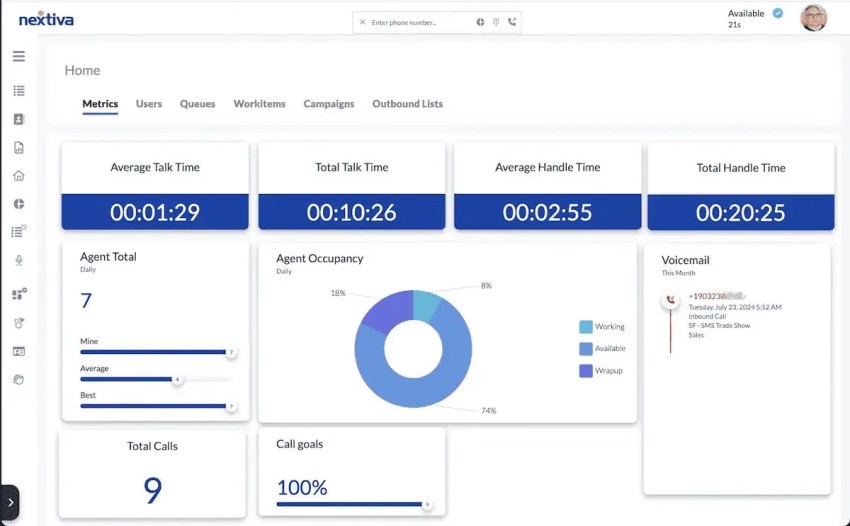
Nextiva’s routing andcall flow capabilities reflect its contact-center DNA. Instead of routing calls based on simple queue logic, Nextiva allows teams to build IVR trees, route callers based on customer data and agent skills, and orchestrate handoffs between AI and human agents within the same flow.
It’s a practical fit for:
- Support teams that need consistent routing logic across voice and digital channels. A customer who starts on chat and escalates to a phone call carries their context forward instead of repeating their issue.
- Operations or sales teams that want a single dashboard showing all customer interactions across channels, not separate reports from separate tools.
The approach is less about maximizing calls and more about amplifying the value of every interaction, regardless of the channel it starts on.
Comparing Dialers and Outbound Motion
If outbound calling productivity is your primary buying criterion, this comparison carries the most weight.
CloudTalk’s dialer strengths
CloudTalk has done well in dialer experience. The Expert plan offers:
- Power dialer: It automatically dials through a list, eliminating manual dialing and reducing idle time.
- Parallel dialer: Available for an additional $39 per user per month, it calls up to 10 numbers simultaneously and connects the rep to the first live answer. This is built for teams optimizing the connect rate above all else.
Both dialers sync with CRM records, logging call outcomes, notes, and recordings automatically. CloudTalk also offers branded caller ID and carrier-level spam remediation for high-volume teams, which helps protect answer rates on outbound campaigns.
For outbound call centers where daily dial volume is the primary metric, this is CloudTalk’s strongest value proposition.
Nextiva’s outbound approach
Nextiva’s outbound story is less about raw dialing speed and more about the full cycle. The platform offers progressive, predictive, and preview dialing modes in its contact center plans, along with routing, analytics, and workflow automation.
- Outbound dialing capabilities sit within a broader platform that also handles inbound calls, chats, and emails.
- Analytics and automation reduce manual work after the call. Call summaries, sentiment analysis, and CRM syncing happen within the platform’s workflow engine.
- Journey orchestration connects outbound activity to the rest of the customer lifecycle. A sales call that converts into a support case keeps its context when it moves between teams.
Teams that use dialing speed and list throughput as the only metrics will find CloudTalk’s dedicated dialer tools more purpose-built. Teams where outbound calling is one part of a larger sales or service operation will find Nextiva more valuable over time.
Comparing AI Capabilities
Both CloudTalk and Nextiva offer AI, but they package it differently.
CloudTalk AI
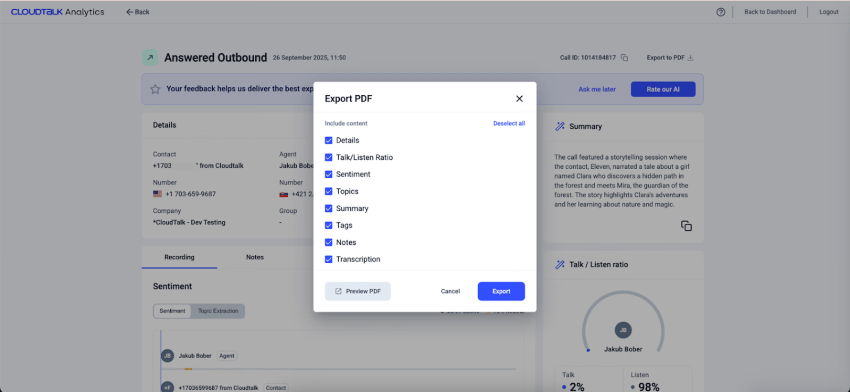
CloudTalk offers two AI categories:
- AI conversation intelligence provides post-call value: automatic call summaries, transcripts, sentiment analysis, topic extraction, and talk-to-listen ratios. These help managers review more calls in less time and spot coaching opportunities without having to listen to every recording. Feature availability varies by plan tier.
- CeTe (AI voice agent) autonomously handles live calls. CeTe can make outbound calls for lead qualification, appointment reminders, and follow-ups, and receive inbound calls for FAQs, routing, and data collection. Its pricing is usage-based.
Questions to resolve before buying:
- Which conversation intelligence features are included in your plan versus billed separately?
- Does CeTe’s per-minute cost align with your projected call volumes?
- How do AI-generated outputs (summaries, tags, sentiment) flow into your CRM automatically versus manually?
Nextiva AI and XBert
Nextiva treats AI as an integrated layer across its platform rather than a standalone product.
XBert AI is Nextiva’s AI receptionist. It handles calls, texts, and web chats around the clock, answering questions from your business’s knowledge base, booking and rescheduling appointments, capturing leads, and routing complex requests to human agents with full conversation context. XBert learns from your website and business data automatically, requiring minimal setup. Pricing starts at $99 per month for 100 interactions, with additional interactions at $0.99 each.
Platform-level AI includes voicemail transcription, real-time sentiment analysis, AI-powered call routing, and chatbots. AI-generated call summaries and notes feed directly into Nextiva’s workflow engine, making insights actionable within the same system rather than being exported elsewhere.
CloudTalk’s AI is strong in the voice lane. Nextiva’s AI is broader, spanning voice, chat, text, and social channels within a single orchestration layer.
Integrations and System Fit
Both platforms integrate with the CRM and helpdesk tools that sales and support teams depend on. The question is how deep those integrations go and whether they reduce tool switching or just add another connection to manage.
CloudTalk integrations
CloudTalk offers native integrations with over 35 tools, including HubSpot, Salesforce, Pipedrive, Zendesk, Intercom, and Shopify, plus Open API access on Essential plans and above.
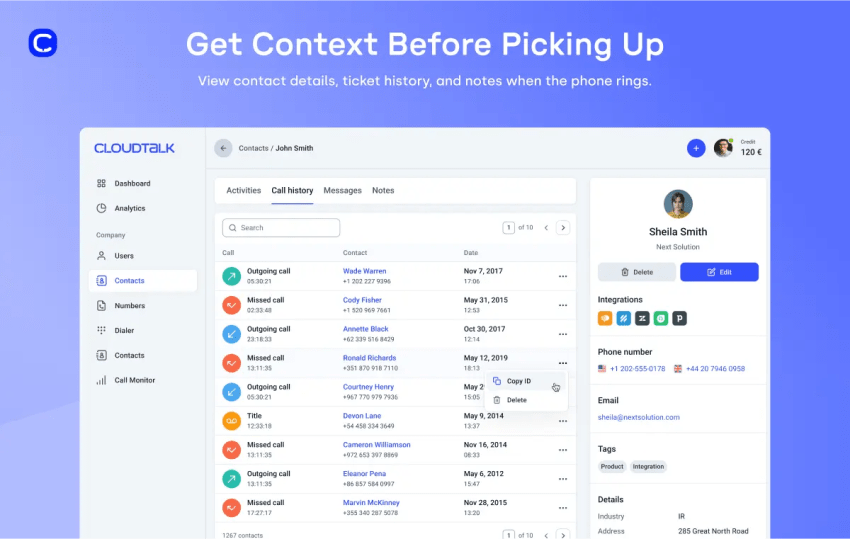
The CRM integration story is a genuine strength. Users praise automatic call logging to HubSpot and Salesforce, noting it reduces manual data entry and keeps CRM records current without rep intervention.
What to verify: Integration depth varies. Salesforce integration, for instance, requires the Expert plan. API access starts with the Essential tier.
Teams needing deep, bidirectional data sync should confirm exactly which logs are automatically synced versus which require manual configuration at the plan level.
Nextiva integrations
Nextiva integrates with Salesforce, HubSpot, Microsoft Teams, Zendesk, and other major CRM and productivity platforms. The MS Teams integration is included on the Engage plan and above and is available on Core as an add-on. Nextiva also provides REST APIs for custom integrations and workflow automation.

Where Nextiva’s integration story diverges is in emphasis. Rather than syncing call data from a separate phone tool into a CRM, Nextiva aims to be the system where customer interactions across voice, chat, email, and social media already live. The CRM integration enriches that unified view rather than building it from scratch.
For teams managing customer relationships across multiple channels, the value of integration shifts from “Does my phone system talk to my CRM?” to “Does my platform reduce the number of tools my team switches between every day?”
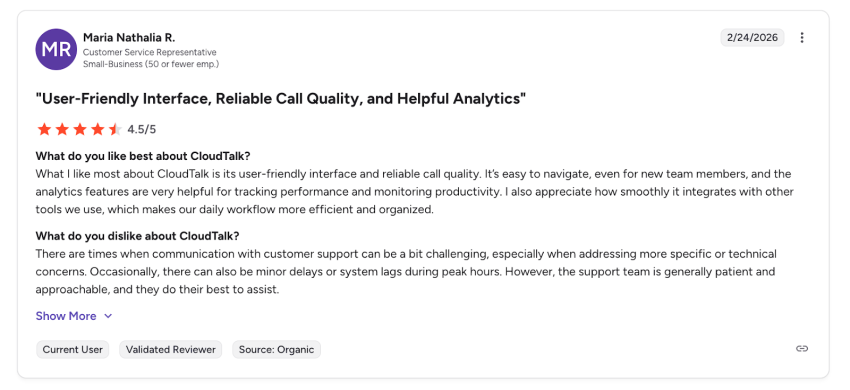
What Reviews and Reliability Signals Tell Us
Aggregate scores only tell you so much. The patterns inside those reviews are what predict whether a platform will work for your team.
CloudTalk review themes
Here’s an overview of what users praise and flag about CloudTalk:
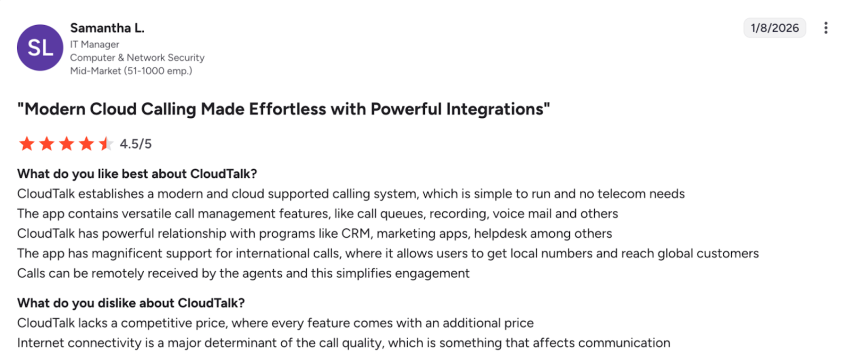
- What users praise: Ease of use is cited positively on Capterra, with reviewers calling the interface user-friendly and quick to learn. CRM integrations with HubSpot, Salesforce, and Pipedrive earn consistent marks for automatic logging. International coverage and quick setup are recurring themes.
- What users flag: Call quality issues rank as the top negative theme on G2, including connection drops and jitter. Billing and cancellation friction drives lower scores on Trustpilot, with complaints about auto-renewal terms.
Nextiva review themes
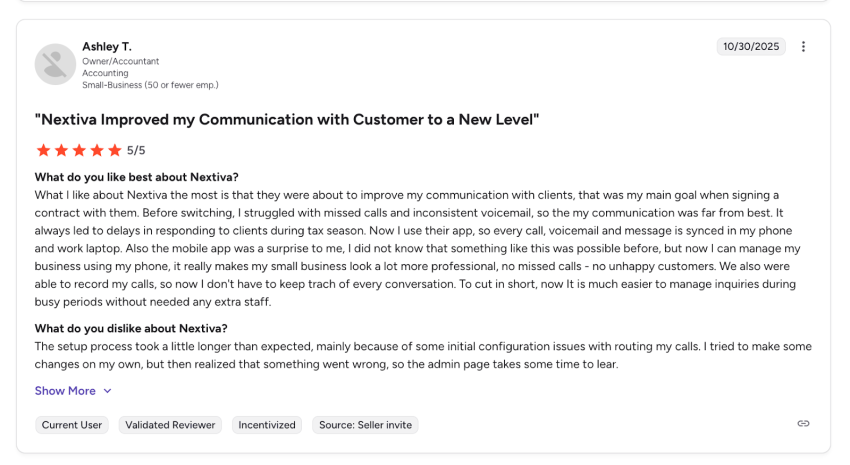
Nextiva earned leadership positions in 31 of G2’s Winter 2025 reports and was ranked #1 in 13 of them. The platform is also recognized as a Strong Performer in the 2025 Gartner Peer Insights Voice of the Customer for CCaaS.
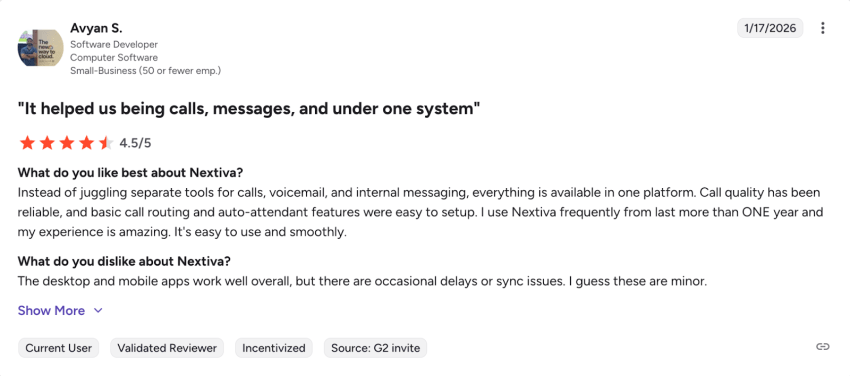
- What users praise: The unified platform that reduces tool switching is the defining positive. Call quality and reliability earn strong marks, backed by high uptime. Customer support during onboarding and ongoing use is frequently described as knowledgeable, patient, and responsive.
- What users flag: Some customers say that the initial setup (advanced IVR) is complex. However, the award-winning customer support makes it easier to navigate the setup while assisting with configurations.
My advice: Don’t take anyone’s word for it, including mine. Run both platforms against your actual workflows, network conditions, and use cases before signing a contract.
| DirectBuy runs 30,000+ calls per month across 600 staff with Nextiva. Their Contact Center Director calls the real-time analytics “irreplaceable and vital.” Read their story. |
Decision Framework for Buyers Comparing CloudTalk Vs. Nextiva
Forget the feature checklist for a moment. Here’s how to think about this decision based on what your team does every day.
Choose CloudTalk if:
- Outbound calling productivity is the priority: CloudTalk’s power dialer and parallel dialer are purpose-built for teams measuring daily dials and connection rates.
- You run a global calling motion: Local numbers in 160+ countries, with local presence dialing, are tricky to match at CloudTalk’s price point.
- You want a focused calling tool: If your stack already covers chat, email, social, and video, and you need a better phone layer, CloudTalk fills that gap.
Choose Nextiva if:
- You need to unify customer conversations across channels: If voice, SMS, chat, email, and social interactions are scattered across different tools, Nextiva consolidates them into one system with shared context.
- Routing, analytics, and automation need to work across the entire customer journey: Nextiva connects outbound sales activity to inbound support workflows. Customer context follows the conversation, not the channel.
- You’re reducing vendor sprawl: Every separate tool adds an integration to maintain, a support queue to navigate, and a renewal to manage. Nextiva’s platform approach means fewer vendors and one place to manage communications, customer support, and team collaboration.
- Reliability and support accountability matter: Nextiva’s uptime, with eight carrier-grade data centers and 24/7 US-based support on all plans, provides a scalable reliability baseline.
Five questions to answer before deciding between CloudTalk and Nextiva
Before you pick either platform, sit down with your team and answer these honestly.
1. Are we buying a dialer or a customer interaction platform?
If the answer is a dialer, CloudTalk deserves serious evaluation. If the answer is a platform, Nextiva fits the need.
2. Do we need omnichannel now or within the next 12 months?
Choosing a unified platform now avoids a painful migration later.
3. How many tools do we currently manage for calling, transcription, QA, analytics, and reporting?
Count them. Nextiva replaces more of them.
4. What does success look like at 50 agents?
Model cost and complexity at your growth target, not just your current headcount. Add-on costs that seem small at five seats compound at 50.
5. What’s our fully loaded cost per seat?
Map both platforms’ pricing against your specific business needs. The base price is the starting point, not the answer.
Why Nextiva Is Built for What Comes Next
CloudTalk does calling well. If your team needs dialing speed, it delivers.
But here’s what I have seen happen over and over: teams start with a dialer, and six months later, they need chat and SMS. Then someone asks why the support team can’t see what the sales team promised on the phone, and suddenly you’re managing five tools that don’t talk to each other.
That’s where the drag sets in. Reps lose context when switching between platforms. Managers pull reports from dashboards that don’t share data. The cost isn’t just financial. It’s the kind of operational friction that worsens the bigger you get, making a scalable, unified platform increasingly valuable.
Nextiva is built to address that compounding problem. Every customer conversation lives in one system. When a customer calls your support line and then messages you on SMS about the same issue, your team sees one thread instead of two disconnected tickets. With Nextiva, you build a customer communication operating system.
Reliance Partners figured that out when they stopped treating calling as an isolated tool and started running outbound sales, inbound support, and analytics on a single platform. If your team is heading in the same direction, explore how Nextiva can support your sales and support operations.

A New Dawn in Customer Experience
The complete customer experience platform. Win every conversation, measure every interaction, and use AI to optimize every customer journey. Grow your business without working harder.
Frequently Asked Questions About CloudTalk vs. Nextiva
CloudTalk is a voice-focused calling platform designed for sales and support teams. Nextiva is a unified customer experience platform that combines voice, video, SMS, chat, email, social media, and review management into a single system with shared routing, analytics, and AI.
Nextiva’s Core plan starts at $15 per user per month (annual). CloudTalk’s Lite begins at $19 per user per month (annual). However, the total cost depends on add-ons and which tools each platform replaces in your stack.
Yes, CloudTalk offers a free trial. Nextiva does not offer a public free trial but provides guided demos with product experts through its sales team.
Startups focused primarily on outbound sales calling may find CloudTalk’s lower entry price and focused dialer tools a natural fit. However, given the price point Nextiva comes in at, it delivers more value compared to CloudTalk. The breadth of functionality reduces the need to bring in other tools. Most importantly, when your teams scale, Nextiva grows with you. There’s no need to plan a costly and time-consuming migration.
Nextiva publicly strives for 99.999% uptime with eight geographically redundant data centers. CloudTalk does not publish a comparable uptime SLA at the same specificity on its pricing or product pages.
XBert is Nextiva’s AI receptionist that handles calls, texts, and web chats 24/7. It answers questions, books appointments, captures leads, and routes complex requests to your team with full context.


