




Some of these articles were extremely long ones.

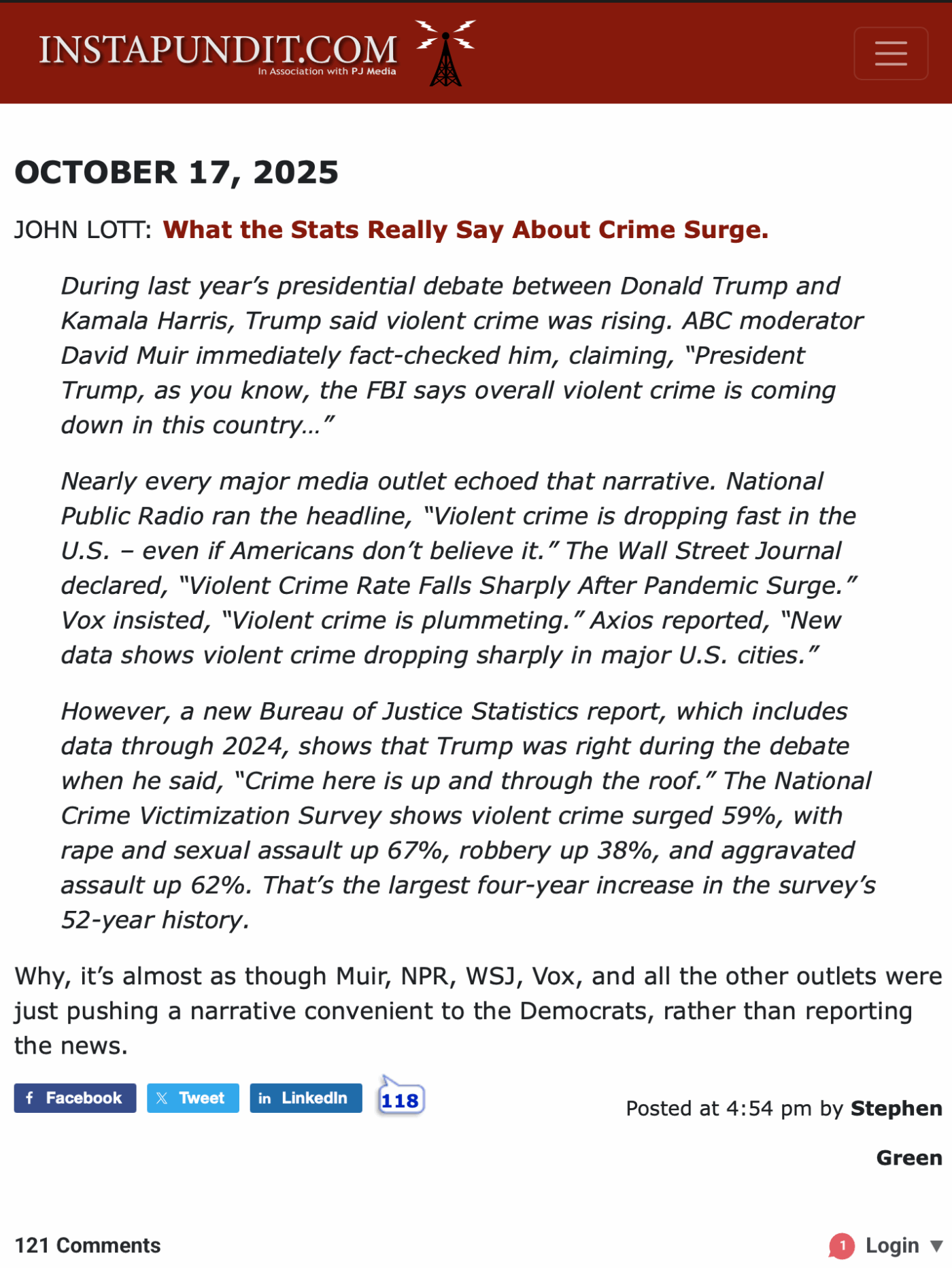
“A new Bureau of Justice Statistics report” shows “Trump was right” last year “when he said, ‘Crime here is up and through the roof,’” reports John R. Lott at RealClearPolitics. The media focused on the FBI’s Uniform Crime Reports, which reflects only offenses reported to DC by police departments. But BJS’s National Crime Victimization Survey asks people if they were crime victims and whether or not they reported them; it shows violent crime surged 59%. The problem? There’s a “growing gap between reported crimes and actual victimization,” as victims don’t bother reporting crimes that won’t be prosecuted by progressive prosecutors — who also deliberately downgrade “violent” offenses. “Until the justice system” restores “accurate reporting, Americans will continue to face rising violence that the FBI’s official statistics fail to capture.”

Americans packing heat have stopped active shootings at least 10 times more than the FBI has counted, showing that life-saving actions by armed citizens are much more common than the liberal anti-gun media reports.
In a new review of 10 years of active shooter reports, a top public safety think tank said that good Samaritans stopped 36%-62% of the incidents, far more than the 3.7% the FBI and media commonly claim.
The Crime Prevention Research Center explained that the competing numbers are due to the FBI’s restrictive definition of active shootings and its misclassification of many.
For example, the center said the FBI doesn’t include in its count cases where armed citizens show their weapons but don’t shoot, and still thwart a mass shooting. In others, it has classified volunteer security guards as professionals.
More importantly, said the center’s President John R. Lott Jr., his report shows that having armed citizens is much more of a lifesaver than the FBI and media have told.
“The FBI defines an active shooter as one or more individuals actively engaged in killing or attempting to kill people in a public place, not involving gang violence or some other crime such as robbery. Such an incident could be something as minor as one person being shot at and missed up to a mass public shooting. While the FBI includes cases where civilians stop active shooters, the news media frequently relies on the limited number of these cases to argue that such interventions are rare,” said the report. . . .

Dr. John R. Lott Jr. is an unusual researcher in these days of fake research. Head of the Crime Prevention Research Center, Lott conducts meticulous research on issues of crime, guns and related topics. What makes Lott unusual is he provides his data sets and methodology on request. He doesn’t make things up. He’s actually fully transparent.
He drives Democrats crazy.
The honest among them—there are a few—will say they hate his conclusions but can’t fault his methods. The rest wildly attack his work, but are always long on heated, hyperbolic rhetoric and short on valid argument.
In a recent Real Clear Politics article, Lott addresses the reality of American crime rates. He begins by harkening back to the Trump/Harris debate where Trump correctly asserted crime was increasing:
ABC moderator David Muir immediately fact-checked him, claiming, “President Trump, as you know, the FBI says overall violent crime is coming down in this country…
Lott noted the usual Democrat media suspects backed Muir. The Wall Street Journal, Vox and Axios among them. NPR, who Democrats are holding the government hostage to refund, headlined: “Violent crime is dropping fast in the U.S. – even if Americans don’t believe it.”
Their unbelief was well founded. . . . [Much more here]
Mike McDaniel, “Trump was right about crime rates,” American Thinker, October 19, 2025.

One of the most popular claims by anti-Second Amendment groups is that firearms lead to more crime. Indeed, anti-gun advocates point to dubious studies that purportedly debunk the research by John R. Lott, an academic, economist, and head of the Crime Prevention Research Center (CPRC). Lott’s work definitively shows that higher concentrations of legal gun ownership result in less crime.
By contrast, leftist research often makes conflation and category errors, such as failing to make a clear distinction between suicide using a firearm and crime committed with a firearm. Suicide deaths by firearm are far more prevalent than crimes committed with firearms.
Furthermore, they claim that instances of firearms being used to prevent violent crime are much less frequent than instances of crimes happening because of guns. To make this argument, the gun-control lobby appeals to data from the FBI.
It turns out that the data the FBI has been providing is inaccurate. That’s because the FBI has been undercounting the number of instances in which armed civilians have thwarted active shooters.
Lott points out that the FBI has known about this issue and acknowledged its error three years ago, but has taken no action to rectify it. “In the years since,” he notes, “the problem has only gotten worse. Since RCI’s 2022 article, the FBI has acknowledged just three additional incidents of armed good Samaritans stopping active shooters from 2022 to 2024, and none in the last two years. In contrast, the Crime Prevention Research Center (CPRC), which I head, has documented 78 such cases over that same period — a 26-fold difference.”
Why has this been happening? Lott sees the issue as twofold: politics and the refusal by many local jurisdictions to report accurate crime data to the FBI. A recent example of this failure to report accurate crime data is at play in the FBI’s own backyard, as it were. The Washington, DC, police are currently under a Justice Department investigation, accused of falsifying crime reports to create the “false illusion of safety” in the city.
Understandably, the FBI would deliver erroneous data if it were receiving bad numbers. But the fact that the FBI, after receiving corrective data, has yet to fix its records on shootings suggests that there is politics at play.
Lott notes an issue with the FBI’s definition of active shooter incidents: “In 2022, the FBI reported that only 11 of the 252 active shooter incidents it identified for the period 2014-2021, or 4.4%, were stopped by an armed citizen. However, an analysis by my organization identified a total of 281 active shooter incidents during that same period and found that 41 of them — or 14.6% — were stopped by an armed citizen.”
“The FBI report compiled for the Biden administration for 2023 and 2024 contains worse errors,” Lott continues. “It asserts that armed civilians stopped none of the 72 active shooting cases it identified. The CPRC, by contrast, identified 121 active shooter cases — 45 of which were ultimately halted by armed civilians. Those incidents included eight cases that likely would have resulted in mass public shootings with four or more people murdered.”
Again, why is the FBI’s data so inaccurate? Another factor is that the FBI isn’t actually compiling the data; instead, the Bureau hires researchers at Texas State University to do so. These researchers, in turn, use Google to scour the nation for news stories regarding shooting incidents. This reliance on media reporting itself is problematic, as facts can often be inaccurate — if the story is even covered. Furthermore, how the media frames an incident will also affect how it is classified.
“Between 2014 and 2024, FBI reports determined that armed citizens stopped 14 of 374 active shooter incidents its researchers identified — or 3.7% — with zero defensive gun use cases occurring in the two most recent years,” Lott reports. “Using the FBI’s definitions, CPRC identified 561 active shooter incidents, with armed citizens stopping 202 of them — or 36%. In addition, CPRC found 31 other cases where civilians intervened before suspects fired their weapons — incidents CPRC excluded because they did not fit the FBI criteria, though they likely prevented shootings as well.”
Over that same decade, the FBI missed 42 instances in which an armed civilian likely thwarted a mass public shooting.
Lott noted two examples of potential mass casualty cases that were quickly ended by a civilian with a firearm. The FBI missed these incidents in its data and has yet to make the necessary corrections. When John Stossel asked the FBI last year about how complete its data is, the Bureau responded, “[Our data is] not intended to explore all active shooting incidents but rather to provide a baseline understanding.” In other words, We’re not interested in data that doesn’t uphold the gun-control lobby’s narrative on “gun violence.”
The correct data blows up the gun-control lobby’s false claim that more guns equal more crime. Some 92% of mass public shootings happen in gun-free zones. In fact, one of the most recent instances of this factor at play was seen in the Annunciation Catholic School attack in Minneapolis in August. The perpetrator explicitly noted in his manifesto, “I recently heard a rumor that James Holmes, the Aurora theater shooter, may have chosen venues that were ‘gun-free zones.’ I would probably aim the same way. … Holmes wanted to make sure his victims would be unarmed. That’s why I and many others like schools so much.”
Marking a building or facility as a “gun-free zone” is nearly the equivalent of putting a target on it. Is it not telling that police stations are rarely the target of mass shootings? Instead, criminals will intentionally target those soft-target locations where they have less fear of being confronted by a good guy with a gun.
Following CPRC’s report, University of Georgia professor David Mustard observed, “The federal government must improve its records related to self-defensive uses of firearms — especially in active shootings. Because academics, media, and policymakers depend on their data, it is essential that the FBI collect and compile the data consistently and accurately.”
Thomas Gallatin, “The FBI’s Gun Data Fail,” The Patriot Post, October 13, 2025.

It’s called proportionate force: The only way to stop a bad guy with a gun, generally, is with a good guy with a gun. This doesn’t actually happen too much, though, if you ask the FBI and legacy media. But you perhaps shouldn’t ask them.
Because in reality, a study finds, armed citizens stop active shootings at least 10 times more than the FBI claims. That’s not exactly a rounding error.
Moreover, this is true of crime in general: Good citizens with guns thwart significantly more of it than is widely known.
As Washington Examiner’s Paul Bedard reports on the active-shooter study: . . .
The Seen and the Unseen
Providing detail, the CPRC writes in its report: . . .
Unfortunately, though, this breeds misunderstanding. And apropos here is a twist on a famed Frédéric Bastiat line. That is, a bad social analyst observes only visible effects. A good social analyst observes visible effects — and what is hidden beneath.
Heinous mass shootings are obvious; they make headlines and shock sensibilities. You can’t miss them. But mass shootings that didn’t happen because a good armed person intervened are not the same kind of “sexy” story. This is even more true when that savior halts a miscreant merely by wielding a weapon and there’s no bloodshed. The media then imitate crickets. . . .

He adheres to all the liberal dogmas of the day. He likely would not have known — or would not have believed it had he been told — that transgender persons are “over-represented” in mass shootings, according to a report by the Crime Prevention Research Center (CrimeResearch.org, Jan. 2). They’re typically portrayed as victims of violence. Yet the “trans share of mass public shootings over the 2018 to 2024 period is 6.8 times their share of the population,” the report states. . . .
Pieter Vree, “Mirror of Society,” New Oxford Review, October 2025

. . . According to an October 2 report by John Lott posted at realclearinvestigatiins.com, the past trend of the FBI underreporting armed citizens who stopped active shooters continues to be a problem. And Lott, president of the Crime Prevention Research Center (CPRC), said it’s not just a small discrepancy; the FBI is grossly underreporting the numbers.
“Even though the FBI acknowledged the issue at the time, it never corrected the error involving the politically fraught issue,” Lott wrote. “In the years since, the problem has only gotten worse. Since RCI’s 2022 article, the FBI has acknowledged just three additional incidents of armed good Samaritans stopping active shooters from 2022 to 2024, and none in the last two years. In contrast, the Crime Prevention Research Center (CPRC), which I head, has documented 78 such cases over that same period—a 26-fold difference.”
The FBI defines active shooter incidents as those in which an individual kills or attempts to kill people in a public place, excluding shootings that are related to other criminal activity, such as robbery or fighting over drug turf. They include instances from one person being shot at and missed all the way up to a mass public shooting.
“In 2022, the FBI reported that only 11 of the 252 active shooter incidents it identified for the period 2014-2021, or 4.4%, were stopped by an armed citizen,” Lott wrote. “However, an analysis by my organization identified a total of 281 active shooter incidents during that same period and found that 41 of them—or 14.6%—were stopped by an armed citizen.”
As Lott further pointed out, the FBI report compiled for the Biden administration for 2023 and 2024 contains worse errors.
“It asserts that armed civilians stopped none of the 72 active shooting cases it identified,” he wrote. “The CPRC, by contrast, identified 121 active shooter cases—45 of which were ultimately halted by armed civilians. Those incidents included eight cases that likely would have resulted in mass public shootings with four or more people murdered.”
Ultimately, Lott said that the FBI has the ability to set the record straight in at least some cases, providing a clearer view of remedies to crime.
“But its unwillingness to correct errors—or its efforts to fix them on the sly, as RCI reported last year—and improve its methodology raises more concerns. Its shortcomings regarding armed citizens thwarting active shooters illuminate many of these problems.
Lott’s report at realclearinvestigations.com also delves into the dangerous fallacy of so-called “gun-free” zones. Those interested in learning more about the FBI’s underreporting of armed heroes and the danger of “gun-free” zones should give it a good read. . . .

Three years ago, Dr. John Lott of the Crime Prevention Research Center (CPRC), writing for RealClearInvestigations, described how the Federal Bureau of Investigation (FBI) was vastly undercounting, “by an order of more than three the number of instances in which armed citizens” had thwarted attacks in public places. Out of 252 “active shooter incidents” the FBI identified in 2014 to 2021, it stated that only 11 were stopped by an armed citizen; in contrast, an analysis by the CPRC using the same definition identified 281 active shooter incidents in the same period, with 41 being stopped by an armed citizen.
Broken down into percentages, the FBI’s data indicated 4.4% of active shooters were impeded by armed citizens, while the CPRC found it to be the much more compelling 14.6%. (The CPRC also found many cases where civilians intervened before the suspects fired their weapons, but which weren’t included in the count because they did not fit the FBI “active shooter incident” criteria.)
At the time that article appeared, the discrepancy was attributed to misclassified shootings (e.g., in which the role of armed civilians was inaccurately credited to security professionals) and overlooked incidents (in which the part armed citizens played was unnoticed or ignored).
The FBI was asked to correct this pattern of distortion and omission but refused to do so. Lott’s new follow-up article with RCI, published this month, states that the agency not only persists with the incorrect reporting, but the problem has become even worse.
His latest article, Unaccountable: The FBI’s Strange Refusal to Fix Key Crime Stat (Oct. 2, 2025), points out that between 2022 to 2024, the FBI has reported just three new incidents of armed civilians stopping active shooters and none in the last two years. The CPRC, meanwhile, has documented 78 such cases over the same period.
According to Lott, an FBI report compiled for the Biden administration for 2023 and 2024 “contains worse errors. It asserts that armed civilians stopped none of the 72 active shooting cases it identified.” This is especially disturbing because the CPRC found there were actually 121 active shooter cases, of which 45 were ended due to an armed citizen, including “eight cases that likely would have resulted in mass public shootings with four or more people murdered.”
These data discrepancies, as Lott acknowledges, may be due to many factors – local police departments don’t track active shooting incidents separately as a class, and the FBI relies on outside researchers using media crime reports as the basis for its statistics, when these underlying crime reports may themselves be incomplete or inaccurate. The CPRC, however, tested its own findings by providing its entire list of cases to a researcher at the university compiling the FBI’s data, who objected to just two of the incidents the CPRC included and the FBI missed. Thereafter, the university “declined to respond to repeated requests for comment.” (Further up the food chain, the FBI reportedly “declined to comment” as well.)
The reason why the FBI’s skewed figures (and consistent underrepresentation of the role of lawfully armed civilians) are so important is that the agency’s statistics are relied on as authoritative by the mainstream news media, researchers, in court cases and legislative debates on gun laws and policy.
A Washington Post article on a 2022 active shooter incident at a shopping mall that ended due to the intervention of an armed civilian described the incident as “unique,” adding that in “recent studies of more than 430 ‘active shooter incidents’ dating back to 2000, the FBI found that civilians killed gunmen in just 10 cases.”
Gun control advocates use the FBI statistics to bolster claims that good guys with guns don’t stop mass shootings and that carrying by private individuals is more likely to harm public safety than not. A 2017 “fact” sheet by the Center for American Progress, for instance, claims “there is very little evidence suggesting that civilians can effectively serve this role,” backing that up with a statement that “an FBI study of 160 active-shooting incidents from 2000 to 2013 found that only one was stopped by an individual with a valid firearms permit.” Brady United claims that “[t]here is no widely endorsed research that expanding public carry – especially concealed carry – has any public safety benefits. Firearms are rarely used successfully in self-defense…When a firearm is present, a situation that could have been diffused may instead end in injury or death.”
Contrary to such assertions, Lott’s CPRC has separately documented, in a study published this year, that lawfully armed civilians stopped active shooter attacks “more frequently and faced a lower risk of being killed or injured than police.” Armed civilians have the advantage of being able to intervene immediately anywhere where carrying concealed is allowed and outnumber on-duty police officers by a wide margin. There were approximately 671,000 full-time sworn law enforcement officers in 2020 (and there’s some indication the numbers have dropped since then). “If only a third are on duty at any given time, that leaves about 223,667 officers to protect a population of 340 million—less than 0.1% of the population.” In contrast, the study points out that in 2024, “21.5 million Americans—about 8.2% of adults—held concealed handgun permits (Lott et al., 2024). In addition, 29 states allowed Constitutional Carry, which requires no permit at all. Surveys show that 7.2% of likely voters carry all the time, and another 8.4% carry some of the time.”
The study examined 180 active shooting cases in which a concealed handgun permit holder stopped an active shooting attack. There was only one case each (0.56%) of a concealed handgun permit holder accidentally shooting a bystander or having their handgun taken away, and no instances where the permit holder “got in the way of police.” Police officers shot and killed the wrong person in four cases (two in which another officer was accidentally shot, and two involving innocent bystanders), meaning the rate at which police accidentally shoot bystanders was over twice the rate at which armed civilians cause such harm (1.14% versus 0.56%). Most significantly, the CPRC found that armed civilians with concealed handgun permits appeared to be more effective, overall, at stopping an active shooting event than law enforcement. Such civilians “stopped 51.5% of the active shootings in non-gun-free zones, [while] police stopped 44.6% of the cases.”
All of this takes on sharper relevance against the backdrop of H.R. 38, the “Constitutional Concealed Carry Reciprocity Act of 2025.” The bipartisan bill, a top priority for the NRA, would establish a federal statutory framework to facilitate the carry or possession of concealed firearms interstate, freeing law-abiding carriers from dealing with the intricacies of the current confusing and ever-changing patchwork of reciprocity and recognition provisions.
The evidence consistently supports the argument that lawfully armed civilians enhance rather than endanger public safety, as recently recognized by the chief law officers of almost half of all states. A letter to the leadership of the U.S. House of Representatives and signed by the Attorneys General of 24 states urged that body to pass H.R. 38 because “[c]oncealed carry is a constitutional right, and it can have substantial public safety benefits by allowing people the means to respond to emergent threats to themselves or others when police are not immediately available to intervene.”
In the meantime, given the importance of the FBI as an ostensible source of trustworthy government information, the agency should revisit its statistics and update its data on armed citizens. All of the cases missed by the FBI (along with links to the underlying sources) are helpfully available at a link included in the RCI article.
Staff, “FBI Persists in Underreporting Armed Citizen Defensive Gun Use,” NRA-ILA, October 13, 2025.

Three years ago, Dr. John Lott of the Crime Prevention Research Center (CPRC), writing for RealClearInvestigations, described how the Federal Bureau of Investigation (FBI) was vastly undercounting, “by an order of more than three the number of instances in which armed citizens” had thwarted attacks in public places.
Out of 252 “active shooter incidents” the FBI identified in 2014 to 2021, it stated that only 11 were stopped by an armed citizen; in contrast, an analysis by the CPRC using the same definition identified 281 active shooter incidents in the same period, with 41 being stopped by an armed citizen.
Broken down into percentages, the FBI’s data indicated 4.4% of active shooters were impeded by armed citizens, while the CPRC found it to be the much more compelling 14.6%. (The CPRC also found many cases where civilians intervened before the suspects fired their weapons, but which weren’t included in the count because they did not fit the FBI “active shooter incident” criteria.) . . .
Lott’s new follow-up article with RCI, published this month, states that the agency not only persists with the incorrect reporting, but the problem has become even worse.
His latest article, Unaccountable: The FBI’s Strange Refusal to Fix Key Crime Stat (Oct. 2, 2025), points out that between 2022 to 2024, the FBI has reported just three new incidents of armed civilians stopping active shooters and none in the last two years. The CPRC, meanwhile, has documented 78 such cases over the same period.
According to Lott, an FBI report compiled for the Biden administration for 2023 and 2024 “contains worse errors. It asserts that armed civilians stopped none of the 72 active shooting cases it identified.” This is especially disturbing because the CPRC found there were actually 121 active shooter cases, of which 45 were ended due to an armed citizen, including “eight cases that likely would have resulted in mass public shootings with four or more people murdered.”
These data discrepancies, as Lott acknowledges, may be due to many factors – local police departments don’t track active shooting incidents separately as a class, and the FBI relies on outside researchers using media crime reports as the basis for its statistics, when these underlying crime reports may themselves be incomplete or inaccurate. The CPRC, however, tested its own findings by providing its entire list of cases to a researcher at the university compiling the FBI’s data, who objected to just two of the incidents the CPRC included and the FBI missed. Thereafter, the university “declined to respond to repeated requests for comment.” (Further up the food chain, the FBI reportedly “declined to comment” as well.) . . .
Staff, “FBI Persists in Underreporting Armed Citizen Defensive Gun Use,” Ammoland, October 18, 2025.


