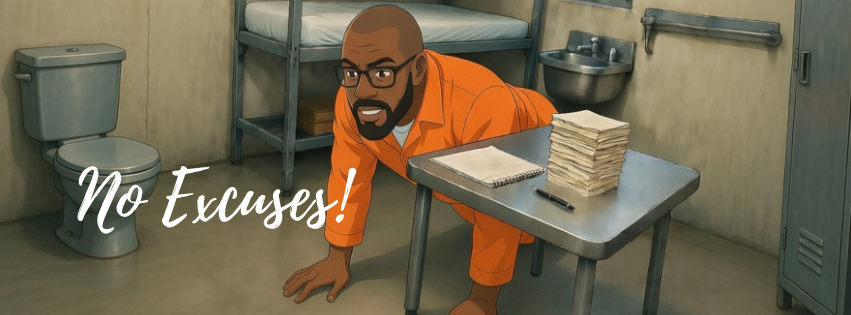



# From the Fortress: What Prison Taught Me About Freedom That Success Never Did
The day they locked the cell door behind me was the first day I was truly free.
It took years of success on the outside to understand what that meant.
That’s not a motivational quote. That’s not a redemption arc dressed up for a TED Talk. That’s the truth — raw, undecorated, the kind that only surfaces when everything fake gets stripped away and all that’s left is you: four walls, a steel bunk, and whatever you’re made of.
This is a prison memoir. But not the kind you’ve seen before.
This isn’t Orange Is the New Black — a white woman’s gap year behind bars, optioned for Netflix and discussed over wine at book clubs. This is Black. This is street. This is what it costs to lose everything and discover that what remains is the only thing that ever mattered.
This is what prison taught me about freedom that success — all the money, all the books sold, all the recognition — never could.
The Cell That Became a Studio
Let me put you in the room.
The sound of that lock doesn’t sound like anything else on earth. Not loud. Not dramatic. A small, clean click that says: this chapter of your life is over.
The smell hits next. Institutional. Concrete and bleach and a hundred men’s stories soaked into the walls. You don’t stop noticing it — you just learn to carry it.
The first night alone with a legal pad and a pencil — that’s where PUSH was born.
Not from inspiration. Not from a writer’s residency or an MFA program or a quiet morning in a Brooklyn café. PUSH was born from desperation. From silence. From having nowhere else to put the truth.
When you have nothing to do but think, you start to see clearly.
No phone. No hustle to run. No audience to perform for. Just the man in the mirror — and that man had serious answering to do. That confrontation is where the writing voice was born. Raw. Unfiltered. Unapologetic. Because there was nothing left to protect.
Most writers spend years searching for their voice. Mine found me in a federal prison cell.
The characters in PUSH weren’t invented — they were excavated. Pulled from lived experience, from streets I knew, from people I’d watched navigate a system designed to grind them down. Viktor Frankl wrote Man’s Search for Meaning inside a Nazi concentration camp. He called it survival science: external captivity cannot destroy internal freedom. I didn’t know Frankl’s work then. But I was living his thesis.
The cell became a studio because it had to. Because letting the system author my story was not an option I was willing to accept.
What Nobody Tells You About Losing Everything
Most people treat loss like a wound. Something that happens to you. Something to survive.
I learned to treat it like surgery.
Prison took the car, the clothes, the status, the ability to walk out a door when you felt like it. The phone calls that weren’t timed and monitored. The freedom of movement that free people take for granted every single day.
What was left was the man. No costume. No props. No hustle to hide behind.
Nearly 1 in 3 Black men in America will be incarcerated at some point in their lifetime. Compare that to 1 in 17 white men. For the Black community, incarceration isn’t an anomaly — it’s a statistically defining feature of Black male life in America. The Sentencing Project documented this in 2023. Black families have been living this math for generations.
For me, the reckoning was simple: the same hustle that built everything was the same hustle that put me in a cell.
The streets teach you to stack — money, power, influence. Keep moving. Keep building. Keep accumulating. Prison teaches you what actually has weight. Turns out, most of what we stack weighs nothing at all.
THE LAST KINGPIN wasn’t just a novel. It was a document. I was writing men who had everything and owned nothing. Men who were free on paper and imprisoned by every choice they’d ever made. I was writing them from inside a cell — and I didn’t see the full irony until years later.
Loss, when you let it teach you instead of just break you, is the most honest education you’ll ever receive.
Donald Goines wrote 16 novels cycling in and out of prison in the 1970s. Became one of the best-selling Black authors in American history. Zero critical establishment support. Zero mainstream literary coverage. Just an authentic Black voice connecting with Black readers who recognized the truth on every page. That’s what weight looks like. That’s what survives.
Freedom Is a Mindset They Can’t Lock Up
Here’s the revelation that changed everything:
Freedom was never about physical space. It was always about mental sovereignty.
Read that again.
While I was inside, I built a publishing empire — not in execution yet, but in concept, architecture, and vision. I mapped it on paper. Wrote the books. Developed the brand. Understood my audience with precision that most authors pay market research firms thousands of dollars to approximate.
Because I was living inside my audience.
The cellblock word-of-mouth feedback loop is the most ruthlessly honest market research in the world. People in prison don’t buy books to be polite. They don’t leave five-star reviews because an algorithm rewards it. They don’t share something with their cellie to seem cultured. If your book hits — it hits. If it doesn’t — you know immediately.
I sold books directly through the mail system. Through the commissary economy. Through an underground network of Black readers hungry — genuinely hungry — for stories that looked like their lives. Stories the publishing industry had decided weren’t worthy of shelf space.
68% of formerly incarcerated people report that prison was when they first seriously engaged with reading and education. (Vera Institute of Justice, 2022.) That number doesn’t surprise me. Remove the noise — the scrolling, the performing, the running — and you create cognitive openings. The brain starts doing what it was built to do: think, connect, create.
The Black urban fiction genre — street lit — was largely born inside prisons and distributed hand-to-hand on cellblocks before it ever reached mainstream bookstores. Incarceration was literally the birthplace of an entire literary movement. The industry that later tried to capitalize on street lit had no idea it was walking into a cathedral that incarcerated Black writers had already built.
FREEZE captures this energy precisely. A story about being locked in place but mentally refusing to stop moving. That’s not a plot device — that’s autobiography. The mind doesn’t recognize bars. The imagination doesn’t respond to lockdown.
The mail-order book hustle I ran from inside was the first proof of concept for everything that came after. I already knew how to move product without traditional infrastructure. I already knew how to build reader loyalty without advertising budgets. I already knew my audience was real, was hungry, and would show up — because they already had.
The prison-to-publishing pipeline I built before the internet existed predates the self-publishing boom by over a decade. No Amazon KDP. No social media. A legal pad, a stamp, and a reader who told a reader who told a reader.
That’s freedom. That’s what they couldn’t lock up.
Success Gave Me Back Everything — Except the Clarity
Here’s the uncomfortable truth: success is loud. Prison was quiet. Quiet is where God talks.
When the money came — and it came — so did everything with it. The platform. The recognition. The people who wanted a piece. The noise.
Success revealed new cages.
Expectations became a cage. The pressure to maintain an image. The performance of prosperity. The constant need to prove you deserved what you’d built — because the world is always looking for a reason to take it back from someone who looks like you.
The hustle on the outside becomes its own sentence if you’re not careful.
I’ve written characters who understood this before I could fully articulate it. SUGAR DADDY. EXTRA MARITAL AFFAIRS. People in those books had the money, the lifestyle, everything that looks like freedom from the outside. And they were locked up in every way that mattered. Locked up by the choices they made to get there. By the version of themselves they had to maintain to keep the machine running. By the gap between who they performed for the world and who they actually were.
The urban fiction market generated an estimated $300 million annually at its peak in the mid-2000s. Three hundred million dollars — an entire commercial and cultural force. Mainstream literary media barely covered it because the readers were Black, the authors were Black, and the stories were about Black life in all its complexity.
We built that without them.
But success in that world came with its own gravitational pull — the temptation to chase the market instead of lead it. To write what sold instead of what was true. To become a brand instead of a voice.
Prison had already inoculated me against the worst of it. I’d already learned the difference between what has weight and what just looks like it does. When the noise gets loud now, I go back to the quiet. Same discipline. Same confrontation with self. Same ruthless honesty that a legal pad demands when there’s nothing else in the room.
What the System Stole — And What It Couldn’t Touch
I’m not going to sugarcoat this.
The system is designed to break people. And it breaks most of them.
Time. That’s what it steals first — and time is the only non-renewable resource any of us have. Years of earning. Years of fatherhood. Years of presence with the people who needed you there. No appeal process for lost time.
Family. Phone calls that cost more per minute than a luxury hotel. Visits that feel like controlled exposure to a life you can no longer fully access. Children who grow up with a father’s absence as a defining feature of their childhood.
Mental health. The isolation, the hypervigilance, the constant threat assessment — it rewires a human nervous system in ways that take years to undo. You come out wired differently. Suspicious of comfort. Hyperaware. The body doesn’t forget.
The federal Bureau of Prisons holds over 158,000 people. That’s 158,000 stories. 158,000 families absorbing the shockwaves. Most of those people don’t have a legal pad and a publishing vision. Most are just trying to survive the sentence and come home to something still standing.
I have to honor those men. The ones who didn’t have a way out through the written word. The ones who did their time and came home to a world that had moved on. The ones who are still inside right now, as you read this.
My story isn’t presented here as exceptional. It’s what’s possible when you refuse to let the system author your story. The difference between my outcome and the outcomes of men with more talent, more intelligence, more potential — that difference is often nothing more than circumstance. A legal pad at the right moment. A reader who passed the book down the block.
What the system couldn’t steal: the stories. The voice. The vision. The will to document Black life on Black terms.
Malcolm X spent years in prison copying the entire dictionary by hand. Found himself there. Developed the intellectual framework that made him one of the most influential figures in American history. His transformation is the archetypal proof that the crucible of incarceration — as brutal as it is, as unjust as the system that creates it is — cannot destroy what a disciplined mind chooses to build.
The system had my body. It never had my voice.
Five Lessons That Only Come From Rock Bottom
You can’t teach these in a classroom. You can’t read your way to them. You earn them the hard way.
1. Silence is a weapon — use it to build, not just to survive.
Most people fear silence and fill it with anything that keeps them from sitting with themselves. Prison removes that option. In forced silence, if you’re willing to go there, you find the things worth building. The real things. The things that last.
2. Your real audience is whoever needs your truth most — write for them, not for approval.
I wasn’t writing for the New York Times Book Review. I was writing for the man on the block who’d never seen his life in a book. For the woman who recognized every character in PUSH because she’d lived the story. Write for need, not applause.
3. The hustle has to have a mission or it’s just motion.
I’ve watched men hustle harder than anyone alive — inside and outside — and end up with nothing because the hustle had no direction. Motion without aim is just exhaustion. Know what you’re building. Let the hustle serve the mission, not the other way around.
4. Legacy is what you make when you stop performing and start documenting.
The books in this catalog aren’t product. They’re proof that Black life — in all its complexity, darkness, beauty, and contradiction — was here. Was real. Was worthy of being written down and passed on. Legacy doesn’t care about your quarterly numbers. It only cares about what survives.
5. Freedom is a daily practice — not a destination.
Success tricks you into thinking you’ve arrived. But real freedom — the kind that can’t be locked up — has to be chosen every single day. Practiced. Protected. Rebuilt constantly against the forces, internal and external, that want to erode it.
From the Fortress: Building What Lasts
The Fortress is not just a home. It’s a symbol.
It’s what gets built when you survive what should have stopped you. When you take the wreckage of a federal case, a cell, a system designed to reduce you — and build something that stands anyway.
25+ novels. Sync licensing. A Spotify presence. Storytelling that reaches people mainstream publishing never wanted to touch. An audience built not through gatekeepers but through the oldest distribution system in the world: one reader telling another reader, this one is real.
The prison memoir Black author tradition — from Goines to Malcolm to Relentless Aaron — represents something the literary establishment still hasn’t reckoned with. We built a movement. A market. A cultural record. Inside cells, on cellblocks, through mail-order systems and hand-to-hand exchanges that predated every algorithm that now tries to replicate what we built organically.
American success culture defines freedom as accumulation. More money. More choices. More access.
Prison inverts this completely.
Freedom inside is defined by what you can protect. Your mind. Your routine. Your sense of self. Your voice. The story you refuse to let the system tell for you.
So I’m speaking directly to you now.
Whoever you are. Whatever locked you up — a cell, a circumstance, a mindset, a situation that took years you’ll never get back. Whatever fortress you’ve been building your life around, whether it imprisoned you or whether you’ve been constructing it stone by stone on the other side of whatever nearly destroyed you.
The story isn’t over.
It’s not over because you’re still here. Still breathing. Still capable of picking up something true and carrying it forward.
That’s what these books are. Documents of Black life, street truth, and what it costs to survive with your soul intact. Written in the dark, under pressure, for people the publishing industry didn’t want to see and still doesn’t fully understand.
Every title in the catalog — PUSH, THE LAST KINGPIN, TRIPLE THREAT, RAPPER R IN DANGER, PLATINUM DOLLS, TOPLESS, FIRE & DESIRE, BUMRUSH, SUGAR DADDY, EXTRA MARITAL AFFAIRS, LADY FIRST, SINGLE WITH BENEFITS, FREEZE — every one of them is proof of what survives when you refuse to let the system write your ending.
Grab the full catalog at [beacons.ai/gorelentless](https://beacons.ai/gorelentless). Carry something real with you.
Relentless.