



If you want to sell a home for a potential maximum overbid, you need something rare.
A tasteful remodel with permits helps. A highly functional layout helps. Being in a prime location helps even more.
Beyond those three fundamentals, I strongly recommend trying to buy a home with a view and or one that sits on a large, usable lot. These attributes make it easier to stand out when buyers are comparing dozens of similar listings.
If you can secure at least two out of these five qualities, I am confident you will be extremely pleased when it comes time to sell your property. You will likely have to pay a premium when purchasing, but you’ll likely get the premium back and then some when selling.
But there is one more rare attribute that can make some savvy homebuyers go absolutely nuts.
Having both an enclosed front yard and an enclosed backyard. This is the unicorn property you want to always be on the hunt for. If you can buy one off market, do your best to take it down!
Most single family homes have enclosed backyards. Some have a front yard and no back yard. Very few also have both enclosed front and back yards. It’s like having brains and beauty.
The next time you go for a walk or drive around your neighborhood, count how many homes actually do. There’s a good chance you won’t find any.
Just How Rare Are Enclosed Front Yards In San Francisco
In dense cities like New York City, they are essentially nonexistent.
In San Francisco, they are rare as well. Even in the most expensive neighborhoods such as Presidio Heights and Pacific Heights, fewer than five percent of homes (1 in 20) have truly enclosed front yards, despite properties routinely selling for $5 – $30 million.
Citywide, I estimate that only about 3% – 4% of single family homes in San Francisco have both an enclosed front yard and an enclosed backyard.
Once you layer in the need for a meaningful front setback, permission or grandfathering for a taller front fence or gate, and a layout that does not compromise sidewalk access, the pool shrinks dramatically.
In denser neighborhoods with narrow lots and minimal setbacks, the share is likely closer to 1% – 2%. In more suburban parts of the city, it may approach 4% – 5%.
This rarity matters, as I think it is underappreciated by today’s homebuyers. When buyers realize there may only be a handful of comparable homes in the entire city that offer privacy and safety in the front and freedom in the back, competition can turn fierce. Emotional competition is where outsized overbids are born.

Why An Enclosed Front Yard Is So Valuable
One of the strongest human instincts is nesting, especially once a woman becomes pregnant. There is a powerful desire to find safe and comfortable shelter for your most precious asset.
This is why bidding wars for move-in ready single family homes are so common. It is also why I recommend buying a home before pregnancy if possible.
Buying while pregnant is like going to the supermarket without a shopping list after not eating for 24 hours. You are hungry, emotional, and discipline tends to disappear. It’s easier to overpay given your time crunch.
An enclosed front yard taps directly into this instinct.
Once you walk through the gate, the outside world gets psychologically locked out. Even if the gate could technically be climbed, the psychological safety of having a defined boundary is incredibly powerful.
Parents are genetically programmed to protect their young, and an enclosed front yard creates a buffer between your front door and the street.
As children grow into toddlers and beyond, an enclosed front yard becomes invaluable. You can let them play outside with far less anxiety. They are not going to run into the street or wander off unnoticed.
A Personal Example Of Why This Matters
With a prior home I sold in 2025 with a preemptive offer, the house had ocean views and a large side by side driveway where my kids and I would draw chalk and scooter around. But I was always nervous when they were there. One careless chase of a ball into the street could have resulted in disaster.
So I improvised. I parallel parked my car in front of the driveway to act as a buffer. I then lined up the trash, compost, and recycling bins along the sidewalk edge for extra protection.
It worked, but it was a workaround.
Meanwhile, passersby would constantly stop to chat. Most were friendly, but sometimes you just want to be left alone. Having an enclosed front yard would have helped.
If you have pets, the value increases further. An enclosed front yard and backyard is dog heaven. You stop worrying about traffic, escape attempts, or recall commands that mysteriously stop working when a squirrel appears.
Why Having A Gate Is Essential
To truly have an enclosed front yard, you need a gate.
A usable front yard is still wonderful. However, without a gate, it does not provide the same mental relief. A gated yard creates a sense of privacy and control that landscaping alone cannot fully provide.
The higher the gate, the stronger that feeling becomes. Meanwhile, consider planting hedges all around your yard that will eventually grow thick and tall, giving you even more privacy.
Having a gate is similar to getting a term life insurance policy when your children are born. You feel a tremendous sense of relief. However, unlike securing affordable life insurance, not everyone can enclose their front yard due to city code restrictions.

Why Enclosed Front Yards Are So Rare In Big Cities
Most people assume enclosed front yards are rare simply because land is expensive. That is true, but incomplete.
You actually need several things to be true at the same time, and cities are designed to prevent at least one of them from happening.
You Need A Meaningful Front Setback
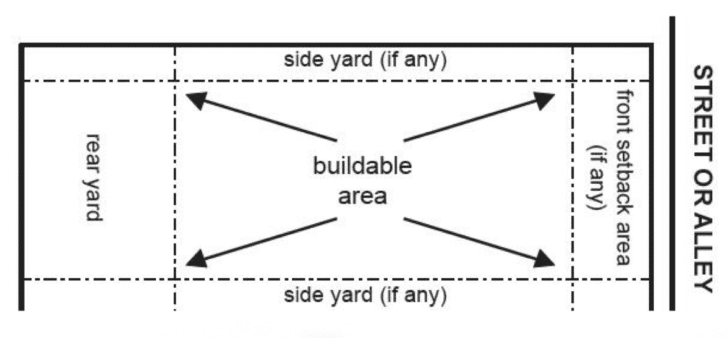
An enclosed front yard requires depth. Based on city codes, you need enough distance between the sidewalk and the front wall of the home to create a usable outdoor space. I’m talking enough space to kick or pass the ball around.
However, in many classic urban neighborhoods, the building comes right up to the sidewalk. Think New York City brownstones, Boston rowhouses, and many older San Francisco blocks. You might get a stoop or a narrow strip of landscaping, but not enough space to create the feeling of a separate front yard.
Most single-family homes in San Francisco have setbacks of between 0 – 10 feet from the sidewalk. A home on a 2,300 sqft lot I sold in 2017 had a gate the opened right out to the sidewalk. It was on a busy street around the corner from one of the busiest streets in San Francisco. Although it had a small backyard, it didn’t feel comfortable raising young children there.
While homes on larger than standard 2,500 lots may have setbacks as deep as 15 feet, which is rare. However, even with a 15 feet deep front yard, that’s not very big.
As land values rise, builders and owners have a strong incentive to push the structure forward and maximize interior square footage. Over time, the market quietly votes against front yard depth, which is why it’s so rare. You need an enormous lot, which is also rare.
Cities Often Discourage Tall Enclosures Facing The Street
Cities like visibility. They want eyes on the street, predictable sightlines, and sidewalks that feel open.
In San Francisco, fences in required front setbacks are generally limited to three feet. Three feet marks territory, but it does not create privacy or the feeling of a protected courtyard.
To get that enclosed feeling, most people want something closer to chest height or preferably higher. That is exactly where the rules tend to bite. You would need a permit to build a fence that’s taller, which is sometimes not approved based on what your neighbor’s have. Further, 75% of the fence needs to be open air.
Your Front Yard Might Not Fully Be Yours
In many cities, the area that feels like your front yard may overlap with required public access zones or even the public right of way (ROW).
In San Francisco, anything that encroaches into sidewalk space can trigger permits and enforcement. Pedestrian standards often expect a continuous clear path, with six feet wide considered desirable and four feet considered the minimum.
This is why people sometimes receive unexpected notices from the city after making improvements they assumed were allowed on their property.
I learned this the hard way during COVID. After building three and a half foot planter boxes in the front yard of my old house with openings in 2015, seven years later, I was either reported or noticed by the city and told to remove them or pay a $3,000 fine.
They looked beautiful and were not on the sidewalk, but on my property. What a crock.
Enclosed Front Yards Create Private Value But Public Friction
An enclosed front yard is like a private outdoor room. The sidewalk is a public corridor. Where the two meet, cities tend to prioritize access and predictability over personal sanctuary.
Enclosures can block sightlines, narrow the effective sidewalk width, and change the feel of a block. One person’s peaceful courtyard is another person’s complaint about a street feeling closed in.
This tension explains why the default setting in many cities is to make enclosed front yards difficult to build. So if you can find a home with one grandfathered in, all the better.
Even Where Front Yards Exist Full Enclosures Are Still Rare
In more spread out cities, front yards are more common. But full enclosures remain the exception. Fence height limits, transparency requirements, and placement rules often prevent turning a front yard into a semi private room.
So rarity is not just about whether a front yard exists. It is about whether you are allowed to enclose it in a meaningful way.
The Practical Takeaway
Before you fall in love with a home’s enclosed front yard potential, check two things carefully: the required front setback and the permitted front fence height. Ask specifically whether the front yard can be enclosed and, if so, how far out the fence can extend. It is not always obvious, and assumptions can be costly.
If a home already has both a gated front yard and an enclosed backyard, especially on a larger lot with a view, you are looking at something extremely rare. Move decisively before others do.
Outdoor space also quietly enhances your quality of life. In spring, summer, and fall, your living space expands outdoors. When it is 75 degrees and sunny, you are not eating lunch inside. You are enjoying peaceful picnics under mature trees in your own cozy private space.
So the next time you are house hunting, pay attention to how few homes offer both an enclosed front yard and an enclosed backyard. If you find one, buy it. When it comes time to sell, that rarity will likely command a meaningful premium over comparable homes without an enclosed front yard.
Readers, do you own a home with an enclosed front yard and backyard? Did you realize just how rare enclosed front yards are in your city? Have you ever deliberately searched for a home with this type of outdoor layout?
Invest In Real Estate Passively
Not everyone can buy a single-family home with an enclosed front yard and backyard, especially in big cities. When one does come on the market, competition is fierce and prices can quickly stretch beyond what feels reasonable.
That does not mean you have to miss out on the feel good wealth effect of real estate.
One way I continue to invest in real estate beyond my own properties is through Fundrise, my preferred private real estate investment platform. Fundrise provides diversified exposure to residential and industrial real estate across the country without the headaches of property management or the stress of local bidding wars.
The platform focuses on assets with scarcity value, constrained supply, and long term durability, the same traits that make enclosed front yard homes so desirable over time. Fundrise is a long-time sponsor of Financial Samurai as our investment philosophies are aligned.


