




The other day I was shopping for a basic pair of running shoes online, and I ended up rage-quitting a site that should’ve been perfect. Not because the products were bad — the catalog was solid — but because everything around the products felt off. Filters didn’t help. The category page was a wall of items with no guidance. Search kept serving me “close enough” results. And the recommendations? Totally random. I bounced in minutes, and I know I’m not the only one who shops like that.
That’s exactly the problem the best e-merchandising software is built to solve, and if you’re on an e-commerce team actively evaluating platforms, you already know what’s at stake. E-commerce is estimated to account for 20.5% of total global retail sales in 2025, which means product discovery isn’t a “nice-to-have” experience layer anymore. It’s a direct revenue lever. When product discovery breaks down, shoppers don’t “figure it out.” They leave. And your team feels it immediately in higher bounce rates, lower conversion, weaker AOV, and less control over what gets surfaced (outside of constant discounting).
I don’t run an e-commerce store myself, but I research software for a living. I went deep into this category. I looked into the tools behind search, category logic, personalization, and onsite campaigns, which decide whether a shopper stays or disappears from your store.
I compared 20+ platforms, read through 1000+ G2 reviews, and looked for the tools that consistently help teams guide shoppers to the right products faster without making the experience feel pushy or robotic.
After all that, I narrowed it down to the five best e-merchandising software: edrone, Luigi’s Box, Salesforce Commerce for B2B, Bloomreach, and Experro.
Best e-merchandising software for 2026: My top 5 picks
- edrone: Best for small e-commerce brands
Quick-to-launch AI product recommendations and automated customer journeys that don’t need heavy dev help. (starts at $50 per month) - Luigi’s Box: Best for intelligent search, product ranking and recommendations
Merchandisable onsite search with synonym management, boosting/burying, and analytics to tune relevance fast. (on request) - Salesforce Commerce for B2B: Best for an enterprise B2B platform
Account-based catalogs and pricing powered by native Salesforce CRM data for truly personalized B2B storefronts.(on request) - Bloomreach: Best for AI-powered personalization
Combines AI-driven discovery with merchandiser controls to personalize search, categories, and recs at scale. (on request) - Experro: Best for mid-sized e-commerce brands
Experience and merchandising layer with a clean dashboard, strong integrations, and high-impact personalization without dev bottlenecks. (on request)
*These e-merchandising software are top-rated in their category, according to the G2 Winter 2026 Grid Report.
The best e-merchandising software with G2 feature ratings
Here’s a quick comparison table showing how each e-merchandising software stacks up on the features that matter most on a daily basis for e-commerce brands, along with their G2 feature ratings.
| Best e-merchandising software | Product recommendations | Product search | Reporting and analytics |
| edrone | 92% | 91% | 92% |
| Luigi’s Box | 97% | 98% | 98% |
| Salesforce Commerce for B2B | 87% | 89% | 95% |
| Bloomreach | 87% | 87% | 91% |
| Experro | 100% | 100% | 100% |
5 best e-merchandising software I recommend
E-merchandising software, in the simplest terms, is the toolkit that helps an online store “arrange the shelves” digitally. I think of them as the brains behind what shoppers see first, what gets recommended next, and how quickly they land on the right product through search, category pages, and personalization.
What makes e-merchandising software the best isn’t just shiny AI features. It’s how well it balances smart automation with real control: strong product search, recommendations that feel helpful (not random), easy product display rules, and analytics that show what’s actually working so teams can keep improving without guesswork.
And the ROI here is pretty convincing. In G2 Data, e-merchandising tools show an average user adoption of 72%, which tells me these platforms tend to stick once teams roll them out. Even better, the estimated ROI payback period averages around 10 months. So for many brands, the lift in conversion and revenue can start covering the cost within the first year.
How did I find and evaluate the best e-merchandising software?
I started with G2’s Grid® Reports to build a shortlist of the top e-merchandising software, using G2 Score, user satisfaction, and market presence to see which tools are actually winning with real e-commerce teams.
Next, I dug into G2 reviews at scale (with a little AI help) to spot the patterns that keep showing up for merchandisers and digital commerce teams: what improves product discovery, which search and recommendation features drive real lift, and where tools fall short once you move past the demo. I paid extra attention to feedback on usability, integrations with e-commerce stacks, and how easy it is to control category pages, promotions, and personalization without leaning on developers.
Since I couldn’t test every platform end-to-end in a live store, I leaned on the people who use these tools every day and validated those takeaways against verified G2 reviews to make sure the wins (and pain points) were consistent.
The screenshots in this article come from G2 vendor profiles and publicly available product documentation.
What makes the best e-merchandising software: My selection criteria
When I evaluate e-merchandising platforms, I’m not just scanning feature lists. I’m looking for the stuff that actually changes how shoppers discover products and how easily your team can steer that experience day to day. Here’s how I distinguished between tools that looked good in theory and the best e-merchandising software in practice.
- Search relevance you can merchandise: Search is where high-intent buyers go, so I need to see strong core relevance (typo tolerance, synonyms, NLP/semantic matching) plus controls like boosting, burying, pinning, and rules. If your team can’t shape search results, you’re basically letting an algorithm run your store.
- Recommendations that blend AI + rules: Pure AI recommendations can be great until they aren’t. I prioritize tools that let you combine behavior-based personalization with merchandiser logic like pushing high-margin items, in-stock alternatives, seasonal sets, or bundles. Best-in-class recommendations feel helpful to shoppers and strategic to the business.
- Category (PLP) and product (PDP) display control: This is your digital shelf. I look for flexible sorting, dynamic rankings, badges, pin-to-top, curated collections, and easy campaign rollouts without dev tickets. The best tools let merchandisers move fast while keeping the browsing experience clean and intentional.
- Experimentation and A/B testing baked in: If a platform can’t prove impact, it’s hard to justify long-term. I want native A/B or multivariate testing for search rules, rec placements, banners, and category logic.
- Analytics that connect actions to revenue: Dashboards are nice, but I’m looking for decision analytics, including zero-result queries, top-converting terms, click-through rates by placement, rec performance, category funnel drop-offs, and revenue lift from specific merchandising changes. Otherwise, you’re optimizing blind.
- Customer data and segmentation depth: Personalization lives or dies on data. I favor tools that ingest behavior, purchase history, and context (device, location, traffic source) and let you build segments like high-intent first-timers or repeat buyers browsing new arrivals. The more precise the audience logic, the better the merchandising gets.
- Integrations with your commerce stack: Even a brilliant tool falls apart if it can’t plug into your ecosystem. I checked for integrations with major ecommerce platforms, CDPs/CRMs, analytics, and marketing tools, plus solid APIs/webhooks. Bonus points if the setup doesn’t require a small engineering army.
No single platform is perfect across every criterion. But every tool I’ve listed excels where it matters most, whether that’s search, recommendations, merchandising control, or analytics, so you can pick the best fit for your store’s priorities.
The list below contains genuine user reviews from the eDiscovery software category. To be included in this category, a solution must:
- Collect data on customers for future alignment of products/services to customer preferences
- Apply real-time data to recommend other purchases complementary to the current product the buyer is perusing
- Have a functional search bar/option
- Facilitate collaboration between different departments or teams within the e-commerce business
- Integrate with payment gateways
*This data was pulled from G2 in 2025. Some reviews may have been edited for clarity.
1. edrone: Best for small e-commerce brands
G2 rating: 4.8/5 ⭐
From what I learned about edrone, it is one of the top e-commerce CRM and marketing automation platforms with built-in product recommendation and personalization features that support e-merchandising goals. At its core, it helps you personalize what customers see and when they see it with smarter automations.
After looking at the G2 Data, I’d say edrone is a strong choice for brands that want e-merchandising plus lifecycle marketing in one stack. It checks the key boxes that matter most for merchandising: behavioral data collection + customer intelligence for aligning product experiences to preferences, AI product recommendations based on browsing + purchase behavior (classic merchandising lever).
It also has on-site personalization layers/pop-ups and dynamic content that influence what shoppers see and buy.
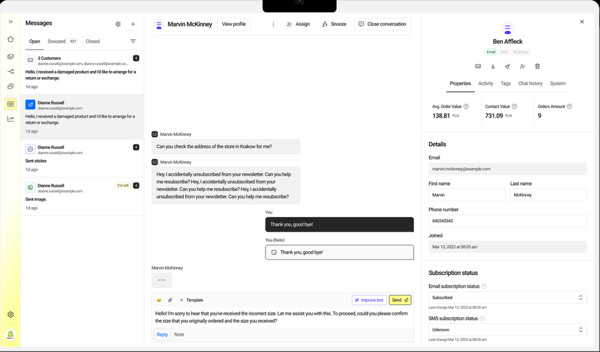
Analysing the G2 review data, I saw satisfaction scores are strong across the board. The quality of support for edrone sits around 99%, and the ease of doing business is near 96%, which aligns with reviewers calling out responsive support and a tool that does what’s required without fuss.
Feature-wise, dashboard (94%), integrations (93%), and product recommendations (92%) are the standout strengths, so it’s not surprising that most adopters come from high-volume retail sectors like apparel and fashion, and retail. In plain terms, teams like that it’s easy to set up, easy to run, and good at driving personalized product suggestions with minimal overhead.
edrone is a feature-rich platform, so teams get a lot of flexibility once they’re in it. A few G2 reviewers hinted that because there’s so much you can customize, it’s worth planning a little onboarding time to feel fully at home. The good news is that the training videos make that ramp-up very manageable.
Along the same lines, if you want to unlock every advanced capability from the start, expect to spend some focused setup time up front so everything matches your workflows; after that, users say it runs smoothly day to day. And for brands maintaining a very large email database with highly specific segmentation filters, looping in edrone’s help desk is a smart way to get those segments dialed in quickly and correctly.
Overall, edrone earns its place on my list of the best e-merchandising software. If you’re a small to mid-market retail or DTC team that wants AI merch recommendations plus automated lifecycle campaigns (welcome, cart recovery, win-back) from a single unified data platform, consider edrone.
What I like about edrone:
- Users consistently call out edrone’s support and guidance as a real differentiator, especially during onboarding and ongoing optimization.
- Reviewers love how quickly they can launch personalized recommendations and campaigns without heavy dev reliance, and see it become part of daily merchandising work.
What G2 users like about edrone:
“Firstly, it’s extremely important to mention how professional and friendly the staff treats you. I must confess that I’ve never experienced such good communication. If there is a lack of this crucial aspect, everything falls apart, but not here, of course. The platform offers a comprehensive suite of tools that make it incredibly easy to manage customer relationships and marketing campaigns. Edrone’s automation capabilities allow for personalized, real-time interactions with customers, which greatly enhance engagement and conversion rates.”
– edrone review, Agata T.
What I dislike about edrone:
- According to G2 reviews I read, edrone offers a lot of depth, so teams who want to use every advanced feature right away might consider setting aside some onboarding time and leaning on the training videos to get fully comfortable.
- Users on G2 note that for brands running very large email databases with ultra-specific segmentation filters, it’s helpful to plan on partnering with edrone’s help desk to fine-tune those segments and keep everything running cleanly at scale.
What G2 users like about edrone:
“So far, I haven’t encountered any significant issues. If I had to mention something, it would be that the initial setup requires a bit of time and effort to fully utilize all of its advanced features. However, once everything is in place, the platform works flawlessly.”
– edrone review, Marchin C.
2. Luigi’s Box: Best for intelligent search, product ranking and recommendations
G2 rating: 4.8/5 ⭐
After digging into Luigi’s Box, I’d describe it as a merch-first product discovery suite for e-commerce: it upgrades your onsite search, category/product listing pages, and AI recommendations so shoppers find the right items faster and you can actively steer what they see.
What stood out to me is how much it leans into classic e-merchandising levers like learning-to-rank, dynamic filters/facets, pin-to-position boosts, banners in search, and personalized rankings, not just better search results.
From what I researched, Luigi’s Box also covers the operational side well. You get query-level analytics to see what customers are actually searching for (and where they’re getting stuck), zero-results tracking, synonym and typo management, and rule-based merchandising layered on top of AI-driven relevance.
On the recommendations side, I like that Luigi’s Box supports use-case-specific widgets like similar products, complementary items, and trending or best-selling blocks that can be deployed across PDPs, PLPs, and search.
It’s also designed to plug into common store stacks (Shopify app plus integrations for platforms like Magento/Shopware/etc), and they push a pretty approachable self-service setup if you don’t want a heavy IT project.
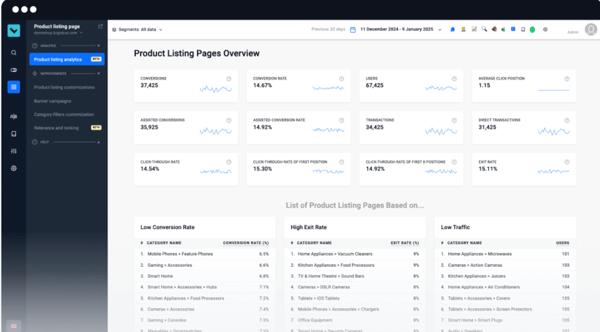
On G2, Luigi’s Box scores really high on the fundamentals that matter for this category: quality of support is around 98%, ease of use is about 95%, and ease of setup is 96%.
The highest-rated capabilities are exactly what I want to see in the best e-merchandising software contender: reports and analytics (98%), product search (98%), and product recommendations (97%).
Reviews I read back that up with very specific wins: users like being able to see what customers are searching for, add synonyms or boost certain products, and quickly improve relevance without rebuilding their whole search stack.
I also saw lots of praise for how smoothly it runs in the background once implemented, and how the recommendations feel practical rather than gimmicky.
Because Luigi’s Box is fairly powerful, teams that want to use every advanced control from day one may want to plan a thoughtful rollout. A few reviewers on G2 mentioned that initial installation and configuration go fastest when you lean on Luigi’s Box support or documentation.
And if you’re a smaller shop or working with a tight budget, you’ll want to weigh the platform’s more pricing against the uplift you expect; multiple reviewers framed the cost as paying for top-notch search and recommendations that deliver, especially if you’re integrating via API or managing more complex feeds.
Overall, Luigi’s Box does the hard stuff exceptionally well: search that converts, recommendations that guide discovery, and analytics that let you keep tuning the experience as shopper behavior shifts.
If you’re a mid-market or enterprise retailer (or a fast-growing store) that cares deeply about search-led revenue and wants serious merchandising control without heavy engineering drag, Luigi’s Box is worth looking at.
- Reviewers consistently love how much search relevance improves, especially with tools like synonyms, boosting, and ranking controls that help shoppers find the right products fast.
- Users also highlight the clarity of the analytics and reporting, saying it gives merchandisers real insight into what people search for and what drives clicks and conversions.
What G2 users like about Luigi’s Box:
“We use Luigi’s Box for our Shoptet e-shop and immediately noticed better search relevance and product recommendations. The integration was easy and the support team is excellent. They helped us fine-tune the setup and guided us during the test period. The dashboard is intuitive and gives a clear overview of search stats and customer behavior.”
– Luigi’s Box review, Jiri K.
What I dislike about Luigi’s Box:
- From the G2 reviews I saw that Luigi’s Box is pretty robust, so teams who want to light up every advanced control on day one might consider planning a thoughtful setup phase and leaning on documentation or support to get everything dialed in.
- A few G2 reviewers note that because it’s a premium-grade search and discovery platform, teams with tighter budgets might want to weigh the investment against expected uplift, especially if they’re earlier-stage or running a smaller catalog.
What G2 users dislike about Luigi’s Box:
“Can get pricey for small shops. It’s worth the money for larger stores, but smaller businesses might find it a bit expensive depending on the features used.”
– Luigi’s Box review, Lauma M.
3. Salesforce Commerce for B2B: Best for an enterprise-level B2B platform
G2 rating: 4.4/5 ⭐
After researching Salesforce Commerce for B2B, my take is that it’s a heavyweight, enterprise B2B e-commerce engine built for manufacturers, distributors, and wholesalers who need way more than a simple online store. The big idea is: your storefront is account-aware, so each customer can log in and see their specific catalog, negotiated prices, contract terms, and promotions, instead of a one-size-fits-all B2C retail experience.
When I think about e-merchandising here, it’s less about adding a widget and more about running the entire B2B commerce engine from the same place where accounts, pricing, orders, and relationships are managed.
It’s built for companies with complex catalogs and customer-specific pricing, and it lets you shape what each buyer sees through personalization, product display logic, and CRM-driven recommendations.
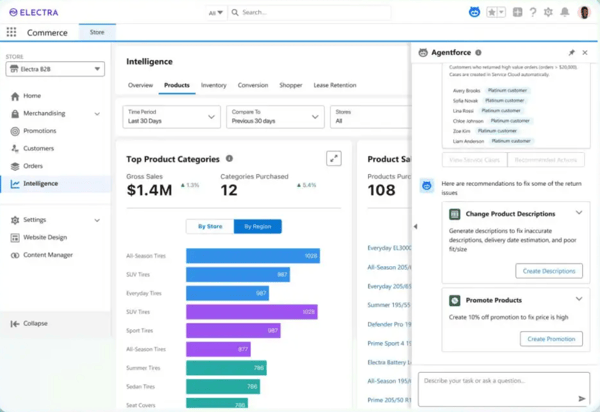
What I saw repeated across docs is how well it handles messy B2B realities like bulk/repeat ordering, CSV uploads, PO-based checkout, multiple ship-tos, and role-based buying/approvals, and then ties all of that back into Salesforce CRM so reps can jump in on carts, quotes, and orders when needed.
On G2, the satisfaction picture is steady and very enterprise-leaning: quality of support sits around 95%, ease of use near 91%, ease of admin around 95%, and ease of doing business with close to 98%.
The highest-rated capabilities are the ones I’d hope to see for B2B merchandising: reports & analytics (95%), dashboarding (93%), and customer data (92%). In the reviews, users keep coming back to the same wins: reliable scalability, deep CRM integration, strong customization, and an interface that helps them organize workflows and manage accounts without hopping between systems.
A few even describe real growth impact once the commerce experience is tuned to how their buyers actually reorder, compare, and negotiate.
Because it’s so feature-dense, teams that want to unlock every advanced workflow right away may want to plan for a thoughtful setup and learning phase. Reviewers on G2 frame it as powerful enough to match very specific business needs, and that power pays off most when implementation is done with care.
Along the same lines, if you’re aiming for a heavily customized build or lots of integrations, it’s smart to budget for that investment up front; users note that the platform shines for larger, complex B2B motions where the ROI justifies the depth.
All things considered, Salesforce Commerce for B2B earns a spot among the best e-merchandising software when your store lives and dies on account-based pricing, personalized catalogs, and tight CRM alignment. If you’re a mid-to-large B2B org already in Salesforce and you want merchandising, ordering, and customer data to run as one connected system, this is a pick that fits like a glove.
What I like about Salesforce Commerce for B2B:
- Reviewers love how tightly it connects with the broader Salesforce ecosystem, making it easy to manage accounts, pricing, orders, and merchandising in one unified workflow.
- Users also call out its scalability and customization for complex B2B catalogs, especially when they need buyer-specific experiences and pricing logic.
What G2 users like about Salesforce Commerce for B2B:
“Salesforce Commerce B2B gives us a reliable way to handle complex product catalogue pricing and customer accounts. The ability to personalize the buying experience for different clients is a big plus. I also like how the dashboard provides visibility into orders and performance. It is easy to implement.”
– Salesforce Commerce for B2B review, Verified user in information technology and services.
What I dislike about Salesforce Commerce for B2B:
- The platform is impressively deep, so teams who want to activate every advanced workflow right away might consider planning a structured rollout and training window to get the most out of that flexibility.
- Because it supports highly tailored B2B builds, teams aiming for lots of custom integrations or unique storefront logic may want to consider budgeting for a more hands-on implementation to match their exact commerce setup.
What G2 users dislike about Salesforce Commerce for B2B:
“The initial setup and configuration can be quite complex, requiring experienced Salesforce developers. Licensing and implementation costs are also high, which can be challenging for smaller organizations.”
– Salesforce Commerce for B2B review, Shovon M.
Explore the best catalog management software on G2 that helps you organize and consolidate all your e-commerce product data into a single, digital point of reference for both merchant and buyer.
4. Bloomreach: Best for AI-powered personalization
G2 rating: 4.6/5 ⭐
Bloomreach is the e-merchandising platform I think of when a brand wants the “brain” of the store to get smarter over time. It sits on top of your catalog and customer behavior to power personalized search, recommendations, and category experiences, so shoppers get nudged toward the right products without you hand-curating every aisle. In simple terms, it helps you make product discovery feel less like scrolling and more like being guided.
The part that matters most for e-merchandising is Bloomreach Discovery: it gives you AI-powered site search, category/PLP merchandising controls, and real-time product recommendations that learn from what shoppers click, buy, and ignore.
What stood out to me is that you can let the AI handle relevance and personalization but still keep merch control like slot/placement rules, boosting strategic items (new arrivals, high-margin, high-inventory), and balancing business goals against pure personalization.
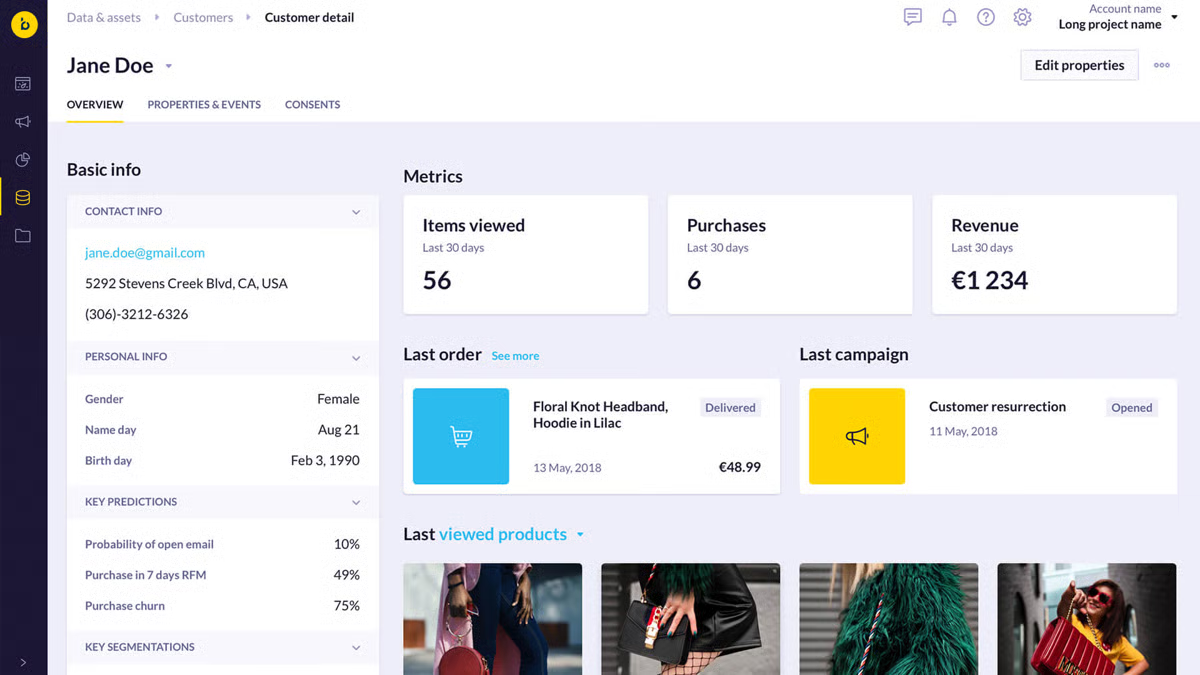
G2 Data lines up with that story: users rate Bloomreach highly for quality of support (about 94%) and meeting requirements (around 93%), and they call out strong day-to-day value once it’s in motion. The features people rave about most are the ones that matter for merchandising at scale: dashboards (93%), reports and analytics (91%), and customer data capabilities (90%).
And reviews repeatedly point to a nice mix of AI-driven personalization plus rule-based control. I saw a strong theme around helping teams surface the right products faster, especially in feedback from retail and apparel teams. There was also consistent praise for the platform’s stability and for how its insights translate into real, actionable campaign decisions.
Because Bloomreach gives you a lot of power, teams who want to tap every advanced feature early may want to plan a thoughtful onboarding runway. Reviewers describe the platform as rewarding once you learn the deeper capabilities, so leaning on tutorials, docs, or a guided enablement path can help you get to full speed faster.
I also noticed a few users wishing for even more depth and flexibility in reporting, so if your team lives in highly custom dashboards or wants very granular breakdowns out of the gate, it’s worth planning how Bloomreach’s reports fit into your broader analytics rhythm.
On the whole, I’d recommend Bloomreach if you want a more enterprise-leaning, AI-heavy merchandising and discovery platform that still lets merchandisers steer outcomes.
What I like about Bloomreach:
- Reviewers consistently highlight how well Bloomreach personalizes search, recommendations, and category experiences, helping shoppers find the right products faster with less manual merchandising.
- Users also like the way customer data and dashboards translate into practical merchandising decisions, especially for retail and apparel teams running lots of campaigns.
What G2 users like about Bloomreach:
“I like the sophistication and level of personalization you can reach with the engagement side of the platform and the discovery side, optimizing the web experience for your visitors and customers.”
– Bloomreach review, Katherine C.
What I dislike about Bloomreach:
- Users on G2 note that Bloomreach is built for depth, so teams who want to activate every advanced capability early might consider planning a thoughtful onboarding ramp to really unlock the platform’s full range.
- Reviewers observe that the reporting is solid for most day-to-day needs, and teams wanting even more granular or highly custom reports might consider pairing Bloomreach insights with their broader analytics setup.
What G2 users dislike about Bloomreach:
“While the documentation is extensive, the initial complexity of custom template language and integration hooks often requires expensive technical resources or consulting partners. This is not a platform for self-starters; it demands a significant, expert-level investment upfront to unlock its full potential, which can inflate the total time and cost of ownership.”
– Bloomreach review, Vishal J.
5. Experro: Best for mid-sized e-commerce brands
G2 rating: 4.9/5 ⭐
After researching Experro, I’d sum it up as an AI-first e-merchandising and product discovery layer that’s trying to make search and browsing feel self-optimizing.
Their core pitch is “Gen AI across discovery.” That means you get Gen AI Search, AI-personalized category/product listing page (PLP) browsing, and AI recommendations in one suite, so the products shoppers see (and the order they see them in) adapt to real intent and behavior instead of static rules.
What stood out to me is the merchandising angle: they emphasize visual and AI merchandising controls, smart and dynamic collections, and automated bundling or recommendation blocks to lift conversion and AOV without merch teams having to hand-tune everything daily.
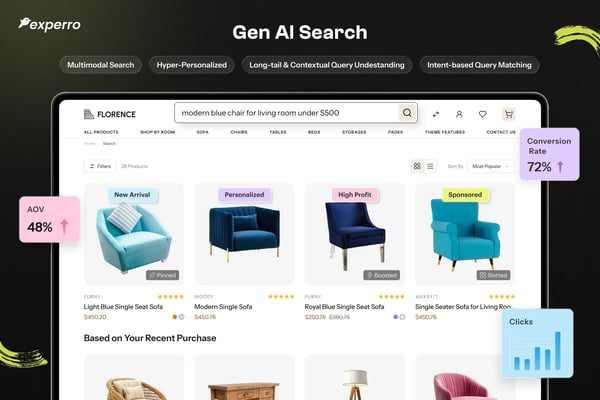
G2 Data for Experro is almost a highlight reel: quality of support and meets requirements are both at 100%, ease of use sits around 99%, and ease of setup is also about 99%.
The top-rated capabilities, dashboard, integrations, and customer data, are all at 100%, which lines up with what reviewers say they value most: a clean, non-overwhelming dashboard, recommendations that feel genuinely relevant, and a strong data foundation to personalize experiences confidently.
I also like how Experro handles cross-page merchandising execution. Features like reusable content blocks, API-first integrations, and campaign-level controls make it easier to roll out AI-driven discovery changes consistently across the storefront without rebuilding layouts or logic every time.
Multiple users also call out how much time they save once workflows are in place, especially when they’re running lots of campaigns or storefront updates across teams.
Because Experro offers a pretty deep set of cross-platform and advanced configuration options, teams who want to take advantage of every sophisticated feature early might consider planning a bit of enablement time around setup.
A couple reviewers specifically wished for more detailed documentation and extra how-to guidance for advanced or cross-platform use cases. Teams that are already comfortable with the platform describe the experience as smooth and the performance as exactly what they were aiming for.
Overall, I’d put Experro on the shortlist for teams that want advanced personalization without sacrificing usability or operational control. Its combination of AI-driven discovery, centralized merchandising workflows, and standout support makes it especially appealing for retail and ecommerce teams trying to move faster without dev bottlenecks.
What I like about Experro:
- Reviewers consistently highlight how easy Experro feels to use day to day, especially the clean dashboard and the way it helps teams launch personalized experiences without extra friction.
- Users also praise the quality of support and the results they see from customer-data-driven recommendations and storefront personalization.
What G2 users like about Experro:
“Experro gives us insights we never had before. We can easily track which products are trending, which keywords are gaining traction, and where customers drop off. The reports are simple to understand, easy to share, and integrate smoothly with our existing tools.
The setup process was easy and straightforward, and our team quickly got the hang of it. We now use Experro regularly to monitor performance and uncover new opportunities. The platform offers an impressive range of features that make analyzing data effortless, and the support team has been consistently reliable whenever we reach out. Overall, it’s become an essential part of how we understand and act on our e-commerce insights..”
– Experro review, Verified user in apparel and fashion business.
What I dislike about Experro:
- Some users on G2 note that Experro is feature-rich, so teams wanting to tap into advanced or cross-platform setups early might consider setting aside a little enablement time to explore everything it can do.
- A few G2 reviewers observe that teams who like extra step-by-step documentation or more guided “how-to” paths might consider leaning on Experro’s team to accelerate that learning curve.
What G2 users like about Experro:
“Some detailed documentation on cross-platform configurations would help during setup.”
– Experro review, Verified user in information technology and services.
Other best e-merchandising software
Here are five more e-merchandising tools worth a look based on my evaluations:
- Athos Commerce: best for retailers that want an all-in-one search, merchandising, and personalization suite built for ecommerce.
- Salesforce Commerce for B2C: best for enterprise B2C brands on Salesforce that need scalable omnichannel commerce with strong personalization.
- Algolia: best for teams that want lightning-fast, developer-friendly onsite search with deep relevance tuning.
- Constructor: best for enterprise ecommerce focused on AI-native product discovery across search, browse, and recommendations.
- Tagalys: best for Shopify fashion/lifestyle brands that want visual merchandising control over collections, search, and recommendations.

Best e-merchandising software: Frequently asked questions (FAQs)
Got more questions? G2 has the answers!
Q1. What are the best platforms for automating merchandising strategies?
Products like edrone, Tagalys, Constructor, and Luigi’s Box are the best for automating merchandising strategies based on G2 reviews. Users highlight their AI- and rules-driven ranking, automated recommendations, and low manual effort to keep catalogs optimized.
Read G2 community discussion on best e-merchandising platforms with automations for more insights.
Q2. What are the best tools for combining merchandising with personalization?
The best tools for combining merchandising with personalization are Bloomreach, Constructor, Experro, and Athos Commerce, based on G2 feedback. Reviewers emphasize real-time behavioral targeting, adaptive sorting, and personalized search and PLP experiences.
Read G2 community discussion on the best e-merchandising tool for personalization for more information.
Q3. What are the best tools for merchandising analytics and performance tracking?
Products like Luigi’s Box, Tagalys, Athos Commerce, and Bloomreach are the best for merchandising analytics on G2. Customers call out strong dashboards for search insights, category performance, recommendation impact, and conversion lift tracking. These e-merchanding tools can be paired with other analytics platforms, too, for further insights.
See G2 discussion on the best e-merchandising tools for analytics for more information.
Q4. What are the top e-merchandising platforms for multi-channel retail?
Products like edrone, Bloomreach, Salesforce Commerce (B2B/B2C), and Athos Commerce are top e-merchandising platforms for multi-channel retail options along with core ecommerce platforms like Shopify, and BigCommerce, based on G2 reviews. Users like that these platforms coordinate onsite merchandising with broader commerce, CRM, and lifecycle touchpoints.
Find more about the best e-merchandising platforms for multi-channel retail in this G2 discussion.
Q5. What are the top tools for managing online product displays?
Tagalys, Luigi’s Box, Constructor, edrone and Bloomreach are the top tools for managing online product displays according to G2 users. Reviews point to visual merchandising, boosting/burying, pinning, and smart PLP sorting controls.
See G2 discussion on the same for more details.
Q6. What are the top-rated e-merchandising platforms for large retailers?
Products like Bloomreach, Constructor, Salesforce Commerce for B2C, and Algolia are top-rated for large retailers based on G2 reviews. Enterprise teams cite scalability, deep relevance tuning, advanced discovery, and strong customization.
Q7. Which e-merchandising software offers drag-and-drop editing?
Products like Tagalys and Bloomreach Discovery are the best drag-and-drop style merchandising tools on G2. Reviewers mention visual workflows for arranging collections, slots, and rules without heavy developer involvement.
Q8. Which e-merchandising tool offers AI-driven product sorting?
Products like Tagalys, Constructor, Experro, and Luigi’s Box are the best for AI-driven product sorting based on G2 reviews. Users highlight machine-learned ranking that adjusts to shopper intent, conversions, and business goals.
Q9. Which is the best e-merchandising platform for online retailers?
Products like edrone, Luigi’s Box, Bloomreach, and Tagalys are the best overall for online retailers per G2 reviewers. edrone stands out for unified CRM-plus-merchandising, while Luigi’s Box and Tagalys lead on ease of use and merchandising control.
Q10. Which platform is best for seasonal merchandising campaigns?
Products like Tagalys, Bloomreach, Salesforce Commerce for B2C, and Athos Commerce are best for seasonal merchandising on G2. Users say these tools make it fast to boost seasonal collections, rerank PLPs, and personalize promo experiences.
Merch magic, sorted
If there’s one takeaway I hope you leave with, it’s this: e-merchandising isn’t about making a site look nice. It’s the quiet engine that turns browsing into buying. The best teams don’t treat merchandising like a seasonal to-do list; they treat it like a living system, one that learns from every search, click, filter, and abandon.
When you get that system right, you’re not just boosting a few products; you’re removing friction, building trust, and guiding shoppers in ways that feel natural, not forced.
Great e-merchandising is basically customer empathy at scale. You’re using signals (intent, context, behavior) to answer the shopper’s unspoken question: “What should I look at next?” And when your store can answer that well, you don’t just win a conversion; you win repeat visits, higher AOV, and a brand experience that feels like it truly gets people. That’s the real compounding effect.
If you want to keep exploring tools and real-user insights in this space, head over to G2’s multichannel retail category to compare options side-by-side.


