Notice: Function _load_textdomain_just_in_time was called incorrectly. Translation loading for the td-cloud-library domain was triggered too early. This is usually an indicator for some code in the plugin or theme running too early. Translations should be loaded at the init action or later. Please see Debugging in WordPress for more information. (This message was added in version 6.7.0.) in /home/releande/public_html/wp-includes/functions.php on line 6170 News Magazine | Get The Most Freshy News Every Day | Page 18
Seattle police detectives are investigating a suspected homicide in the Georgetown neighborhood this afternoon.
At about 11:30 a.m., patrol officers responded to a report of a body in a tent encampment in the 1000 block of South Bailey Street. There, they found a man with apparent fatal injuries.
The Seattle Fire Department arrived and pronounced the victim deceased.
Officers cordoned off the area until detectives with the Homicide and Crime Scene Investigation Units arrived to process the scene. The King County Medical Examiner will take custody of the deceased and determine the cause and manner of death.
The circumstances are under investigation. There is no suspect information at this time and police did not make any arrests.
Anyone with information is asked to call the violent crimes Tip Line at 206-233-5000. Anonymous tips are accepted.
Incident Number: 2026-75681
Seattle police officers tape off the scene of a suspected homicide in the Georgetown neighborhood.
Kathrynne surprised us with a few visits the past week and I wish you could hear the squeals coming from Kierstyn and Micah when they see her. This is what a 17-year age gap looks like. 😍
If you’re struggling to come up with budget-friendly meals that the whole family will love, utilize this list of 70 dinner ideas under $10! If you’re willing to get creative, there are dozens of frugal dinner ideas that will keep your family (and your wallet) full!
Here are 70 other easy dinner ideas your family will love — all for under $10.
If your goal as a parent is to raise kids who always make the right choices and decisions, you are probably going to find yourself often frustrated and stressed because your kids aren’t turning out as perfect as you’d envisioned.
But if, instead, you see your goal as a parent to point your kids to Jesus, then mistakes are opportunities to have great conversations, love your kids right where they are at, walk with them well, and extend the same grace and patience that God shows us. Parenting isn’t ultimately about the results (because we can’t save or change our kids’ hearts); it’s about our faithfulness.
Jesus came to take the heavy and impossible burden of perfection off our shoulders as moms. We will never get it all right or do it all right (and neither will our kids!), but that’s the whole reason we have Jesus! We can look to Him, rest in Him, and put our hope in Him — even on the hard days and the days when we make mistakes and mess up, yet again. I’m so thankful for His grace!
If you have experienced any sort of disappointment or loss or challenges in your life recently — or you know someone who has, please watch this interview with @courtneyprayduke!! Trust me, it will be well worth your time.
He gave her the courage and strength to get up and to keep choosing to live — to put one foot in front of the other, to preach the truth of Who He is in the darkest valley, and to let other people care for and carry her.
It’s baseball season again! I LOVE the hours and hours we spend outside watching Silas… it’s my spring and summer hobby!
Happy World Down Syndrome Day to the boy who has wrecked our world in the most beautiful of ways. We will never be the same because of you, David! 😍
I look back on these past five years we’ve been privileged to love you and think about how I’m such a different person because of getting to be your mama.
You’ve taught me that there is so much we prioritize and chase after and stress about in this life that really doesn’t matter.
You’ve helped me to slow down and learn to notice and appreciate so many tiny things I used to rush right past.
You’ve opened up my eyes to a whole world of incredible people and families I never world have gotten to know — I now excitedly go out of my way to meet anyone who has disabilities or has a child or family member with disabilities! I didn’t know I was going to get to join such an incredible club of #theluckyfew!
You and your mama have changed my viewpoint on so many things and given me a deep well of compassion and advocacy for those who are overlooked or marginalized.
You’ve taught me that you don’t need words to communicate and express love.
And most of all, you’ve helped me get to discover what radical reliance on Jesus looks like. I’ve gotten so many opportunities to see His faithfulness in miraculous ways as we’ve navigated all sorts of challenges and unexpected emergencies the last five years. I could literally write a book on the crazy amazing stories of God’s goodness. And it’s caused me to have so much more calmness and deeper trust because I’ve gotten to see firsthand just how faithful God is… and I believe with all my heart that He will continue to be faithful – no matter what! ❤️
We love you our sweet David Mateo Paine!
I’ve been testing out Walmart dresses to see if I can find the perfect Easter dress… and we found 20 options all under $25! You can see a video of some of the dresses here.
In Case You Missed It – Posts From This Week
Best Christian Books and Devotionals for Teens — The teenager years can be a lot, but they’re also some of the most spiritually significant years a person will ever walk through. That’s why I’m so excited to share these recommendations for books to encourage your teen’s faith.
Easter Basket Ideas for Teens — Are you stumped about what to put in your teen’s Easter basket? I know the feeling! Check out this list of recommendations, complete with ideas for both guys and girls.
Homemade Chipotle Chicken Bowls ($10 Family Dinner Idea) — These customizable rice bowls are a family-favorite that comes together in minutes — no trip to Chipotle needed!
Best Devotionals and Christian Books for Kids — I often get asked for recommendations of devotionals to do with kids and I finally put together a post with my top recommendations!
Curious What My Week Actually Looks Like?
Get a behind-the-scenes peek at what I’m reading, loving, and learning — plus subscriber-only recommendations you won’t find anywhere else.
This website may contain affiliate links and advertising so that we can provide recipes to you. Read my disclosure policy.
Meet Stracotto, the Italian pot roast you didn’t know you were missing! A seared roast is slowly braised in a rich, hearty tomato sauce until it is melt-in-your-mouth tender. The sauce alone is worth making this recipe for!
Reasons This Recipe Is a 10/10
Fall-Apart Tender Beef: The roast slowly braises in the oven until it’s ultra tender and packed with rich flavor.
A Sauce With Incredible Depth: The tomato-based sauce simmers for hours, developing bold, savory flavor that’s perfect for spooning over pasta, mashed potatoes, or creamy polenta.
Even Better the Next Day: The leftovers are just as delicious! My family happily sopped up the extra sauce with buttered, crusty bread, which might have been my favorite part.
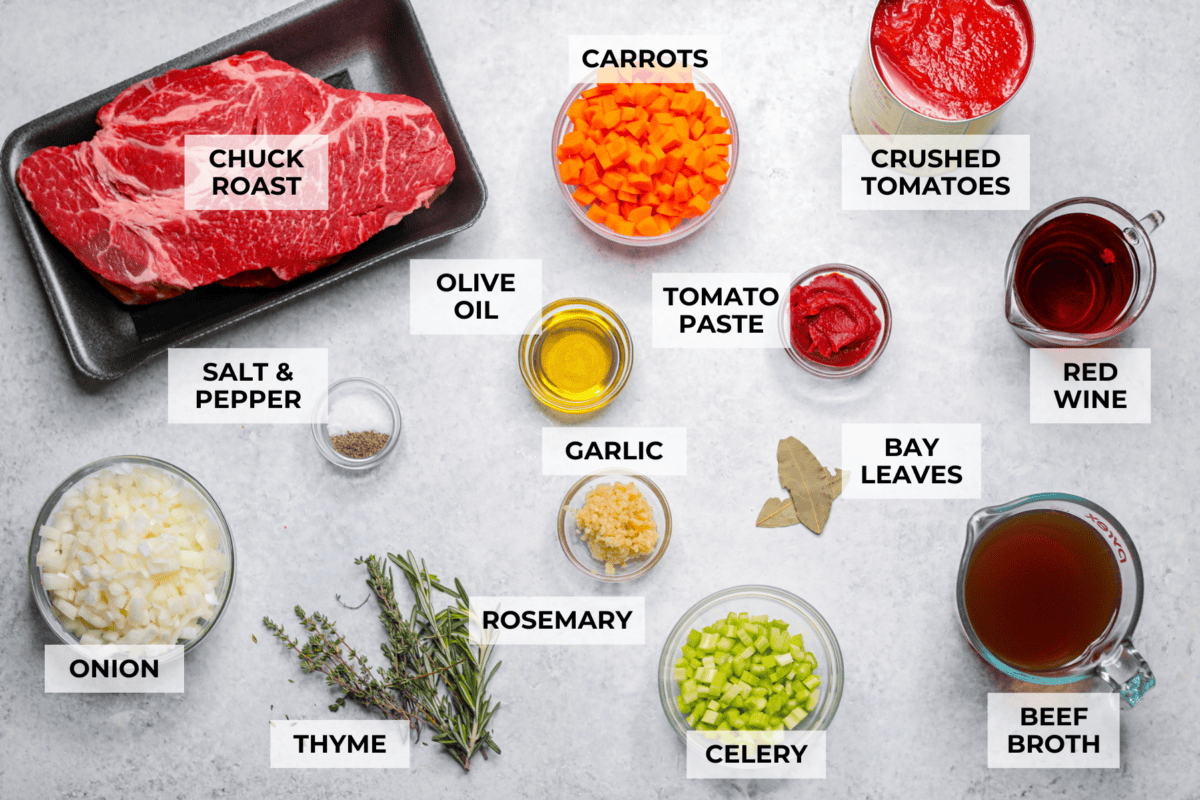
Ingredients for Italian Pot Roast
Choose the Right Cut of Beef: I used a chuck roast, but a round roast or brisket (with most of the fat cap trimmed) works great too.
Wine Substitutions: If you’d rather skip the wine, swap in beef broth or apple juice. Add 1–2 tablespoons of apple cider vinegar or 1 tablespoon of balsamic vinegar to give the sauce a touch of acidity.
How to Make Stracotto
If your go-to comfort food is a classic pot roast like my Mississippi version, you’re going to love this Italian twist. It’s easy to prepare, and while it simmers low and slow in the oven, the flavorful sauce and juicy beef make every minute worth the wait.
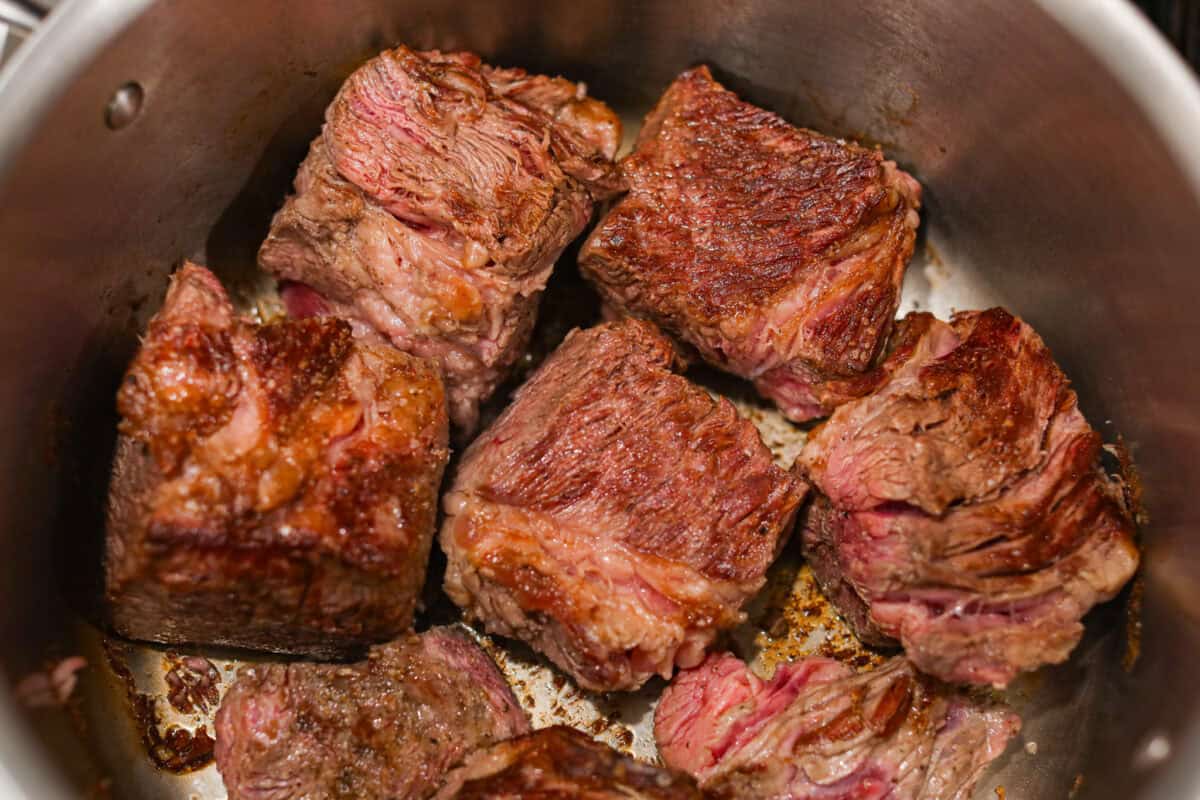
Sear the Beef: Preheat the oven to 350ºF. Cut the roast into a few smaller pieces, pat dry with paper towels, and season all sides of the beef with salt and pepper. Heat a large, oven-safe pot or large Dutch oven over medium-high heat. Add the beef to the pot and sear on all sides for 3-4 minutes per side, until a deep crust forms. Remove to a plate and set aside.
Cook Vegetables: Lower the heat to medium and add the olive oil, onion, carrots, and celery to the pot. Cook for 3 minutes. Add garlic and cook for another minute.
Wine: Add the wine and use a wooden spoon to scrape any browned bits up from the bottom of the pan.
Broth: Stir in the beef broth.
Add Herbs & Tomatoes: Stir in tomato paste, tomatoes, bay leaves, thyme, rosemary, and salt and pepper to taste.
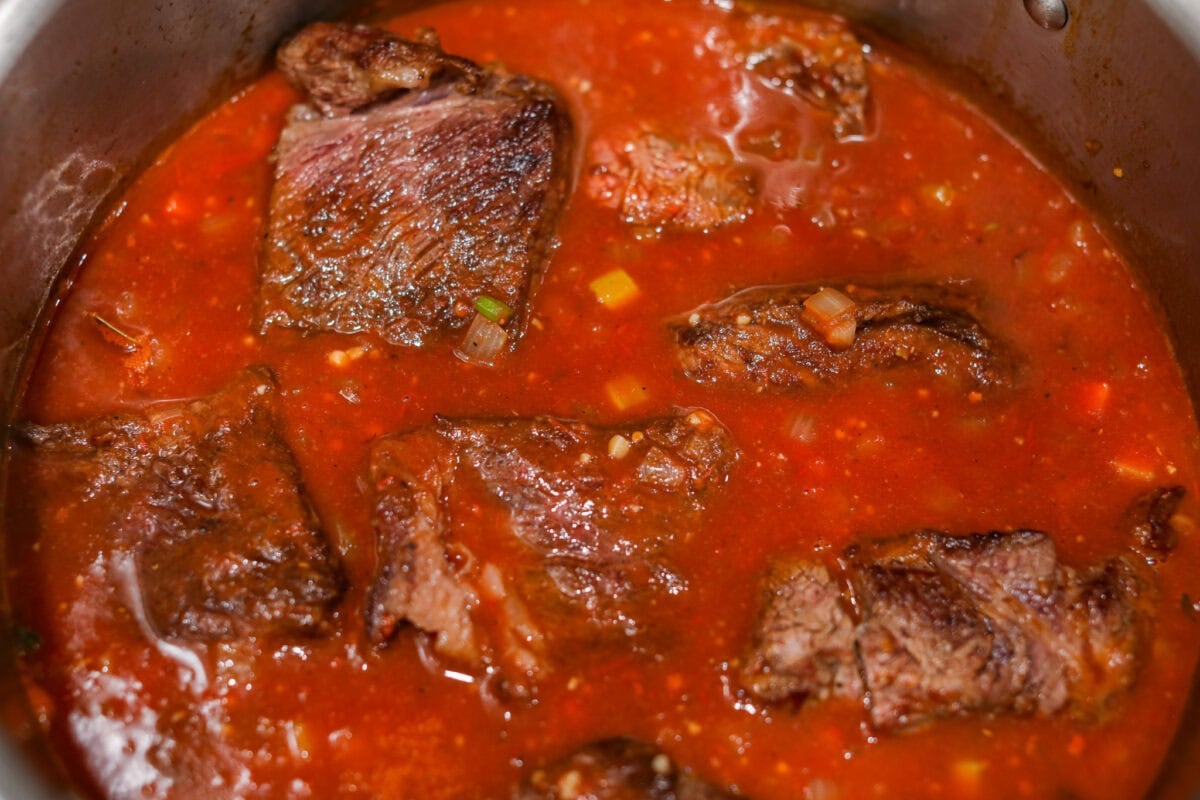
Roast: Add the beef back to the pot, then place the lid on and transfer it to the oven. Bake for 3 ½-5 hours, until the beef is easily shredded with two forks. Discard the bay leaves and herb stems before serving Italian Pot Roast.
Alyssa’s Pro Tip
Save Time on Veggies: For quicker prep, toss the onions, celery, and carrots into a food processor and pulse until roughly chopped. You’ll get perfectly sized pieces without the extra chopping.
Other Italian Pot Roast Cooking Methods
Slow Cooker Instructions:
Combine everything except the beef in a large 6 or 7-quart slow-cooker. Brown the beef as directed in the recipe card, then add it to the slow cooker. Cover and cook on LOW for 8-10 hours, or on HIGH for 4-6 hours.
Stovetop Instructions:
Instead of transferring the pot to the oven in step 6, simmer over medium-low heat on the stovetop for 3-4 hours, until the beef is tender and shreddable. Carefully stir the sauce every 30 minutes or so to prevent burning.
Pin this now to find it later
Pin It
Prevent your screen from going dark
Preheat the oven to 350 degrees Fahrenheit. Cut 3-4 pounds chuck roast into a few smaller pieces, pat dry with paper towels, and season all sides of the beef with salt and ground black pepper.
Heat a large, oven-safe pot or Dutch oven over medium-high heat. Add the beef to the pot and sear on all sides for 3-4 minutes per side until a deep crust has formed. Remove to a plate and set aside.
Lower the heat to medium and add 1 tablespoon olive oil, 2 cups diced onion, 1 ½ cups diced carrots, and 1 cup diced celery to the pot. Cook for 3 minutes before adding 2 tablespoons minced garlic and cook for another minute.
Add 1 cup dry red wine and use a wooden spoon to scrape any browned bits up from the bottom of the pan.
Stir in 1 ½ cups beef broth, then add 2 tablespoons tomato paste, 2 cups crushed tomatoes, 2 bay leaves, 5 sprigs fresh thyme ,1 sprig fresh rosemary, and salt and ground black pepper to taste.
Add the beef back to the pot, then place the lid on and transfer it to the oven. Bake for 3 ½-5 hours, until the beef is easily shredded with two forks. Discard the bay leaves and herb stems before serving.
Fridge: Store leftovers in the refrigerator in an airtight container for up to 5 days. Reheat in the microwave in 1- minute increments, or on the stovetop over medium heat, stirring frequently.
Freezer: Store the cooked pot roast and sauce in the freezer in a freezer-safe bag or container for up to 3 months. Thaw completely in the refrigerator for 24 hours (or longer if needed), then heat over medium heat on the stovetop, stirring frequently.
After a workout, you probably already know to reach for protein. It’s one of the most common pieces of fitness advice, and for good reason. Protein provides the amino acids your muscles need to recover and grow, and getting it soon after training helps make the most of that recovery window. But there’s more to the story than just hitting a certain number of grams.
A recent randomized controlled trial conducted by researchers from the University of Illinois tested whether the fat packaged with your protein changes the muscle-building signal in the hours that follow exercise. Their findings revealed that not all protein-rich meals perform equally, even if the protein content is the same.1
How Fat Content Determines the Muscle-Building Response to Protein
The featured trial, published in The American Journal of Clinical Nutrition, enrolled 16 physically active adults who completed a resistance training session involving leg press and leg extension exercises. Immediately afterward, participants consumed one of three test meals, and researchers collected muscle and blood samples over the next five hours to measure the post-exercise muscle-building response.2
• Three meals, one key difference: fat content — Participants were randomly assigned to consume either a low-fat pork (LFP) meal, a high-fat pork (HFP) meal, or a carbohydrate-only (CHO) drink. All meals were precisely formulated. The LFP meal provided 20 grams of protein, 4.4 grams of fat, and 120 kilocalories.
The HFP meal also delivered 20 grams of protein, but with 20.6 grams of fat and 266 kilocalories. The CHO drink supplied 73.3 grams of carbohydrate and 266 kilocalories, with no protein or fat. The study design allowed for within-subject comparisons between pork meals and a parallel comparison to the carb-only condition.
• Lean pork produced the strongest muscle-building effect — Myofibrillar protein synthesis increased to 0.106% per hour after the low-fat pork meal, more than double the baseline rate of 0.047%. High-fat pork raised synthesis to 0.072% per hour, a modest increase that was significantly lower than the lean pork response.
The carbohydrate drink raised synthesis only slightly, from 0.040% to 0.056% per hour, with no significant effect. In head-to-head comparisons, lean pork outperformed both alternatives. Most notably, high-fat pork showed no significant difference from carbohydrate alone, meaning that the added protein failed to deliver a muscle-building benefit when it came packaged with a high-fat load.
• Slower amino acid delivery explains the outcome — Plasma levels of leucine, an amino acid essential for stimulating muscle protein synthesis, rose higher and peaked faster after the low-fat meal than after the high-fat meal. Essential amino acid concentrations followed the same pattern.
The researchers concluded that fat delayed or reduced the appearance of amino acids in the bloodstream, likely weakening the anabolic signal during the early window of recovery. Several mechanisms were proposed to explain this result:
“[T]he most straightforward answer is that differences in the lipid content of the pork conditions are known to result in slowed gastric emptying. The latter likely impacted the differential postprandial aminoacidemia observed and the subsequent enhancement of the anabolic properties of ingesting LFP compared with HFP,” the study authors reported.
“For example, past efforts have demonstrated that fast-digested proteins that contain a higher proportion of leucine are particularly effective at stimulating a postprandial rise in muscle protein synthesis rates. This concept has been coined the leucine trigger hypothesis and has largely only been pertinent when comparing isolated protein sources such as whey or casein.
Here, we demonstrated a more rapid and greater postprandial rise in plasma leucine concentrations in the LFP compared with the HFP condition … Hence, the enhanced anabolic effectiveness of the LFP condition may have simply been related to the leucine trigger, particularly because both LFP and HFP demonstrated a similar total net exposure to postprandial amino acids.”3
What Earlier Research Shows About Higher Protein and Muscle Growth
The featured study aligns with the findings of a 2020 review published in Nutrients, which examined current literature to determine how increasing protein intake affects body composition when combined with regular resistance training.4
• Higher protein intakes support increases in lean mass in trained individuals — Several trials included in the review reported that consuming protein well above the recommended daily amount (RDA) improved body composition during resistance training. In one 10-week study, resistance-trained men taking whey and casein gained more lean mass than those consuming carbohydrate alone.
Other trials found that intakes of 2 to 3 grams per kilogram per day (g/kg/day) during structured training programs supported either greater lean mass gains or more pronounced reductions in fat mass compared to lower-protein diets. These benefits appeared consistently in individuals who maintained regular resistance training.
• Not all studies found additional benefits, highlighting individual and training-related variables — While many trials showed improvements, others reported no difference between higher-protein and moderate-protein groups.
For example, some resistance-trained men consuming 2.6 to 3.3 g/kg/day showed no further advantage in lean mass or strength over individuals consuming roughly half that amount. These discrepancies suggest that training status, program design, baseline protein intake, and study duration influence outcomes.
• Pre-sleep protein meaningfully increases overnight muscle protein synthesis — One of the clearest findings in the review is that consuming casein before bed boosts overnight muscle protein synthesis. This response occurs in both younger and older adults and is even stronger when resistance exercise takes place in the evening. Casein is digested slowly, allowing a steady release of amino acids throughout the night, which supports muscle repair and adaptation.
• Long-term training programs combined with pre-sleep protein also improved muscle size and strength — In a 12-week evening resistance-training study, participants who consumed casein before bedtime increased quadriceps size and strength more than those receiving an isocaloric placebo.
Other long-term studies using morning or afternoon exercise showed mixed results, suggesting that timing relative to the training session influences how effectively pre-sleep protein supports adaptation.
• Higher protein intake does not increase fat mass — Across all trials included in the review, increasing daily protein intake did not lead to fat gain, even when total calories were higher. Some studies even reported reductions in fat mass in high-protein groups. The evidence consistently shows that protein overfeeding does not contribute to excess fat accumulation in trained individuals.
How Protein Source Shapes Recovery After Intense Training
Another study published in Nutrients in May 2025 provides additional evidence that animal protein offers a strong recovery advantage after intense exercise. The trial used a randomized, double-blind, placebo-controlled crossover design in military cadets completing the Army Combat Fitness Test, a demanding assessment that includes sprints, drag pulls, lifting tasks, and other high-output movements.5
• Researchers compared pork- and plant-based meals after maximal effort — Twenty-three men and women aged 18 to 40 completed clinical assessments, soreness ratings, dietary questionnaires, and blood and urine sampling at each visit.
Participants consumed either a pork- or plant-based MRE for three days after the fitness test, with meals similar in total daily protein but differing in amino acid density and creatine content. The crossover design allowed each participant to serve as their own control.
• Animal protein produced stronger recovery signals — Across the 72-hour recovery period, the pork-based meals led to lower muscle soreness in multiple thigh regions, a sharper reduction in cortisol at 48 and 72 hours, a higher testosterone-to-cortisol ratio within the pork condition, and reduced urinary urea nitrogen, indicating less protein breakdown.
These responses point to a more favorable recovery environment after consuming the animal-based meals, although testosterone itself did not differ between diets, and inflammatory markers showed mixed patterns rather than a uniform improvement.
• Amino acid density and creatine explained the advantage — The pork meals delivered substantially higher essential amino acids and nearly 10 times more creatine than the plant-based meals, as shown in the study’s nutrient tables.
The authors note that this richer nutrient profile may help explain improvements in soreness ratings, cortisol reduction, and nitrogen retention. The study did not test mechanisms directly but concludes that the plant-based meals would require targeted fortification with essential amino acids and creatine to match the recovery support seen with pork.
• Protein combining improves plant-based outcomes — Although the plant-based meals in this study contained less creatine and fewer essential amino acids, the authors emphasize that these limitations are correctable. They recommend fortifying plant-based MREs with additional essential amino acids and creatine to support post-exercise recovery on par with animal-based options.
This reflects the broader principle that protein quality depends on amino acid completeness and bioactive compounds. Combining plant sources like legumes and grains balances limiting amino acids and creates a more effective protein profile.
As long as you reach 2 to 3 grams of leucine per meal, plant-based meals can still promote muscle protein synthesis, provided total protein intake is high enough and timed to meet your recovery window.
These findings reinforce a consistent theme — after strenuous exercise, protein quality matters. Read more about the importance of protein quality in “Eating Animal Protein After Training Improves Recovery, According to Study.”
Setting the Right Daily Protein Target for Your Body
Daily protein needs depend on your ideal body weight, not the number you see on the scale alone. Ideal weight reflects what is appropriate for your height, age, and sex. Using current weight often inflates targets in people carrying excess body fat or sets them too low in those who are underweight, which leads to inaccurate and unhelpful protein goals.
• Start with a clear target based on ideal body weight — Most adults do well with about 0.8 grams of protein per pound of ideal body weight, or 1.76 grams per kilogram. This generally places protein at about 15% of daily calories. Roughly a third of that intake (about 5% of your daily protein) needs to come from collagen-rich sources such as bone broth, oxtail, shank, or other connective tissue cuts.
• Calculate your ideal weight before setting your intake — Use any reputable ideal body weight calculator and enter your height, age, and gender. Once you have that number, multiply it by 0.8 to find your daily protein goal. For example, if your ideal weight is 128 pounds, your daily target becomes about 102 grams. This method applies across body types and ages, including older adults, who often benefit from the higher end of the range.
• Spread protein evenly through the day — Dividing your intake across meals makes it easier to reach your target and improves how your body uses those amino acids. If you’re aiming for 100 grams per day, you can take in about 33 grams for each of your three meals.
A person with an ideal weight of 135 pounds would need about 108 grams daily, which breaks down to roughly 54 grams if eating twice a day. As a guide, one ounce of steak supplies about 7 grams of protein, so a 5-ounce serving gives you around 35 grams.
• Needs shift with age, activity, and health — Children require only 5 to 10 grams per meal, while young adults need about 20 grams. Most adults need at least 30 grams per meal to support muscle tissue. Older adults, athletes, and those recovering from illness often need more to overcome reduced anabolic sensitivity or increased training demands.
• Aim for balance rather than excess — Protein is essential, yet routinely going far above your requirement strains your organs and skews your amino acid balance, especially when collagen intake is low.6 Staying within your calculated range and using a mix of muscle and collagen-rich proteins supports strength, recovery, and long-term metabolic health.
For a deeper look at how to match your protein intake to your daily rhythm, read “When Is the Best Time to Eat Protein?”
What to Eat After Training for Muscle Recovery
Once you know your daily protein target, the next step is making sure each meal delivers enough leucine to trigger muscle repair. Aim for about 2 to 3 grams of leucine in your post-workout meal. Hitting this threshold ensures your protein actually stimulates recovery rather than simply adding to your daily total.
• Animal proteins are the most efficient way to meet this threshold — Grass fed beef, wild-caught fish, pastured eggs, and dairy all provide complete amino acid profiles and naturally high amounts of leucine in realistic serving sizes. Whey protein isolate is also highly concentrated, delivering close to 3 grams of leucine per scoop.
• Tempeh is a reliable plant-based option when portioned correctly — A 150-gram serving offers 28 to 30 grams of protein and a little over 2 grams of leucine, making it one of the few whole-food, plant-based choices that meet the post-workout recovery threshold without requiring additional powders or blends.
• Avoid unfermented soy products like tofu — While some sources include tofu as a plant-based protein option, unfermented soy has been linked to several health concerns. Tempeh remains the better choice, as fermentation helps break down many of soy’s harmful compounds. For more information on soy’s risks, read “Soybean Oil Linked to Genetic and Neurological Damage.”
• If you’re eating pork and poultry, choose pasture-raised varieties — The pork used in the studies above was part of a controlled research protocol, but for real-world use, sourcing matters. Conventional pork and chicken are often raised on feed high in polyunsaturated fats (PUFs), which alters the fat profile of the meat.
When possible, choose pasture-raised options. Organic, pasture-raised pork delivers high-quality protein and is one of the richest dietary sources of thiamine (vitamin B1), which supports mitochondrial energy production. Here’s a quick leucine breakdown for common post-workout protein choices:
Food (serving)
Protein (g)
Est. leucine (g)
Lean beef, cooked, 3 oz
22 to 26
2.3
Pork loin, cooked, 3 oz
24 to 26
2.1
Whey isolate, 25 to 30 g
23 to 27
2.5 to 3.0
Cottage cheese, 1 cup
25 to 28
2.0 to 2.5
Eggs, 2 large
12 to 14
1.0 to 1.2
Tempeh, 150 g
28 to 30
2.0 to 2.1
Milk, 16 oz
16
1.4 to 1.6
No matter which protein sources you rely on, make sure your meals still include high-quality fats (especially outside the post-training window), clean carbs, and colorful fruits and vegetables. When protein is integrated into a balanced plate, it supports daily recovery and long-term health without crowding out other essentials.
Animal Protein Remains Necessary Until Better Alternatives Exist
At this time, I firmly agree with the assertion that animal protein is required to optimize human biology. Yet after five decades of studying the issue, I’ve concluded that relying on animal sources is far from ideal.
That is why I am engaged in research to solve this dilemma — developing healthier, cost-effective alternatives from plants and microbial fermentation that can supply the dozen essential nutrients found only in animal foods, such as creatine, carnitine, choline, carnosine, vitamin B12, taurine, anserine, and others.
I am fully committed to this path, and once a practical replacement exists, I will no longer consume animal flesh. For now, there is no truly pragmatic alternative for most people, but creating one is my deepest commitment.
Frequently Asked Questions (FAQs) About Post-Workout Protein Intake
Q: Why does the amount of fat in my post-workout meal matter?
A: The featured study showed that meals with the same protein content produced very different muscle-building responses depending on how much fat they contained. The low-fat meal triggered a much stronger rise in muscle protein synthesis, while the high-fat meal produced a weaker signal that wasn’t any better than carbohydrates alone.
Fat appears to blunt this response because it slows gastric emptying and delays the rise in amino acids, especially leucine, during the early recovery window when your muscles are most responsive.
Q: If high-fat protein blunts muscle building, do I need to avoid fat entirely?
A: You don’t need to avoid fat altogether, but the findings suggest it’s ideal to keep it low in your immediate post-workout meal. Save richer fats for meals later in the day, when digestion speed doesn’t affect recovery as much.
Q: Can plant-based protein work as well as animal protein after training?
A: Yes, but it takes more planning. To match the recovery effect of animal protein, you need enough essential amino acids like leucine, and you may need to combine plant sources. Plant proteins also lack creatine, so adding creatine separately helps close the gap.
Q: How much protein do I need to eat each day?
A: Your target depends on your ideal body weight. Multiply your ideal weight (in pounds) by 0.8 to find your daily intake in grams. This gives you a more accurate number than using your current weight, especially if you’re overweight or underweight.
Q: How much leucine do I need after a workout?
A: Aim for 2 to 3 grams of leucine in your post-workout meal. This level reliably triggers muscle protein synthesis. Lean meats, pastured eggs, grass fed dairy, and whey protein make it easy to hit that threshold.
Note: This article contains spoilers for KPop Demon Hunters.
It’s not often that a studio strikes gold, hits the jackpot, and captures lightning in a bottle all at once. Yet that’s precisely what Netflix did when it acquired the animated musical KPop Demon Hunters, and ever since, the world has been captivated by the story of the Huntrix trio, a popular girl band that secretly moonlights as a demon-hunting warrior team.
Echoes of eternal truth are likely a part of why this film resonates so powerfully with audiences around the world.
These young ladies—Rumi, Mira, and Zoey—are the titular demon hunters, locked in a battle of wits, words, and weapons with the demon boy band Saja Boys. The boys want to harvest souls for their demonic overlord, Gwi-Ma, while the girls fight to keep the underworld from infiltrating and pillaging the human world. The plot might sound like nothing more than a corny Sailor Moon rip-off, but KPop Demon Hunters is so much more—musically, visually, and thematically.
What it Sounds Like
The film’s popularity rests largely on the shoulders of its songs, and there isn’t a single dud to be found in the seven original tunes sung by the dueling bands. Not only are the songs infectious earworms (sorry for the imagery), but they also act as emotional and thematic mileposts along the story’s narrative arc. I’m not a fan of K-pop, but I heard about the soundtrack and gave it a try—and subsequently listened to it dozens of times in the following months.
Of course, “Golden” is the film’s flagship song, what with its chart-topping and award-winning track record. Initially, one line from Mira in this song bothered me as a parent: “Called a problem child / ‘Cause I got too wild / But now that’s how I’m getting paid.” But in the context of Asian culture (which is more community-driven and honor-bound than Western culture), Mira’s “wildness” is basically just her speaking her mind. Watch the film in vain for even a hint of what we Americans would call wildness.
And while KPop Demon Hunters is not a Christian film in a literal sense, it’s worth noting that the two villain songs sung by the Saja Boys exhibit a surprisingly biblical theology of sin. Their first song, “Soda Pop,” illustrates how temptation works: it’s exciting and enticing on the front end, masking the true consequences of sin. Then, with “Your Idol,” the masks come off as the demons show their true colors. Songwriter EJAE leaned on her Christian upbringing to help write the lyrics for “Your Idol” so that the song literally “sounds like what an Idol is.”
Eye Candy Corn
The film’s visual palette blends 2-D and 3-D animation techniques and stylized movements. This gives the film’s characters a CG anime quality with choppy movements, slightly reminiscent of stop-motion photography. While not entirely unlike the Spider-Verse films in appearance, it forged its own unique aesthetic path.
There is one visual element, however, that deserves critique. While keeping things PG-rated, the story nevertheless dips its toe into sexual objectification. The main problem isn’t the trio of protagonists, however; with a wardrobe of mostly normal clothing, they are (to quote co-director Maggie Kang) “not overly sexualized but still very strong and feminine.” Rather, the main offense comes from the willing self-objectification of the demon boy band—specifically, the character Abby, named for his proudest feature. For example, in one scene his buttoned shirt pops open, revealing a ripped torso over which the camera and the Huntrix girls rapturously ogle. The screenplay itself refers to one or more of the Saja Boys as “hot” on three separate occasions, and says at one point, “The sex appeal is off the charts.”
This is just another example of our post-MeToo age moving away from female objectification (a good thing) by replacing it with male objectification (which is just switching one evil for another). As is the case with any vice, two wrongs don’t make a right. This abasement of the male antagonists has been defended as being played just for laughs, rather than for the sake of titillation, but visual objectification is still objectification, regardless of intent.
Demonology and Semantics
Serious concern has been raised in numerous Christian circles about KPop Demon Hunters focusing on, well, demons. The problem with any given film, however, is rarely the topic. Rather, it’s how that topic is handled. Including demons in your story can be both appropriate and effective, as evidenced by films like Nefarious and The Exorcism of Emily Rose, not to mention the Bible itself.
But we need to take a step back and make an important distinction. Based largely on Korean folklore rather than Scriptural reality, the film’s “demons” are closer to fantastical beings like goblins than the evil spirits that exist in the real world. Consider that, in this film, the word “demon” applies to both creatures with varying degrees of humanoid appearance and actual humans who have made a pact with Gwi-Ma.
These fully human “demons” could be compared to characters like Doctor Faustus and Dorian Gray who sold their souls to the devil in exchange for wealth and power. Consider also how the demons in this film act: instead of possessing humans, they harvest human souls—which causes the body associated with that soul to disappear entirely. With its numerous fantasy elements, the film’s title could also have been KPop Goblin Hunters.
Nevertheless, the word demon is apt for this film, as it works on two fronts: describing the external monsters that the Huntrix girls fight as well as the internal and metaphorical demons they must battle.
No More Hiding
Fifteen minutes into the story, we learn that lead-singer Rumi is part demon herself, as evidenced by the vein-like skin patterns that all demons share. She fastidiously hides these patterns from her friends through the long-sleeve clothes she wears, and her secret goal in defeating Gwi-Ma is to rid herself of the shame she feels about her lineage.
Shame is a major theme of the narrative. It is the key weapon Gwi-Ma uses to control and manipulate both demons and humans. And the way Rumi’s shame is resolved has led some audiences to believe that the film’s message is about self-acceptance at the expense of rejecting darkness. In other words, we defeat shame by embracing our faults rather than confessing and forsaking them.
It’s understandable why some audiences might walk away with this message. After all, we’re awash in a culture that promotes absolute self-acceptance as a way to justify all sorts of sins. A character coming to terms with their shame could be interpreted (rightly or wrongly) as being about accepting their shame, or even finding “glory… in their shame” (Philippians 3:19). However, at least two factors indicate that this isn’t the true message of KPop Demon Hunters.
First, co-director Maggie Kang has explicitly stated that the message of the film is about “overcoming your inner demons”—not about “accepting your inner demons.” That is an important distinction to make. There is a difference between confessing shame and embracing shame, and Kang’s intent was to promote the former, not the latter.
A similar confusion can crop up in response to the gospel itself. The freeness of the grace of God leads some to interpret the gospel message as antinomianism—i.e., you can sin all you want, because where sin increases, grace increases all the more (Romans 5:21). But rather than encouraging us to sin so that grace may increase (Romans 6:1), the gospel defeats our sin so that we can live a genuinely new life (Romans 6:4). As has been shown in redemptive history, promoting freedom can easily be mistaken as promoting lawlessness.
The second reason why KPop Demon Hunters is about overcoming shame rather than accepting it lies in Rumi’s character arc. Her initial response to shame, as expertly pointed out in my wife’s review of the film, is to hide and to work. These are the two natural human responses to shame, and they are both defunct. As to hiding, the Huntrix’s mantra—“Our faults and fears must never be seen”—is a form of self-deception that solves nothing. (Rumi eventually confesses as much during the song “Free” when she sings, “We can’t fix it if we never face it.”) As to work being the solution to shame, all of Rumi’s efforts prove ineffective in overcoming her inner demons; the more she insists that she can fix herself, the less she is able to do so.
What finally turns the tide is when Rumi comes face to face with Gwi-Ma, her accuser, and accepts the truth. Gwi-Ma tells her she can’t fix herself, and she admits, “I can’t”; Gwi-Ma reminds her that everyone finally sees her faults, and she confesses, “They do.”
When the devil throws our sins up to us and declares we deserve death and hell, we ought to speak thus: “I admit that I deserve death and hell. What of it? Does this mean that I shall be sentenced to eternal damnation? By no means. For I know One who suffered and made a satisfaction in my behalf. His name is Jesus Christ, the Son of God.”
It is true that KPop Demon Hunters has no clear God figure, and Rumi does not appeal to anyone or anything outside herself for rescue. Interestingly enough, though, it is the subsequent sacrificial act of another character that finally secures Rumi’s freedom and empowers her to overcome both the outer and inner darkness. She confesses the truth, someone makes satisfaction on her behalf, and her shame is definitively overcome.
Truth over lies. Confession over hiding. Sacrificial love over self-effort. All the ways in which Rumi experiences liberation come not by denying the reality or legitimacy of shame, but by dealing with it in a way that brings true and lasting peace.
The filmmakers of KPop Demon Hunters didn’t set out to make a story exemplifying the gospel’s transforming power. Still, there’s enough common grace in the film’s narrative that paints “a shadow of the things to come” (Colossians 2:17), even if the reality is found in Christ. These echoes of eternal truth are likely a part of why this film resonates so powerfully with audiences around the world.
More purpose. More innovation. More unforgettable moments. Here’s how Intrepid evolved in 2025 – and what it means for your next adventure.
Intrepid’s latest Integrated Annual Report just dropped. Because keeping things real and transparent is one of the ways we hold ourselves to account. There’s a lot to digest, so we’ve dug through the details to bring you five key ways we – and you – are giving back, making a positive impact and, ultimately, changing the way we all see the world.
Intrepid has never been afraid to point out the elephant in the room. Like when we took an industry-leading stance against elephant riding back in 2014. And while we have a long history of taking action on the climate crisis, through carbon offsetting and participation in the Science Based Targets Initiative, it’s time to look another elephant – let’s call him Jumbo – directly in the eye.
We know it; you know it. The uncomfortable truth is that we create demand for air travel, which our travellers book to and from our trips. We’ve never been required to report on the impact of these flights, but we believe they should be considered when we’re measuring the footprint of our adventures.
So, in 2025, we reset our climate action plan. We’ve stepped away from carbon offsetting and the Science Based Targets initiative. Instead, we’ve adopted a new lifecycle emissions reduction target, which includes Intrepid traveller flights to and from their trips, and will invest in a new AUD 2 million Climate Impact Fund. This will allow us to focus on investing in projects that actively cut emissions from our supply chain – turning ambition into real-world action. You’ll see this show up on our trips, too – whether you’re zipping around Nepal in an electric minivan or spending the night at solar-powered Daintree Ecolodge as it transitions to 100% renewable energy.
2. Giving more than ever before
Intrepid travellers are changemakers. More than 9700 of you chose to give back to the destinations you visited in 2025 through donations to The Intrepid Foundation. The foundation had a record year, smashing its fundraising goal of AUD 3 million by AUD 600,000, welcoming six new partners and disbursing AUD 3.4 million across 45 countries to 58 worthy causes.
From enhancing lifesaving healthcare in rural Colombia and empowering kids in Thailand to take action on climate change to protecting native birds in New Zealand and much more – together, we’re making real progress towards protecting nature, addressing inequality and empowering communities across the globe.
Once you’ve experienced a small-group adventure with Intrepid, it can feel like you’ve found the key to unlocking trips that are simultaneously stress-free, soul-nourishing and infused with cross-cultural connections. For decades we’ve been taking those in-the-know all around the world, on a mission to create positive change through the joy of travel.
But if we really want to move the dial on that mission, we need to reach even more Intrepid people – the ones who have yet to discover our style of adventure. To help us do that, we painted the town Intrepid red (again) with our latest Only Intrepid campaign, lighting up billboards across London, Melbourne, Auckland and beyond, and hit screens worldwide with our first global TV ad – all in the name of getting more likeminded people to try our small-group trips.
4. Strengthening ties with local communities
Our trips are as much about who you meet as where you go. Intrepid travellers want authentic interactions with the communities and cultures they’re experiencing – and we’re constantly looking for new ways to make that happen in a way that’s beneficial for everyone.
In 2025 we introduced 50 new community-led experiences to our trips, many of which are led by women and Indigenous peoples – think meeting a host mother at a family homestay in Phiring Village, South Africa, or hearing tales of the land from a Wiwa elder on a trek to the lost city of Colombia.
Sometimes, where we choose not to operate can be just as important as where we do. In parts of northern Tanzania, the displacement of Indigenous Maasai communities from their ancestral lands in the name of tourism and conservation has raised serious human rights and cultural heritage concerns. We consulted community-led organisations to better understand the potential impact of tourism there – and under their guidance, chose not to run trips in the affected district. Instead, we’re enabling Intrepid travellers to engage respectfully with Maasai culture, through locally owned and community-run experiences in areas where participation delivers direct benefit to communities.
5. Expanding experiences in nature
Sometimes, you just need to touch grass. In 2025, we connected travellers with nature in new ways, launching almost 100 new wildlife and nature-based experiences. Think hiking to glaciers in Greenland, croc-spotting on a pirogue (canoe) in Benin and planting grass for pygmy elephants in Borneo – fresh-air-filled, perspective-shifting stuff.
And when the US National Park Service faced more than USD 1 billion in cuts, placing 75% of America’s protected lands and more than 1500 jobs at risk, we took a stand. We launched Active-ism – a limited-edition series of trips in US national parks hosted by leading US environmentalists such as Leah Thomas and Pattie Gonia, with a focus on equipping travellers with the know-how they need to act when it comes to climate justice, civic engagement and practical ways to protect public lands. It was such a hit, we’re doing it again in 2026.
Read the full Intregrated Annual Report to learn more about Intrepid’s financial, environmental and social performance in 2025.
As customer interactions shift almost exclusively to digital environments, digital experience management (DXM) has evolved from a desirable marketing strategy to a crucial operational framework.
According to our State of Customer Experience Report, businesses that bank on data to personalize digital journeys are seeing a significant increase in customer lifetime value (CLV) and brand loyalty. This guide will show you how to optimize your digital customer journey, which technical components are essential for success, and how to thrive in an AI-driven market.
Take the AI Maturity Assessment
In just 5 minutes, get your personalized score and recommendations to move forward with AI.
What Is Digital Experience Management?
Digital experience management (DXM) is the coordinated discipline of monitoring and optimizing a user’s digital interactions with a brand. Although often associated with marketing, it’s a cross-functional strategy that unites IT performance, customer support, and product design toward a single goal: creating a seamless customer journey.
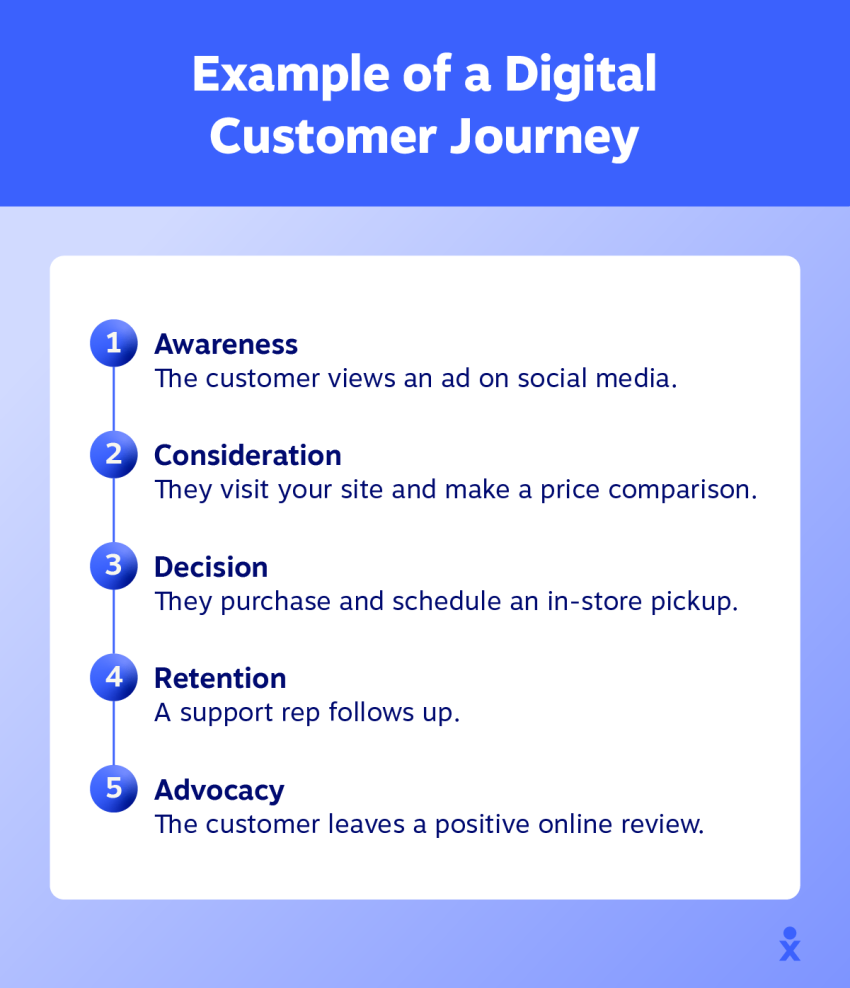
DXM helps connect different digital touchpoints. It includes managing a customer’s entire digital journey, from a social media ad to a mobile landing page, an AI-powered chat, and a post-purchase SMS notification, all the way to receiving the product.
Digital Experience (DX) vs. Customer Experience (CX)
DX and CX are commonly confused and used interchangeably. Customer experience is the larger customer ecosystem, while digital experience represents the ecosystem of the water itself.
Customer experience covers the entire relationship between a customer and a brand, including offline interactions such as in-store purchases, hardware packaging, and traditional phone support. It’s the sum of all touchpoints across the customer lifecycle.
Digital experience is a specialized subset of CX that focuses exclusively on the digital interface. It captures a user’s digital journey with a brand through software and screens.
This distinction is key for resource allocation. A business may have a market-leading product (high CX value), but if the digital onboarding process is fragmented or slow (low DX value), the business will experience high customer churn rates before the customer fully realizes the product’s benefits.
DXM vs. DEX: Aligning External and Internal Experiences
To develop a solid digital experience strategy, also consider the digital employee experience (DEX). The digital experience of your employees through the tools they use and the quality of the customer experience are closely linked.
Digital experience management focuses on the external customer journey. Key goals include improving conversion rates, brand image, and customer lifetime value (CLV).
Digital employee experience focuses on the internal employee journey. Key goals include increasing employee productivity, reducing software impact, and lowering burnout.
Feature
DXM
DEX
Primary user
Customers, leads, and subscribers
Employees, remote staff, and IT teams
Key objectives
User satisfaction, engagement and revenue growth
Efficiency and operational agility
Primary friction
Broken links, slow load times, or confusing navigation
Disconnected apps, data silos, or slow CRM response times
Business impact
Lower acquisition costs and higher retention
Reduced overhead and faster time-to-resolution
When internal teams work with fragmented tools, customers experience the resulting delays. For example, if a support representative has to manually search three platforms to find a customer’s billing history (poor digital experience), the customer experiences slower and less professional interaction (poor digital management).
Unifying these internal tools, for example, with customer experience management software like Nextiva, will help businesses improve digital employee experience, which in turn positively impacts the customer experience.
Why Is Digital Experience Management Important?
In the digital realm, the quality of a user’s experience helps differentiate brands. Customer experience leaders should see DXM not as a cost factor, but as a key to increasing customer loyalty and optimizing day-to-day operations.
Here are some of the reasons why you need a DXM strategy:
1) Retention and customer lifetime value (CLV)
Acquiring new customers is more expensive than retaining existing ones. High-quality digital management reduces obstacles like long loading times or complicated navigation, which lead to customer churn. An intuitive digital customer journey increases customer retention rates, improving their long-term value.
2) Brand differentiation and trust
In highly competitive markets, features and prices are similar across competitors. A seamless, high-performing digital experience then becomes a key brand attribute. Consistency across web, mobile devices, and support channels builds professional trust; a fragmented experience, on the other hand, shows a lack of internal coordination.
3) Operational scalability
Manual customer management isn’t scalable. An effective DXM strategy uses automation to handle high interaction volumes without linear staff increases. Answering routine inquiries via self-service and AI helps businesses focus on demanding, complex problem-solving.
4) Data-backed decision making
DXM provides a feedback loop with detailed data. When you observe digital user behavior, you can pinpoint exactly where interest wanes, so your management can make time-sensitive investment decisions based on actual user behavior, rather than internal departmental assumptions.
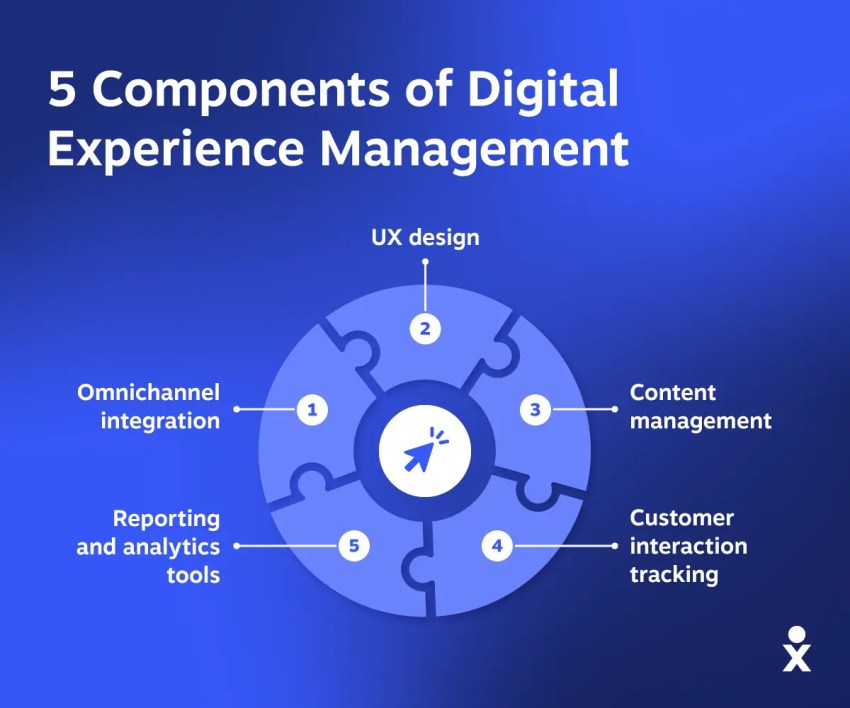
Key Components of a DXM Strategy
A working DXM strategy requires a synchronized tech stack that bridges the gap between marketing, IT, and customer service.
1) Omnichannel integration
At the very basic level, DXM should help maintain a consistent conversation across digital platforms. You’ll need:
Unified user interface: Employees should be able to manage SMS, WhatsApp, live chat, and email through a unified dashboard.
Contextual history: The system should display the user’s previous interactions for the employee (or AI) to provide relevant support immediately.
2) Digital experience monitoring (DEMO)
DEMO focuses on your digital assets’ technical performance. DEMO involves:
Real-user monitoring (RUM): Captures loading times and errors that visitors experience in real time.
Synthetic testing: Automated scripts test your website or app around the clock so that your critical processes (like checkout or login buttons) function flawlessly.
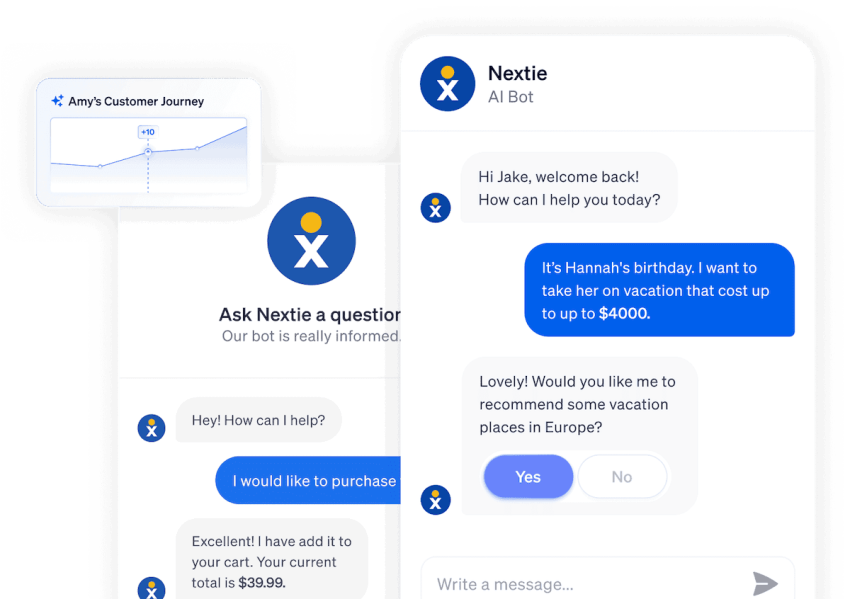
3) Conversational AI and agentic workflows
Artificial intelligence is the latest addition to DXM for managing customer interactions at scale. Some key AI technologies supporting DXM include:
Intent recognition: Natural language processing (NLP) instantly identifies customer needs.
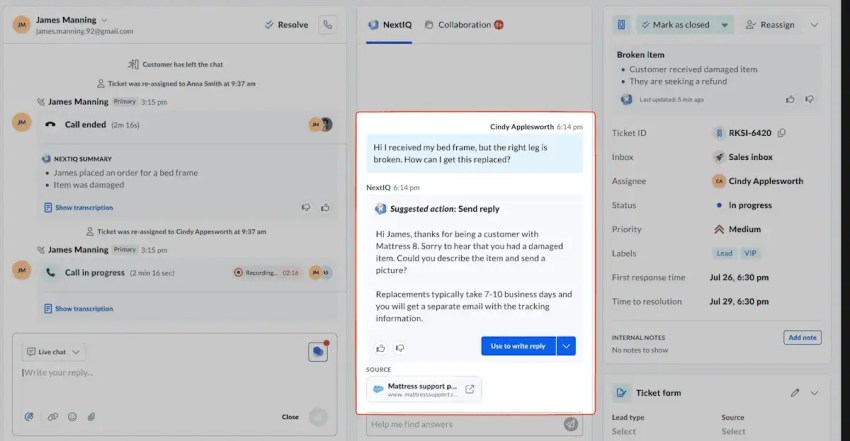
Automated summarization: AI tools transcribe and summarize calls or chats for faster handoffs and improved management visibility.
4) Content and digital asset management (CMS/DAM)
To create a consistent brand identity, all digital assets, including images, technical documentation, and marketing copy, should be managed from one place. For example, your help center always provides the latest version of the product manual, and your web chatbot delivers accurate and up-to-date pricing information.
5) Reporting and sentiment analysis
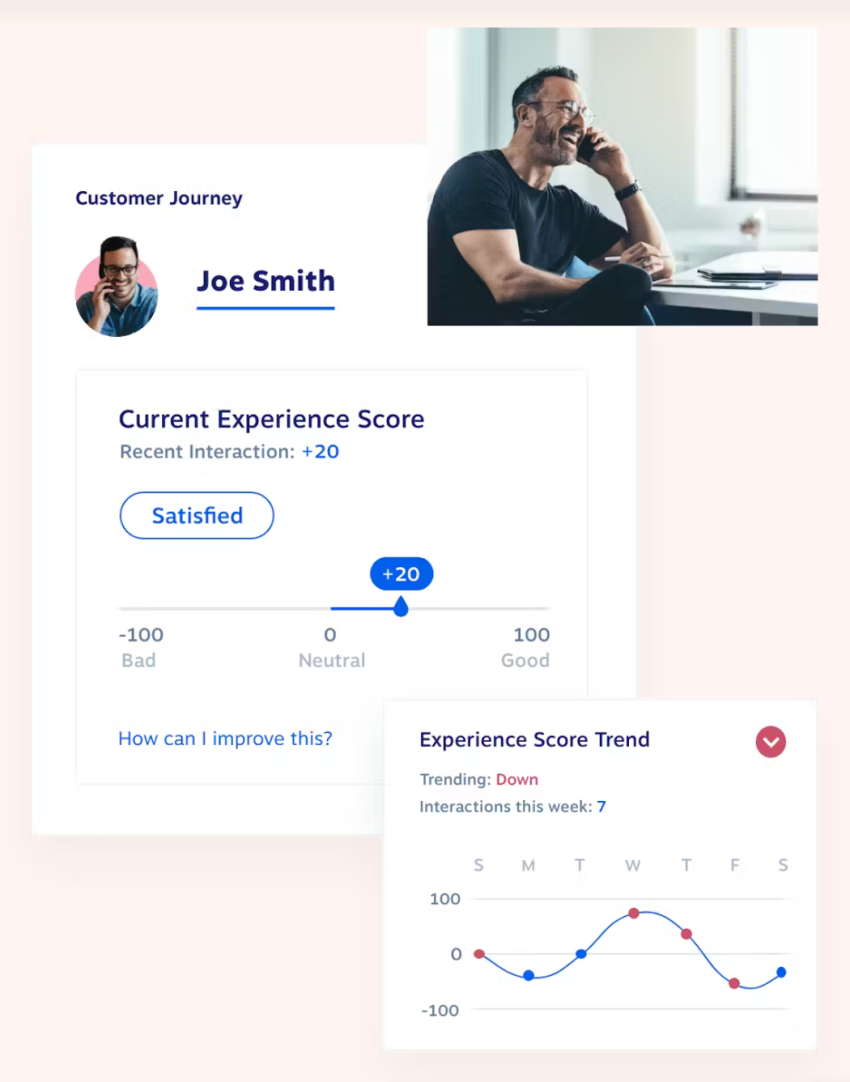
Besides simple clicks, a sophisticated DXM strategy captures user sentiment. Analyzing the tone of digital interactions enables businesses to identify customer dissatisfaction and proactively tweak their strategy. Real-time dashboards provide your management team with a continuous overview of your business’ digital health.
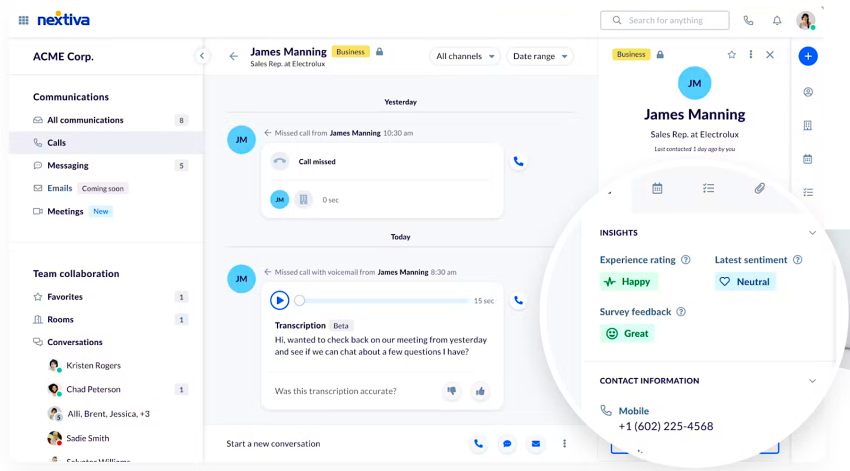
Track every customer interaction in one place—calls, voicemail transcriptions, and real-time sentiment insights side by side in Nextiva.
Top Benefits of Digital Experience Management
An efficient DXM strategy unifies communication and data, helping achieve both increased revenue and higher profitability. Here are some of the key benefits DXM brings to your business:
1) Increased operational efficiency
Manually managing digital channels is resource-intensive. DXM platforms streamline workflows by automating routine data entry and conversation tagging. When your communication tools automatically sync with your CRM, your employees spend less time on administrative tasks and more time resolving complex customer issues.
2) Higher conversion and retention rates
Friction is the biggest enemy of digital experience. Monitoring the customer journey helps businesses identify points of failure, say a confusing mobile checkout or a slow-loading pricing page. Eliminating these technical hurdles improves conversion rates. Personalized digital experiences also make customers feel understood, which, in turn, reduces customer churn.
3) Data-driven insights
DXM offers detailed insights into customer behavior that cannot be captured with traditional analytical methods. Analyzing conversations and sentiment enables management to identify emerging market trends or product weaknesses in real time, allowing them to proactively adapt their business strategy instead of reactively trying to mitigate damage.
4) Scalable personalization
AI-powered content and product recommendations enable businesses to offer several users a personalized experience simultaneously. Customer experience personalization means each user receives the information most relevant to their needs, which increases the likelihood of a successful purchase.
Common Pitfalls of DXM
While the advantages are clear, to implement a DXM strategy, you need to overcome several structural and technical challenges, including:
1) Persistent data silos
One of the biggest obstacles to delivering an exceptional digital experience is fragmented data. If information from a web chat isn’t available to a support representative during a phone call, the customer has to submit their request again. To avoid this, you need a unified customer experience management (UCXM) platform that centralizes interaction data across departments.
2) Addressing technology fragmentation
Many companies suffer from the complexity of their existing, sometimes incompatible, applications. This leads to high licensing costs and technical debt. Switching to a central digital experience platform reduces this complexity and aligns all tools toward a common goal.
3) Maintaining scalable performance
With increasing digital traffic, guaranteeing short loading times and 100% availability is challenging. Without a dedicated DEMO, technical issues can go unnoticed for hours. You can end up losing revenue and suffering irreparable reputational damage.
4) Combining automation and human interaction
Finding the right balance between AI bots and human support is a common challenge. Heavy automation adds to customer frustration, while too little can result in high operating costs. A successful DXM strategy uses AI to handle routine tasks while having a human expert always available for complex or critical customer queries.
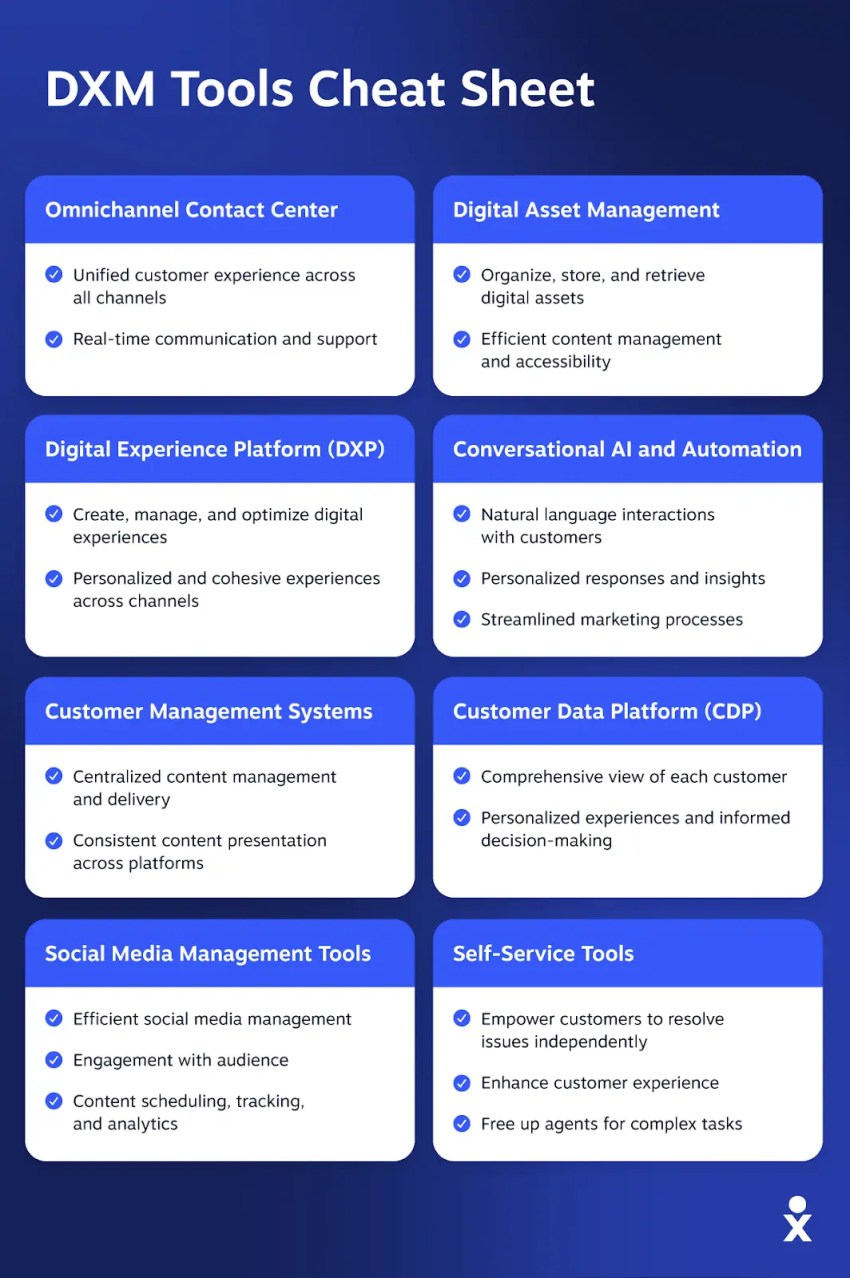
To implement a DXM strategy, you need a tech stack covering customer communication, data, and performance monitoring. While specialized, standalone solutions exist, unified digital experience platforms minimize integration efforts.
You need:
Omnichannel contact center: Combine telephony, email, SMS, and social media into a single user interface. Your employees have access to the complete call history, no matter how the customer contacted you.
Digital experience monitoring: Tools for monitoring technical health, such as page load times, API availability, and click behavior (heatmaps).
Customer data platform (CDP): A central database that aggregates data from your website, CRM system, and marketing tools, giving a 360-degree view of each customer.
Content management systems (CMS): These help create and distribute digital content across digital channels, helping maintain a consistent brand image.
Conversational AI and self-service: AI-powered chatbots and knowledge bases that allow customers to solve routine problems (like tracking an order or resetting a password) without human support.
Implementing a DXM Strategy
Transitioning to a mature DXM model doesn’t happen overnight. Use this phased approach to align your tech and operations:
Review your current digital journey: Identify every digital touchpoint — from social media presence to after-sales support. Use analytics to find drop-off points where users abandon the funnel. Is it a technical error or a confusing user interface?
Unify your communication channels: Consolidate your previously separate tools. Implement a unified communications platform like Nextiva for seamless data flow between your team and your customers.
Implement experience monitoring: Use monitoring tools to identify problems, such as slow page loading for users in a specific region or mobile app crashes after an update. Proactive monitoring helps resolve issues before they negatively impact your customer satisfaction scores.
Use AI and automation: Identify the most frequent customer inquiries. Use conversational AI to automate handling these tasks. You’ll free up your employees for challenging interactions that require empathy and complex problem-solving.
Measure, iterate, and scale: Connect your digital metrics (like page load time or chat response time) to business outcomes (like conversion rate).
Enhance Your Digital Experience Management Strategy with Nextiva
Effective digital experience management requires more than just a good UX design; it demands a powerful communications infrastructure. Nextiva’s unified customer experience platform eliminates the technical hurdles that obstruct the customers’ digital journey.
Nextiva consolidates your digital touchpoints into a unified interface, giving you tools like:
Omnichannel integration across all plans: Whether Core, Engage, or Power Suite, Nextiva keeps your digital communications, including telephony, business SMS, and team chat, unified. Your employees get to deliver consistent brand communication across various digital channels.
Advanced orchestration: For businesses expanding their digital presence, Nextiva offers omnichannel engagement across web chat and telephony. It bridges the gap between digital and traditional channels and offers features like web and ACD callback to respect your customers’ time.
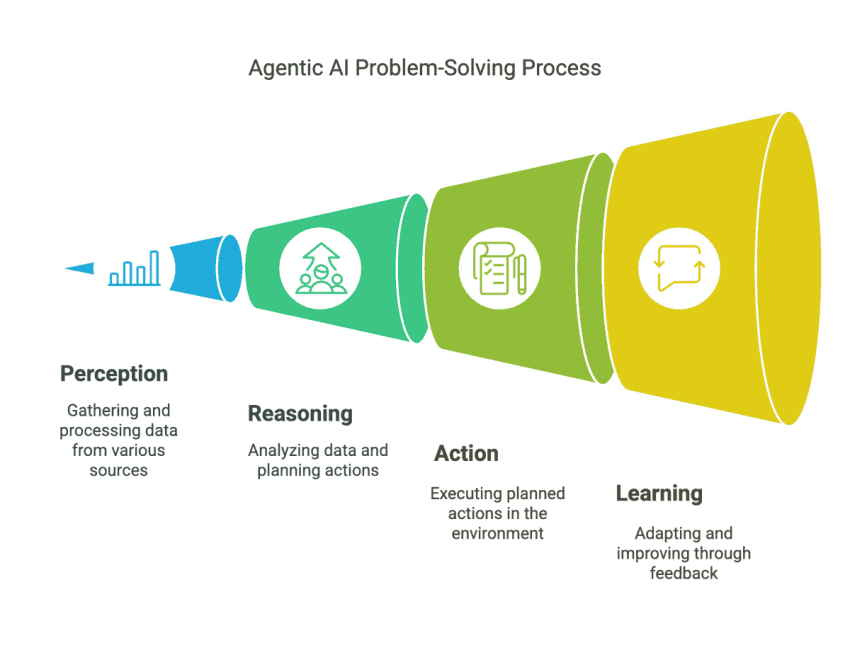
AI-powered insights and transcription: Thanks to Agentic AI, the platform offers real-time dashboards and automated summaries. Customer experience managers get to better monitor user sentiment throughout the user journey and identify technical or service bottlenecks before they negatively impact customer satisfaction.
Complete transparency: Your employees have access to full conversation history at any time to provide a personalized customer experience that boosts ROI. Nextiva reduces app switching and data silos, helping improve both the employee experience and the overall digital experience for your customers.
See how Nextiva can enrich your DXM strategy today.
Create an amazing digital customer experience.
Engage on every channel with Nextiva’s platform for the best customer experience.
Digital Experience Management FAQs
Here’s a brief overview of the key aspects of digital experience management.
What is the difference between DEM and DEX?
Digital experience management, also known as DXM or DEM, focuses on the external customer or user journey. Digital employee experience (DEX) focuses on the internal digital environment, so employees have the fast, reliable, and integrated tools they need to stay productive.
What is an example of a DXP platform?
A digital experience platform (DXP) is an integrated suite of digital technologies. For example, Nextiva provides a communications-led DXP that unifies customer engagement across voice and digital channels, while platforms like Adobe focus on content-led digital experiences.
What does a digital experience manager do?
A digital experience manager shapes the overall customer journey, including defining the UX strategy, managing buyer personas, and overseeing the technical integration of tools like CRMs, CMSs, and communication platforms.
A crew of cargo thieves were busted with $7 million worth of name-brand goods including everything from ATVS and golf carts to top-shelf liquor and Disney apparel — as well as a cool $1 million in cash, authorities said.
Detectives with a cargo theft division of the Los Angeles County Sheriff’s Department announced that its operation took place from December 2025 to February 2026.
It involved 13 search warrants in Los Angeles, Riverside and San Bernardino Counties.
A crew of cargo thieves were busted with $7 million worth of name-brand goods including everything from ATVS and golf carts to top-shelf liquor and Disney apparel.
The items recovered included MasterCool AC units, golf carts, ATVs, Sony soundbars, LG microwaves, Canon printers, Ring cameras, Craftsman tools, Classica Cordials premium liquor and Disney clothing.
Thirty-six companies — including Amazon, Sony, LG, T.J. Maxx, Marshalls, Dollar General, Costco, Classica Cordials and Monster Energy — were affected by the thefts.
The suspects involved were booked and charged with grand theft cargo, money laundering and receiving stolen property.
Thirty-six companies — including Amazon, Sony, LG, T.J. Maxx, Marshalls, Dollar General, Costco, Classica Cordials and Monster Energy — were affected by the thefts.The suspects involved were booked and charged with grand theft cargo, money laundering and receiving stolen property.
The items stolen also included:
Hisense televisions
Wolff shoes
Milwaukee tools
LG appliances
Jelly Cat plush animals
Axil XCor Pro headphones
Black & Decker tools
Pentair pool equipment
Style Craft hair clippers
Monster Energy drinks
Cosmetics
Authorities did not provide identities of the suspects.
Download The California Post App, follow us on social, and subscribe to our newsletters
Whew, Roommates! The back-and-forth between Shyne and Brandy over their past relationship isn’t letting up and neither is Ray J. Shyne spun the block with a reply after the singer claimed their past connection was strictly “platonic.”
RELATED: Whew! Brandy Sets The Record Straight After Shyne & Mase Allege They Dated Her At The Same Time (VIDEOS)
Shyne Calls Out Brandy For Seemingly Rewriting Their Relationship History
If you’ve been out of the loop, Brandy and Shyne started trading words after Shyne recalled their relationship during an appearance on Mase and Cam’ron’s ‘It Is What It Is’ podcast. Shyne said he and Mase dated Brandy at the same time, but she stepped in and shut that down, saying what they had was nothing more than a “friendship.”
Now, Shyne is circling back to slam her claims. He spoke exclusively with TMZ and said he never meant any harm when he talked about her. Still, he called her a “liar” and said he thinks she’s avoiding admitting that she dated both him and Mase in attempts to protect her image.
“I don’t know, I can’t get into her mind. I’m just saying she has lied to the public before to protect her image, and maybe the fact that she was seeing both Mase and I at the same time, she feels it’s not good for her image.”
He continued saying, “If he was capping, Mase would’ve said, ‘Nah, Shyne I don’t remember it like that.”
Here’s What Brandy Previously Said About Her & Shyne’s Status
Shyne’s latest comments came right after Brandy hopped on Instagram to shut down rumors that she dated him. The ‘Full Moon’ songstress also gave fans a peek into her upcoming memoir, ‘PHASES,’ dropping March 31. She said she’s tired of people pushing a narrative about her that isn’t true and made it clear she and Shyne never had any relations.
“In the late 90’s, I had a platonic friendship with rapper Shyne. In an unfortunate turn of events, that friendship is now being mischaracterized as ‘we dated.’ Unequivocally, we did not! I’m not sure why an untrue narrative about a scope of what was a friendship more than 20-years ago is being reshaped during his current media interviews,” she wrote.
From there, she told fans she never asked Ray J to step in and defend her. “While I love my brother Ray J, I don’t condone or support the messages he’s shared on social media and have not asked him to defend me in any form,” Brandy continued.
Ray previously went live to stand up for his big sis after he saw the comments Shyne made while chopping it up with Mase and Cam’ron.
“Shyne, Mase, and Cam — like, I don’t know. I never had a problem with them but I saw some s**t today, and they gotta know that a n****a gon’ come back strong and say some s**t,” Ray said during the stream.
Ray J Continues Going Off & Steps Back In To Defend His Sister
Even though Brandy said she doesn’t condone her baby brother stepping in, he spun the block AGAIN! He hopped on a new livestream and spoke on Shyne’s time behind bars. From there, he asked fans to stop saying he needs help when all he’s doing is standing ten toes down for someone he loves. “Why do I need help?” Ray continued, “I’m defending somebody I love. What am I doing wrong? I don’t give a f***.”
RELATED: Whew! Shyne Reacts After Ray J Says He’ll “Slap” The “Daylights” Out Of Him & Mase For Claiming They Allegedly Dated Brandy At The Same Time (VIDEOS)