Notice: Function _load_textdomain_just_in_time was called incorrectly. Translation loading for the td-cloud-library domain was triggered too early. This is usually an indicator for some code in the plugin or theme running too early. Translations should be loaded at the init action or later. Please see Debugging in WordPress for more information. (This message was added in version 6.7.0.) in /home/releande/public_html/wp-includes/functions.php on line 6170 News Magazine | Get The Most Freshy News Every Day | Page 23
You know a kid is special when the internet collectively says, “Wait… how is he already this big and adorable?!”That’s exactly what happened when New York mom Lauren Wilsonshared a video of her nephew, Jaxson, at just 7 months old. The clip has racked up millions of viewsas social media users couldn’t get enough of the chunky little star.
RELATED: Bundle Of Joy! Jasmin Lawrence And Eric Murphy Reveal Daughter’s Name Amid Baby Shower (PHOTOS)
Jaxson Had Us Stopping Mid-Scroll
In the video, Jaxson shows off his 25 poundsand 26-inch frame—a tiny package with big personality. Lauren tells PEOPLE she was simply “obsessed with him” and wanted the world to see just how cute he is. And the internet delivered, stopping mid-scroll to gush over the baby boy everyone was suddenly talking about.
This Baby’s Growth Game Is Strong
But while fans were shocked at his size, Jaxson’s mom, Adrienne Wilson, 29, explains that he’s always been a little on the chubbier side. “Jaxson was born 7 lbs. 14 oz., [but] was always on the chubbier side,” she claims. “Jaxson just turned 1 this January! He weighs 33 pounds now!” The proud mom shares that while they get attention in public for his size, the reaction from over 9.4 million online viewershas been a whole new level of wild.
From Big Baby To Viral Star
Doctors aren’t concerned about Jaxson’s weight, especially since he’s tall and growing evenly. In fact, Adrienne says he’s practicing walking with supportand is already showing signs of being a little daredevil. He’s “happy and very silly,” and a total “risk taker,” she shares. Apparently, the baby “let’s nothing hold him back” from what he wants to do!
Beyond the milestones and viral fame, Adrienne says the journey into motherhood has been a transformation. “My favorite thing has honestly been seeing me change from who I was into full mama bear mode. I enjoy motherhood and [am] excited for the journey ahead as Jaxson continues to grow,” she revealed.
RELATED: It’s A What? Lala Baptiste And Jay Cinco Confirm Their Baby’s Gender In Heartwarming Reveal (VIDEO)
In poker, having position means you act last. And acting last is one of the most powerful advantages in the game. You can raise with nothing to push opponents into folding, call with a weaker hand without fear of getting re-raised, or simply check and do nothing when your cards are mediocre. Every option costs you less because you already know what everyone else has done.
Conversely, acting out of position means going first with no information. You’re not sure how your opponents will respond to whatever you do. That uncertainty is expensive. It’s why experienced players are more aggressive when they have position and more cautious when they don’t.
I bring this up because Fundrise recently gained position over Robinhood. And what Fundrise chose to do with that position was revealing. Not because it tells us exactly how its venture product, VCX, will trade after listing on the NYSE. Nobody knows that. But because it gave us a rare, unscripted look at how management thinks under pressure. And for a closed-end fund, that matters enormously.
Please note that Fundrise is a long-time sponsor of Financial Samurai, as our investment philosophies are aligned. I have met and spoken with Ben Miller, the cofounder and CEO, many times over the years. I am also an investor in Fundrise products.Fundrise has not reviewed this post and all thoughts are my own. For background, I used to work in banking (equities) and have helped take over 100 companies public (IPO) during my 13-year career at GS and CS.
How Fundrise Gained Position Over Robinhood
Robinhood listed its Venture Fund I (RVI) on the NYSE on Friday, March 6, 2026. Going first likely felt like an advantage, both for marketing momentum and for capturing early investor demand before Fundrise could list its venture product.
It didn’t play out that way. That Friday evening, the US and Israel launched missile strikes on Iran, triggering massive volatility across global markets. Stock exchanges in Japan and Korea fell between 5% and 10%. US futures declined over 2% that Sunday evening before paring losses and rebounding Monday.
Robinhood may have partially attributed RVI’s 16% decline to the Iran strikes. But those of us watching closely noticed something that preceded the missiles: only about 12.4 million of the intended 40 million shares offered during the IPO were accounted for on Friday.
The weak demand was visible before a single strike was launched. The war gave Robinhood a convenient explanation, but the lack of appetite told the real story.
Suddenly, Fundrise had position.
The Decision That Revealed A Lot
What management does when they have an advantage tells you more about them than what they do when everything is going smoothly. Fundrise now had full visibility into what had just happened to Robinhood, the state of global markets, rising oil prices, and a war with no clear end date.
They had a choice: proceed with the VCX listing the week of March 9 anyway, or wait.
Fundrise chose to wait. And that choice told us something useful.
More Time, More Data, More Respect For Investors
Every additional day before listing brings new information. Oil prices, the trajectory of the conflict, the S&P 500, economic data, and investor sentiment are all moving in real time. Having the flexibility to absorb those data points before committing to a date is a genuine edge that Robinhood no longer had.
There is also a practical dimension.
Hundreds if not thousands of existing Fundrise investors received emails about the window to purchase unrestricted pre-listing shares, and I would guess a meaningful portion invested additional capital.
Settling those accounts and getting funds transferred and reflected in brokerage accounts takes about a week, sometimes longer. Listing before that process was complete would have left a real group of investors unable to participate in the opening trade. Waiting until they were ready was simply the right thing to do.
None of this guarantees a strong opening. But it does suggest management was thinking about the interests of existing investors rather than just racing to the finish line.
Why Management Is More Important With a Closed End Fund
This is the part that matters most for the long run, and it’s worth slowing down on.
As I wrote in my post on how different funds trade, closed end funds do not have the automatic arbitrage mechanism that keeps ETFs trading close to their net asset value (NAV).
With a regular ETF, large institutional investors called “authorized participants” can create or redeem massive share baskets whenever the market price drifts too far from NAV. That keeps the two in tight alignment.
Closed end funds have no such mechanism. A fixed pool of shares simply trades between buyers and sellers on the open market, with no corrective force pulling the price back toward what the underlying assets are actually worth.
The result is that closed end funds (that mostly own public investments) historically trade at a discount to NAV averaging around 7% to 8%. That discount can persist for years or even decades, and it tends to widen during periods of market stress when investors want liquidity and few buyers are stepping up.
Without that built-in correction, management decisions matter far more than they would with a typical ETF.
Questions Closed-End Fund Managers Must Ask
What new private companies should the fund invest in?
What existing positions should get sold, and at what valuations?
When the fund trades at an unreasonably wide discount to NAV, does management buy back shares to narrow the gap and reward existing investors?
When it trades at a premium, does it issue new shares wisely to raise fresh capital?
These are not passive decisions. Every one of those calls directly shapes what investors experience over a 5 to 10 year holding period, for better or worse.
This is why management quality is not just a nice-to-have with a closed end fund. It is vital.
A Small Signal, But a Real One
I am not drawing sweeping conclusions from one decision.
VCX could still list and trade at a significant discount to NAV. Despite owning stakes in some of the most compelling private companies in the world right now, including OpenAI, Anthropic, Databricks, and Anduril, the venture portfolio could still underperform. Management could make poor reinvestment decisions down the road. But I am hopeful its holdings continue to increase in value.
What I am saying is that the decision to delay was the right process, regardless of outcome. The conditions at the time of Robinhood’s listing were about a 3 out of 10. Normal conditions sit around a 6 or 7.
Listing into a 3 environment, immediately after watching a comparable product fall 16% in its opening week, would have been very difficult to justify to investors. Thankfully, RVI has rebounded from its first day of trading and is only trading at a ~7% discount to NAV at the time of this publication. That’s within the average discount to NAV expected for closed-end funds.
Conditions to list now are about a 4.5 given we are aware of the geopolitical disruption, valuations have come down, and progress in the war is being made.
When evaluating any long term investment in a managed fund, I am not just investing in the assets. I am also investing in the people making decisions about those assets. Every signal matters.
It is the same reason institutional investors insist on meeting with senior management before making a large bet. They want to look the decision makers in the eye, ask hard questions, and get a feel for whether the people running the money are thinking clearly and acting in shareholders’ best interests. One meeting does not tell you everything. But it tells you something.
Fundrise’s decision to delay is that kind of signal. Small, but real.
Congrats to Anduril for winning a contract worth up to $20 billion from the U.S. military on March 13, 2026
The Direct Listing Signal
Fundrise going the direct listing route rather than a traditional IPO like Robinhood Venture Fund I is another signal worth paying attention to.
In a traditional IPO, a company issues new shares and sells them primarily to institutional investors, hedge funds, and large allocators who get first priority. Retail investors and existing shareholders often get crowded out or receive a tiny fraction of what they wanted. The institutions then flip their shares on the open market, which can create selling pressure right out of the gate.
Fundrise took a more personal approach. Rather than selling new shares to outside institutions, Fundrise asked a portion of its existing base of venture product investors whether they wanted to purchase up to $10,000 each in unrestricted pre-listing shares they could sell immediately after listing. That is not just a fairer price discovery process. It is also a meaningful capital raise targeted entirely at existing, informed investors.
Think about the math for a moment, and I’m estimating here. Let’s say 5,000 of existing investors participated at the full $10,000. That is $50 million in fresh capital raised before the fund even lists. And that capital came from people who already understand the product, believe in the thesis, and chose to put more money in rather than wait on the sidelines.
For a closed end fund, raising capital before listing is helpful. Once the fund is trading on the open market, issuing new shares becomes more complicated. You generally need the stock trading at a premium to NAV to justify a secondary offering without diluting existing shareholders. Locking in fresh capital before listing, from true believers rather than institutional flippers, sidesteps that challenge entirely.
It also means the initial float is largely in the hands of long term holders rather than traders looking for a quick gain. That does not guarantee a strong opening price, but it does reduce some of the artificial volatility that can come from investors who were never committed to holding in the first place.
Play Your Position Well
In poker, position only gives you an edge if you use the information in front of you wisely. From what I can observe, Fundrise did exactly that.
By delaying the listing, management improved the odds at the margin. Maybe a 10% discount to NAV in the chaos of the second week of strikes becomes a 5% discount in calmer waters. Maybe a 10% premium becomes 15%.
Nobody knows until the listing actually happens. But the direction of the probabilities shifted in investors’ favor simply because management chose patience over urgency.
That is all you can ever ask of the people running your money. Not certainty. Not a guaranteed outcome. Just good process, clear thinking, and the discipline to wait when waiting is the right move.
Personally, I plan to hold onto my shares for five plus years, and will buy the dip if there is one once listed.
When Will VCX List?
It looks like the new tentative listing date is March 17, 2026 as listed on the NYSE. I’m assuming the latest will be by March 31, 2026. Hopefully, when it does list, things will have stabilized further. However, if the geopolitical situation remains tense and public markets stay highly volatile, the listing could be pushed to a later date.
I’m in no rush, as I trust Fundrise management to do what’s best for its investors. Obviously, Fundrise also wants to give its product the best chance to perform well.
What I do know is that over the long term, the quality of management compounds just like capital does. Good decisions made consistently over time add up. And right now, the early signals suggest Fundrise is making the right kinds of decisions.
Reader Questions And Suggestions
Have you ever used your position to gain an advantage in investing or in life? Do you prefer being first to market, or do you like to sit back, gather information, and act when the timing is right?
For those invested in the Fundrise venture product, did you purchase pre-listing shares when the window opened? And do you think delaying the VCX listing was the right call given everything happening in the markets right now?
In addition to the venture product, I am also an investor in Fundrise real estate. With commercial real estate valuations still depressed relative to stocks and supply continuing to tighten, I have been dollar cost averaging into CRE as a long term diversifier. If you are curious, the minimum investment is just $10, so the barrier to entry is low.
Once again, Fundrise is a long-time sponsor of Financial Samurai, and Financial Samurai is also an investor in Fundrise products. Please evaluate every investment thoroughly before putting your capital at risk. Only invest money you are comfortable losing, as risk assets come with no guarantees. Maintaining proper asset allocation is essential.
Get my posts in your inbox as soon as they are published by signing up here. Then subscribe to my free weekly newsletter here. I’ve been writing about helping readers achieve financial freedom since 2009.
I’ve written many times about how I clean my house with natural cleaners. Now to check off something that’s been on my list for a while: a complete cleaning checklist for the whole house!
Sometimes it’s hard to get the motivation (or time) to take on deep cleaning. However, the one time of year most of us feel like tackling it is when spring finally arrives and the weather warms up.
Spring cleaning doesn’t have to mean complicated systems or cabinets full of cleaning supplies. In fact, the simpler the process, the more likely I am to actually do it (or convince the kids to help!). I like to open the windows for fresh air, turn on the air filter, and tackle one room at a time. Nothing beats the satisfaction of checking items off a list as you go.
Below is the room-by-room checklist I use for deep cleaning the house each spring. You’ll also find the printable version at the bottom.
Cleaning Supplies to Have on Hand
Before getting started, it helps to gather a few simple cleaning supplies so everything is within reach. Most of these are items you may already have around the house.
A Note on Microfiber
I have some old microfiber cloths that I bought when I first started with natural cleaning that I still use. However, if you’re buying supplies, I recommend opting for cotton cloths or re-using old natural fiber clothing as rags. Microfiber is basically plastic and contributes to our plastic pollution problem every time they’re washed.
I’m using mine up since I already have them, but I won’t be buying more. You can read more about microfiber and my thoughts and solutions to the problem here. So whenever you see cleaning cloths or microfiber mentioned below, just keep this in mind.
Basic cleaning supplies:
Microfiber cloths, cotton cloths, or old T-shirt rags
Spray bottles of cleaners
Mop
Small bucket for soapy water
Vacuum with attachments
Helpful natural cleaning products:
You don’t need every single cleaner on this list, just pick and choose what works best for you. Basics like baking soda, vinegar, and natural dish soap can tackle most messes!
My Minimalist Natural Cleaning Closet
Confession time: If you ever wonder how I do it all… well, I don’t. Like most busy families, it’s all about priorities and simplifying where possible.
I used to make all my cleaners from scratch, but life with older kids, a business, and a podcast eventually changed that. These days there are so many excellent natural options available that I prefer using a few high-quality products that work for multiple purposes.
Here’s a quick roundup of my current natural cleaning favorites:
With just a handful of supplies, it’s possible to clean almost everything in the house without the harsh chemicals found in many conventional cleaners.
Whole-House Tasks (Start Here)
there are a few cleaning tasks that apply throughout the entire house. Start by opening windows for ventilation and turning on an air filter if you have one. Fresh air makes the whole process feel easier and helps clear out lingering dust and indoor pollutants.
Before diving into deep cleaning, start with a quick tidy-up. Pick up items from the floor, return things to their proper places, and keep a bin nearby for items you want to donate or get rid of. Spring cleaning is the perfect time to declutter as you go.
And if you have kids at home, enlist them! My kids have their own room checklists, and they love the satisfaction of crossing something off the list. Next, work from the top down in each room. This keeps dust from falling onto areas you’ve already cleaned.
Whole-house cleaning checklist:
Dust from the highest points (door frames, window frames, shelves, etc.)
Vacuum or dust away cobwebs
Clean light fixtures and ceiling fans
Wipe down walls, switch plates, and door frames
Clean doors and door handles (hydrogen peroxide works well if anyone has been sick)
Clean baseboards
Vacuum or sweep all floors
Mop hard floors
Move furniture (coffee tables, chairs, etc.) and clean underneath
Clean windows inside and outside
Wipe window frames and sills
Wash blinds, drapes, and window screens
Clean rugs and decorative pillows
Vacuum couches and under cushions
Wax and polish wooden surfaces
After dusting or vacuuming walls, wipe them down with a damp cloth to remove grime, grease, and marks. Kitchens especially tend to collect grease buildup on walls over time. If you have tile in the kitchen or bathroom, spring is also a good time to clean and reseal grout lines, which helps prevent water damage and staining.
Living Room and Living Areas
Living spaces tend to collect the most daily clutter, so I like to start here. Begin by picking up everything on the floors and moving it to the appropriate rooms. Then work from top to bottom, dusting furniture, shelves, and fixtures.
Living room cleaning checklist:
Open windows or run an air filter for ventilation
Dust furniture with a damp rag or cloth
Dust lighting fixtures and fan blades
Spot clean furniture with baking soda and water or natural all-purpose cleaner
Clean lamps with cloths. Hydrogen peroxide spray is great for cleaning white lampshades
Wipe down electronics and screens with a screen safe cleaner
Wash windows and windowsills
Wash or wipe down blinds. I like taking them down and washing them in the bathtub with vinegar and water.
Wipe down walls and switch plates
Wash throw blankets and pillows
Vacuum couches and chairs
Remove couch cushions and vacuum crumbs
Condition leather furniture if needed
Sweep, vacuum, or mop floors
If your living room has area rugs or carpet, spring is also a great time to deep clean them. Use your vacuum attachments to reach corners and along baseboards.
Kitchen
The kitchen is often the most used room in the house, which means it benefits from a deep clean at least once a year. Start by clearing off countertops so you can thoroughly clean surfaces. This is also a great opportunity to declutter appliances and store ones you rarely use.
Kitchen cleaning checklist:
Open windows or run an air filter
Dust high surfaces, lights, and fans. Use warm, soapy water as needed to tackle kitchen grease.
Remove everything from countertops and wipe them down
Wipe down backsplash and walls to remove grease buildup
Clean the outside of cabinets (use a wood-safe cleaner if needed)
Wipe down appliances. Use a stainless steel cleaner as needed.
Clean the stove, stove vent, and replace vent filter
Deep clean the oven
Remove food from the fridge and freezer and wipe down inside
Wipe down the outside of the refrigerator
Pull out fridge and stove and clean underneath
Dust refrigerator coils and clean the grate at the front
Clean out the pantry and wipe shelves
Clean sink and fixtures
Deep clean dishwasher by running it empty with vinegar
Clean garbage disposal
Hose down the trash can and let it disinfect in the sun
Sweep and mop the floor
Clean tile grout if needed
If your kitchen has granite counters, use a granite-safe cleaner rather than vinegar, which can damage the stone over time. You can also find a more detailed kitchen cleaning checklist here.
Bathrooms
Bathrooms are another area where deep cleaning makes a big difference. Warm, damp environments can allow mold and mildew to develop if they aren’t cleaned regularly. Just like any other room, be sure to start at the highest surfaces first, like the walls and tops of the door and window frames.
Bathroom cleaning checklist:
Open windows or run an air filter
Dust high surfaces, lights, and fan
Take everything out of cabinets and wipe shelves. Get rid of anything you don’t use, old or expired
Clean mirrors and windows
Wipe down counters and sinks
Clean makeup brushes and replace old makeup
Scrub shower and tub
Remove soap scum and hard water buildup in the shower/bath and sink
Replace or wash the shower liner
Clean tile and grout, reseal if needed. Baking soda and hydrogen peroxide work well for stained grout.
Deep clean the bathroom fan
Clean around the outside of the toilet
Clean the inside of the toilet bowl
Mop the floor and wipe baseboards
Restock natural bath supplies
A shower filter can also help reduce mineral buildup, which makes the shower easier to clean over time. If the toilet seat still looks dingy despite cleaning, it might simply be time to replace it. Sometimes that’s the easiest fix!
Bedrooms
Bedrooms are usually simpler to clean but benefit from a seasonal refresh. Start by picking up anything on the floors and clearing surfaces so you can clean more easily. Here’s what I keep in my nightstand for a more relaxed nighttime routine and refreshed morning.
Bedroom cleaning checklist:
Open windows or run an air filter
Dust furniture, lights, and fans. Start from the top and work your way down so any falling dirt/dust can be cleaned up.
Wash sheets, blankets, and bedding
Wash throw pillows if needed
Hang pillows or mattress pads in the sun for a few hours to air out.
Wash pillows in the washer if they can be machine washed
Vacuum or mop floors
Clean under the bed
Wipe down walls and switch plates
Wipe down doors and handles
Clean lamps and lampshades
Wash windows, windowsills, and blinds
Clean out nightstands and drawers and toss expired items like old lip balm
Remove clothes from drawers, wipe down drawers, and return clothes. (This may not be the time to start KonMari folding, but I highly recommend checking it out!)
Refresh linen spray and drawer freshener sachets.
Spring is also a great time to declutter closets and refresh your wardrobe. I like to use this time to simplify clothing and rotate seasonal items. A capsule wardrobe can make getting dressed much easier and keeps closets from becoming overcrowded.
If it’s been several years, evaluate whether the mattress still provides good support. Sometimes a better night’s sleep is just a mattress upgrade away. Here’s one we love.
Laundry Room or Utility Room
The laundry room often becomes a catch-all space for cleaning supplies, storage bins, and random household items. A quick seasonal reset helps keep things organized. I also keep this printable reference sheet for how to naturally treat stains in my laundry room.
Laundry room cleaning checklist:
Open windows or run an air filter
Dust lights, shelves, and surfaces
Remove everything from cabinets and shelves. Declutter and organize what’s left.
Wipe down shelves and cabinets
Declutter old cleaning products or expired supplies
Wipe down washer and dryer
Deep clean the washing machine
Wash the dryer lint trap with dish soap to remove buildup
Clean the dryer vent
Wipe down walls and baseboards
Sweep and mop floors
Organize laundry products and restock as needed
Replace or refelt wool dryer balls if needed
This is also a good time to evaluate the space and see if better organization would help. Maybe it’s time to add coat hooks in the mudroom, a mat for muddy boots, or a shelf to store laundry supplies that are currently piled on the floor.
Make Spring Cleaning a Family Routine
Deep cleaning the entire house can feel overwhelming, but breaking it down room by room makes it much more manageable. And when you sign up for my VIP newsletter you’ll get my free Deep Cleaning Checklist as a thank you here. I’m also giving you my complete Home Organization Binder printables with blank room cleaning templates to customize.
I like to print out the checklist and slip it into a binder sleeve so it can be reused each year. Turn on a favorite playlist, open the windows, and enjoy the fresh air while you work. By the time you finish, the whole house feels lighter, cleaner, and ready for the new season. Happy spring cleaning!
Did I miss anything on the checklist? I’d love to hear what’s on yours.
Actual Play can easily be associated with epic tales of long campaigns, deep character backstories, and fantastical worlds. Yet, there is real value in stepping into condensed and specific frameworks, like a slasher film, to invoke the same feeling of sitting down to watch a standalone film. The Panic Table’sHow’s My Driving achieves just that with the combination of a multi-talented cast, a well-designed Daggerheart hack, and a familiar genre formula. While the show is originally meant for viewing on YouTube, a podcast version is also available. I even had the chance to talk to Cameron Danger Strittmatter, the show runner and Game Master, about the process.
How’s My Driving? The Daggerheart Horror Hack.
Quick info:
Vibes: Slasher Film System: How’s My Driving, a Daggerheart horror hack Show Length: ~2Hours Accessibility: Detailed content warnings in the show description include: Animal Distress, Violence & Gore, Horror & Psychological Themes, Vehicular Trauma, and other specific phobias. Platforms: YouTube, Podcast version available Language: English
Our scream queens are made up of our regular tropes: the baddie, the loverboy, and the group mom.
Jude, the baddie played by Laurie Hernandez, is a quintessential hottie who gets shit done. Others may think Jude is fully comfortable with herself, but she still has her own secrets.
Emma, the lover(girl) played by Gina Susanna, is fully committed to their crush, even if that means they are just friends.
Daphne, the group mom played by Anne Monteverdi, is a fierce protector of her friends and has a past that proves useful when face-to-face with a cold-blooded killer.
The cast of How’s My Driving is multi-award-winning (one even has Olympic gold). I asked Strittmatter how he gathered the table together.
“Gina is the first panic table fan,” he revealed. “She showed up out of the weeds glistening and dewy, and has been rooting for us since we showed up.” Gina can be found in beloved actual plays like BlackwaterDND’s Godkiller: Balance, as well as Afterlight. “At the time that we had brought on Laurie Hernandez, I had done one other show with her, but was unaware that she was a two-time Olympic medalist and about to debut on Broadway.” Hernandez and her team, dubbed the “Final Five,” won gold in team gymnastics at the Rio de Janeiro 2016 Olympic Games. “We really hit it off. She was the other guest, and I said, ‘Would you ever wanna just get freaky on our freaky show with cameras on?’”Anne Monteverdi, also known as Gnome Anne, is an experienced player at the forefront of many conversations about collaborative storytelling. “You cannot approach actual play without colliding with, or stepping gently around Anne Monteverdi, like it can’t be done. I would say a disproportionate amount of the comments have been about Anne’s extraordinary performance and how it keeps you on your toes.”
We follow these young friends driving down one of the long stretches of Oklahoma highway, where DNGN Club Games is based, in a tale set in 2003. After crashing into a deer and nearly getting run over by a sketchy van, the players are stalked and tormented by a mysterious killer who just wants to hug their face with a plastic bag. It’s refreshing to have a story that doesn’t give the killer any redeemable qualities. He is just evil. But this story isn’t about him; it’s about three survivors and the power of love.
Two key aspects show me Strittmatter’s goal was to spotlight the players: the editing and how he facilitates the game. The switching camera edit style means that rather than a static shot of the full group, we spend more time with individual shots of the players. Even when Strittmatter describes how the “community and safety you had, vanishes into the vacuum of night,” each player is featured on screen as those words marinade. Early in the show, the camera switching is pretty frequent, sometimes a little jarring, but as we get more familiar with the characters, the cameras linger more. We get to savor the tension and excitement in every roll, Monteverdi’s gesturing with their pencil, Hernandez peeking back into frame, and Susanna’s lovesick eyes. There was no hiding of the player behind the character. Even Strittmatter’s camera frame is backlit and he spends most of the show facing the players, which naturally draws your eyes in their direction. Then there are the scenes that Strittmatter lays before them like a blood-soaked red carpet. As someone who spent some years in Oklahoma City, I vividly imagined each moment, down to the scorched ween smell. The non-player characters are only there to make the players the focus and do very little to help resolve anything. Don’t fall for any of Strittmatter’s characters; they don’t last long.
Chemistry like this table doesn’t come around often, so it makes perfect sense that a sequel is already on the cutting room floor. How’s My Driving: Thank you for Shopping will return with the same cast, slated to be released this spring.
I haven’t been as quick to jump into Daggerheart as many of my friends, but this actual play has shown me not only an incredible creation by Jack Panic, the creator behind DNGN Club, but a condensed version of the game that feels much more like a version I would love to play.
“I never thought about Daggerheart as a horror game,” Strittmatter explained. “I played two versions of the game, one of which was run by DNGN Club’s Jack Panic himself, to walk us through how the game is played.” The use of fear to bolster the killer and the slowly depleting fuel (the alternate version of hope) fits perfectly in a slasher film. When the Game Master refers to a “speed limit,” it’s a signal to the players that is the threshold for success they have to meet. “Replacing the hope and fear and that fuel diminishes, captures the terror of a game like dread where you know that statistically your luck is running out.” The game is stripped down to its core storytelling mechanics, so one session is enough to finish a full story. “The reason How’s My Driving kicks ass is that Jack takes the SRD of Daggerheart and he boils it down to what makes Daggerheart a fundamentally superior cinematic storytelling system as compared to the great and grand dragon. Instead of complex stat blocks, the driver has one move, kill, that’s it. If you fail against it, you die.” The only way the players can avoid the killer is by spending their fuel or hoping to roll higher. Panic even took the game design a step further into augmented reality by creating a phone number you can call to kick-start the game. For the GM, the prep work is minimal; you could pick up this module and start playing it right away.
“You can spend a lifetime designing your Saw-like machination for the players, but that’s not the show. What they do with what you throw at them is the show,” – Cameron Danger Strittmatter, Game Master.
“I played it with my family — I suspected in that moment it would be in a manner in which family does anything with their nerdy offspring, which is with high tolerance and genuine mercy,” Strittmatter’s suspicions mirror my own when trying to approach my family about actual play and roleplay. “So for them to be on the edges of their seats at the end of How’s My Driving and asking when they could start playing the next round. I thought, ‘This is muy bueno.’” That potential to introduce new people into tabletop roleplay cannot be understated.
The above graphic was posted before the show was made available for podcast formats.
The beauty of the slasher film genre is how specific the formula is — a ritual, as Strittmatter describes it. Something like that can seem constraining, but what it really means is freedom to focus more on surrounding details. A slasher will have some kind of Killer who is inspired to kill due to a trauma. The killer then stalks their victims and one by one kills their prey. The simple message is that the killers could be anyone and anywhere. This was a winning choice for an Actual Play.
When talking about how he approached the genre, Strittmatter explained, “I pick one or two pieces of art, and I decided these are the boundaries in which we will work. No Country for Old Men really stands out for me. Every time I picture the plastic bag, man, I’m like, what would Anton Chigurh do?”
You don’t watch a slasher film just for the ending; it’s exploring how different people act in a life-or-death situation, and maybe for the cheesy one-liners. This team leans hard into the campy side of slashers and splatters it with pop culture references and tension-breaking humor. In this case, we get an incredibly wholesome sapphic romance that pokes fun at media from the early 2000s. Even the 4:3 aspect ratio snaps you right back to when we were all scared of a little girl crawling out of our televisions. I would have liked a little more exposition of the player characters near the end of the show, but that’s what a sequel is for! The familiarity of the genre also meant that there was much less execution needed up front. The audience is instead greeted with a blood-dripping opening sequence that’s still stuck in my head. The details we learn are just enough to whet the imagination, but not so dense that we struggle against the current.
This show is a monument to all the reasons I fell in love with Actual Play and wanted to write about it. Strittmatter remembered a comment that lauded the show’s ingenuity to Daggerheart as Paranormal Activity was for Blumhouse. We see the real reactions of people enjoying a game, professional collaboration, and total buy-in from everyone involved, and the excitement of knowing how easily the entire show could shift from one dice roll. So the question remains, who will survive the sequel?
Panda, She/They, has worked in Theatre, live events, and the TTRPG Actual Play space. They started writing reviews in 2024 as they wanted to see in depth reviews like what she knew while working in community theatre.
Bus companies offering the Manila-Baguio route are adding more trips to their timetables, giving commuters and tourists traveling between the country’s capital and the City of Pines more public transit options.
In this post, you’ll find a compilation of bus schedules from three of the biggest companies operating the Manila-Baguio-Manila route — Victory Liner, Genesis Transport, and Pangasinan Solid North — as of the indicated dates in the corresponding sub-sections.
WAIT, WAIT, WAIT! If you have an upcoming trip and still on the planning stage, you can also visit our The Poor Traveler Masterlist. Here, we compiled travel essentials, including immigration requirements and all our recommended hotels and tours. Just visit this page: TPT Masterlist. We have a compilation for destinations around the world.
Among the trusted transport companies for Baguio trips is Victory Liner, which has terminals in Cubao, Pasay City, Caloocan, Sampaloc, and Avenida. Aside from their regular air-conditioned buses, it also has a few first-class and royal class journeys per day, taking TPLEX/Pozzorubio with no stops. These buses have bigger legroom, free wifi, and a restroom onboard.
And good news for fur-mily members, as Victory Liner now allows pets on board. Just take note of the rules and guidelines. As of January 2026, here is their pet policy.
Photo Credit: Victory Liner Facebook Page
If you want a guaranteed seat or ticket with Victory Liner, you may book online through their official website.
As of: 13 January 2026 Fares: Inner Cities, P641; Express, P651
Photo Credit: Victory Liner Facebook Page
Deluxe Bus (Express)
07:00 AM
09:00 AM
11:00 AM
01:00 PM
03:00 PM
05:00 PM
As of: 13 January 2026 Fare: P766
First Class Bus (Express)
01:15 AM
03:15 AM
06:15 AM
08:15 AM
10:15 AM
12:15 PM
02:15 PM
04:15 PM
06:15 PM
08:15 PM
09:15 PM
11:15 PM
As of: 9 February 2026 Fare: P1032
Photo Credit: Victory Liner Facebook Page
Royal Class Bus (Express)
12:15 AM
02:15 AM
11:30 AM
10:15 PM
As of: 17 January 2026 Fare: P1,546
Photo Credit: Victory Liner Facebook Page
BAGUIO to CUBAO Bus Schedule
Regular Aircon Bus
01:10 AM – Inner Cities
02:00 AM – Inner Cities
02:30 AM – Inner Cities
03:20 AM – Express
04:40 AM – Inner Cities
05:40 AM – Express
07:00 AM – Inner Cities
07:40 AM – Express
08:20 AM – Inner Cities
09:00 AM – Inner Cities
09:20 AM – Express
10:45 AM – Inner Cities
11:20 AM – Inner Cities
11:40 AM – Express
12:30 PM – Express
12:45 PM – Inner Cities
01:00 PM – Inner Cities
01:30 PM – Express
02:45 PM – Express
03:20 PM – Inner Cities
04:20 PM – Express
05:05 PM – Inner Cities
05:40 PM – Inner Cities
06:30 PM – Inner Cities
09:30 PM – Express
11:40 PM – Express
As of: 26 January 2026 Fares: Inner Cities, P641; Express, P651
Photo Credit: Victory Liner Facebook Page
Deluxe Bus (Express)
12:40 AM
01:40 AM
06:40 AM
07:00 AM
07:30 PM
08:30 PM
10:30 PM
As of: 26 January 2026 Fares: P766
First Class Bus (Express)
05:15 AM
07:15 AM
08:15 AM
09:15 AM
01:15 PM
02:15 PM
04:15 PM
05:00 PM
06:15 PM
07:00 PM
09:15 PM
11:15 PM
As of: 9 February 2026 Fare: P1032
Photo Credit: Victory Liner Facebook Page
Royal Class Bus (Express)
11:15 AM
12:15 PM
03:15 PM
11:30 PM
As of: 17 January 2026 Fare: P1,546
Photo Credit: Victory Liner Facebook Page
PASAY to BAGUIO Bus Schedule
Regular Aircon Bus
12:30 AM – Inner Cities
01:00 AM – Inner Cities
02:00 AM – Inner Cities
04:00 AM – Inner Cities
05:00 AM – Inner Cities
06:00 AM – Inner Cities
07:00 AM – Inner Cities
08:00 AM – Express
09:00 AM – Inner Cities
11:00 AM – Inner Cities
12:00 PM – Inner Cities
01:00 PM – Inner Cities
02:00 PM – Inner Cities
03:00 PM – Express
04:00 PM – Inner Cities
05:00 PM – Inner Cities
06:00 PM – Inner Cities
07:00 PM – Express
08:00 PM – Inner Cities
09:00 PM – Inner Cities
10:00 PM – Inner Cities
11:00 PM – Express
11:30 PM – Express
As of: 13 January 2026 Fare: Inner Cities, P655; Express, P666
Photo Credit: Victory Liner Facebook Page
Deluxe Bus (Express)
03:00 AM
10:00 AM
02:30 PM
09:30 PM
As of: 17 February 2026 Fare: P766
Photo Credit: Victory Liner Facebook Page
First Class Bus (Express)
01:15 AM
06:15 AM
08:15 AM
10:15 AM
11:15 AM
01:15 PM
03:15 PM
04:15 PM
06:15 PM
07:15 PM
08:15 PM
10:40 PM
11:55 PM
As of: 9 February 2026 Fare: P1032
Photo Credit: Victory Liner Facebook Page
Royal Class Bus (Express)
02:15 AM
05:15 AM
12:15 PM
11:15 PM
As of: 17 January 2026 Fare: P1,546
Photo Credit: Victory Liner Facebook Page
BAGUIO to PASAY Bus Schedule
Regular Aircon Bus
12:20 AM – Inner Cities
02:00 AM – Inner Cities
04:20 AM – Inner Cities
05:20 AM – Inner Cities
06:20 AM – Inner Cities
07:40 AM – Express
09:00 AM – Inner Cities
10:00 AM – Inner Cities
12:00 PM – Inner Cities
01:00 PM – Inner Cities
01:45 PM – Express
02:30 PM – Express
03:40 PM – Inner Cities
04:40 PM – Inner Cities
05:20 PM – Inner Cities
06:00 PM – Inner Cities
07:00 PM – Inner Cities
08:00 PM – Inner Cities
09:00 PM – Inner Cities
10:20 PM – Express
11:00 PM – Express
11:45 PM – Express
As of: 26 January 2026 Fare: Inner Cities, P655; Express, P666
Photo Credit: Victory Liner Facebook Page
Deluxe Bus (Express)
01:00 AM
03:00 AM
08:15 AM
12:15 PM
As of: 17 February 2026 Fare: P766
Photo Credit: Victory Liner Facebook Page
First Class Bus (Express)
12:30 AM
02:15 AM
04:00 AM
05:00 AM
06:15 AM
09:15 AM
10:15 AM
11:15 AM
03:15 PM
05:15 PM
07:15 PM
08:15 PM
11:15 PM
As of: 9 February 2026 Fare: P1032
Photo Credit: Victory Liner Facebook Page
Royal Class Bus (Express)
11:40 AM
01:40 PM
04:15 PM
10:00 PM
As of: 17 January 2026 Fare: P1,546
Photo Credit: Victory Liner Facebook Page
CALOOCAN to BAGUIO Bus Schedule
Regular Aircon Bus
07:00 AM – Express
09:00 AM – Inner Cities
11:20 AM – Inner Cities
02:00 PM – Inner Cities
04:00 PM – Inner Cities
06:00 PM – Inner Cities
10:00 PM – Inner Cities
11:00 PM – Express
As of: 13 January 2026 Fare: Inner Cities, P633; Express, P644
Photo Credit: Victory Liner Facebook Page
BAGUIO to CALOOCAN Bus Schedule
Regular Aircon Bus
05:00 AM – Inner Cities
07:00 AM – Inner Cities
09:00 AM – Inner Cities
11:20 AM – Inner Cities
12:45 PM – Inner Cities
03:00 PM – Inner Cities
05:00 PM – Inner Cities
11:20 PM – Inner Cities
As of: 26 January 2026 Fare: P633
Photo Credit: Victory Liner Facebook Page
SAMPALOC to BAGUIO Bus Schedule
Regular Aircon Bus
04:00 AM – Inner Cities
03:00 PM – Inner Cities
11:00 PM – Inner Cities
As of: 13 January 2026 Fare: P643
Photo Credit: Victory Liner Facebook Page
BAGUIO to SAMPALOC Bus Schedule
Regular Aircon Bus
06:00 AM – Inner Cities
10:00 AM – Inner Cities
As of: 26 January 2026 Fare: P643
Photo Credit: Victory Liner Facebook Page
AVENIDA to BAGUIO Bus Schedule
Regular Aircon Bus
08:00 AM – Inner Cities
12:00 PM – Inner Cities
As of: 13 January 2026 Fare: P643
Photo Credit: Victory Liner Facebook Page
BAGUIO to AVENIDA Bus Schedule
Regular Aircon Bus
02:00 AM – Inner Cities
10:00 PM – Inner Cities
As of: 26 January 2026 Fare: P643
Photo Credit: Victory Liner Facebook Page
Pangasinan Solid North Transit Schedule & Fare
The latest bus company to launch a P2P bus service to Baguio is Pangasinan Solid North or simply “Solid North”, which operates from PITX (Parañaque Integrated Terminal Exchange) and uses TPLEX to reach Baguio.
Their Luxury Class buses are 28-seater, with 3 seats per row (2+1). Equipped with in-bus restroom, Lazy Boy seat recliner, free wifi, and USB charging ports.
Solid North also allows pets on board! As of February 2026, here’s the pet policy.
Photo Credit: Solid North Facebook Page
Pangasinan Solid North bus tickets can also be booked online via their official website or 12Go!
Genesis Transport is one of the most established bus companies plying the Manila-Baguio route. They operate multiple trips from their Cubao and Baguio terminals daily using 2×2-seaters.
For those who want a more comfortable journey, JoyBus may be the better choice. It’s the luxury arm of Genesis, using 28-seater executive coaches with three (3) seats per row (2+1), ensuring a wide leg room and plenty of moving space. All premium buses have a restroom (CR) on board.
Tickets may be booked in advance through Genesis Transport’s official booking sites. To book, visit iWantSeats. Available payment options are through GCash or bank deposit.
Below is the timetable for both Genesis regular air-conditioned buses and JoyBus.
CUBAO to BAGUIO Bus Schedule
01:00 AM – JoyBus Premiere
02:00 AM – Deluxe
03:00 AM – JoyBus Premiere
05:00 AM – JoyBus Premiere
07:00 AM – JoyBus Premiere
09:00 AM – JoyBus Premiere
10:00 AM – Deluxe
11:00 AM – JoyBus Premiere
01:00 PM – JoyBus Premiere
02:00 PM – Deluxe
03:00 PM – JoyBus Premiere
05:30 PM – JoyBus Premiere
07:30 PM – JoyBus Executive
09:30 PM – JoyBus Premiere
11:30 PM – JoyBus Premiere
As of: 30 January 2026 Fares: Deluxe, P650; JoyBus Executive, P850; JoyBus Premiere, P880
Photo Credit: Genesis Transport Facebook Page
BAGUIO to CUBAO Bus Schedule
02:00 AM – JoyBus Premiere
04:00 AM – JoyBus Executive
06:30 AM – JoyBus Premiere
08:30 AM – JoyBus Premiere
10:30 AM – JoyBus Premiere
12:30 PM – Deluxe
02:30 PM – JoyBus Premiere
04:30 PM – JoyBus Premiere
06:30 PM – Deluxe
08:00 PM – JoyBus Premiere
As of: 30 January 2026 Fares: Deluxe, P650; JoyBus Executive, P850; JoyBus Premiere, P880
Photo Credit: Genesis Transport Facebook Page
PASAY to BAGUIO Bus Schedule
01:00 AM – JoyBus Executive
03:00 AM – JoyBus Premiere
04:00 AM – Deluxe
05:00 AM – JoyBus Premiere
07:00 AM – JoyBus Premiere
09:00 AM – JoyBus Premiere
10:00 AM – Deluxe
11:00 AM – JoyBus Premiere
01:00 PM – JoyBus Premiere
02:00 PM – Deluxe
03:00 PM – JoyBus Premiere
04:00 PM – Deluxe
05:00 PM – JoyBus Premiere
07:00 PM – JoyBus Premiere
09:00 PM – JoyBus Premiere
11:00 PM – Deluxe
As of: 30 January 2026 Fares: Deluxe, P730; JoyBus Executive, P900; JoyBus Premiere, P930
As of: 30 January 2026 Fare: JoyBus Executive, P850; JoyBus Premiere, P880
BAGUIO to AVENIDA Bus Schedule
08:00 AM – JoyBus Executive
12:00 PM – JoyBus Executive
08:00 PM – JoyBus Premiere
As of: 30 January 2026 Fare: JoyBus Executive, P850; JoyBus Premiere, P880
BAGUIO TO PASAY via AVENIDA
11:00 PM – JoyBus Premiere
As of: 30 January 2026 Fare: JoyBus Premiere, P930
Photo Credit: Genesis Transport Facebook Page
Where to Stay in Baguio
If you want to get easy access to the key attractions in the City of Pines, the best area to stay is near Burnham Park. However, keep in mind that this is a very busy zone, especially during peak season — Panagbenga in February, summer months, Holy Week, and Christmas. Here are some of the top hotels in Baguio, as reviewed by travelers online.
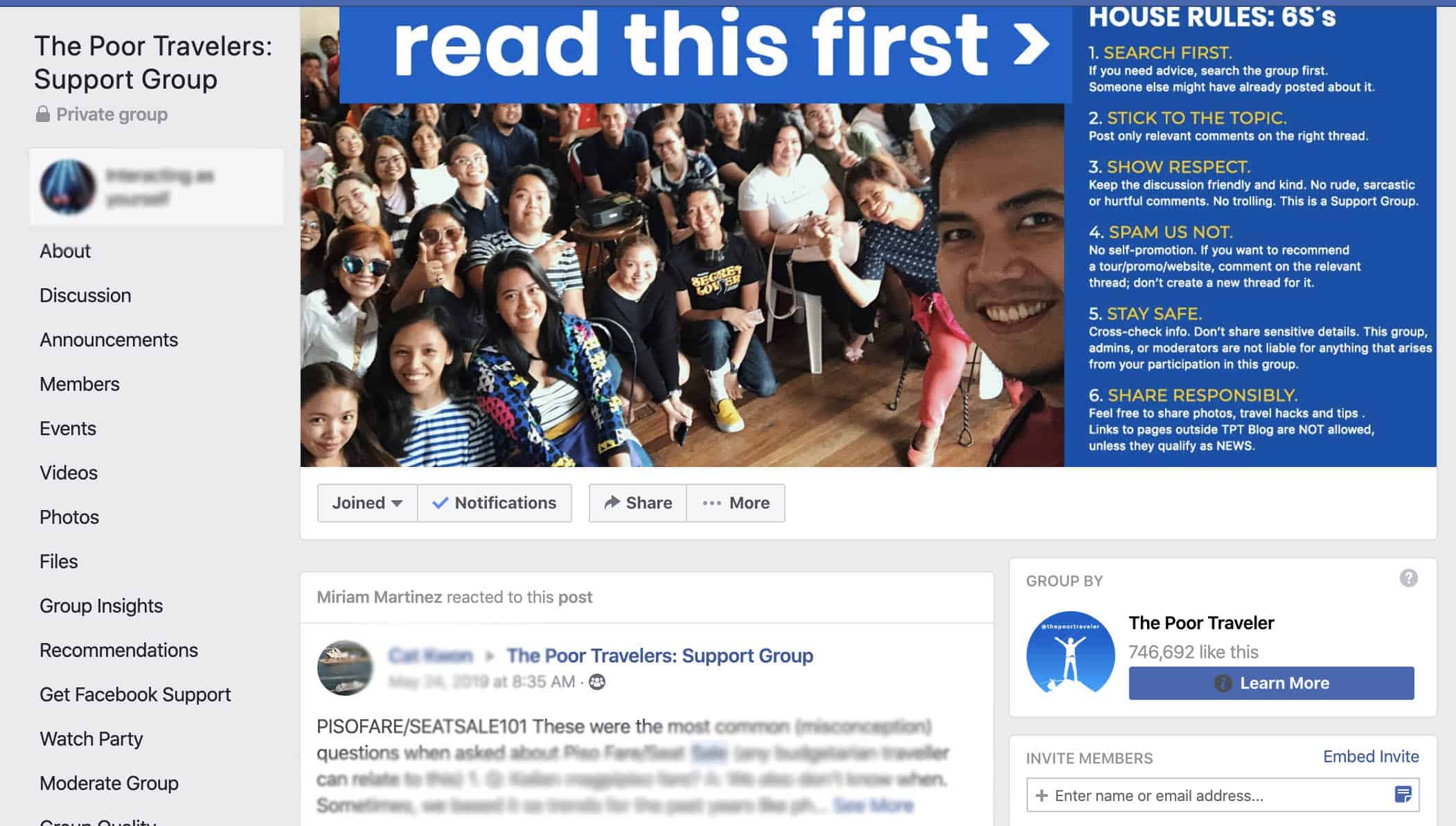
✅ If you have any questions or need travel tips, feel free to post them to the TPT Support Group. The members are very helpful. This Facebook support group has been around for a long time, and many members have found travel buddies through it. You can join too! Just visit The Poor Traveler Support Group. Note that this is different from The Poor Traveler Facebook page.
Updates Log
2026 2 23 – Updated and added schedules/timetables and fares 2021 1 18 – First uploaded
Let Us Gather in a Flourishing Way explores contemporary Latinx artists’ innovations and interventions within established traditions of painting, inviting discussion on a variety of themes and revealing the diversity and expansiveness present within the field. The fifty-eight artists in the exhibition—and those in the Latinx field more broadly—encourage us to interrogate the continued relevance of boundaries, from political borders to disciplinary confines. This exhibition therefore celebrates artists whose expressions are first and foremost personal and subjective, but whose heterogeneous and culturally specific interventions enrich one another and the history of American and contemporary art, two fields from which such artists have been historically excluded. Inspired by former U.S. Poet Laureate Juan Felipe Herrera’s poem “[Let Us Gather in a Flourishing Way],” the show celebrates abundance and presents a vision of Latinx art that is, like the diaspora itself, infinitely complex.
The show’s intergenerational and regionally broad dialogue is reflected in seven thematic groupings: (New) Histories, offering new perspectives on personal, cultural, and global histories; Bodies & Figures, representations of and by marginalized people, considering the importance of the body, and who is or isn’t seen in an image; Identity/Place, a consideration of how identity and place shape each other with a diasporic lens; Land/tierra, varied approaches to land and the built environment, from the material to the imaginary; Community, highlighting various communities—artistic, blood, and chosen—and their importance to populations within the diaspora; Pinturx, contemporary Latinx approaches to traditional painting genres like still life and portraiture; and Abstractions, exploring centuries-long Indigenous and European abstract traditions still in use by artists today.
Allowing for cacophony and heterogeneity in its narratives, the exhibition takes its cues from the artists themselves, who are actively cultivating the landscape of contemporary painting as visitors will experience it in the museum. Rather than telling a finished story, as survey exhibitions often do, this exhibition gives audiences a peek into this vibrant and lively active network.
Let Us Gather in a Flourishing Way is organized by the Buffalo AKG Art Museum and curated by Curator Andrea Alvarez. It will be followed by a national tour including presentations at the Des Moines Art Center, the Museum of Contemporary Art Denver, the Phoenix Art Museum, and the Frye Art Museum, Seattle.
Reliance Partners, an insurance agency in the US, runs a 150-person team that averages around 30,000 calls per month. Sales reps dial out to prospects using local area codes to increase answer rates. Service agents handle inbound claims and quotes via auto attendants, routing callers to the right department.
Reliance didn’t just need a dialer. They needed outbound calling, inbound routing, a mobile app for remote staff, analytics for team productivity, and local presence numbers — all under one roof.
That story matters here because it mirrors the real decision behind comparing CloudTalk vs. Nextiva. The comparison comes down to a simple question: do you need a calling tool or a complete customer experience platform?
I’m Jack Kosakowski, SVP of Marketing at Nextiva. I spent nearly a decade running a B2B demand agency before joining this team, so I know what it looks like when tools either accelerate or slow productivity. I’ll be upfront about where I sit, but I’ll be equally upfront about where each platform fits and where it doesn’t.
This guide to CloudTalk vs. Nextiva breaks down both options so you can decide based on your operating reality.
CloudTalk vs. Nextiva: An Overview
Before getting into the details, here’s a side-by-side snapshot of both platforms. The sections after this table dig into each area.
Category
CloudTalk
Nextiva
Founded
2016, Bratislava, Slovakia
2008, Scottsdale, Arizona
Customers
4,000+ businesses
150,000+ businesses, 1 million+ users
Primary focus
Cloud calling for sales and support
Unified customer experience management
Channels
Voice, SMS, WhatsApp
Voice, SMS, video, email, chat, social, reviews
AI
CeTe AI voice agents (per-minute billing); conversation intelligence
XBert AI receptionist ($99 per month); platform-level AI across channels
CRM integrations
HubSpot, Salesforce, Pipedrive, Zendesk
Salesforce, HubSpot, MS Teams, Zendesk, and 30+ integrations
Video conferencing
Not offered
Built-in on Core plan and above
Uptime SLA
Not publicly specified at the same level
Strives for 99.999%, eight redundant data centers
Free trial
A free trial is available
No public free trial; guided demos available
24/7 support
Chat/email on all plans
Phone, chat, email on all plans (US-based)
G2 rating
4.4/5 (1,732 reviews)
4.5/5 (3,443 reviews)
Industry recognition
Gartner Peer Insights: 4.4/5 for CCaaS
#1 in 13 G2 Winter 2025 reports; Gartner Strong Performer for CCaaS
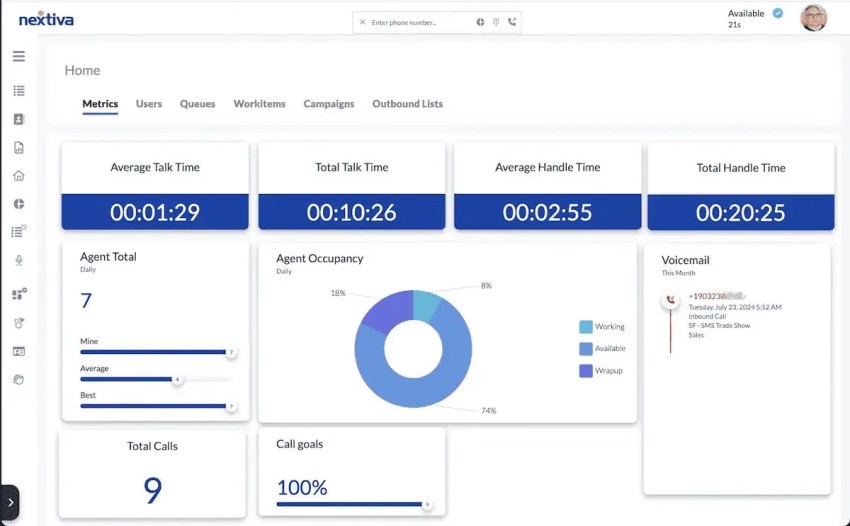
What jumps out from this table is a structural difference. CloudTalk is a calling platform with strong outbound tools. Nextiva is a broader, multichannel customer experience platform that includes calling.
Why does that matter? Because it changes what you’re shopping for. If you need a dialer, you’re comparing features. If you need a communications operating system, you’re comparing architectures. This guide covers both, but knowing which decision you’re making will save you a lot of time.
What is CloudTalk?
CloudTalk is a cloud-based call center platform and VoIP phone system built for sales and support teams. It focuses on telephony-first workflows with strong international reach. The company offers local phone numbers in over 160 countries, making it especially attractive for teams running global outbound campaigns.
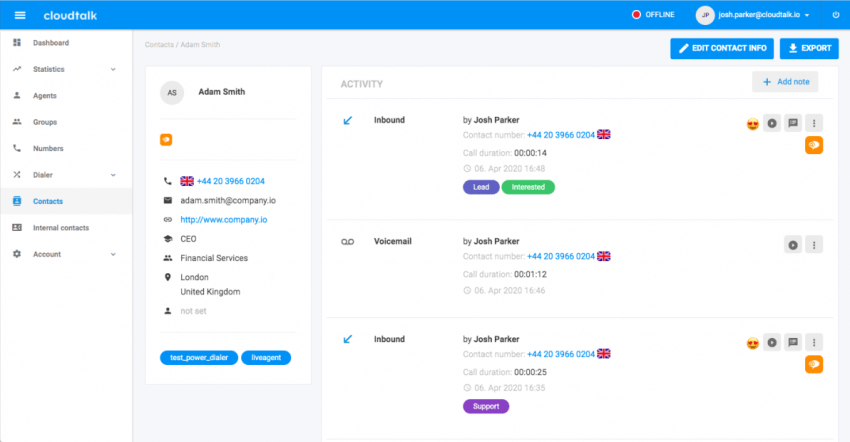
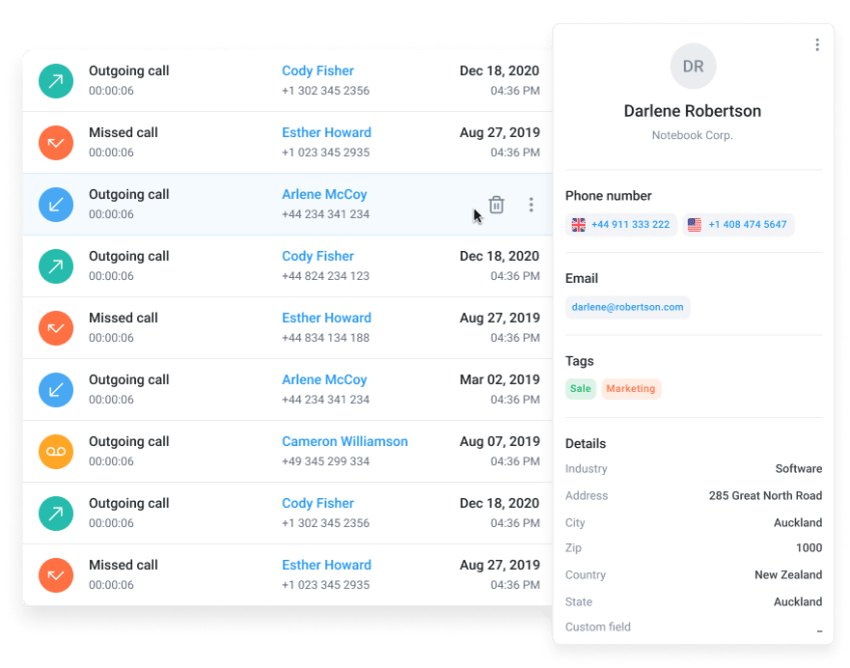
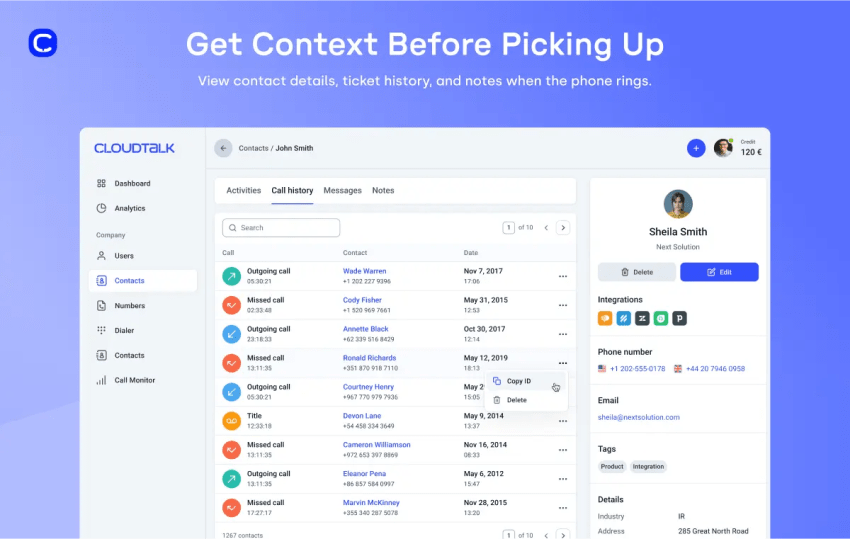
At its core, CloudTalk is about keeping reps on the phone and keeping CRM data clean. If your team lives in HubSpot or Salesforce and needs a tool that automatically logs calls, syncs data back to the CRM, and lets them power through a call list without friction, CloudTalk is built for that. It integrates with over 35 tools, including Pipedrive, Zendesk, Intercom, and Shopify.
CloudTalk also offers AI capabilities. Its AI voice agent, CeTe, handles both inbound and outbound calls autonomously. CeTe qualifies leads, books appointments, answers FAQs, and transfers to human agents when needed. Conversation intelligence features include call summaries and transcripts.
What CloudTalk is not:
CloudTalk is not a unified communications platform. It does not offer video conferencing, team messaging, and other features relevant to the unified communications as a service use case. If your team needs those capabilities, they’ll come from separate vendors. That’s not a flaw in CloudTalk’s design; it’s a reflection of its focus.
What is Nextiva?
Nextiva is a unified customer experience management platform. Where CloudTalk focuses on voice, Nextiva orchestrates conversations across voice, SMS, email, live chat, social media, and video conferencing through a single system. The platform functions as both a call center software solution and a unified communications hub.
Founded in 2008, Nextiva serves over 150,000 businesses and powers more than 1 million users.
The idea behind Nextiva is simple: stop paying for five tools when one can do the job. Instead of managing separate vendors for your phone system, helpdesk, chat, and social media, Nextiva brings those channels into a single platform with shared routing, analytics, and automation.
AI runs across the platform. XBert, Nextiva’s AI receptionist, handles calls, texts, and chats around the clock, booking appointments, capturing leads, and routing complex requests to human agents with full context. On top of that, AI voicemail transcription, sentiment analysis, and chatbots are built into certain plans.
Nextiva strives for 99.999% uptime with eight geographically redundant data centers and provides 24/7 phone, chat, and email customer support across all plans, staffed by a US-based team.
What Nextiva is not:
Nextiva is not just a niche dialer tool. It doesn’t position itself as a single-channel calling product with bolt-on extras. Nextiva offers different auto dialers, but the real value shows up when your team needs shared context, routing, and analytics to connect conversations.
CloudTalk vs. Nextiva: Pricing and Total Cost of Ownership
Both platforms charge per user, but the sticker price only tells part of the story. What matters is what’s included and what costs extra. If you’re evaluating CloudTalk alternatives, understanding the total cost of ownership is the first step.
CloudTalk pricing structure
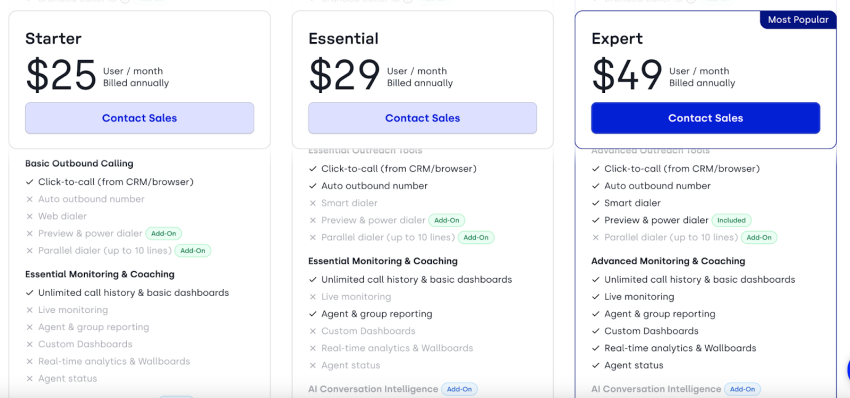
CloudTalk offers tiered plans with annual billing. Pricing varies by region, so the figures below reflect US-based annual billing:
A custom plan with enterprise security, unlimited outbound calls, and custom onboarding is available on a quote basis.
Here’s where the real cost starts adding up:
Dialer access requires Expert: The power dialer and parallel dialer, both central to CloudTalk’s outbound story, only unlock at $15 per user per month and $39 per user per month, respectively. A team that signs up on the Lite plan expecting outbound productivity will need to upgrade. These features are available on the Essential plan as an add-on. Power dialer is included in the Expert plan.
AI voice agents are usage-based: AI conversation intelligence costs $9 per user per month. AI voice agents start at $350 for 1,000 minutes of monthly use.
International numbers carry additional fees: While CloudTalk supports 160+ countries, local numbers in many regions come with per-number charges beyond the base plan. Branded numbers start at $0.07 per call.
Conversation intelligence packaging: AI call summaries, sentiment analysis, and topic extraction are available depending on your plan tier. Verify which AI features come standard or as add-ons.
If you’re a sales leader, you’re likely looking at CloudTalk for the power dialer feature. It’s important to note that this is an add-on for the $19 Lite plan. To get the dialer and the Salesforce integration, you must move to the Expert tier at $49 per user per month.
By the time you add AI conversation intelligence ($9 per user per month) and branded numbers, your seemingly affordable dialer is costing you over $60 per month per rep. This is where Nextiva’s Power Suite ($75 per user per month) starts to look significantly more attractive, as it bundles those AI features and multichannel routing into the base price.
Nextiva pricing structure
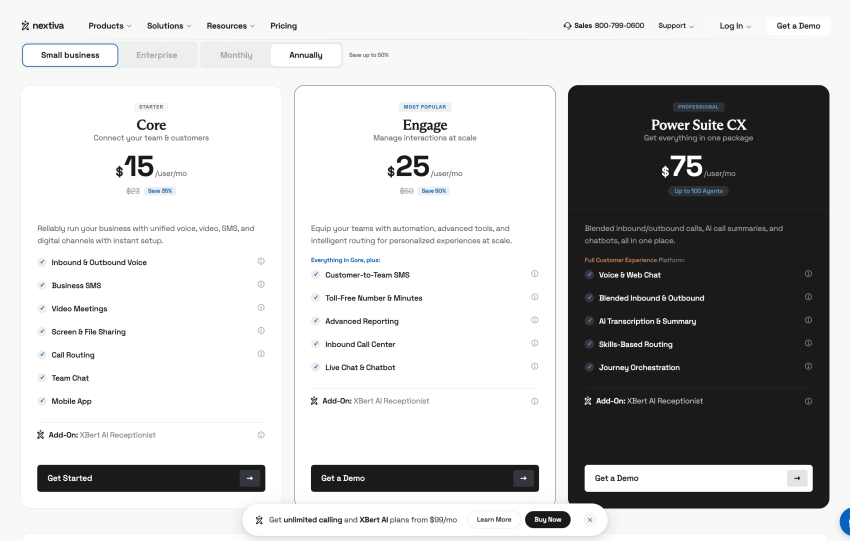
Nextiva offers small business plans built around channel breadth and platform depth. These figures reflect the most recent publicly available pricing:
Plan
Annual Price (per user/month)
Key Inclusions
Core
$15
Features: Inbound and outbound voice Business SMS Video meetings Screenshare and file share Call routing Team chat and collaboration Mobile app Add-on: XBert AI Receptionist
Engage
$25
Includes everything in Core, plus: Customer-to-team SMS messaging Toll-free number and minutes Advanced reporting Inbound sales and service call center (fees may apply) Web chat: Live and bot Add-on: XBert AI Receptionist
Power Suite
$75
Features: Voice and web chat Blended inbound and outbound calling AI transcription and summarization Workforce management Customizable, intelligent, and skills-based routing Support for up to 100 agents Add-on: XBert AI Receptionist
Monthly billing runs 35% higher for the Core plan and 50% higher for the Engage plan. Enterprise plans with concurrent pricing, usage-based models, and advanced security are available separately for larger operations.
Here’s what stands out about Nextiva’s pricing:
Nextiva’s Core plan at $15 per user per month bundles voice calling, video conferencing, team chat, SMS, social media management, and basic interactive voice response (IVR). For teams currently paying separately for a phone system, chat, and experience-related capabilities, the combined cost often favors Nextiva, even when the seat price is similar to CloudTalk’s.
Don’t just compare seat prices. Count how many subscriptions Nextiva can replace across your stack. That’s where the math changes.
Cedar Financial consolidated from seven vendors down to one with Nextiva and saw a 471% increase in agent call volume. Read the full story.
CloudTalk’s calling infrastructure is good for global reach. With local phone numbers in 160+ countries, it helps teams run international outbound campaigns. If your sales motion depends on local presence dialing across European, APAC, or LATAM markets, CloudTalk simplifies it.
High-volume outbound teams where connect rate and list throughput are primary metrics. A BDR team calling into Germany, the UK, and Brazil can use local numbers in each market from a single platform.
CRM-first calling workflows where reps need calls logged automatically in HubSpot or Salesforce without manual data entry.
CloudTalk’s country coverage is impressive, but it’s rarely all-in. While they offer the numbers, many regions carry separate monthly rental fees and higher per-minute outbound rates. If your global operations are primarily in the US, Canada, the UK, and Ireland, Nextiva’s bundled minutes often result in a lower total bill at the end of the month. Always ask for a projected usage quote before signing up.
Where Nextiva stands out
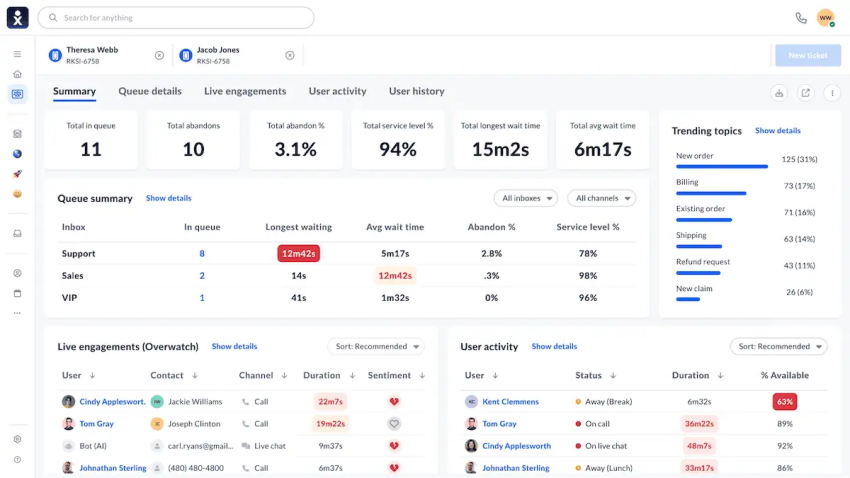
Nextiva’s routing andcall flow capabilities reflect its contact-center DNA. Instead of routing calls based on simple queue logic, Nextiva allows teams to build IVR trees, route callers based on customer data and agent skills, and orchestrate handoffs between AI and human agents within the same flow.
Support teams that need consistent routing logic across voice and digital channels. A customer who starts on chat and escalates to a phone call carries their context forward instead of repeating their issue.
Operations or sales teams that want a single dashboard showing all customer interactions across channels, not separate reports from separate tools.
The approach is less about maximizing calls and more about amplifying the value of every interaction, regardless of the channel it starts on.
Comparing Dialers and Outbound Motion
If outbound calling productivity is your primary buying criterion, this comparison carries the most weight.
CloudTalk has done well in dialer experience. The Expert plan offers:
Power dialer: It automatically dials through a list, eliminating manual dialing and reducing idle time.
Parallel dialer: Available for an additional $39 per user per month, it calls up to 10 numbers simultaneously and connects the rep to the first live answer. This is built for teams optimizing the connect rate above all else.
Both dialers sync with CRM records, logging call outcomes, notes, and recordings automatically. CloudTalk also offers branded caller ID and carrier-level spam remediation for high-volume teams, which helps protect answer rates on outbound campaigns.
For outbound call centers where daily dial volume is the primary metric, this is CloudTalk’s strongest value proposition.
Nextiva’s outbound approach
Nextiva’s outbound story is less about raw dialing speed and more about the full cycle. The platform offers progressive, predictive, and preview dialing modes in its contact center plans, along with routing, analytics, and workflow automation.
Outbound dialing capabilities sit within a broader platform that also handles inbound calls, chats, and emails.
Analytics and automation reduce manual work after the call. Call summaries, sentiment analysis, and CRM syncing happen within the platform’s workflow engine.
Journey orchestration connects outbound activity to the rest of the customer lifecycle. A sales call that converts into a support case keeps its context when it moves between teams.
Teams that use dialing speed and list throughput as the only metrics will find CloudTalk’s dedicated dialer tools more purpose-built. Teams where outbound calling is one part of a larger sales or service operation will find Nextiva more valuable over time.
Comparing AI Capabilities
Both CloudTalk and Nextiva offer AI, but they package it differently.
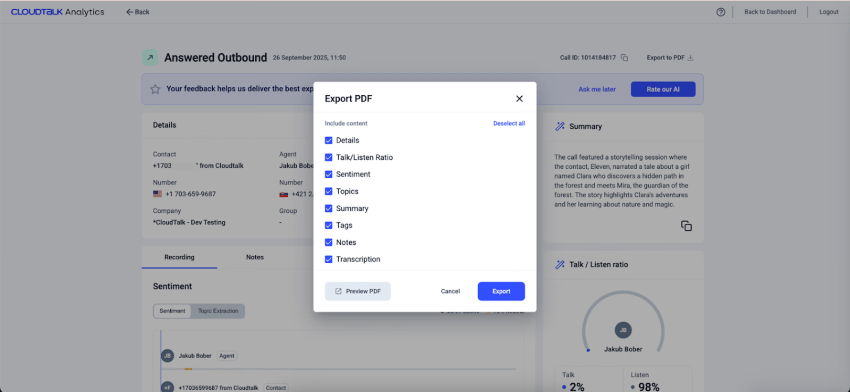
AI conversation intelligence provides post-call value: automatic call summaries, transcripts, sentiment analysis, topic extraction, and talk-to-listen ratios. These help managers review more calls in less time and spot coaching opportunities without having to listen to every recording. Feature availability varies by plan tier.
CeTe (AI voice agent) autonomously handles live calls. CeTe can make outbound calls for lead qualification, appointment reminders, and follow-ups, and receive inbound calls for FAQs, routing, and data collection. Its pricing is usage-based.
Questions to resolve before buying:
Which conversation intelligence features are included in your plan versus billed separately?
Does CeTe’s per-minute cost align with your projected call volumes?
How do AI-generated outputs (summaries, tags, sentiment) flow into your CRM automatically versus manually?
Nextiva AI and XBert
Nextiva treats AI as an integrated layer across its platform rather than a standalone product.
XBert AI is Nextiva’s AI receptionist. It handles calls, texts, and web chats around the clock, answering questions from your business’s knowledge base, booking and rescheduling appointments, capturing leads, and routing complex requests to human agents with full conversation context. XBert learns from your website and business data automatically, requiring minimal setup. Pricing starts at $99 per month for 100 interactions, with additional interactions at $0.99 each.
Platform-level AI includes voicemail transcription, real-time sentiment analysis, AI-powered call routing, and chatbots. AI-generated call summaries and notes feed directly into Nextiva’s workflow engine, making insights actionable within the same system rather than being exported elsewhere.
CloudTalk’s AI is strong in the voice lane. Nextiva’s AI is broader, spanning voice, chat, text, and social channels within a single orchestration layer.
Integrations and System Fit
Both platforms integrate with the CRM and helpdesk tools that sales and support teams depend on. The question is how deep those integrations go and whether they reduce tool switching or just add another connection to manage.
CloudTalk integrations
CloudTalk offers native integrations with over 35 tools, including HubSpot, Salesforce, Pipedrive, Zendesk, Intercom, and Shopify, plus Open API access on Essential plans and above.
The CRM integration story is a genuine strength. Users praise automatic call logging to HubSpot and Salesforce, noting it reduces manual data entry and keeps CRM records current without rep intervention.
What to verify: Integration depth varies. Salesforce integration, for instance, requires the Expert plan. API access starts with the Essential tier.
Teams needing deep, bidirectional data sync should confirm exactly which logs are automatically synced versus which require manual configuration at the plan level.
Nextiva integrations
Nextiva integrates with Salesforce, HubSpot, Microsoft Teams, Zendesk, and other major CRM and productivity platforms. The MS Teams integration is included on the Engage plan and above and is available on Core as an add-on. Nextiva also provides REST APIs for custom integrations and workflow automation.
Where Nextiva’s integration story diverges is in emphasis. Rather than syncing call data from a separate phone tool into a CRM, Nextiva aims to be the system where customer interactions across voice, chat, email, and social media already live. The CRM integration enriches that unified view rather than building it from scratch.
For teams managing customer relationships across multiple channels, the value of integration shifts from “Does my phone system talk to my CRM?” to “Does my platform reduce the number of tools my team switches between every day?”
What Reviews and Reliability Signals Tell Us
Aggregate scores only tell you so much. The patterns inside those reviews are what predict whether a platform will work for your team.
CloudTalk review themes
Here’s an overview of what users praise and flag about CloudTalk:
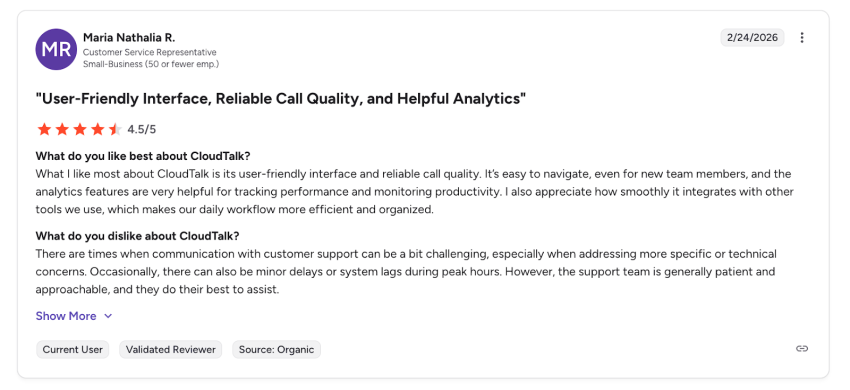
What users praise: Ease of use is cited positively on Capterra, with reviewers calling the interface user-friendly and quick to learn. CRM integrations with HubSpot, Salesforce, and Pipedrive earn consistent marks for automatic logging. International coverage and quick setup are recurring themes.
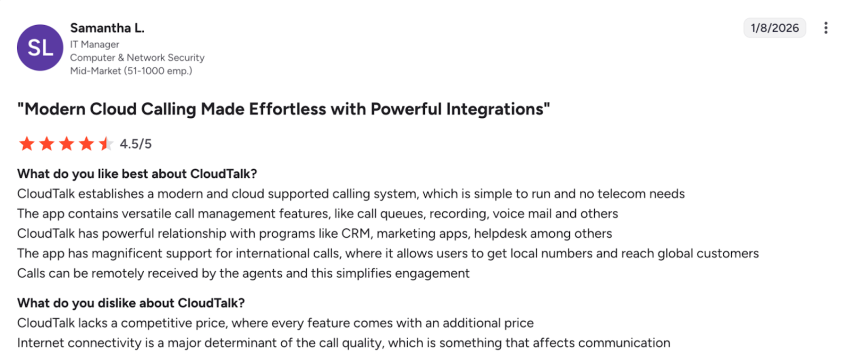
What users flag: Call quality issues rank as the top negative theme on G2, including connection drops and jitter. Billing and cancellation friction drives lower scores on Trustpilot, with complaints about auto-renewal terms.
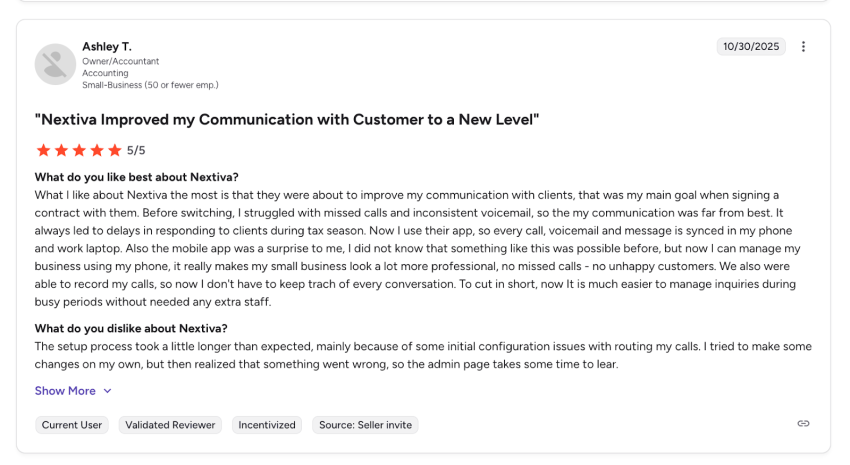
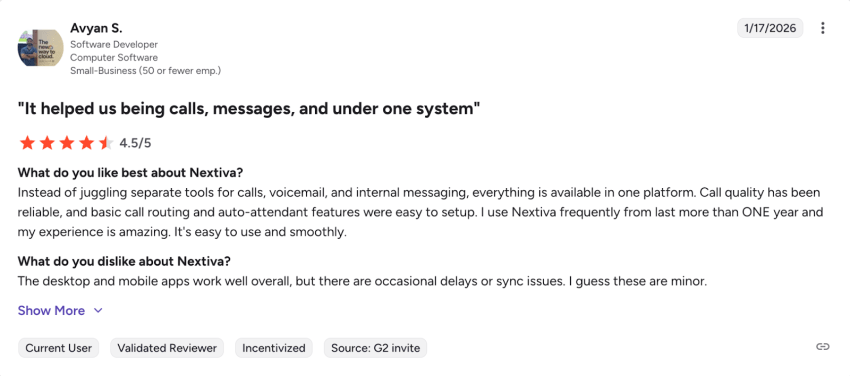
What users praise: The unified platform that reduces tool switching is the defining positive. Call quality and reliability earn strong marks, backed by high uptime. Customer support during onboarding and ongoing use is frequently described as knowledgeable, patient, and responsive.
What users flag: Some customers say that the initial setup (advanced IVR) is complex. However, the award-winning customer support makes it easier to navigate the setup while assisting with configurations.
My advice: Don’t take anyone’s word for it, including mine. Run both platforms against your actual workflows, network conditions, and use cases before signing a contract.
DirectBuy runs 30,000+ calls per month across 600 staff with Nextiva. Their Contact Center Director calls the real-time analytics “irreplaceable and vital.” Read their story.
Decision Framework for Buyers Comparing CloudTalk Vs. Nextiva
Forget the feature checklist for a moment. Here’s how to think about this decision based on what your team does every day.
Choose CloudTalk if:
Outbound calling productivity is the priority: CloudTalk’s power dialer and parallel dialer are purpose-built for teams measuring daily dials and connection rates.
You run a global calling motion: Local numbers in 160+ countries, with local presence dialing, are tricky to match at CloudTalk’s price point.
You want a focused calling tool: If your stack already covers chat, email, social, and video, and you need a better phone layer, CloudTalk fills that gap.
Choose Nextiva if:
You need to unify customer conversations across channels: If voice, SMS, chat, email, and social interactions are scattered across different tools, Nextiva consolidates them into one system with shared context.
Routing, analytics, and automation need to work across the entire customer journey: Nextiva connects outbound sales activity to inbound support workflows. Customer context follows the conversation, not the channel.
You’re reducing vendor sprawl: Every separate tool adds an integration to maintain, a support queue to navigate, and a renewal to manage. Nextiva’s platform approach means fewer vendors and one place to manage communications, customer support, and team collaboration.
Reliability and support accountability matter: Nextiva’s uptime, with eight carrier-grade data centers and 24/7 US-based support on all plans, provides a scalable reliability baseline.
Five questions to answer before deciding between CloudTalk and Nextiva
Before you pick either platform, sit down with your team and answer these honestly.
1. Are we buying a dialer or a customer interaction platform?
If the answer is a dialer, CloudTalk deserves serious evaluation. If the answer is a platform, Nextiva fits the need.
2. Do we need omnichannel now or within the next 12 months?
Choosing a unified platform now avoids a painful migration later.
3. How many tools do we currently manage for calling, transcription, QA, analytics, and reporting?
Count them. Nextiva replaces more of them.
4. What does success look like at 50 agents?
Model cost and complexity at your growth target, not just your current headcount. Add-on costs that seem small at five seats compound at 50.
5. What’s our fully loaded cost per seat?
Map both platforms’ pricing against your specific business needs. The base price is the starting point, not the answer.
Why Nextiva Is Built for What Comes Next
CloudTalk does calling well. If your team needs dialing speed, it delivers.
But here’s what I have seen happen over and over: teams start with a dialer, and six months later, they need chat and SMS. Then someone asks why the support team can’t see what the sales team promised on the phone, and suddenly you’re managing five tools that don’t talk to each other.
That’s where the drag sets in. Reps lose context when switching between platforms. Managers pull reports from dashboards that don’t share data. The cost isn’t just financial. It’s the kind of operational friction that worsens the bigger you get, making a scalable, unified platform increasingly valuable.
Nextiva is built to address that compounding problem. Every customer conversation lives in one system. When a customer calls your support line and then messages you on SMS about the same issue, your team sees one thread instead of two disconnected tickets. With Nextiva, you build a customer communication operating system.
Reliance Partners figured that out when they stopped treating calling as an isolated tool and started running outbound sales, inbound support, and analytics on a single platform. If your team is heading in the same direction, explore how Nextiva can support your sales and support operations.
A New Dawn in Customer Experience
The complete customer experience platform. Win every conversation, measure every interaction, and use AI to optimize every customer journey. Grow your business without working harder.
Frequently Asked Questions About CloudTalk vs. Nextiva
What is the main difference between CloudTalk and Nextiva?
CloudTalk is a voice-focused calling platform designed for sales and support teams. Nextiva is a unified customer experience platform that combines voice, video, SMS, chat, email, social media, and review management into a single system with shared routing, analytics, and AI.
Which platform is cheaper between CloudTalk and Nextiva?
Nextiva’s Core plan starts at $15 per user per month (annual). CloudTalk’s Lite begins at $19 per user per month (annual). However, the total cost depends on add-ons and which tools each platform replaces in your stack.
Does CloudTalk offer a free trial?
Yes, CloudTalk offers a free trial. Nextiva does not offer a public free trial but provides guided demos with product experts through its sales team.
Which platform is better for startups: CloudTalk or Nextiva?
Startups focused primarily on outbound sales calling may find CloudTalk’s lower entry price and focused dialer tools a natural fit. However, given the price point Nextiva comes in at, it delivers more value compared to CloudTalk. The breadth of functionality reduces the need to bring in other tools. Most importantly, when your teams scale, Nextiva grows with you. There’s no need to plan a costly and time-consuming migration.
Which platform has better uptime: CloudTalk or Nextiva?
Nextiva publicly strives for 99.999% uptime with eight geographically redundant data centers. CloudTalk does not publish a comparable uptime SLA at the same specificity on its pricing or product pages.
What is XBert?
XBert is Nextiva’s AI receptionist that handles calls, texts, and web chats 24/7. It answers questions, books appointments, captures leads, and routes complex requests to your team with full context.
If you’ve enjoyed the egg bites at Starbucks, here’s how to make them at home! These egg bites have become a staple recipe in my kitchen. Sure, they’re not the prettiest egg recipe, but they’re wonderfully flavorful and silky tender. They’re a protein-rich snack or ready-made breakfast to keep in your refrigerator (they freeze and defrost well, too).
These egg bites are a fun cooking project with a few twists along the way. I was surprised to find cottage cheese in Starbucks’ ingredient list. It’s the secret ingredient that offers a lovely tang and extra protein. Once blended, the lumpy texture disappears, which explains why I’d never guess it was there.
Instead of Starbucks’ sous vide cooking method, we’ll bake the muffin tray on a rimmed baking sheet filled with a small amount of hot water. The steam from the water bath gives these bites a luscious, smooth texture. Without it, the eggs would brown at the bottom and taste more like frittata muffins. It’s a small detail that makes a big difference!
Inspired by Starbucks
I modeled the recipe after Starbucks’ vegetarian egg bites. I ate a ton of them when I was pregnant with our daughter, as I had trouble with gestational diabetes. My brother stayed in the hospital for a month as he recovered from a bad accident, and Starbucks was a short walk across the street. Their egg bites were one of the few protein-rich, low-carb snacks I could find that didn’t spike my blood sugar.
Starbucks uses egg whites in its recipe, but I used whole eggs because the yolks are high in choline, and separating eggs can be fussy and wasteful if you don’t have a good use for them. This recipe doesn’t taste exactly like theirs because the ingredients and cooking method are a bit different, but it’s definitely similar. If you like Starbucks’ version, I’m confident you’ll enjoy these, too.
This recipe and my energy balls have been my go-to postpartum snacks, so consider making a batch for your friends who have just had a new baby.
Egg Bite Substitutions
This recipe is so flexible! It’s the perfect way to use the leftover veggies and cheese in the fridge. Here’s guidance on how to adjust the recipe yourself, and you’ll find my suggested variations in the next section.
Change the cheese
Instead of mild Monterey Jack, try cheddar cheese, Gruyère, mozzarella, crumbled goat cheese or your cheese of choice. You could replace some of the cheese with crumbled feta or grated Parmesan, but using all feta or Parm could make it too salty.
Change the veggies
Substitute up to 2 cups of vegetables for the spinach and red peppers used in this recipe. They’ll retain their texture after baking, for the most part, so I recommend cooking and chopping them before stirring them into the egg mixture.
Timing considerations: The recipe below calls for sautéeing green onions, spinach and roasted red bell peppers for just a minute or two, until tender and wilted. You could substitute arugula for the spinach, or try kale, chard, or collard greens—they’re tougher, and would likely require a couple extra minutes on the stove.
If you’re using tougher veggies, you’ll need to cook them longer—consider steaming for a milder flavor or roasting for caramelized complexity. This recipe is a great use for leftover roasted vegetables, like sweet potatoes or cauliflower.
A note on the green onion…
I prefer it lightly cooked as written below for a more mild flavor and tender texture. If you’re not cooking any other ingredients in a skillet, you could substitute 2 tablespoons finely chopped fresh chives or 1 medium clove of garlic, pressed or minced, for similarly irresistible allium flavoring.
Suggested Flavor Variations
This section draws inspiration from my favorite egg-based recipes on the blog.
Spinach, goat cheese and sun-dried tomato
Sauté the spinach as described in the recipe below, add some chopped sun-dried tomatoes and crumbled goat cheese. (Inspired by these scrambled eggs.)
Broccoli cheddar
Use steamed broccoli, cheddar cheese, and chives or sautéed green onion. Include some chopped spinach if you’d like. (Inspired by my this frittata.)
Arugula, cremini mushroom and goat cheese
Sauté the mushrooms, then add arugula and cook just until it’s wilted. (Inspired by this quiche.)
Butternut squash and Parmesan
Start with roasted butternut squash, and add some chopped chives. (Inspired by this frittata.)
Print
Egg Bites
These egg bites are cheesy, tender, fluffy and delicious! Inspired by Starbucks, this recipe is easy to make at home. Egg bites are the perfect grab-and-go breakfast or protein-rich snack. They freeze well and defrost quickly in the microwave! Recipe yields 1 dozen egg bites.
Preheat the oven to 325 degrees Fahrenheit, and line all twelve muffin cups with paper liners. In a kettle or medium saucepan, bring 3 cups of water to a boil and maintain a simmer until it’s needed.
In a blender, combine the eggs, cottage cheese, 1 cup of the shredded cheese, and the salt and pepper. Blend on high for 8 to 10 seconds, just until the mixture is smooth and frothy (no longer!). Set it aside.
Melt the butter in a large skillet over medium heat. Add the green onion and a pinch of salt, and stir to combine. Add the spinach and roasted red pepper, and cook just until the spinach is wilted, about 1 to 2 minutes. Remove the mixture from the heat and let it cool for a couple of minutes, then stir it into the blender mixture.
Place the prepared muffin pan on a large, rimmed baking sheet. Carefully pour the egg mixture into the muffin cups, filling each cup about three-fourths full. Divide the remaining ½ cup of shredded cheese over the egg bites, then transfer the stacked pans to the oven. Carefully pour the hot water into the sheet pan, just enough to submerge the bottom of the muffin cups.
Bake for 26 to 30 minutes, until the egg bites have set. Remove the muffin pan from the sheet pan of water in the oven, let the bites rest for 5 minutes, then transfer the bites to a cooling rack. Egg bites will keep in the fridge, covered, for up to 4 days, or in the freezer for up to 3 months. Remove the paper liners before reheating them in a microwave or on a rimmed baking sheet in a 300-degree oven until warmed through (they will release some moisture while reheating, which you can discard; the paper liners will trap it, so remove those beforehand).
Nutrition
The information shown is an estimate provided by an online nutrition calculator. It should not be considered a substitute for a professional nutritionist’s advice. See our full nutrition disclosure here.
Chronic fatigue syndrome (CFS) continues to puzzle medical practitioners. To date, it’s estimated that around 3.3 million Americans have this condition. However, this number may not be completely accurate because CFS symptoms overlap with dozens of other conditions, making it difficult to formally diagnose. To make matters worse, there’s no official test for CFS. Therefore, coming up with a diagnosis requires a multifaceted approach.1
Fortunately, researchers have begun to make headway into discovering a big part of what causes CFS — ticks.2 Often hidden in plain sight, these minuscule parasites contain bacteria such as Babesia or Bartonella, which transfer to your blood once they latch onto your skin.3
So, if you’ve been told your labs are normal but you can barely get through the day these days, you’re not imagining it — the answer may be hiding in your blood.4
An Unexpected Source Behind Chronic Fatigue — Ticks
A study published in Pathogens investigated whether people living with CFS carry hidden blood infections that standard tests completely miss. In this case, researchers focused on organisms known to cause tick- and flea-borne disease. They selected 50 participants who reported fatigue episodes lasting between six months to 19 years, and used certain blood tests to detect signs of tick-borne infections.5
• The extent of tick-borne infections in CFS — A total of 23 participants tested positive for either Babesia, Bartonella, or both. Breaking it down further, 10 had Babesia, 11 had Bartonella, and two carried both strains.
According to the authors, both Babesia and Bartonella cause “chronic, subclinical infections,” where levels of the organism stay extremely low and fluctuate over time. This means a standard blood test often misses the infection because the organism ducks in and out of detectability. If you’ve ever received conflicting test results or are told that your labs look fine on paper, ticks could be the culprit.
• How the infections lead to CFS — A Babesia infection occurs inside red blood cells, which strains oxygen delivery throughout the body and reduces cellular energy production.6 Bartonella, on the other hand, targets the CD34+ cells — progenitor cells that help maintain and repair the lining of your blood vessels.7 Now, when both pathogens coexist, your energy output and neurological stability suffer on two fronts simultaneously.
Babesia functions much like malaria in that it parasitizes red blood cells and disrupts oxygen transport.8 When your cells do not receive steady oxygen, they struggle to make adenosine triphosphate (ATP), your body’s energy currency. Bartonella spreads through red blood cells and blood vessel linings, creating inflammation that triggers pain, muscle fatigue, and neurological issues.9
• Limitations of the research — The study does not quantify improvement rates or track symptom resolution because it focused strictly on detection, not treatment. Still, it serves a powerful purpose — if nearly half of CFS sufferers carry a tick-borne infection, ignoring that possibility delays your chance of recovery.
The specialized tests validate the importance of adopting a holistic view on health care because standard systems fail to detect tick-borne diseases that lead to CFS. By using enrichment blood cultures (a method that grows the organism in a lab sample over time to raise its concentration to detectable levels), the researchers uncovered infections that regular polymerase chain reaction (PCR) or antibody tests would likely have dismissed.
Overall, the study reframes how CFS can be approached for better treatment. According to the authors, these findings justify new case-control studies and updated diagnostic strategies that rely on direct detection rather than assumptions about symptom psychology or stress. So, if your health care provider dismissed your symptoms because of normal labs, this research gives you firm ground to request more advanced testing and push for a more accurate explanation.
Chronic, Unspecified Illnesses Could Be Traced Back to Ticks
In a related study published in Parasites & Vectors, researchers investigated the Babesia species and its link to chronic, unexplained disease. They selected seven individuals whose daily lives were affected by the hallmark symptoms of CFS.10
The study used digital PCR testing, which looks directly for DNA rather than relying on antibody-based results that often miss chronic infections. Each participant submitted multiple blood and serum samples over a seven-day period, which was a vital step because Babesia and Bartonella fluctuate in how detectable they are from day to day. This increases the chances of uncovering an infection if your symptoms fit the CFS profile, but your standard bloodwork looks normal.
• Tissue samples helped elucidate how the parasites behave — Two participants submitted tissue samples, while another contributed a sample from an intravenous port. These were analyzed alongside standard blood samples (given by all seven participants) to look for Bartonella. Including tissues shows how deeply these organisms can embed themselves.
• Exposure plays a big role in getting infected — The study design also required detailed questionnaires covering age, sex, animal exposure, travel history, outdoor activity, symptom patterns, illness duration, and all previous treatments.
Out of all this, one common pattern emerged — direct exposure or contact to animals, both domesticated and wild. “Four individuals were veterinary workers, two were students, one of whom was a veterinarian’s daughter, and one was a pre-school-age child,” the researchers noted.11
• Babesia produces symptoms that mirror many chronic illnesses — Participants reported fatigue, night sweats, muscle pain, excessive thirst, headaches, and sleep problems — symptoms most doctors chalk up to stress, burnout, or nonspecific viral issues. By linking these issues with confirmed Babesia infection through direct DNA detection, the study gives you a more concrete path for treatment and eventual recovery.
• The rate of co-infection is overwhelming — Six participants carried one or more Bartonella species alongside Babesia. For those trying to understand persistent symptoms, this means your illness might not be driven by a single infection. Instead, you might carry multiple organisms at once, each adding its own layer of fatigue, neurological instability, and immune disruption.
• The findings also highlight the inconsistencies of routine laboratory tests — While standard tests often return negative results, the combination of digital PCR (a highly sensitive technique that can detect even a handful of DNA copies in a blood sample) and sequencing identified the parasite in all seven participants. Thus, using these methods on current and CFS sufferers can help detect potential tick-borne infections within them.
Don’t Wait Until You Get a Tick-Borne Disease — Take Preventive Measures
For people living in states where wild animal populations are surging, it would be wise to stay alert to this growing health concern. As noted in the findings, wildlife (such as deer) are a common source of exposure to tick-borne diseases. Here are several practical strategies I recommend to help you reduce your risk:
• Limit time in tick-prone areas when possible — Ticks thrive in wooded areas, tall grass, brush, and overgrown vegetation. If you’re hiking, camping, or spending time outdoors, stay in the middle of trails to avoid contact with plants where ticks may be waiting.
• Dress for defense — Wear long sleeves, long pants, and long socks whenever you’re in high-risk areas. Tuck your shirt into your pants and your pant legs into your socks to keep ticks from reaching your skin. Wearing light-colored clothing is also helpful since it makes ticks easier to spot.
• Do a full tick check once you’re back indoors — After spending time outside, examine your body carefully. Use a handheld mirror or full-length mirror to check hard-to-see areas and remove any ticks immediately. Also, inspect clothing, outdoor gear, and pets, since ticks can hitch a ride on them.
Having a sticky lint roller is a good first line of defense once you get home — simply roll it over your clothes and pets as soon as you come in. A few quick passes can pick up crawling ticks before they have a chance to attach.
• Shower promptly after outdoor activity — After cleaning yourself and your clothing, shower within two hours of coming inside. This helps rinse off unattached ticks and reduce your risk of infection.
• Protect your yard from ticks — Mow the grass regularly and remove leaf piles and debris. Trim tall grass and brush around your home and along the edges of your yard. You can also create a 3-foot border of gravel or wood chips between your lawn and wooded areas to help limit tick movement into recreational spaces.
• Don’t forget your pets — Dogs are especially vulnerable to tick bites and can easily bring these parasites indoors. Consult an integrative veterinarian to choose the most appropriate tick prevention strategy for your animal.
• Use a safe insect repellent — Avoid repellents containing diethyltoluamide, commonly called DEET. It has been associated with unwanted side effects. Instead, consider natural alternatives such as lemon eucalyptus oil, neem oil, or cedar oil to help deter ticks and other pests.
• Reduce exposure to electromagnetic fields (EMFs) — In my interview with Dr. Dietrich Klinghardt, an expert on Lyme disease (caused by black-legged ticks found in deer), he strongly encourages removing as many EMF sources as possible as it can have a positive impact in managing this condition.
In fact, he’s convinced that the increased virulence of Lyme disease is because of the drastic increase in EMF sources around us. You can listen to our conversation below. For an in-depth list of tips for reduction, read “10 Studies Detail Health Risks of 5G.”
Found a Tick? Follow These Steps
One major reason tick-borne illnesses have become so widespread is that many people still don’t know how to safely remove and dispose of a tick once it has attached to their skin. It’s also important to understand that outdated tactics — like trying to burn the tick off or smothering it with nail polish — don’t solve the problem, and can also actually raise your risk of infection.
• Removing a tick the wrong way can increase disease risk — Ticks are often tiny, sometimes no larger than a sesame seed, which makes them tricky to handle. Using your fingers or bulky tweezers can easily crush the tick. If you squeeze its body, you may force pathogens from inside the tick directly into your skin.
• A fine-point tweezer is your best option — Use a sharp, fine-tip tweezer and grip the tick as close to your skin as possible, right where its mouthparts are embedded. Then pull straight upward with slow, steady pressure. Avoid jerking, twisting, or yanking, since that can cause the tick to break apart and leave pieces behind.
• Proper disposal is just as important — Never crush a tick with bare fingers, as this can spread its blood, bacteria, and saliva onto your skin. Instead, wrap it in tape and throw it away, flush it down the toilet, or drop it into alcohol.
What you do in the first few minutes after discovering a tick bite can either reduce your exposure or significantly increase it. For a more thorough breakdown of what to do — and what to avoid — read “The Best and Worst Way to Remove a Tick.”
Frequently Asked Questions (FAQs) About the Link Between Tick Bites and Chronic Fatigue Syndrome
Q: How are ticks connected to chronic fatigue syndrome (CFS)?
A: A recent study found that nearly half of CFS participants tested positive for tick-borne infections — Babesia and Bartonella. These organisms invade red blood cells and damage blood vessel linings, producing persistent fatigue, pain, and neurological symptoms.
Q: Why do standard blood tests fail to detect these tick-borne infections?
A: Babesia and Bartonella maintain extremely low bloodstream levels that fluctuate over time, affecting detectability. Advanced methods like enrichment blood cultures and digital PCR are far more effective at uncovering these hidden infections.
Q: What is coinfection, and why does it matter for people with unexplained chronic illness?
A: Coinfection means carrying multiple pathogens simultaneously. In one study, six of seven chronically ill participants harbored both Babesia and Bartonella, each attacking the body differently — compounding symptoms and explaining why single-pathogen treatments often fail.
Q: What are the most effective ways to prevent tick-borne illness?
A: Wear long, light-colored clothing outdoors, stay on established trail routes, perform full-body tick checks afterward, and shower within two hours. At home, keep grass mowed, remove leaf litter, and create gravel barriers between your lawn and wooded areas.
Q: What should you do if you find a tick attached to your skin?
A: Use fine-tipped tweezers to grip the tick close to the skin and pull straight up with steady pressure — never squeeze, twist, or jerk. Dispose by sealing in tape, flushing, or dropping in alcohol. Avoid burning or smothering methods.