Notice: Function _load_textdomain_just_in_time was called incorrectly. Translation loading for the td-cloud-library domain was triggered too early. This is usually an indicator for some code in the plugin or theme running too early. Translations should be loaded at the init action or later. Please see Debugging in WordPress for more information. (This message was added in version 6.7.0.) in /home/releande/public_html/wp-includes/functions.php on line 6170
News Magazine | Get The Most Freshy News Every Day | Page 462
Saturday, June 13, 2026
Home Blog Page 462

Behind the Mic Battles: Dissecting Hip-Hop Beef Analysis

0

Hip-Hop Beefs: Unveiling the Dynamics

Understanding the dynamics of hip-hop beefs requires a deep dive into their historical significance and how these rivalries have evolved over time. This section aims to shed light on these aspects.

Historical Significance of Hip-Hop Rivalries

Hip-hop rivalries have played a crucial role in shaping the genre. From lyrical battles to public feuds, these conflicts have created some of the most memorable moments in hip-hop history. Rivals often used beefs as a way to assert dominance, prove lyrical superiority, and engage listeners through compelling narratives.

One of the early significant rivalries was between KRS-One and MC Shan in the mid-1980s, famously known as “The Bridge Wars.” Their feud revolved around the origins of hip-hop, with each artist claiming their respective borough as the birthplace of the genre. This rivalry not only highlighted the competitive nature of hip-hop but also emphasized the genre’s roots in local culture and representation.

Evolution of ‘Beefs’ in Hip-Hop Culture

Over time, hip-hop beefs have evolved, influenced by changing technology, media platforms, and cultural shifts. In the early years, beefs were primarily local, with artists from different neighborhoods or cities engaging in battles through live performances or radio appearances.

With the advent of the internet and social media platforms, hip-hop beefs entered a new era. Diss tracks could be released instantly online, reaching a global audience within minutes. Social media allowed for real-time interactions, escalating conflicts and making them more public than ever before.

Era Notable Rivalries Medium Impact
1980s KRS-One vs. MC Shan Radio, Live Performances Local Impact
1990s East Coast vs. West Coast Mixtapes, Music Videos National Impact
2000s Nas vs. Jay-Z Internet, Albums Global Impact
2010s Drake vs. Meek Mill Social Media, Online Platforms Instant Global Reach

Furthermore, the commercial aspect of hip-hop beefs has also evolved. Feuds often attract a lot of media attention, leading to increased record sales and digital streams. This commercial benefit sometimes leads to speculation about whether certain beefs are genuine or orchestrated for publicity.

By examining the historical significance and evolution of hip-hop rivalries, one can gain a deeper understanding of their complexity and the lasting impact they have on the genre.

Analyzing the Triggers

In the realm of hip-hop, rivalries, often referred to as “beefs,” play a significant role in shaping the narrative and culture of the genre. Understanding the triggers behind these disputes requires a deep dive into the reasons and various factors that fuel these conflicts.

Reasons Behind Hip-Hop Beefs

Hip-Hop beefs can arise from a multitude of reasons. At the core, these rivalries often stem from deeply personal issues, professional disagreements, or clashes over artistic identity.

  • Territorial Disputes: Rivalries often emerge from the geographical divisions within the hip-hop community, notably the East Coast vs. West Coast feud.
  • Artistic Differences: Conflicts over artistic direction and originality can spark beefs. Artists may feel their style or lyrics have been copied or disrespected.
  • Personal Relationships: Personal vendettas and broken friendships within the industry can lead to public feuds.
  • Commercial Success: Competition for chart dominance and financial success can also ignite rivalries.

Impact of Ego, Fame, and Competition

Ego, fame, and competition are significant contributors to the intensity and longevity of hip-hop beefs.

  • Ego: Artists’ egos can lead to heightened sensitivity towards criticism and perceived slights. The public nature of the industry means any insult, real or imagined, can quickly escalate.
  • Fame: Maintaining a public image is crucial in the hip-hop world. Fame can both exacerbate and prolong conflicts as artists strive to assert their dominance.
  • Competition: The competitive nature of hip-hop encourages artists to constantly prove their supremacy and relevance, often through lyrical battles and public diss tracks.

Table: Common Triggers of Hip-Hop Beefs

Trigger Explanation
Territorial Disputes Conflicts based on geographical regions (e.g., East Coast vs. West Coast).
Artistic Differences Disputes over originality and artistic direction.
Personal Relationships Feuds arising from personal matters and broken friendships.
Commercial Success Rivalries due to competition for chart positions and financial gains.
Ego Sensitivity to criticism and the need for respect.
Fame The pressure to maintain a dominant public image.
Competition The drive to prove one’s superiority in the industry.

Analyzing these triggers offers insight into the intricate dynamics of hip-hop beefs. These rivalries are not only about personal animosities but are deeply interwoven with the culture, fame, and competitive spirit of the hip-hop industry. They reflect the struggle for identity, respect, and dominance in a highly publicized and scrutinized arena.

Notable Hip-Hop Beefs

Hip-hop has a long history of rivalries and conflicts that have shaped the genre and influenced the broader cultural landscape. Some of the most notable feuds have left a lasting impact on the hip-hop community and continue to be discussed and analyzed today.

East Coast vs. West Coast Feud

One of the most infamous and significant feuds in hip-hop history is the East Coast vs. West Coast rivalry. This conflict primarily took place during the early to mid-1990s and involved some of the biggest names in the industry. The rivalry was characterized by geographical pride and intense competition between artists from New York (East Coast) and Los Angeles (West Coast).

The feud reached its peak with the high-profile conflict between two prominent figures: Tupac Shakur (West Coast) and The Notorious B.I.G. (East Coast). This rivalry was fueled by a mix of personal animosities, lyrical attacks, and media exaggeration. Sadly, the feud culminated in the tragic deaths of both artists, which had a profound and lasting effect on the hip-hop community.

Key Figures Region (Coast) Outcome
Tupac Shakur West Coast Fatal shooting (1996)
The Notorious B.I.G. East Coast Fatal shooting (1997)

Iconic Beefs: Diss Tracks and Public Feuds

Hip-hop beefs often manifest through diss tracks and public confrontations. Diss tracks serve as a platform for artists to express their grievances and assert dominance. These feuds can sometimes escalate into public spats that grab headlines and draw significant attention.

Some iconic beefs have produced memorable diss tracks that have become part of hip-hop lore. For example, the feud between Nas and Jay-Z in the early 2000s gave rise to legendary diss tracks such as Nas’s “Ether” and Jay-Z’s “Takeover.” These songs showcased the lyrical prowess and competitive spirit of both artists.

Another notable example is the feud between LL Cool J and Canibus, which resulted in a series of diss tracks aimed at each other. These public disputes provided fans with intense and entertaining battles, further solidifying the culture of competition in hip-hop.

Feud Participants Key Diss Tracks
Nas vs. Jay-Z “Ether” (Nas), “Takeover” (Jay-Z)
LL Cool J vs. Canibus “The Ripper Strikes Back” (LL Cool J), “Second Round K.O.” (Canibus)

By examining these notable hip-hop beefs, one can gain a deeper understanding of the dynamics, impact, and legacy of rivalries in hip-hop culture. These conflicts have not only shaped the careers of the artists involved but also influenced the genre as a whole.

Societal Implications

Exploring the societal implications of hip-hop beefs provides valuable insights into the dynamics of the music industry and its broader cultural impact. This section will delve into the violence and conflict within the industry and the influence of these rivalries on cultural dynamics.

Violence and Conflict in the Industry

Hip-hop beefs often escalate beyond verbal altercations, resulting in violent confrontations that can have severe outcomes. These conflicts sometimes lead to physical violence, which fuels a cycle of aggression within the industry. The competitive nature of the genre, combined with personal egos and the quest for dominance, can create an environment where disputes turn deadly.

Incidents of violence are not merely isolated events; they reflect deeper issues within hip-hop culture and society at large. The following table highlights some notable instances of violence linked to hip-hop beefs:

Year Incident Description Outcome
1996 East Coast vs. West Coast feud reaches climax Death of Tupac Shakur
1997 Continued East Coast vs. West Coast tension Death of The Notorious B.I.G.
2002 Public altercation between prominent artists Multiple injuries reported

Influence on Cultural Dynamics

Hip-hop beefs have a significant impact on cultural dynamics, influencing how communities perceive and engage with the genre. These rivalries often reflect broader societal issues such as race, class, and power struggles. The narratives surrounding hip-hop beefs can shape public opinion and reinforce stereotypes, affecting how artists and their work are perceived.

Hip-hop, as a cultural movement, has the power to influence social norms and values. The way beefs are portrayed in the media can affect young listeners, who may emulate the aggressive behavior seen in their idols. These conflicts also provide a platform for artists to address social injustices and highlight systemic issues, leading to a complex interplay between music and societal change.

The following table showcases the influence of hip-hop beefs on various cultural aspects:

Cultural Aspect Positive Influence Negative Influence
Media Attention Increased publicity Sensationalism of violence
Social Awareness Highlighting systemic issues Reinforcing negative stereotypes
Fan Engagement Deepened artist loyalty Fostering divisiveness among fans

By examining the violence and conflict in the industry and its influence on cultural dynamics, one can gain a comprehensive understanding of hip-hop beef analysis and its far-reaching societal implications.

Deconstructing the Narrative

Dissecting the underlying narratives of hip-hop beefs reveals complex layers involving gender dynamics, racial issues, class struggles, and power structures within the music industry.

Gender and Racial Dynamics in Hip-Hop Beef

Gender and racial dynamics play a significant role in hip-hop beef analysis. Traditionally, hip-hop has been a male-dominated genre, and the industry’s competitive nature has often magnified gender disparities. Female MCs frequently face heightened scrutiny and bias, making their involvement in hip-hop beefs even more complex.

  • Gender Representation: Female artists often have to work harder to gain recognition and respect in the industry. When they engage in public feuds, it tends to garner a different type of media attention compared to their male counterparts. This can reinforce stereotypes or challenge norms, depending on how the narrative unfolds.

  • Racial Issues: Hip-hop originated within African American communities, and many of its beefs reflect underlying racial tensions. Racial dynamics are often highlighted in how artists present their cultural identity and heritage through their music and conflicts.

Class and Power Struggles in the Industry

Class and power struggles are integral to understanding the full scope of hip-hop beefs. The genre’s origins in marginalized communities highlight themes of overcoming adversity, making class and socioeconomic status prominent factors.

  • Economic Disparities: Many hip-hop beefs stem from perceived or real economic inequalities. Artists coming from impoverished backgrounds may engage in feuds as a way to assert their success and dominance over rivals.

  • Industry Power Dynamics: The power structures within the music industry often fuel these rivalries. Record labels, media outlets, and influential producers can play significant roles in either mitigating or exacerbating conflicts between artists.

Factor Influence on Hip-Hop Beefs
Gender Representation Media attention, bias, and recognition issues
Racial Dynamics Cultural identity and community representation
Economic Disparities Assertions of success, dominance, and wealth
Industry Power Structures Mitigation or exacerbation of conflicts

By examining these aspects, we gain a deeper insight into the multifaceted nature of hip-hop beefs and their impact on the genre and culture at large.

Understanding the Legacy

Lessons Learned from Hip-Hop Beefs

Hip-hop rivalries have been instrumental in shaping the narratives and dynamics within the genre. These conflicts have yielded several lessons that have become integral to the culture and its evolution.

  1. Artistic Evolution: Beefs have often pushed artists to innovate and elevate their lyrical and musical prowess. The competitive nature of these conflicts encourages creativity and helps refine the craft.

  2. Media Influence: Hip-hop beefs demonstrate the power of media in shaping public perception. The coverage and portrayal of rivalries can magnify conflicts, impacting how audiences perceive the involved parties.

  3. Conflict Resolution: Many rivalries have provided insights into conflict resolution within the industry. The transitions from animosity to collaboration highlight the potential for growth and reconciliation.

  4. Business Acumen: Artists have learned to navigate the business aspects of their careers through these rivalries. Beefs often lead to increased publicity and commercial opportunities, demonstrating the intertwining of art and commerce.

Impact on Contemporary Hip-Hop Culture

The influence of historic hip-hop rivalries on modern hip-hop culture is profound. These past conflicts have left an indelible mark on the genre, influencing both artist relations and audience engagement.

  1. Cultural Reference Points: Contemporary artists often reference classic beefs in their music, interviews, and social media, acknowledging the legacy and lessons of past conflicts.

  2. Social Media Dynamics: The advent of social media has transformed the nature of hip-hop beefs. Platforms like Twitter and Instagram allow for instantaneous public exchanges, shifting how rivalries unfold and are consumed.

  3. Generational Impact: The lessons from earlier beefs continue to influence younger generations of hip-hop artists. They draw inspiration, caution, and strategic insights from the experiences of their predecessors.

  4. Economic Impact: Rivalries in contemporary hip-hop contribute significantly to the economic dynamics of the industry. Public beefs often lead to increased streaming numbers, concert attendance, and media coverage.

Aspect Historical Rivalries Contemporary Impact
Artistic Evolution Elevated Lyrical Battles Continued Innovation
Media Influence Shaping Public Perception Social Media Amplification
Conflict Resolution From Animosity to Collaboration Strategic Navigations
Business Acumen Increased Publicity Significant Economic Contribution

The analysis of hip-hop beefs underscores their intricate influence on the genre, offering rich insights into the dynamics and legacy of these cultural phenomena.
10. Behind the Bars: Captivating Hip-Hop Beef Documentaries for Fans

0

Exploring Hip-Hop Beef Documentaries

What Are Hip-Hop Beef Documentaries?

Hip-hop beef documentaries delve into the intense rivalries and conflicts among artists within the hip-hop community. These documentaries often feature behind-the-scenes footage, interviews, and historical context, shedding light on the animosities that have shaped the genre. By exploring these feuds, viewers gain insight into the personal and professional lives of the artists, the cultural implications, and the impact on the music industry.

Importance of Documenting Hip-Hop Rivalries

Documenting hip-hop rivalries holds significant value for multiple reasons. First, it preserves the history and evolution of hip-hop culture, providing a chronological narrative of key events and personalities. Second, it offers a nuanced understanding of the complex dynamics within the community, including issues of identity, power, and respect. Lastly, these documentaries can serve as educational tools, allowing scholars, students, and fans to analyze the socio-economic and cultural factors that drive these conflicts.

Importance Details
Historical Preservation Chronicles the evolution of hip-hop and its key events
Cultural Understanding Offers insight into the complex dynamics and identity conflicts within hip-hop
Educational Tool Provides a resource for scholarly analysis on socio-economic and cultural issues

By exploring these elements, hip-hop beef documentaries provide a comprehensive look at the genre, highlighting the forces that shape its landscape.

Iconic Hip-Hop Beefs

Iconic hip-hop beefs have shaped the cultural and historical landscape of the genre. Below, we explore two of the most influential rivalries that have been immortalized in captivating hip-hop beef documentaries.

East Coast vs. West Coast Rivalry

The East Coast vs. West Coast rivalry is one of the most recognized and impactful feuds in hip-hop history. Emerging in the early 1990s, this conflict was primarily between artists and record labels from the East Coast, centered in New York City, and those from the West Coast, mainly based in Los Angeles. Key figures in this rivalry included notorious East Coast rapper The Notorious B.I.G. (Biggie) and West Coast legend Tupac Shakur (2Pac).

The rivalry was marked by diss tracks, public insults, and sometimes violent confrontations. Media outlets also played a significant role in escalating the tension, frequently highlighting conflicts and fueling animosity between the two coasts.

Aspect East Coast West Coast
Main Artists The Notorious B.I.G., Nas, Puff Daddy Tupac Shakur, Dr. Dre, Snoop Dogg
Main Labels Bad Boy Records Death Row Records
Geographic Centers New York City Los Angeles

Biggie vs. 2Pac: The Most Notorious Beef

The feud between The Notorious B.I.G. (Biggie) and Tupac Shakur (2Pac) stands as the most notorious and tragic beef in hip-hop history. This conflict not only epitomized the East Coast vs. West Coast rivalry but also encapsulated personal animosity and professional competition. The tension between these two artists initially began over miscommunication and allegations of involvement in a robbery and shooting incident involving Tupac.

Multiple diss tracks from both sides kept the feud alive in the public eye. Tracks like “Hit ‘Em Up” by Tupac and “Who Shot Ya?” by Biggie became anthems of this bitter conflict. Unfortunately, the feud culminated in the untimely deaths of both rappers, which many believe were directly related to their rivalry.

Incident Tupac Shakur The Notorious B.I.G.
Initial Conflict 1994 shooting at Quad Studios Allegations of involvement
Iconic Diss Track “Hit ‘Em Up” “Who Shot Ya?”
Date of Death September 13, 1996 March 9, 1997

Understanding these iconic hip-hop beefs is crucial for appreciating the social and cultural dynamics that have influenced the genre. The impact of these rivalries extends beyond music, affecting the broader landscape of hip-hop culture and history.

Captivating Hip-Hop Beef Documentaries

The realm of hip-hop is often punctuated by intense rivalries, and numerous documentaries have captured these moments in a way that is both gripping and enlightening. These hip-hop beef documentaries allow fans to delve deeper into the stories behind the disputes.

“Beef” Documentary Series

The “Beef” documentary series stands as one of the most comprehensive explorations of hip-hop rivalries. Spanning multiple entries, this series delves into some of the most notorious feuds in the genre, offering an in-depth look at the circumstances and personalities involved.

Key Features of “Beef” Series:

  • Chronicles multiple high-profile feuds
  • Interviews with key artists
  • Behind-the-scenes footage and exclusive clips
Documentary Episodes Release Year
Beef Vol. 1 1 2003
Beef Vol. 2 1 2004
Beef Vol. 3 1 2005

“The Infamous Times: The Original 50 Cent”

“The Infamous Times: The Original 50 Cent” uncovers the story of Kelvin “50 Cent” Martin, a notorious street figure from Brooklyn whose name would later inspire the famous rapper. This documentary provides insight into the gritty reality of his life and the influence he had on hip-hop culture.

Key Features of “The Infamous Times: The Original 50 Cent”:

  • Focus on Kelvin Martin’s life
  • Exploration of street culture’s influence on hip-hop
  • Interviews with individuals who knew Martin
Documentary Duration Release Year
The Infamous Times: The Original 50 Cent 1 hr 23 mins 2005

These documentaries offer a window into the high-stakes world of hip-hop rivalries, capturing the drama, danger, and cultural impact of these beefs on the music industry and beyond.

Insightful Narratives

Analyzing the Impact of Hip-Hop Beef

The impact of hip-hop beef extends beyond the individuals involved, affecting the culture, business, and perception of the genre. Documentaries that delve into these rivalries provide valuable insights into how these feuds shape hip-hop culture. They explore the influence on the careers of artists and how these conflicts often catalyze creative evolution, pushing boundaries in lyrics, production, and performance.

One significant effect of hip-hop beef is its role in boosting publicity and fan engagement. Rivalries draw public interest, media attention, and often lead to increased sales and streams for the artists involved. However, the darker side includes violence, both real and portrayed, which can create lasting tensions within the community.

Understanding the Cultural Significance

The cultural significance of hip-hop beef lies in its reflection of broader societal issues. These rivalries often underscore themes of power, respect, and survival within marginalized communities. They highlight the challenges faced by artists growing up in environments where conflict and competitiveness are a means of gaining influence and credibility.

Hip-hop beef documentaries reveal how these rivalries mirror the struggles and aspirations of their communities. They offer a lens through which viewers can understand issues such as economic disparity, gang culture, and the quest for identity and respect within the music industry.

Table: Common Themes in Hip-Hop Beef Documentaries

Theme Description
Power Struggles Rivalries often emerge from battles for dominance and influence in the hip-hop scene.
Creativity and Innovation Feuds push artists to elevate their music and artistry, resulting in groundbreaking tracks.
Social Issues Conflicts often reflect wider societal issues such as poverty, violence, and racial tensions.
Media and Publicity Beefs attract significant media coverage, impacting artist popularity and sales.

Understanding these nuances through hip-hop beef documentaries provides a comprehensive look at the profound impact of these conflicts on the culture and history of hip-hop. The documentaries serve as a crucial tool for fans and scholars interested in the interplay between music, society, and individual narratives within the genre.

Educational Value

Sociology of Hip-Hop Beef

Hip-hop beefs offer a unique lens through which the social dynamics within the genre can be understood. These rivalries often encapsulate broader societal issues such as socio-economic disparities, regional identities, and the quest for respect and recognition. Sociologically, these conflicts reveal the ways in which hip-hop artists negotiate their place within a competitive and often hostile environment.

Documentaries focused on hip-hop beefs delve into these issues by exploring the backgrounds of the artists involved and the socio-economic contexts that fuel such rivalries. Scholarly analysis within these documentaries typically addresses:

Aspect Explanation
Socio-Economic Backgrounds Examines the socio-economic struggles that shape the artists’ narratives.
Regional Differences Highlights the impact of regional identity and local pride in fueling rivalries.
Media’s Role Investigates how media amplifies and sometimes exacerbates conflicts.

Exploring Intersectionality in Hip-Hop Culture

Intersectionality plays a pivotal role in understanding hip-hop culture and, consequently, the beefs within it. The term refers to the interconnected nature of social categorizations such as race, class, and gender, which can lead to overlapping and interdependent systems of discrimination or disadvantage.

Hip-hop beef documentaries often explore how these intersecting identities influence the dynamics of rivalries. For instance, the portrayal of masculinity in hip-hop culture is frequently examined, revealing how expressions of toughness and dominance are rewarded while vulnerability is often stigmatized.

Additionally, the role of gender within hip-hop beefs is increasingly gaining attention, shedding light on how female artists navigate a predominantly male-centered genre. Exploring intersectionality in hip-hop beef documentaries includes:

Aspect Explanation
Race and Ethnicity Analyzes how racial and ethnic identities shape artists’ experiences and conflicts.
Gender Dynamics Examines the challenges and contributions of female artists within hip-hop beefs.
Class Struggles Investigates how socio-economic status impacts the nature and outcome of rivalries.

These documentaries provide valuable educational insights into how music, culture, and societal constructs intersect and influence each other, making them essential viewing for fans and scholars alike.

Hip-Hop Time Machine: Revisiting Historical Hip-Hop Beef Sagas

0

Evolution of Hip-Hop Beef Culture

Origins of Hip-Hop Rivalries

The genesis of hip-hop rivalries can be traced back to the very beginnings of the genre in the late 1970s and early 1980s. These early conflicts were often rooted in the competitive spirit inherent in hip-hop culture. Emcees and DJs would engage in battles to showcase their skills, vying for respect and recognition within their communities. Hip-hop originated in the Bronx, New York, where block parties became breeding grounds for these friendly competitions. DJs would compete to draw the biggest crowds, while emcees would engage in lyrical battles known as “freestyle” contests. These battles were instrumental in the evolution of the genre, pushing artists to continually hone their craft and innovate. As hip-hop grew, so did the scope of these rivalries. They moved beyond the local block parties and into more public arenas, such as radio stations and live performances. The competitive nature of these early rivalries set the stage for the more intense and high-profile “beefs” that would later dominate the genre. This image has an empty alt attribute; its file name is 476444438_3914261788813834_6736645443700182561_n-820x1024.jpg

The Rise of ‘Beefs’ in Hip-Hop Culture

The 1980s and 1990s saw the transition from friendly competition to the more adversarial “beef” culture that would come to define hip-hop. These confrontations were marked by public feuds, diss tracks, and, in some cases, physical altercations. A pivotal moment in the rise of hip-hop beefs was the infamous feud between Marley Marl and KRS-One. This rivalry, which began as a battle over creative differences and territorial pride, escalated into a series of diss tracks that captured the attention of hip-hop fans worldwide. KRS-One’s “South Bronx” and Marley Marl’s “The Bridge” are prime examples of how these feuds transition from local disputes to nationally recognized conflicts. Perhaps the most iconic and defining rivalry was the East Coast vs. West Coast feud of the 1990s. This conflict pitted major hip-hop artists from New York (East Coast) against those from Los Angeles (West Coast), resulting in a series of highly publicized diss tracks and media coverage. The feud reached its peak with the tragic deaths of Tupac Shakur and The Notorious B.I.G., which underscored the dangerous consequences of these rivalries.
Year Rivalry Key Figures Notable Diss Tracks
1985 Marley Marl vs. KRS-One Marley Marl, KRS-One “The Bridge,” “South Bronx”
1994 East Coast vs. West Coast Tupac Shakur, The Notorious B.I.G. “Hit ‘Em Up,” “Who Shot Ya”
The rise of beefs in hip-hop culture reflects the genre’s roots in competition and the desire for dominance and respect. While these rivalries have led to some of the most memorable moments and music in hip-hop history, they also highlight the darker side of the genre’s quest for supremacy.

Iconic Hip-Hop Beef Sagas

Throughout the history of hip-hop, some rivalries have become legendary, shaping the genre and influencing both artists and fans. This section focuses on three key aspects: the East Coast vs. West Coast rivalry, notorious feuds and diss tracks, and their impact on the industry and artists.

East Coast vs. West Coast Rivalry

The East Coast vs. West Coast rivalry is perhaps the most infamous feud in hip-hop history. Emerging in the late 1980s and peaking during the mid-1990s, this rivalry pitted artists and labels from the East Coast, primarily New York, against those from the West Coast, particularly Los Angeles.
Coast Key Artists Main Record Labels Notable Events
East Coast The Notorious B.I.G., Nas, Jay-Z Bad Boy Records, Def Jam Source Awards 1995 (“The King of New York” declaration), Tupac’s shooting in New York
West Coast Tupac Shakur, Dr. Dre, Snoop Dogg Death Row Records, Ruthless Records Vibe Magazine cover story, 1995 MTV interview with Tupac

Notorious Feuds and Diss Tracks

Some conflicts in hip-hop have transcended regional boundaries to become personal vendettas between artists. These feuds are often intensified by diss tracks—songs explicitly aimed at discrediting an opponent. Notable feuds include:
  • Nas vs. Jay-Z: The feud between these two New York giants produced some of the most influential diss tracks, including Nas’s “Ether” and Jay-Z’s “Takeover.”
  • Drake vs. Meek Mill: This more recent feud highlighted the power dynamics in modern hip-hop, with tracks like Drake’s “Back to Back” gaining massive popularity.

Impact on Artists and the Industry

Hip-hop rivalries and beefs have had a profound impact on the artists involved and the music industry as a whole. These conflicts have influenced record sales, public perceptions, and even led to tragic consequences.
Category Positive Impact Negative Impact
Record Sales Increased album sales and publicity Short-term gains often followed by long-term repercussions
Public Perception Solidified artist legacies and intensified fan loyalty Deteriorated relationships between artists and within communities
Industry Dynamics Brought attention to emerging artists and labels Heightened tension leading to violent outcomes (e.g., deaths of Tupac and The Notorious B.I.G.)
The saga of hip-hop beefs, especially iconic ones, continues to shape and redefine the genre. Examining these conflicts offers valuable insights into the complex interplay between art, culture, and society in the world of hip-hop.

Societal and Cultural Influence

Examining Power Struggles

Power struggles have been a recurring theme in hip-hop beef sagas, often reflecting broader societal issues. Rivalries within the music genre frequently mirror hierarchies and conflicts present in society at large, such as battles for dominance, control, and respect. These disputes often escalate into public conflicts, shedding light on the socio-political landscape of the times.
Rivalry Year Key Figures
East Coast vs. West Coast 1990s The Notorious B.I.G., Tupac Shakur
Boogie Down Productions vs. The Juice Crew Late 1980s KRS-One, Marley Marl
Jay-Z vs. Nas Early 2000s Jay-Z, Nas

Gender Dynamics in Hip-Hop Beefs

Gender dynamics offer a unique perspective on hip-hop rivalries, as male and female artists face different challenges and expectations. Historically, male artists have dominated diss tracks and beef sagas, while female rappers often encounter additional scrutiny and bias. This discrepancy highlights gender inequalities both within the music industry and in broader cultural contexts.
Feud Year Key Figures Key Diss Track
Nicki Minaj vs. Remy Ma 2017 Nicki Minaj, Remy Ma “ShETHER”
Lil’ Kim vs. Foxy Brown Late 1990s Lil’ Kim, Foxy Brown “The Notorious K.I.M.”

This image has an empty alt attribute; its file name is relentlessaaron_hip_hop_violence_-ar_23_-v_6.1_dfb2d78e-b841-43b7-9f86-9e9705851003_1-683x1024.png

Reflection of Societal Realities

Hip-hop beefs often serve as a reflection of societal realities, mirroring issues related to race, class, and economic opportunity. Artists use their platforms to discuss their personal experiences, frustrations, and the systemic challenges they face. These narratives offer valuable insights into the socio-economic conditions affecting communities and contribute to the ongoing dialogue about social justice.
Topic Artist(s) Impact
Systemic Racism Various Amplifies awareness of racial injustice
Economic Struggle Various Highlights economic challenges
Urban Violence Various Sheds light on community violence
In examining these aspects, it’s clear that hip-hop beefs are not just about personal feuds, but also serve as a lens through which larger societal issues can be understood.

Media and Public Perception

The media and public perception play significant roles in the evolution and amplification of historical hip-hop beefs. From broadcast news to social media, the ways in which conflicts are portrayed and consumed have a profound impact on artist reputations and fan engagement.

Media’s Role in Amplifying Beef Sagas

The media has long been instrumental in magnifying hip-hop rivalries, turning personal conflicts into public spectacles. By offering constant coverage and commentary, media outlets amplify these beefs, often escalating the tensions between artists.
Medium Impact Level (1-10)
TV News 8
Music Magazines 7
Radio Shows 6
Social Media 9
Media coverage frequently includes interviews, opinion pieces, and coverage of diss tracks, which provide a platform for artists to air grievances and escalate tensions. This coverage often highlights provocative statements and dramatic moments, which can fuel further confrontations.

Public Reaction and Fan Involvement

Public reaction and fan involvement are pivotal in shaping the narratives around hip-hop beefs. Fans often take sides, supporting their favorite artists in online forums, social media discussions, and even at live events. This fervent support can drive streaming numbers and album sales for artists involved in prominent feuds. Fans engage in:
  • Social media discussions
  • Attending concerts
  • Purchasing merchandise
  • Streaming diss tracks
Fan Activity Impact on Beef (1-10)
Online Debates 8
Concert Attendance 6
Merchandise Sales 5
Streaming Diss Tracks 7
Fan participation can both support and hinder artists, as intense scrutiny sometimes pressures artists into escalating the conflict merely to satisfy their followers.

Influence on Hip-Hop’s Evolution

The interplay between media coverage and public perception influences the broader trajectory of hip-hop culture. Historical beefs have contributed to the evolving artistry, thematic focuses, and rivalry dynamics within the genre. Over time, these conflicts have shaped not just individual careers, but also the cultural and societal contexts in which hip-hop exists. Key influences include:
  • Innovative lyrical content
  • Evolution of music styles
  • Introduction of new sub-genres
  • Shifts in industry power dynamics
Aspect Influence Level (1-10)
Lyrical Content 8
Music Styles 6
New Sub-Genres 5
Industry Dynamics 7
Understanding the role of media and public reaction in historical hip-hop beefs provides insight into the significant cultural impact of these iconic rivalries. The dynamics between artists, media, and fans continue to shape the evolution of hip-hop as a genre and cultural force.

Lessons Learned and Moving Forward

Impact of Historical Beef Sagas

Historical hip-hop beefs have left a lasting mark on the music industry. These conflicts often resulted in heightened tensions and significant artistic output, with numerous diss tracks and public confrontations. Beyond the music, these rivalries had real-world consequences, sometimes leading to violence and tragedies.
Aspect Notable Examples
Diss Tracks “Hit ‘Em Up” by Tupac, “Ether” by Nas
Public Confrontations Tupac vs. Biggie, Jay-Z vs. Nas
Consequences Increased media scrutiny, violence

Evolution of Conflict Resolution in Hip-Hop

Over time, the methods for resolving conflicts in hip-hop have evolved. While the early days were marked by public feuds and aggressive tracks, more recent approaches include dialogue and collaboration. Social media has also played a role, enabling artists to address issues directly and more transparently.
Era Conflict Resolution Methods
1980s-1990s Diss tracks, public feuds
2000s-Present Dialogue, social media interactions, collaborations

Significance in Hip-Hop History and Culture

These historical beefs are not just isolated incidents; they reflect broader societal and cultural dynamics. The rivalries often highlight issues of power, gender, and societal realities. They have also influenced the evolution of the genre, adding layers of complexity to hip-hop’s narrative.
Influence Examples
Societal Issues Power struggles, gender dynamics
Cultural Impact Shaping genre narrative, artist development
Media Influence Amplification of conflicts, public perception
The significance of these beefs in hip-hop history extends far beyond the music, offering insights into the cultural and societal factors that shape the genre. Understanding these conflicts provides a deeper appreciation of hip-hop’s evolution and its place in broader cultural discourse.

Sodam: Micro-Realism Maestro Redefining Tattoo Art

0

[ad_1]

Roots of Artistic Passion

From a young age, Jae-min Oh, known professionally as Sodam, harbored a deep affinity for Japanese manga, a passion that laid the groundwork for his artistic journey. Growing up in Korea, Sodam spent countless hours immersed in the vibrant world of manga, finding joy and fulfillment in every stroke of his pencil. This early love for drawing gradually evolved, steering him towards a profound appreciation for pencil sketches, particularly as he prepared for university entrance exams. During this period, the detailed artistry of plaster statues captivated him, shaping his unique micro-realism tattoo style. These statues, emblematic of the grandeur of Greek and Roman art, infused his work with a sense of beauty and sophistication, seamlessly integrating intricate dots, lines, and planes into his tattoos.

The transition from manga to the fine details of plaster statues was a pivotal moment in Sodam’s artistic development. He discovered the potential of blending the meticulousness of micro-realism with the expressive power of tattoo art. By focusing on small yet intricate designs, he differentiated his work from traditional black and gray tattoos, creating pieces that resonate with a unique and captivating aesthetic. This blend of influences from his formative years continues to inform and inspire his work, making his tattoos stand out in the ever-evolving world of body art.

Sodam: A Serendipitous Journey into Tattooing

Sodam’s path to becoming a renowned tattoo artist was as unconventional as it was inspiring. His initial foray into the world of visual design during university ignited a passion for the creative process, particularly through graphic programs that offered boundless possibilities. His journey took an unexpected turn when he stumbled upon tattooing, an art form that fascinated him with its primal connection to fashion. During a time when tattoo culture in Korea was still burgeoning, Sodam eagerly exchanged knowledge within online communities, compensating for the lack of formal education in the field.

The allure of tattoos, seen as the most primal form of fashion, captivated Sodam. His fascination grew, leading him to abandon his studies in graphics and pursue a career as a tattoo artist. This decision marked the beginning of an illustrious career, one where he could merge his interests in art, fashion, and culture. His unique perspective and innovative approach quickly set him apart, earning him recognition and respect within the tattoo community. This transition, fueled by curiosity and passion, underscores Sodam’s ability to adapt and thrive in new artistic domains.

Crafting a Safe and Inspiring Workspace

For Sodam, the workspace is more than just a physical location; it’s a crucial element of the tattooing process that demands meticulous attention to hygiene. Working on human bodies requires a stringent adherence to cleanliness, making it imperative to maintain a proper hygiene system in his tattoo studio. Ensuring the use of disposable products and covering all items that may come into contact with hands are standard practices, coupled with regular government-certified hygiene training. This rigorous approach underscores Sodam’s commitment to providing a safe and professional environment for his clients.

Skill is undeniably important for any tattoo artist, but Sodam emphasizes that understanding and practicing impeccable hygiene are equally vital. This dedication to maintaining high standards reflects in the quality of his work and the trust he builds with his clients. A well-maintained workspace not only ensures safety but also fosters an atmosphere conducive to creativity. For Sodam, the balance between artistic expression and hygienic practice is non-negotiable, forming the foundation of his professional ethos.

Sodam: Inspirations and Milestones

Among the myriad influences in Sodam’s artistic journey, Alphonse Mucha holds a special place. Mucha’s art, characterized by its intricate beauty and charm, has left an indelible mark on Sodam. His admiration for Mucha began decades ago when he purchased an art book in Tokyo, captivated by the artist’s ability to render women in a graceful and enchanting manner. Mucha’s “Zodiac,” in particular, holds profound significance for Sodam, serving as a pivotal piece that illuminated the possibilities of tattoos beyond conventional designs.

The influence of Mucha’s “Zodiac” extended beyond mere admiration; it inspired Sodam to explore the potential of tattoos as a form of high art. This revelation led him to embrace a style that blends meticulous detail with artistic elegance, pushing the boundaries of what tattoo art can achieve. Mucha’s legacy continues to inspire Sodam, reminding him of the transformative power of art and its ability to inspire new directions and ideas.

Sodam’s recent achievements further underscore his artistic prowess. His first solo photo exhibition of tattoo works marked a significant milestone, offering a retrospective of his career and a glimpse into his future endeavors. Winning first place in the Best Anime category at the Body Art Tattoo Expo 2024 in San Francisco and serving as a judge highlighted his stature in the tattoo community. These accomplishments are a testament to his dedication and talent, setting the stage for future exhibitions and artistic projects.

Looking ahead, Sodam envisions hosting a painting exhibition in San Francisco, aiming to create a relaxed and inviting atmosphere akin to a party. Balancing his work and creative pursuits, he remains committed to pushing the boundaries of his art, continuously evolving and inspiring others in the process.


[ad_2]

Source link

Integration Platforms Explained: Simplifying SaaS Developmen…

0

[ad_1]

Tired of the complex and endless cycle of integrations and reintegrations? Are they standing in the way of a streamlined product development process and maximum efficiency?  

How 1,200 Kids in Cuyahoga County Had Attorneys Lacking Qual…

0

[ad_1]

More than 1,200 children accused of serious crimes in Cuyahoga County since 2020 were defended by court-appointed lawyers who lacked state-mandated qualifications, The Marshall Project – Cleveland found.

Ohio reimburses counties for private attorneys to represent people who can’t afford them. However, the taxpayer money comes with strings: Attorneys must keep up with legal education and, in some cases, have trial experience.

The qualification requirements, put in place for juvenile cases 15 years ago, are meant to ensure that youth defense lawyers have training in how juvenile law is different and the best ways to communicate with child clients.

“This isn’t just mini-adult court,” said Leah Winsberg, a former senior policy attorney with the Children’s Law Center, a nonprofit that provides legal services to children and advocates for policy reform. “Lawyers don’t just know stuff because they are lawyers. That is why we need ongoing training.”

Ignoring the standards in Cuyahoga County has contributed to distrust in the system, leading community and child advocates to publicly question whether it causes worse outcomes for kids. The state, which is working with court officials to bring them into compliance, could halt reimbursements, though that is rare.

County juvenile court officials contend that the state’s reimbursement system does not guarantee experienced representation, and that the additional requirements — no matter how well-intentioned — have created a disincentive for attorneys to take on demanding youth defense work.

“The current system also expects us to be the police of attorney ‘qualifications,’” Cuyahoga County Juvenile Court Administrator Timothy McDevitt said in an email.

In 2023, nearly 1,800 children were accused of various levels of crimes, sometimes more than once, in more than 2,800 cases, according to court records. When they can’t afford a lawyer, the court picks a county-employed public defender or a private practice attorney to defend them.

The Marshall Project – Cleveland spoke to more than a dozen young people, now all adults, about their experiences with court-appointed lawyers. Most, like Demarion Harris, who will be 26 when he’s up for parole in 2030, had no idea how the court picked their attorneys or that the attorneys sometimes lacked the required training.

Several described rushed attorneys who didn’t explain key defense options — including how they could fight to keep their cases out of adult court. Others felt that their attorneys barely made court arguments on their behalf.

Harris said his attorney, one of the juvenile court’s most frequently appointed private attorneys, advised him to forgo key hearings in his felonious assault case, which he later pleaded guilty to in adult court.

“I didn’t really understand what was really going on. He told me, ‘You’re getting bound over to the adult court system,’” Harris said. “He didn’t break down all the motions I had to go through. He didn’t tell me none of that.”

Parents of the young defendants said they often heard little to nothing from private attorneys, many of whom failed to return messages.

“You feel helpless,” said Tekisha Cunningham, whose son, Jaylan, was transferred to adult court where he pleaded guilty last year to involuntary manslaughter and other charges. “And as a parent, that’s the one feeling you don’t want to feel.”

What’s not clear is whether, overall, attorneys’ qualifications affect the outcomes for children facing crimes. Unlike adult court, that type of information for juvenile cases isn’t readily available. The juvenile court provided information on more than 450 cases where prosecutors wanted to transfer a child’s case to adult court, a legal process called a bindover. (Read our explainer to learn more about bindovers.)

Young people with court-appointed private attorneys, regardless of whether they met the qualification requirements, had their cases moved to adult court more often than cases handled by public defenders.

Court-provided defense attorneys need to be as capable as the prosecutors they face, said Gayl Branum Carr, previous president of the National Council of Juvenile and Family Court Judges.

“Our justice system is based on a level playing field, so we have a check-and-balance system,” the retired judge from Virginia said. “It’s even more important when you’re talking about a child who’s charged with a delinquent act.”

Until this year, the juvenile court operated on an honor system where attorneys self-certified on applications that they had the required legal education and trial experience. Unlike other large juvenile courts in Ohio, Cuyahoga County didn’t check. The court trusted attorneys to provide an accurate account of their credentials, said McDevitt, the court administrator. Likewise, the state relied on judges and courts to track and verify the attorneys’ qualifications.

An excerpt of a multipage document reads, “Optional delinquency qualification worksheets: The following sections are provided as a convenience to assist you in determining whether you meet the minimum qualifications established in O.A.C. 120-1-10 for appointment to various levels of delinquency cases. You are not required to submit these sections with your application.”

This year, after community members and The Marshall Project – Cleveland questioned county court officials about not following state rules, the court asked attorneys to update their qualifications and reapply for case assignments. Dozens did not. In May, the court found about two-thirds of remaining attorneys lacked at least some of the required legal education or jury trial experience.

At a June meeting of Ohio’s Public Defender Commission, which oversees the system, a court official said just four qualified private attorneys remained to defend children in serious bindover cases, such as murders and aggravated robberies.

The Marshall Project – Cleveland report from March found that, for the year ending October 2023, judges or their staff gave two-thirds of court-appointed delinquency assignments to 10 attorneys. The juvenile court’s reliance on so few attorneys flouted state and local rules that prohibit judges from making or influencing assignments.

Dozens of community members and child advocates at the state’s meeting in June criticized the court’s practice of hand-picking attorneys. They demanded more scrutiny of whether it was a factor in the high number of children from Cuyahoga County who end up on adult court.

For years, Cuyahoga County has sent more children to adult court than the next four most populous counties combined, according to state data, with more than 90% of those children being Black.

“It’s demoralizing for the community to learn, as we have, that the very court judging our children is itself not following the law,” said Ginger Van Wagenen, a retired attorney and a member of Greater Cleveland Congregations, a non-partisan group of more than 30 congregations and organizations.

A photo of people holding hands and bowing their heads while praying outdoors.
A photo of a group of people walking toward a building.

Members of Greater Cleveland Congregations, a non-partisan group of more than 30 organizations, held a prayer vigil before June’s Ohio Public Defender Commission meeting. The group attended the quarterly meeting in Cleveland to question and criticize Cuyahoga County’s standards for providing youth with legal representation.

At the meeting, a court official said she did not know how many children were represented by unqualified attorneys — including on current cases.

To qualify for a court appointment to represent kids in felony-level cases, attorneys need to log 12 hours of study in criminal law and procedure in the two years before the assignment. At least half of those hours need to be on juvenile delinquency topics.

The Marshall Project – Cleveland reviewed nearly 200 Ohio Supreme Court records that track continuing legal education hours completed by 46 local attorneys and found that:

  • Defense counsel fell short on educational qualifications in 79% of felony-level assignments to private lawyers.

  • The state reimbursed Cuyahoga County hundreds of thousands of dollars for assignments to attorneys who lacked qualifications. Some of the reimbursement covered work on other cases for the same clients.

  • In picking private lawyers, Administrative Judge Thomas O’Malley assigned private attorneys who turned out to lack the training requirements in 87% of felony cases and 96% of bindover cases — shares higher than any other judge.

The findings were shared with more than a dozen of the private attorneys.

Attorneys, for the most part, said they did their best to meet the qualifications, but pointed to a lack of clarity about which courses would count.

News Inside

The print magazine that brings our journalism behind bars.

The state rules aren’t specific, leaving it to local officials to decide. Several attorneys said they believed that guardian ad litem courses, designed for an attorney who represents the best interests of children in legal matters and whose work differs from defense counsel, should count. (Find more on how we processed and analyzed the data at the end of this story.)

The state public defender’s office asks for a “good faith estimate” by an attorney or court about whether courses relate to juvenile defense, a spokesperson said.

Court officials or attorneys can contact the state for advice on whether a course would qualify. Attorneys can also ask to be exempt from the training and trial experience requirements if they prove they can provide high-quality, competent representation. None of the 46 attorneys reviewed by The Marshall Project – Cleveland asked for guidance or requested an exemption in recent years, the spokesperson said.

Four private attorneys — Edward Borkowski, William Beck, Paul Daher and Christopher Lenahan — accounted for nearly half of all felony case assignments to attorneys who lacked qualification for reimbursement, The Marshall Project – Cleveland found.

From 2020 through early 2022, Borkowski handled 26 bindover cases — more than any other court-appointed private attorney. Eighteen of the cases were transferred to adult court. Juvenile Court judges appointed Borkowski even though he did not provide the court proof of the jury trial experience required under state rules, according to the court’s review. He needed two criminal jury trials to take first- or second-degree felony cases and three for murder cases. Borkowski did not respond to multiple requests for comment.

Attorney Ian Friedman, who represents lawyers Beck, Daher and Lenahan, said each of the attorneys, who have practiced in juvenile court for decades, believed that the classes they took, including courses for guardians ad litem, satisfied the eligibility criteria in place.

“The only story to be told of these attorneys would be one of great skill and understanding in rendering outstanding legal assistance to their clients,” Friedman said. “If there are any concerns about the services afforded, the analysis should be aimed elsewhere because these attorneys have only operated at the highest levels within a Justice system that was in place long before they began practicing.”

There appears to be a recent uptick in the number of attorneys meeting the legal education requirements. But some, including Beck, Daher and Lenahan, are no longer applying to take the most serious cases, including bindovers for murder or aggravated robbery. Others, like Borkowski, are no longer eligible after the court found that they lacked jury trial experience.

Going forward, juvenile court officials said they won’t rely on attorneys to report their own qualifications. The court created a staff position to monitor qualifications and case assignments, which continue to be made by judges and their staff despite state and local rules that bar judges from steering assignments.

Judges have also shifted more cases with children accused of crimes to the county public defender’s office, which two years ago raised the issue of whether private attorneys were fully qualified.

Even as the court has increased case assignments to the public defender by more than 40% since 2022, administrator McDevitt accused the state of turning a “blind eye” to the inexperience of some public defenders.

We Are Witnesses

Intimate portraits of people who have been touched by the criminal justice system

He asked how many would be “unqualified” if held to the same standards as appointed attorneys. “From daily experience, our judges would tell you the answer to that question is: many.”

The state qualifications for attorney training and trial experience apply only to court-appointed defense lawyers. The state treats public defenders more like county prosecutors and sets comparable standards for salaries and budgets that cover training and hiring experts to help defend clients.

Twenty of Cuyahoga County’s 27 juvenile public defenders have at least five years of experience, said Cullen Sweeney, the county’s chief public defender. New attorneys receive trial court training and start by handling mostly misdemeanor or low-level felony cases. They team up for trials, Sweeney explained. Caseloads are regularly monitored to avoid overextending staff.

The public defender’s office has in-house social workers and investigators who can help bolster defense arguments. Private court-appointed attorneys can hire experts and, if judges approve, get reimbursed for those expenses. The state public defender has no record of reimbursement for experts, but has asked the court for evidence of whether juvenile judges have granted or denied such requests.

“I get that the [Cuyahoga County Juvenile] Court does not like or apparently agree with the administrative code,” Sweeney said. “We all have rules with which we do not necessarily agree. We can always advocate for a change to the law but none of us have the luxury of simply ignoring it.”

How we analyzed state reimbursement and local court data

The Marshall Project reviewed whether attorneys selected by the Cuyahoga County Juvenile Court to represent children in felony delinquency cases from 2020 through 2023 met state qualifications for case assignment and reimbursement. According to Ohio Administrative Code 120-1-10, reimbursement is contingent on the attorneys meeting minimum qualifications, like taking legal education courses every two years and taking more serious felony cases to trial in the past decade.

We compiled our review of qualifications as a database, then linked it with reimbursement records obtained from the Office of the Ohio Public Defender. These records are known as “fee bills” and represent money the state reimbursed Cuyahoga County for covering the cost of defending people who cannot afford to hire an attorney.

Using the fee bills, The Marshall Project linked more than 1,500 cases involving more than 1,200 children who were represented by at least one of 40 court-appointed private attorneys who did not meet state standards for reimbursement at the time they were appointed to the case.

First, an attorney gets assigned a case and does work on it. Then the attorney submits the bills to the court, where they are reviewed and approved by a judge. The county reviews the calculation for the attorney fee and issues payments if accurate. Monthly, the county sends the bills to the state public defender’s office to get paid out. The state reviews and records information from the batched bills and pays the county accordingly. The reimbursement process can take up to three months or more from the time the attorney finishes the case.

How we determined appointments

To determine the time of appointment, the analysis used filing dates for each case, which were provided by the court. The data provided by the Office of the Ohio Public Defender lists one case number per reimbursement, though the total amount may cover other cases for the same client.

In some instances, multiple attorneys can bill on the same case. We considered only felony-level appointments in which an attorney billed as defense counsel. Our published results considered the qualifications of any attorneys assigned to a case. In our analysis, we looked at other variations, like whether all attorneys who billed for a case were unqualified. The findings did not differ significantly and capture all children who were defended by an unqualified attorney.

How we determined qualifications

To look at whether attorneys met the state reimbursement requirements, we reviewed Ohio Supreme Court transcripts that track continuing legal education courses and training classes that attorneys take. We looked at transcripts for 46 attorneys who were assigned by the court to represent children accused in serious delinquency cases — cases that would be felonies if they were adults.

The Ohio Supreme Court tallies continuing legal education in two-year increments. We reviewed the courses attorneys took in each two-year period prior to the filing dates for cases the court assigned them.

Ohio sets criteria that these attorneys must meet in order for the county to be reimbursed with taxpayer money for the representation. Every two years, the attorneys must complete 12 course hours in criminal law practice and procedure with at least six hours focused on juvenile delinquency practice and procedure.

The state doesn’t list specific courses that meet those standards, leaving the decision on what counts to county and court officials.

Since Cuyahoga County didn’t previously check on qualifications and didn’t have a system for doing so, we consulted with other Ohio counties, including Franklin and Hamilton, which do. We also asked the Ohio Public Defender’s office for general guidance on the types of credits that should count and reviewed a similar analysis by The Wren Collective, published in December 2023. Based on those discussions we:

  • Did not count credits geared toward acting as a guardian ad litem (someone who represents a child’s interests) because it is not related to providing defense in a criminal case.
  • Counted all courses that mentioned the term “juvenile.”
  • Counted general courses around topics such as children with psychiatric, mental health or substance abuse disorders that were not specifically focused on guardian ad litem work.

[ad_2]

Source link

John Legend Reacts To Trump’s Immigrant Pet-Eating Claims

0

[ad_1]

Whew! Roomies, John Legend is puttin’ Donald Trump on game about his hometown of Springfield, Ohio.

RELATED: Whew! Social Media Reacts After John Legend Shares His Thoughts On Donald Trump (WATCH)

John Legend Claps Back At Donald Trump

John Legend shared facts on Instagram after Donald Trump made comments about Haitian immigrants eating pets at his first presidential debate with Vice President Kamala Harris.

However, Legend explained that immigrants moved to Ohio seeking opportunities.

“The bottom line is these people came to Springfield, because there were jobs for them and they were willing to work,” the musician stated.

The award-winning singer emphasized that everyone should show “patience and grace” towards Haitians as they get adjusted. Additionally, he addressed Trump’s claims about their eating habits.

“Nobody’s eating cats, nobody’s eating dogs. We all just want to live and flourish and raise our families in a healthy safe environment. How about we love one another,” Legend continued.

Social Media Reacts

Instagram user @_angiestaten_ wrote, Damn, he was very calm, very demure when he spoke 😮‍💨” 

Instagram user @teddyrozay wrote, They play with Haitians every election. Never fails.” 

While Instagram user @caroline_kautsire wrote, These elections are raining cats and dogs! Now I have to put my hands up when I approach someone’s pet…just to prove I come in peace and not because of hunger. 😂😂😭😭” 

Then Instagram user @1makanson wrote, Haitians won’t even eat frog legs 😂 why would y’all believe they would eat a cat or dog? 💀” 

Lastly, Instagram user @diall0smith wrote, Another Springfield, OH native and I second this!!👋🏽” 

Here’s What Trump Said About Haitian Immigrants At The Presidential Debate

Trump’s baseless clam that Haitian immigrants in Ohio eat dogs and cats sparked millions of reactions nationwide.

“They’re eating the dogs, the people that came in, they’re eating the cats. They’re eating the pets of the people that live there, and this is what’s happening in our country, and it’s a shame,”Trump said during an answer to a question about immigration.

NBC News reports that Donnie’s outlandish statement prompted a response from Springfield police and Springfield Mayor Rob Rue. Mayor Rue rejected the claim, stating that the city has no documented cases of immigrants eating pets.

“Rumors like these are taking away from the real issues such as housing concerns, resources needed for our schools and our overwhelmed health care system,” Mayor Rue explained.

RELATED: It’s Goin’ Down! VP Kamala Harris & Donald Trump Face Off In Their First Presidential Debate (LIVE UPDATES)

What Do You Think Roomies?


[ad_2]

Source link

How to spread the tax liability between spouses?

0

[ad_1]

Reader wonders if he can transfer ‘in-kind’ from his brokerage account to his wife’s smaller account

Article content

By Julie Cazzin with Andrew Dobson

Q: Can I transfer “in-kind” from my brokerage account to my wife’s smaller brokerage account in order to spread the tax liability? If so, what’s the best way to do that? If not, what’s another tax-efficient way to spread the tax liability? — Bruce B

FP Answers: You can transfer assets to your spouse in-kind, but it may not necessarily help your tax situation due to spousal attribution.

Advertisement 2

Article content

Spousal attribution can apply when you transfer an asset to a spouse such that future income and capital gains are taxable back to you. The rule exists to ensure that a higher-income spouse who transfers assets to a lower-income spouse cannot avoid the higher taxes that come with being in a higher tax bracket.

Article content

Attribution rules also apply between parents and minor children. The main difference is that capital gains realized by a child using gifted money are attributable and taxable to the child. Interest and dividends are taxable back to the gifting parent.

Despite the attribution rules, there are strategies you can employ to help improve your overall family tax efficiency.

First, though you can’t transfer your portfolio to your wife without attribution applying, you can contribute to her registered accounts without worrying about the rule. For example, you can give your spouse money to contribute to their tax-free savings account (TFSA) and registered retirement savings plan (RRSP).

You can also set up a spousal RRSP for which you would be able to deduct the contributions from your income, but your spouse will be able to withdraw in the future based on their tax rates as long as the three-year rule does not apply. If you make a contribution to a spousal RRSP, your spouse needs to wait three calendar years to make the withdrawal without attribution back to you.

Article content

Advertisement 3

Article content

You mention spreading the tax liability for your investments. If one of your concerns is the deferred capital gain on investments you want to sell, Bruce, there could be a benefit to selling over multiple years. But the capital gain would need to be quite large.

If the capital gain on the sale pushes you into a higher tax bracket, that might be one reason to consider being strategic, especially if your capital gains for a single year could exceed $250,000, given the new capital gains inclusion rate of two-thirds for large capital gains. But waiting a year or more to sell an investment you want to sell today risks focusing too much on tax over investment strategy.

Another strategy that has become less popular in recent years due to high interest rates is the use of a prescribed rate loan (PRL) or spousal loan.

The concept of a PRL is that the higher-income spouse “lends” money to the lower-income spouse at the Canada Revenue Agency‘s prescribed rate. This loan allows the lending spouse to shift taxable assets to the lower-income spouse so that they can invest and earn income at lower tax rates.

Advertisement 4

Article content

It is easy to see the benefit of this strategy when rates are low because the break-even point is more achievable. The loan interest is taxable income for the lending spouse, while the portfolio income (with an applicable deduction for the loan interest) is taxable to the borrowing spouse.

The CRA determines the prescribed rate on a quarterly basis. Prior to the fall of 2022, the prescribed rate was under three per cent for more than a decade, which made it easier to justify the strategy. The prescribed rate is currently five per cent, which makes it less reasonable since the expected returns have to be fairly high for the strategy to make sense.

The prescribed rate when the loan is made can apply forever. If rates fall, this may become a more viable strategy.

Recommended from Editorial

In the meantime, Bruce, your wife could save some or all of her income while you use your income to pay some or all of the family expenses. This is a legitimate way to build an investment portfolio in her name over time.

Andrew Dobson is a fee-only, advice-only certified financial planner (CFP) and chartered investment manager (CIM) at Objective Financial Partners Inc. in London, Ont. He does not sell any financial products whatsoever. He can be reached at adobson@objectivecfp.com.

Bookmark our website and support our journalism: Don’t miss the business news you need to know — add financialpost.com to your bookmarks and sign up for our newsletters here.

Article content

[ad_2]

Source link

Banana Pancakes – Crunchy Creamy Sweet

0

[ad_1]

These Banana Pancakes are thick, fluffy, and delicious! Slices of bananas are dropped onto the batter and fried until golden brown and caramelized. Drizzle the pancakes with maple syrup or make our brown sugar cinnamon butter!

Four banana pancakes, drizzled with brown sugar butter and topped with slices of fresh bananas on a plate with fork.
Jump to:

Why You’ll Love These Pancakes

Weekend breakfast just got better! These fluffy pancakes are made from scratch with my best-ever pancake recipe and slices of fresh bananas. You may remember my Strawberry Pancakes recipe, where slices of fresh berries are placed on the raw side of each pancake just before flipping. They were a huge hit! This time, I used bananas that were very ripe but not yet super soft. Best idea ever!

Each bite tastes like banana Foster because the slices of bananas caramelize and brown sugar adds rich flavor. We also ditched the maple syrup and mixed melted butter with brown sugar and cinnamon. These banana pancakes are going to make your weekend breakfast! Just be ready to serve seconds!

Ingredients:

All ingredients for banana pancakes on a white tile board.All ingredients for banana pancakes on a white tile board.
  • bananas: ripe but not too soft, since we are slicing them to place on each pancake;
  • flour: I used all-purpose but whole wheat works too; if you are using gluten-free, use one you are familiar with and can substitute equal amounts;
  • baking powder and baking soda: leavening agents necessary for proper rising;
  • milk or buttermilk: I used whole milk and added 2 teaspoons of apple cider vinegar to make homemade buttermilk;
  • egg: helps bring the ingredients together;
  • oil: I used vegetable oil but olive oil works too;
  • brown sugar: adds rich flavor and pairs great with bananas to give the pancakes that banana Foster flavor;
  • vanilla extract: because pancakes are almost like a dessert.

How to make banana pancakes?

  • Preheat a griddle pan.
  • Slice bananas into ¼” thick disks.
  • Mix all ingredients for pancake batter in a bowl.

Would you like to save this recipe?

We’ll email this post to you, so you can come back to it later!

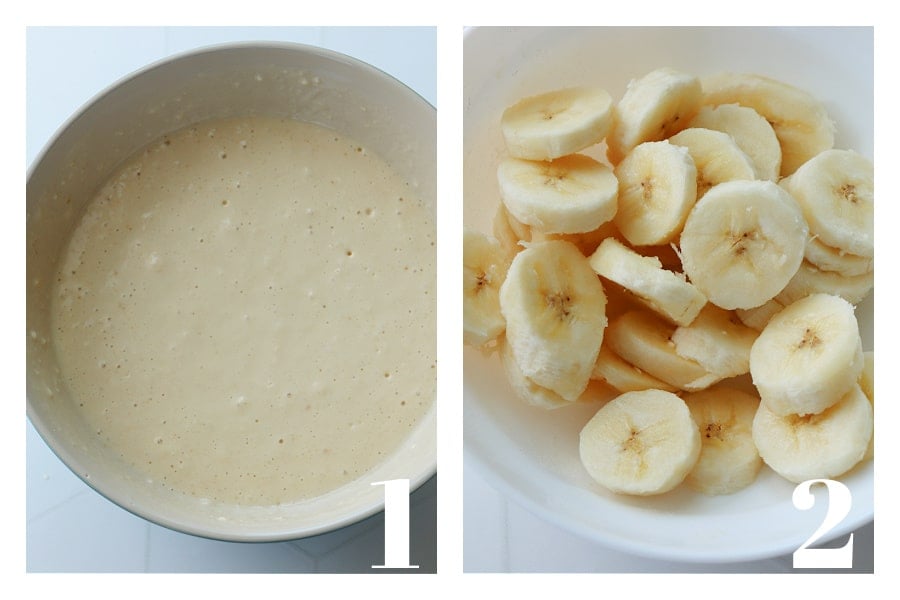
Pancake batter in a bowl and slices of bananas on a plate.Pancake batter in a bowl and slices of bananas on a plate.
  • Pour ¼ cup of pancake batter onto a hot griddle.
  • Place 3 to 4 slices of bananas onto each pancake. Cook until you see bubbles popping around the edges of each pancake. Flip each one.
  • Cook until golden brown.
  • Melt butter and mix with brown sugar and cinnamon. Drizzle over pancakes and enjoy!
Raw side of pancakes with bananas on a cast iron griddle pan and cooked pancakes on the pan.Raw side of pancakes with bananas on a cast iron griddle pan and cooked pancakes on the pan.

Helpful Tips!

  • Use a cast iron griddle or griddle pan. I used a 10″ pan and I can easily fry 4 pancakes at a time. Just make sure to heat it up before you pour the batter onto the pan.
  • Mix milk with lemon juice or apple cider vinegar to make a quick, homemade buttermilk. The pancakes will be extra fluffy!
  • Don’t overmix the batter! It’s totally okay for it to be lumpy (aka you can see clumps in the batter). The more you mix the batter, the flatter the pancakes will be.

How to know when pancakes are ready to be flipped?

Once you pour the pancake batter onto a hot griddle, do not walk away. Pancakes cook really fast. As soon as you see bubbles popping around the edges of each pancake, gently lift one side with a turner and peek if the bottom is golden brown. If it is, flip the pancake. Repeat until you used all of the batter.

Recipe FAQs:

How to keep pancakes warm?

The classic way to keep pancakes warm is to use a warmer drawer or heat up the oven at a low temperature. I place the cooked pancakes on a plate and cover it with a pasta bowl, while I cook another batch.

How to store leftover pancakes?

Any leftovers should be stored in a fridge, for up to 3 days. To reheat, place the pancakes on a griddle and heat up on a low setting.

Can pancakes be frozen?

Once cooked, cool the pancakes completely. Place on a parchment paper lined baking sheet and freeze. Then place in a freezer bag and freeze for up to 2 months. Defrost the pancakes in the fridge and reheat just before serving.

Four banana pancakes on a plate with a fork, set on a napkin.Four banana pancakes on a plate with a fork, set on a napkin.

More breakfast recipes:

If you like this recipe and make it, let me know in the comments below! Don’t forget to rate it if you enjoyed it!

Four banana pancakes, drizzled with brown sugar butter and topped with slices of fresh bananas on a plate with fork.Four banana pancakes, drizzled with brown sugar butter and topped with slices of fresh bananas on a plate with fork.

Banana Pancakes

These Banana Pancakes are thick, fluffy, and delicious! Slices of bananas are dropped onto the batter and fried until golden brown and caramelized. Drizzle the pancakes with maple syrup or make our brown sugar cinnamon butter!

Prep Time 15 minutes

Cook Time 15 minutes

Total Time 30 minutes

Course Breakfast

Cuisine American

Servings 4 servings

Calories 282 kcal

Prevent your screen from going dark

Ingredients 


Instructions 

  • Preheat the griddle or griddle pan until hot.

  • In a large mixing bowl, whisk together flour, baking soda, baking powder, salt and brown sugar.

    1 cup all-purpose flour, ½ teaspoon baking soda, 1 teaspoon baking powder, ¼ teaspoon salt, 3 tablespoons packed brown sugar

  • In a glass measuring cup, mix milk and lemon juice or vinegar (I recommend apple cider vinegar). Let it sit for a few minutes.

    1 cup whole milk, 2 teaspoons lemon juice or vinegar

  • Add oil and egg to buttermilk. Mix well.

    1 large egg, 2 tablespoons vegetable oil

  • Add vanilla and stir in.

    ½ teaspoons vanilla extract

  • Slice bananas into ¼” thick slices.

    3 bananas

  • Pour ¼ cup of pancake batter onto a hot griddle. Place 3 to 4 slices of fresh bananas on each pancake.

  • Cook for 2 minutes OR until bubbles start popping around the edges of each pancake.

  • Flip pancakes and fry until the other side is golden brown and the banana slices are caramelized.

  • Serve with maple syrup or brown sugar cinnamon butter (recipe below) and more slices of fresh bananas.

Notes

  • To make the brown sugar butter: melt 6 tablespoons of butter in a microwave-safe bowl. Add two tablespoons of brown sugar and ¼ teaspoon of ground cinnamon. Mix until smooth. Pour over pancakes.
  • Don’t overmix the batter! It’s totally okay for it to be lumpy (aka you can see clumps in the batter). The more you mix the batter, the flatter the pancakes will be.
  • Please note, that the nutrition value can vary depending on what product you use. The information below is an estimate. Always use calorie counter you are familiar with.

Nutrition

Calories: 282kcal | Carbohydrates: 56g | Protein: 8g | Fat: 4g | Saturated Fat: 2g | Polyunsaturated Fat: 0.5g | Monounsaturated Fat: 1g | Trans Fat: 0.01g | Cholesterol: 48mg | Sodium: 326mg | Potassium: 573mg | Fiber: 3g | Sugar: 23g | Vitamin A: 215IU | Vitamin C: 9mg | Calcium: 141mg | Iron: 2mg

[ad_2]

Source link

How a 16th-Century Explorer’s Sailing Ship Worked: An Animat…

0

[ad_1]

These days, it feels as if you can’t go very long at all before scrolling past anoth­er announce­ment about some new tech­no­log­i­cal devel­op­ment (real­ized or sched­uled) relat­ed to space explo­ration. Some react to this by won­der­ing what could pos­si­bly be out there in the uni­verse to jus­ti­fy such enor­mous­ly cap­i­tal- and research-inten­sive projects. Cen­turies ago, sim­i­lar sen­ti­ments were no doubt voiced about the more adven­tur­ous kinds of sea­far­ing. In the new Ani­ma­graffs video above, you can see all that went into the con­struc­tion and equip­ment of a six­teenth-cen­tu­ry explor­er’s sail­ing ship in great detail, from the keel to the fish davit.

The par­tic­u­lar ship you see bro­ken down into its con­stituent parts in this video nev­er actu­al­ly exist­ed. But it may look famil­iar, espe­cial­ly if you’ve seen the recon­struc­tion in Lon­don of Gold­en Hind, the galleon in which Fran­cis Drake cir­cum­nav­i­gat­ed the world in the fif­teen-sev­en­ties. The video’s cre­ator Jacob O’Neal drew a good deal of inspi­ra­tion from that par­tic­u­lar ship, but also incor­po­rat­ed oth­er char­ac­ter­is­tics bor­rowed from the Mary Rose, the Mayflower, Swe­den’s Vas­sa, and var­i­ous Span­ish galleons of what we now regard as “the ear­ly age of sail, when ships began to cross the globe instead of mere­ly fol­low­ing coast­lines or cross­ing inter­nal bod­ies of water.”

How­ev­er advanced a mod­el it would’ve been in its day, this ship could only make a long transocean­ic jour­ney so com­fort­able for its crew of 80 or so, most of whom would’ve been sleep­ing on mats, sub­sist­ing pri­mar­i­ly on bread and beer (rationed at one gal­lon per man per day), and using rudi­men­ta­ry out­door toi­lets. Pre­sum­ably, few would have signed up for such a tri­al if not for the promise of bring­ing rich­es back from dis­tant lands — sup­ple­ment­ed, in the par­tic­u­lar case of the Gold­en Hind, by “unof­fi­cial­ly sanc­tioned pira­cy of Span­ish galleons.” We have here, in oth­er words, a vari­ety of pirate ship, the vehi­cle for swash­buck­ling adven­tures fan­ta­sized about by gen­er­a­tions upon gen­er­a­tions of young­sters.

I myself nev­er dreamed of pira­cy, but I do remem­ber the rap­tur­ous gid­di­ness with which my first-grade class react­ed to learn­ing about the sail­ing ship’s “poop deck.” O’Neal does­n’t neglect that com­po­nent, but nor does he dwell on it, hav­ing many more impor­tant parts to explain and con­tex­tu­al­ize in 40 min­utes. To get an idea of how dra­mat­i­cal­ly ships evolved as the age of sail pro­gressed, have a look at his hit video on the eigh­teenth-cen­tu­ry HMS Vic­to­ry just above. Though the age of space explo­ration seems to have yet to begin in earnest, some of us are no doubt already psych­ing our­selves up to climb into the mod­ern equiv­a­lent of the Gold­en Hind for the 34-month trip to Mars.

Relat­ed Con­tent:

See the Well-Pre­served Wreck­age of Ernest Shackleton’s Ship Endurance Found in Antarc­ti­ca

Watch the Sink­ing of the Lusi­ta­nia Ani­mat­ed in Real Time (1915)

16th-Cen­tu­ry Japan­ese His­to­ri­ans Describe the Odd­ness of Meet­ing the First Euro­peans They Ever Saw

How an Ancient Roman Ship­wreck Could Explain the Uni­verse

Based in Seoul, Col­in Marshall writes and broad­casts on cities, lan­guage, and cul­ture. His projects include the Sub­stack newslet­ter Books on Cities and the book The State­less City: a Walk through 21st-Cen­tu­ry Los Ange­les. Fol­low him on Twit­ter at @colinmarshall or on Face­book.


[ad_2]

Source link