Notice: Function _load_textdomain_just_in_time was called incorrectly. Translation loading for the td-cloud-library domain was triggered too early. This is usually an indicator for some code in the plugin or theme running too early. Translations should be loaded at the init action or later. Please see Debugging in WordPress for more information. (This message was added in version 6.7.0.) in /home/releande/public_html/wp-includes/functions.php on line 6170 News Magazine | Get The Most Freshy News Every Day | Page 51
Mendes Wood DM is pleased to present Krzysztof Grzybacz’s latest body of work in his first solo exhibition at the gallery in Brussels. Behind its seemingly polished framework, To Empty Out emerges as an exhibition beautifully rife with contradictions that overlay serious and playful themes according to Grzybacz, who often sets out to “clash the forces” of gravity and levity through his chosen subjects. Through sublime florals, bawdy scenes, and raw portraits of social life, Grzybacz balances contemplation and observation, navigating between painterly precision and intuitive expression in this deeply personal exhibition. Grzybacz starts each painting with sketches and drawings, but once confronted with its white plane, the artist gives himself up to the canvas in a stream of consciousness – emptying his psyche out as he follows his intuition in dialogue with the painting’s surface in a spontaneous yet ambitious free-flowing conversation grounded in precision and skill.
In contrast to early displays of still lifes that depict manufactured products, such as cosmetics, lighters, and nail clippers, To Empty Out centersaround flowers, a frequent subject in Grzybacz’s paintings from 2022 onward. He notably approached the botanical motif in Colors of the Eyes(2022), which explores the color palette of his subject’s irises through a line of flowers. Grzybacz’s latest body of work continues the trajectory through works that combine chrysanthemums, dahlias, primroses, ranunculuses, poppies with the body, human tissue, self-portraiture. Unsaturated polychromatic compositions draw from nature and memory, reflecting the artist’s belief that flowers, each carrying its own hue, “are the true heroes of color.” Grzybacz, who sees his depictions of flowers as a rebellious step away from expectations set for him as a contemporary artist, eschews outright references to the lexicon of painting. While working with an art-historical awareness, the nature that surrounded the artist during his childhood, along with his drive toward nature’s perfection, defines much of his recent focus. The structure and display of the flower motif are also the result of a meditative painterly process: “When I paint flowers, I do not go back to photos or a catalog. I’m trying to recall my own catalog.” The flowers of his imagination bloom on the canvas in a geometric, rhythmic, even universal, order.
Grzybacz’s latest works are characterized by a visceral, literal layering of the exhibition’s central theme. Bodily, primal, and chaotic, the works often depict vivid human interactions: the chatter in which one empties out oneself through verbal and physical communication with another. The flowers appear here as grotesque embellishments, human satire. The painter is a quiet observer of a rowdy crowd; he pays notice to laughter, teeth, and body parts clumsily falling out of clothes. The elements mirror and multiply each other, blooming and unfolding, sprouting and overlapping in a continuous motion, dense yet fluid, layered, flourishing turmoil. Between living presences and nature morte, “The symbol of flowers has a social sense; they are destined to die and disappear,” says the artist, who took symbolic inspiration from pyrogenic plants that flower in response to fire when creating the works in To Empty Out.
Ultimately, the painter’s technique demonstrates masterful balance and organization. He constructs his imagery by clearing away surplus paint to uncover, explore thinner layers. This process of swabbing down the excess gives his works a hard-to-capture halo, an otherworldly quality. In their depiction of conflicting forces, the works assert a rarely encountered steadiness – they transmit that comforting quality of looking at an image that seems certain and defined. It is a process of removal, of emptying out of the surface to leave space only for the quintessential conveyors of form and meaning.
If you’ve spent more than five minutes researching help desk software, you’ve heard of Zendesk. It’s one of the most widely known platforms in customer support — the platform every other help desk gets compared to.
The FBI is investigating letters from sick trolls menacing “Today” show co-host Savannah Guthrie with threats about her missing mother — as the feds are pouring resources behind Arizona police desperately searching for the 84-year-old grandmother.
One letter sent to Guthrie was from a nutcase who said he had knowledge of the abduction — but also included a slew of slurs. The writer also made reference to accused murderer Luigi Mangione and the Jan. 6 US Capitol riot, according to law enforcement sources.
And that’s just one of numerous letters that have been emerging since Guthrie’s mother, Nancy, disappeared from her Tucson home Saturday night.
Savannah Guthrie with her mom, Nancy, in an undated photo. Instagram/savannahguthrieNancy Guthrie is believed to have been abducted from her Tucson, Arizona, home. Courtesy NBC Universal
Other notes have been sent to news outlets like TMZ and included purported details from inside Nancy’s home, claims about what she was wearing when she was taken — and even multimillion-dollar ransom demands to be paid in bitcoin.
Detectives with the Pima County Sheriff’s Department are leading the investigation, but the FBI has opened up its sprawling resources to supplement the local cops, sources told The Post.
Federal forensics specialists are helping to analyze the purported ransom letters and follow tips outside Tucson, while the bureau has been poring over cellular tower data to see who passed through Nancy’s neighborhood on and around the night she vanished.
Warrants to search Nancy’s digital accounts — which could help track her movements — are also being expedited by the FBI, while its agents have been deployed to circumvent Arizona jurisdictional restrictions and follow up in-person leads, sources said.
Nancy Guthrie’s missing persons poster. APSpatters of what appears to be blood were found outside Nancy Guthrie’s Tucson home. BACKGRID
Customs and Border Protection has even joined in — Tucson is just 70 miles from the Mexican border — to provide sniffer dogs for ground searches.
Here’s the latest on Savannah Guthrie’s missing mom
The federal aid comes as President Trump personally affirmed he would provide whatever resources he could to help with the investigation while speaking to reporters in the Oval Office Tuesday.
Savannah Guthrie with her mom, Nancy, in an undated photo. Nancy went missing earlier this week. savannahguthrie/Instagram
“I always got along very good with Savannah. Very unusual situation, but we’re going to find out,” said Trump, who has been interviewed by Guthrie in the past.
“I’m going to call her later on. I think it’s a terrible thing,” he said.
Police in Arizona say they are investigating the legitimacy of several suspected ransom notes sent to media outlets around the area where Nancy Guthrie, the mother of Savannah Guthrie — who hosts NBC’s morning show Today — was allegedly abducted.
At least three different media outlets, TMZ and two of CNN’s Tucson affiliates, KOLD and KGUN, reported receiving the purported ransom notes demanding millions in bitcoin for Guthrie’s release.
‘Today’ host Savannah Guthrie’s mother abducted from her home, police believe
Police have not determined whether the notes are legitimate, but told reporters on Tuesday that they are being taken seriously.
Story continues below advertisement
“When the note comes to us, it’s like any piece of evidence. You give it to us. You give us a lead. We’re going to look at every aspect of that lead and work it as a lead,” Sheriff Chris Nanos said.
Nanos said TMZ reported receiving the note before alerting authorities.
The outlets that reported receiving the ransom note said it contained specific information about the inside of Guthrie’s home, but did not provide any further details. Nanos has not confirmed whether the contents of the notes match the crime scene. He said that the notes had been shared with Savannah Guthrie.
Get breaking National news
For news impacting Canada and around the world, sign up for breaking news alerts delivered directly to you when they happen.
In a new interview with NBC’s Liz Kreutz on Today on Wednesday morning, Nanos said, “We have nothing else to go on but the belief that she is here.”
“We want to save her,” he continued.
In a statement posted on X on Tuesday afternoon, the Pima County Sheriff’s Department said it was aware of reports of ransom notes and that it was working closely with the FBI.
— Pima County Sheriff’s Department (@PimaSheriff) February 3, 2026
Story continues below advertisement
Investigators believe Guthrie, 84, was taken from her home in Tucson, Ariz., against her will.
Nanos said Guthrie has limited mobility and noted other factors indicating she did not leave on her own, but declined to elaborate further.
Guthrie, who lived alone, was of sound mind, he added.
“This is not dementia-related. She’s as sharp as a tack. The family wants everyone to know that this isn’t someone who just wandered off,” Nanos said, adding that she needs daily medication.
Nanos said at a news conference Sunday night that Guthrie was last seen around 9:30 p.m. Saturday at her home in the Tucson area.
Trending Now
‘Today’ host Savannah Guthrie’s mother abducted from home, police believe
Carney’s grocery, GST benefit plan will cost $12.4B over six years: PBO
Her family reported her missing around noon Sunday. The sheriff said a family member received a call from someone at church saying Nancy Guthrie wasn’t there, leading family to search for her at her home and then calling 911.
This image provided by the Pima County Sheriff’s Department on Feb. 2, 2026, shows a missing person alert for Nancy Guthrie.
Pima County Sheriff’s Department via AP
Nanos told CBS News that security footage from Guthrie’s home revealed nothing because it was likely auto-deleted after a certain period. It will have to be obtained via forensic means, he said.
Story continues below advertisement
A search using dogs, drones and supported by border patrol agents and a homicide unit was triggered over the weekend but has since been pulled back, Nanos said. It is not standard for the homicide team to get involved in such cases, he added.
“This one stood out because of what was described to us at the scene and what we located just looking at the scene,” Nanos said Sunday. He was not ruling out foul play.
“We don’t see this as a search mission so much as it is a crime scene,” the sheriff said on Monday.
A small amount of blood was found inside the Tucson home, a law enforcement source told CBS News. As of this writing, it has not been confirmed whose blood was at the scene. Tests are currently being conducted to determine its origin.
Savannah Guthrie issued a statement on Monday about her mother’s disappearance.
“On behalf of our family, I want to thank everyone for the thoughts, prayers and messages of support,” she said. “Right now, our focus remains on the safe return of our dear Nancy.”
I’ve cried a thousand tears and there’s a million more to come.
Almost a fortnight ago, Dozer was hospitalised at SASH with a double lung infection (pneumonia). If he was a spritely young chap, it probably wouldn’t be a big deal. But he’s 13.9 years old, with other medical conditions, and with that comes the reality that is the circle of life.
The initial prognosis was dire, and he went downhill worryingly fast. But my boy is a fighter. Against all odds, he improved, his lungs showed some healing and his vitals were strong. He worked hard on physical rehab and was even discharged on the weekend ………
The happiness of discharge day was sadly fleeting….we were back at ICU mere hours later. With -some of the wonderful ICU nurses of SASH (left to right: Heather, Jo Jo, Taylor, Raf and Dr Adelina).
…….only to be back in ICU a mere 2 hours later with complications. Discharged again….then back in ICU again 10 hours later.
We’re in the final chapter of Life of Dozer and we all know how the story will end. But before we get to the final page, it is my greatest hope that Dozer can come home in good enough condition to have some time to do the things he loves the most – spending time with his favourite people, scavenging around the table, playing with friends at the beach.
And being by my side, 24/7. All the neck rubs in the world. All the hugs, all the kisses, all the pats.
So for the next little while, I will be taking time away from work. JB and my brother Goh are taking charge of both RTE and RTM (our food bank). JB is going to start sharing new recipes and bring some much needed cheer to this website. Hopefully one a week, if he can manage it with the extra business operations responsibilities he’s taken on. He’s been dropping off recipe samples to me at ICU, which I appreciate greatly, even if eating French delicacies next to beeping machines feels slightly surreal.
I can’t promise to share Dozer updates on all his recipes – to be frank, it depends how Dozer is going – but you’ll see some interesting insights into how JB and I work together on recipes remotely. 🙂
Thank you for all the years of love you’ve shown Dozer, for sharing your own fur baby stories, and for making him feel so deeply adored far beyond our little world. I hope to be able to share some more light hearted Life of Dozer tales for the next little while.
Love – Nagi x
Life of Dozer
In honour of the joy Dozer has brought to this website over the years, I can’t finish this post without bringing some cheer to the Life of Dozer section. 🙂 Here he is eating an ice pop – literally just plain ice. It’s his absolute favourite treat these days! Funny how much the bar drops when you’re in hospital, gourmet expectations reduced to frozen tap water and he’s living his best life. ❤️
Lazarus Kgasi entered the orbit of paleontology on a whim. After high school, he needed to support his family. He worked a couple of odd jobs before he was hired as a fossil digger. It would forever change his life.
Tommy Trenchard for NPR
hide caption
toggle caption
Tommy Trenchard for NPR
Lazarus Kgasi walks with ease across a gently rolling landscape about an hour’s drive outside of Pretoria, South Africa. A few trees are sprinkled here and there but it’s mostly grass. Kgasi, a tall man with a big smile, knows the place well.
“We are going to see a fossil site in the Cradle of Humankind,” he says, referring to the UNESCO World Heritage site that has produced a stunning trove of early hominid fossils, helping prove that the African continent was indeed the birthplace of humanity.
“This is where the story started,” says Kgasi, age 52. “Every fossil here help[s] us to reconstruct the past — to tell the story of where do we come from.”
When he arrives at a sunken pit of uneven stones and dirt that was once a cave, Kgasi says, “I hear voices of our human ancestors.” Some of those ancestors left Africa to explore Europe. But others remained. “I’m the descendant of [those] that stayed in Africa,” he reflects. “And hence my skin color. It’s [a] bit darker to cater for the harsh African sun.”
That darker skin color meant that Kgasi might have never ended up as a professional paleontologist.
“I hear voices of our human ancestors,” says Kgasi with an air of reverence. Here in the Cradle of Humankind, the unearthing of a treasure trove of hominid fossils helped prove that the African continent was the birthplace of humanity.
Tommy Trenchard for NPR
hide caption
toggle caption
Tommy Trenchard for NPR
Digging without credit
Kgasi is one of eight children. Back when he finished high school, he knew full well what he had to do — find a job to support his family.
“I felt that I needed just to chip in and help,” he says. “When you are strong enough to go and work, it’s what every Black boy at my age do.”
He did clerical work. He tried his hand as an auto mechanic. Then, on a whim, in 2000, he applied for a job as a fossil digger in the Cradle of Humankind. “I just picked it up as a random job,” he says.
Kgasi was joining the ranks of the numerous Black men who, over the years, dug out fossils for white researchers (some from South Africa and others from overseas) who examined and identified them — and then took credit for them.
The paleontologists that Kgasi first worked with noticed something familiar in him: the makings of a scientist. “They saw a potential in me,” he says.
Tommy Trenchard for NPR
hide caption
toggle caption
Tommy Trenchard for NPR
“Black people were not viewed as equals,” he says. “They were viewed as their names were not warrant to be on research articles. By depriving them that knowledge, you basically control them. You are just a laborer.”
Black contributions were simply erased. It’s a practice that began during apartheid, “a very dark period for South Africa,” says Kgasi. And it continued after apartheid ended in 1994, including the time when he was hired.
For months, Kgasi didn’t know why he was digging. He had never learned about human evolution or the role that his country had played in reconstructing the story of our ancestors. He just dug.
But after about two years, Kgasi began to wonder — what exactly were these things he was pulling out of the earth? So he asked the American and European researchers he was working for, and they started explaining things to him.
“I was one of the luckiest one to be taught why this is important and why are we doing this,” recalls Kgasi. “Because that’s where I believe everything started lifting off for me. I started having a lot of researchers sharing their knowledge with me and treating me as an equal.”
A natural scientist
In Kgasi, the researchers noticed something familiar: the makings of a scientist.
“They saw a potential in me that you have an interest in these fossils,” he says. “And they start giving me more responsibilities.”
The researchers put Kgasi in charge of the field site. He began doing preliminary identifications of the fossils before handing them over. He got hired by the local university, first as a fossil excavator and then as a manager of the other excavators. And soon, he started doing his own research, which he continues to this day.
Kgasi makes his way down to one of the vertical surfaces of the pit and scrapes it gently.
He reveals a small chunk of something white. “It’s a bone,” he says with an air of reverence. “I would say it’s something of a clavicle around 3.5 million years old.” He believes that it’s from a non-human primate that once lived here.
Kgasi searches for the fossilized bones of the animals that once shared the landscape with our ancestors. To know how they once lived, he says it’s essential to understand the world they inhabited.
Tommy Trenchard for NPR
hide caption
toggle caption
Tommy Trenchard for NPR
This is the kind of fossil that Kgasi is looking for. He wants to find the animals that once shared this landscape with our ancestors. That’s because to know how they once lived, Kgasi says it’s essential to understand the world they inhabited.
“With the hominids only, we cannot paint that picture of what they saw to tell you about what the environment looked like,” he argues. “You need other extinct animals so that you put everything together. In a simplest term, you need the whole zoo.”
Over the years, Kgasi has helped fill out that zoo by unearthing bones from frogs, monkeys, birds and the first fossil snake fang to be found in the Cradle of Humankind.
And then there’s Kgasi’s crown jewel.
Before Kgasi discovered this skeleton of a giant prehistoric cat, all that had been known about the species came from a single tooth. This finding, among others, helped earn him the respect of his fellow paleontologists.
Tommy Trenchard for NPR
hide caption
toggle caption
Tommy Trenchard for NPR
Kgasi’s dynamite discovery
Inside the Ditsong National Museum of Natural History in Pretoria, in the room adjacent to the main entrance, sits a large display case. An array of 1.8 million-year-old fossilized bones is laid out on a red carpet. They belong to Panthera shawi, a giant prehistoric cat.
“This one is a male,” says Kgasi. “It’s twice the size of an African male lion. It’s huge.”
Kgasi could barely contain himself in 2015 when he discovered this specimen in one of the caves in the Cradle of Humankind. He was off the ground, suspended by a series of ropes, to chip away into what was once the cave wall.
“They have to beg me to come down from the ropes to come and have lunch cause I didn’t want to stop,” he says. “I was screaming, ‘I found this! I found a femur!'”
Much of Kgasi’s excitement came from the fact that for years, all that had been known about this species was derived from a single tooth found in the late 1940s by Robert Broom, a renowned white paleontologist. In other words, there wasn’t much to go on.
And here Kgasi was, pulling bone after bone out of the soft rock, ultimately extracting the entire skeleton and a chunk of the skull. Its sheer size revealed just how formidable a hunter this feline was.
In a word, pulling a fossil from the rock and touching it for the first time, is “magical,” says Kgasi.
Tommy Trenchard for NPR
hide caption
toggle caption
Tommy Trenchard for NPR
“It will help us to know: Were these the big cats that ate our ancestors?” he says. “That were chasing our ancestors? These are the things that we’re trying to understand.”
Subsequently, Kgasi found an adult female of the species and six cubs.
This finding, among others, helped him earn the respect of certain corners of the paleontological community.
“I’ve just been really fortunate to work with Laz and to count him as a friend, getting pretty close to decades, if not over,” says Justin Adams, a vertebrate paleontologist at Monash University in Australia. He says that Kgasi is “a genuine paleontologist” and “representative of the hidden history of Black South African contributions to our discipline. Laz’s passion transcends the categorizations of a job.”
Kgasi routinely sets aside fossils that he’s sure that Adams will appreciate. “He knows intrinsically from his training and his experience what actually does rise to the merit of — this requires attention,” says Adams. “He’s processed the first articulated skeleton of an extinct hyena that’s ever been found anywhere in Africa. And he’s the only person I would trust with it.”
A swirl of ancient hominid teeth sit in a drawer inside the Ditsong National Museum of Natural History in Pretoria — a mere sampling of the many fossilized riches found over the years in South Africa.
Tommy Trenchard for NPR
hide caption
toggle caption
Tommy Trenchard for NPR
A magical mentor
Everything that Kgasi knows he has learned by doing. He never went to college or graduate school.
Perhaps due to his lack of formal training, he recognizes the power of a solid education. This is one reason he spends a good chunk of his time speaking to young people in the field and at the museum — to encourage them to consider studying paleontology.
“It’s so magical, if I may put it that way, to bring them in here and they sit down,” he says. “You look like them. You are telling the story of these fossils in their own language, Setswana.”
This matters because the global language of science tends to be English. So by speaking Setswana, Kgasi is making these discoveries accessible and recognizable to young Black South Africans.
Kgasi also helps mentor graduate students like Boitshepo Motsodisa, who’s pursuing her Ph.D. in paleontology at the University of Pretoria.
“I think if he can do it, then no matter the odds, that means that I can have a successful career in this field,” she says. “So representation matters a lot for me and it’s what has kept me going.”
Left: Boitshepo Motsodisa is pursuing her Ph.D. in paleontology at the University of Pretoria. Of Kgasi, her mentor (pictured, right), she says, “I think if he can do it, then no matter the odds, that means that I can have a successful career in this field.”
Left: Ari Daniel for NPR; right: Tommy Trenchard for NPR
hide caption
toggle caption
Left: Ari Daniel for NPR; right: Tommy Trenchard for NPR
That motivation has helped her navigate the challenges that she’s run into as one of the few Black students in her department.
“It’s not very overt,” she explains. “But I had trouble. One of my reviewers did not think that my work was of scientific value. And you question yourself.”
However, Kgasi has zero doubts of what Motsodisa is capable of.
“In my personal view, she’s going to reach the sky,” he says proudly. “She is the hope of South Africa. She’s got big shoes to fill. And I think she’s got big feet. So that means those shoes will be filled.”
Motsodisa’s eyes are wide. “No pressure at all,” she says with a laugh.
For Kgasi, the students and young people he engages with are heirs to a powerful legacy.
“These fossils are not mine,” he says. “They belong to everybody in South Africa.”
This story was supported by a grant from the Pulitzer Center.
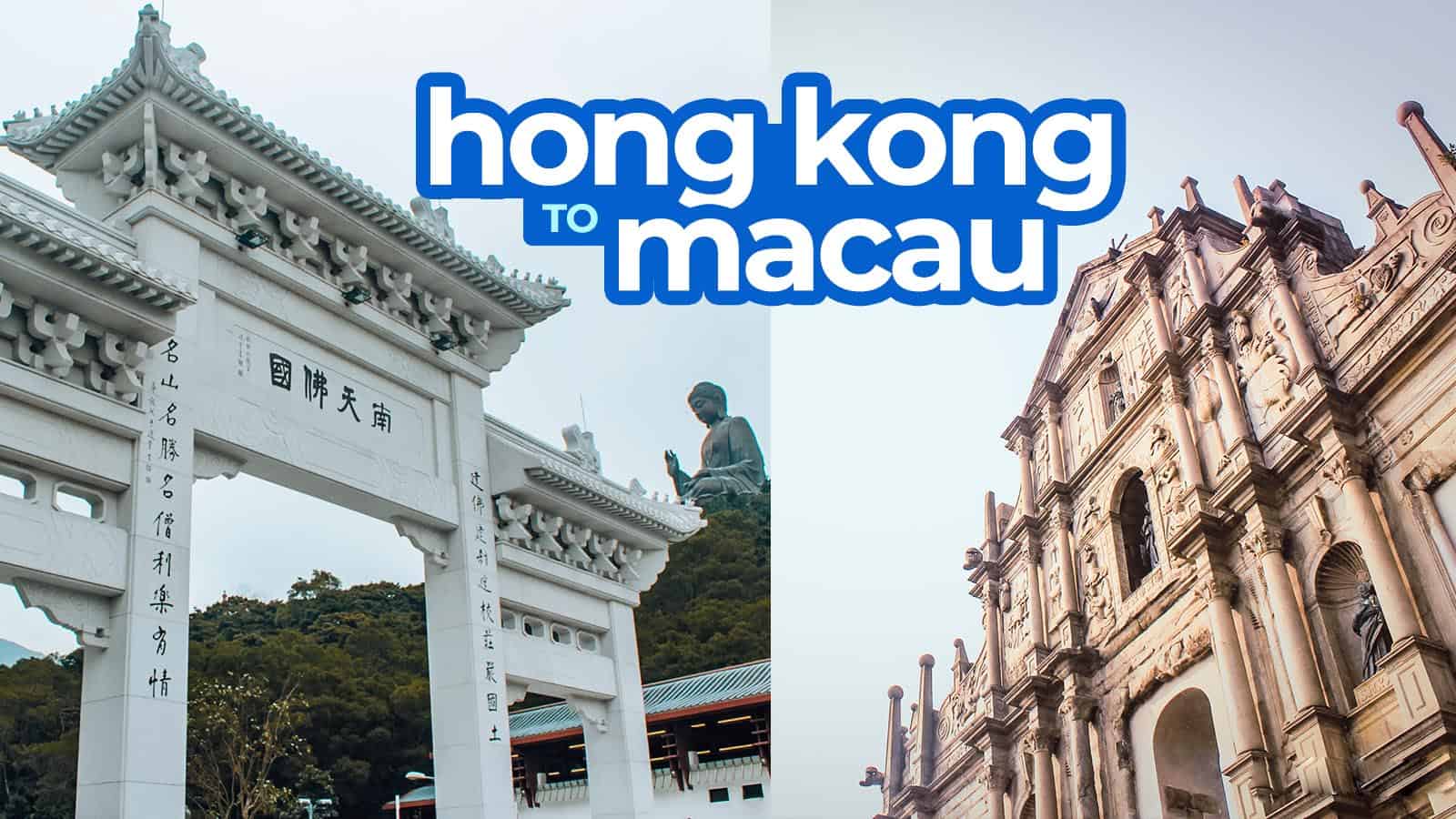
Macau makes a fantastic day trip from Hong Kong because it’s compact and easy to reach. Just an hour by ferry or two hours by bus from Hong Kong, you can step into a completely different world. You can explore Macau’s two sides: the historic Portuguese colonial side and its hyper-modern glitzy side, even in a single day.
In this article, we’ll share with you our Macau day trip itinerary.
WAIT, WAIT, WAIT! If your are traveling soon and still on the planning stage, you can also visit our The Poor Traveler Masterlist. Here, we compiled travel essentials, including immigration requirements and all our recommended hotels and tours. Just visit this page: TPT Masterlist. We have a compilation for destinations around the world.
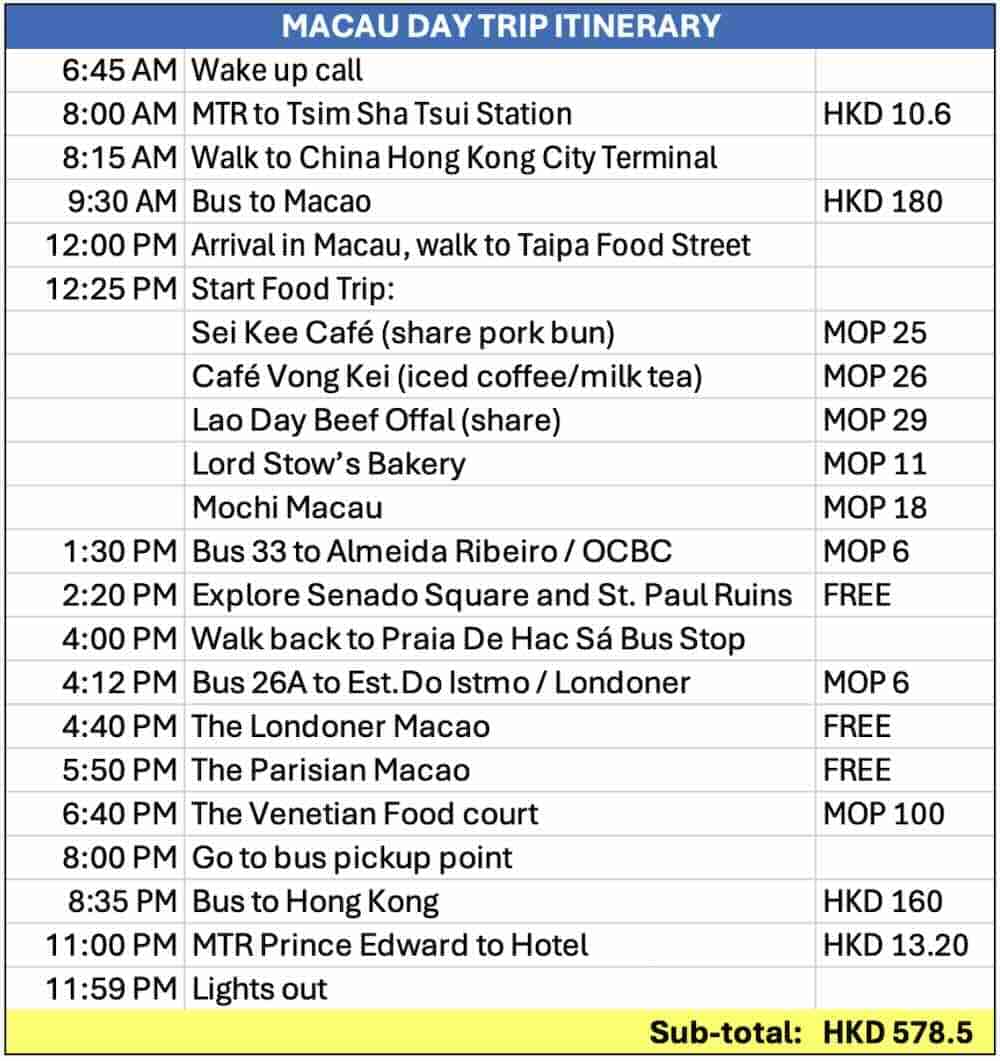
To maximize the limited time we’ll be spending in Macau, let’s start early. Wake up at 6:45 AM and give yourself plenty of time to get ready. Don’t forget to bring your passport because we’ll be crossing borders today!
China Hong Kong City Terminal
By 8:00 AM, take the MTR from Central Station to Tsim Sha Tsui Station. The fare is HK$ 10.6.
From here, open your Google Maps and use it to get to the China Hong Kong City Terminal, where you can catch the bus to Macau. You’ll be walking for around 10 minutes.
For this itinerary, book this bus transfer in particular. There are many Hong Kong-Macau bus options on Klook, but you need to book this one specifically because it has the stops and timings that match our itinerary.
For pickup location, choose CHINA HONG KONG CITY, and for drop off, choose GALAXY MACAU. The Venetian is OK, too, but Galaxy is closer to our first stop.
TIP! If you’re booking this on Klook, use our promo code THEPOORTRAVELERKLOOK for 3-5% OFF if you’re a new user.
On our trip, though, we actually booked the one from Prince Edward because it entailed a shorter walk. But now that I’m looking at their page, for some reason, the earliest departure time available on Klook is 11:50 AM, which is too late. But from China Hong Kong City Terminal, there are earlier options.
If you really want to depart from Prince Edward, I think you can also book on the supplier’s official website.
At the end of the day, choose the pickup point that is more accessible from the hotel you’re staying in.
TIP! If you don’t have a hotel yet, book with Agoda to get a huge discount! Up to P5900 or USD 100 off. Just visit www.thepoortraveler.net/agoda to redeem the discount coupon, or if you prefer using the Agoda mobile app, just tap on the DEALS page and enter our promo code AGODATPT, all caps. Then search and select a hotel, and upon check out, enter AGODATPT again in the coupon field to apply the discount. This will give you up to 10% OFF capped at USD 100 (P5900 based on current exchange rate).
Be sure to arrive at the pickup location on time! Board the correct bus and off you go.
By the way, we also created a detailed article on how to get to Macau from Hong Kong, which you can read here: HONG KONG to MACAU by Bus & Ferry
HZMB Port
At the Hong Kong-Zhuhai-Macau Bridge (HZMB) Port, you will get off the bus, go through Immigration on foot as you exit Hong Kong, and find the same bus on the other side. So listen to the instructions, remember your bus number, and always pay attention!
There are plenty of signs at the port. But once you make it past Immigration, the signs you should look for are marked CROSS BOUNDARY COACH. Not to be confused with Shuttle Buses. A staff member will check your ticket to make sure you’re boarding the correct bus.
Then, strap in. You’ll be crossing the Hong Kong–Zhuhai–Macao Bridge, one of the longest sea bridges in the world. It should take over an hour from here. You’ll also be clearing immigration on the Macau side.
Alight at Galaxy Macao, then walk for 12-15 minutes to our first stop.
Taipa Food Street
We begin our Macau adventure with a food trip here at Taipa Food Street! Officially known as Rua do Cunha, it is one of Macau’s most beloved foodie alleys, tucked into the historic heart of Taipa Village. This narrow pedestrian lane has been drawing locals and visitors alike for decades!
Taipa Food Street, a 20-minute walk from The Venetian
To be honest with you, these are not the cheapest options in Macau. You’ll find more affordable versions of these items in other parts of Macau. But what makes Taipa Food Street great is that you’ll find some of the most iconic eats in just one area, with its mix of Portuguese-influenced classics and local Macanese flavors. You can sample snacks and specialties from stall after stall, all within a few blocks.
Café Vong Kei
When you arrive, the first thing that will steal your attention is the giant milk tea bottle on the side of the building housing Café Vong Kei. So let’s start our culinary crawl here. This colorful café has become a major landmark here. Open since the mid-20th century, it’s best known for its iced coffee and milk tea (MOP 26). Both drinks are balanced and bold: the coffee is smooth and refreshing, while the milk tea has that classic silky sweetness that pairs perfectly with a stroll down the street.
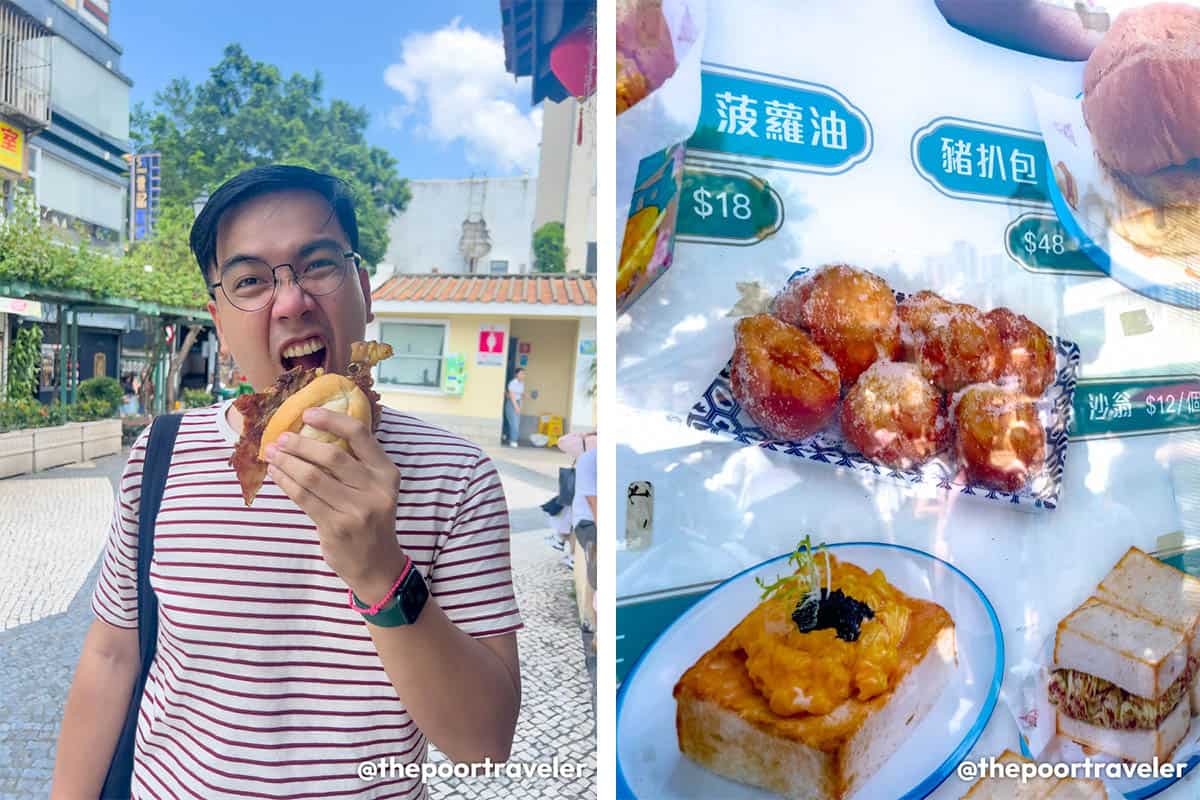
But wait, don’t drink it yet. We’ll be using it to wash down the solid items we’re going to stuff our faces with — like pork chop bun (MOP 48)! Café Vong Kei’s pork chop is so big it looks like it’s about to jump out of the bread. It’s juicy and peppery, complemented by the crispy pastry.
Our initial intention was to buy one from Café Vong Kei and another at Sei Kee Café not too far away. But after finishing one, we were already so full that we skipped the latter. So that’s the lesson here. If you’re doing a food crawl, just order one and share! Leave room for the other stops.
Sei Kee Café
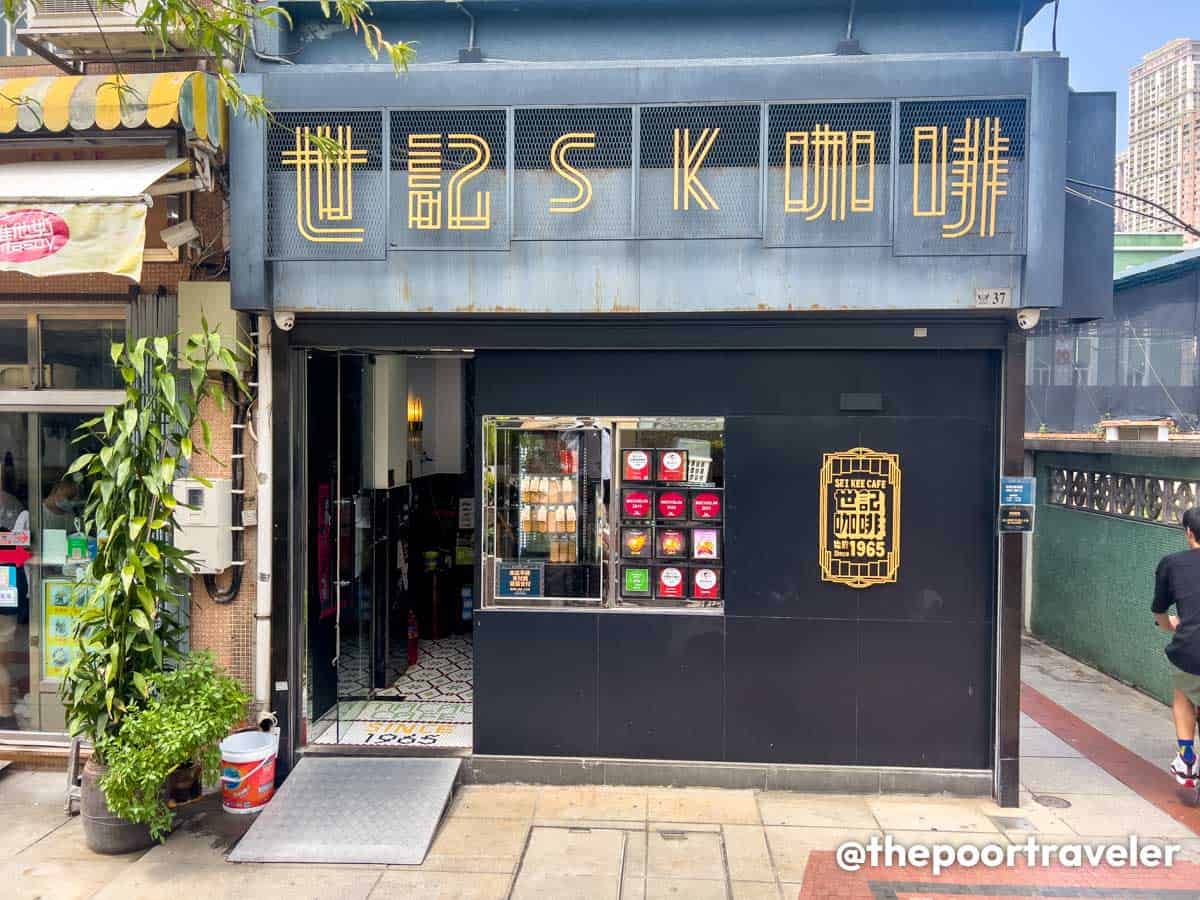
I would still urge you to try Sei Kee Café. It is one of the oldest neighborhood cafés in Macau, dating back to the 1960s. It’s also earned a Michelin Bib Gourmand designation for its quality and value. Too bad we weren’t able to try it. Its pork chop bun costs MOP 50.
Lao Day Beef Offal
Just a few steps away, the scent of slow-cooked beef fills the air at Lao Day Beef Offal. This spot has risen to fame more recently, earning recognition on local foodie lists and drawing long queues for its richly seasoned beef offal (about MOP 58). Tender, hearty, and deeply savory, each bowl offers a taste of Macau’s street-food culture that is unpretentious, bold, and deeply satisfying.
Lord Stow’s Bakery
No visit to Taipa Food Street is complete without hitting Lord Stow’s Bakery, the birthplace of Macau’s legendary egg tart. Founded by Andrew Stow in Coloane in 1989, this bakery’s tarts are crisp on the outside with a creamy, caramelized custard center — a perfect blend of Portuguese baking tradition and local flair, and a signature Macau must-try at around MOP 11 per piece.
Mochi Macau
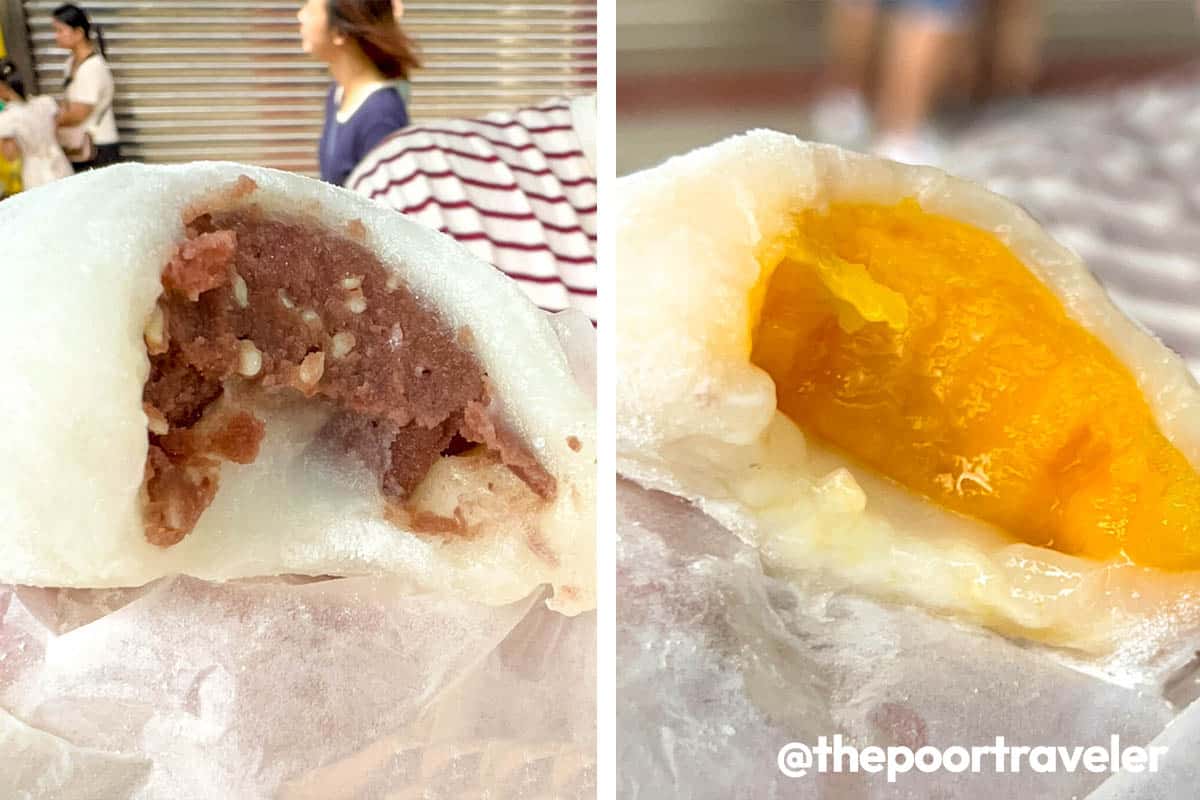
To finish on something sweet and chewy, swing by Mochi Macau (often recognized locally as Cheung Chau Ping Kei) for freshly made mochi (about MOP 18). While fruit-filled versions are popular, the red bean mochi is widely considered the best here, and we agree. It’s slightly sweet, delightfully chewy, and a perfect sweet note after savory snacks.
And that wraps up our lunch. Now, let’s head over to Macau’s historic core. And to do that, we need to catch Bus 33 and alight at Almeida Ribeiro/OCBC stop. By the way, buses here in Macau collect a flat rate of MOP 6.
We’re now in the Macau peninsula and it’s here that you’ll find the Old Macau. And at its center lies Senado Square.
Senado Square
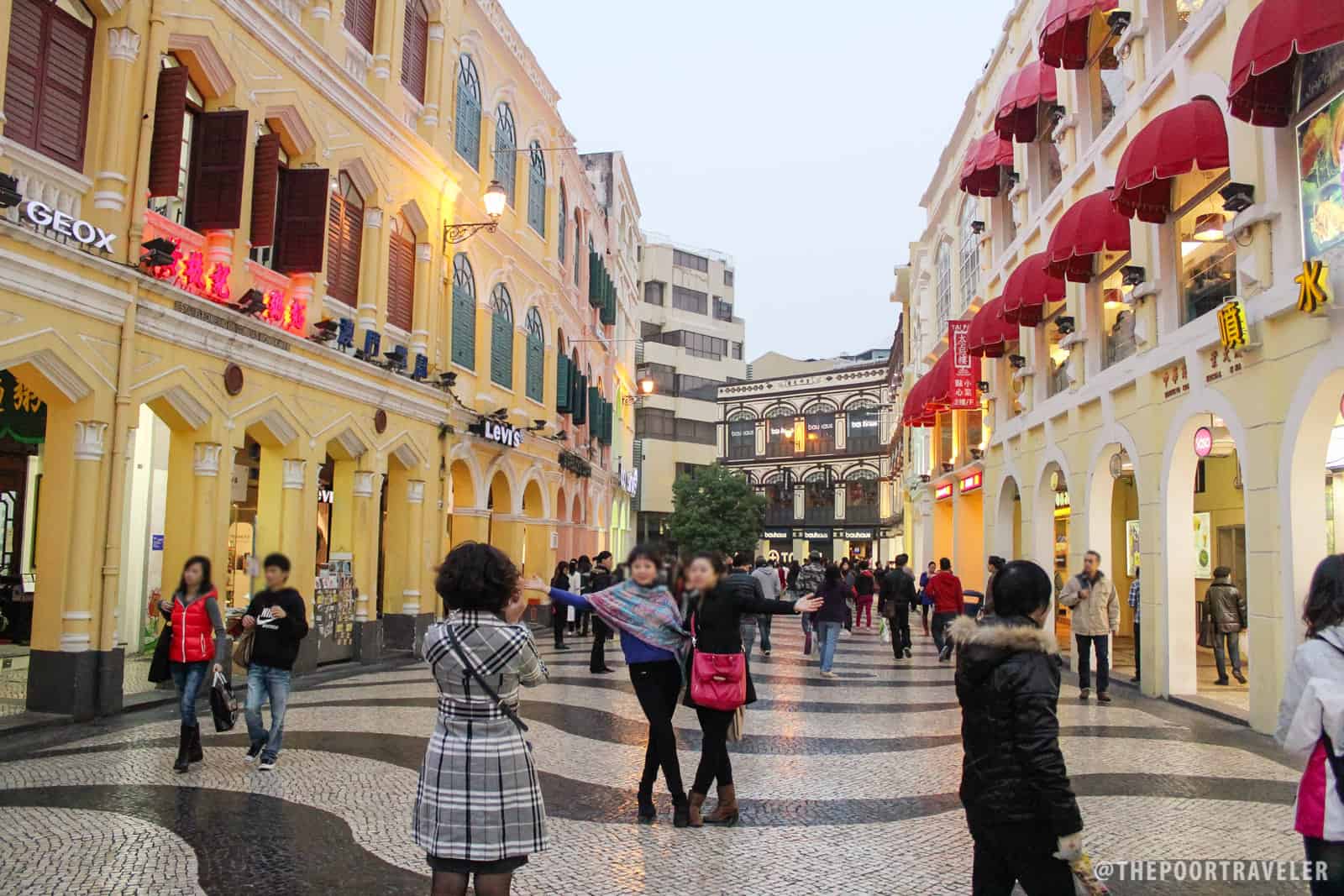
Senado Square is the beating heart of Macau’s historic center and a UNESCO World Heritage site. This wide, open plaza is surrounded by colorful pastel colonial buildings and European-style pavement patterns that make it feel like a small slice of Portugal in the middle of Asia. It’s a pedestrian-friendly hub where locals and tourists mingle.
The square is home to several historic landmarks, including the Holy House of Mercy, St. Dominic’s Church, and the Leal Senado Building. During festivals, Senado Square comes alive with decorations, street performances, and vibrant markets, giving visitors a real sense of Macau’s rich cultural tapestry.
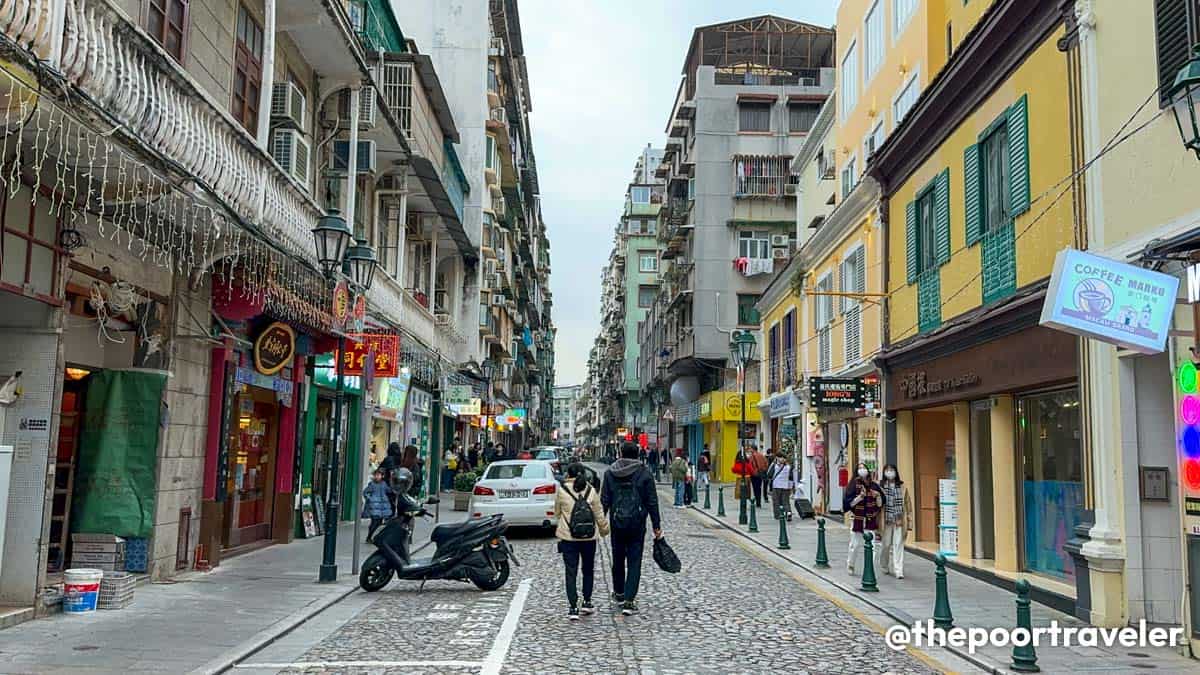
As you walk deeper into the inner streets, your senses will be bombarded! The alleys leading off the square are lined with stores selling Macau delicacies, from Portuguese egg tarts to almond cookies and traditional meat jerky, many of which offer free samples to tempt passersby. This makes strolling through the area not only scenic but delicious — a perfect way to taste local flavors as you explore.
Ruins of St. Paul’s
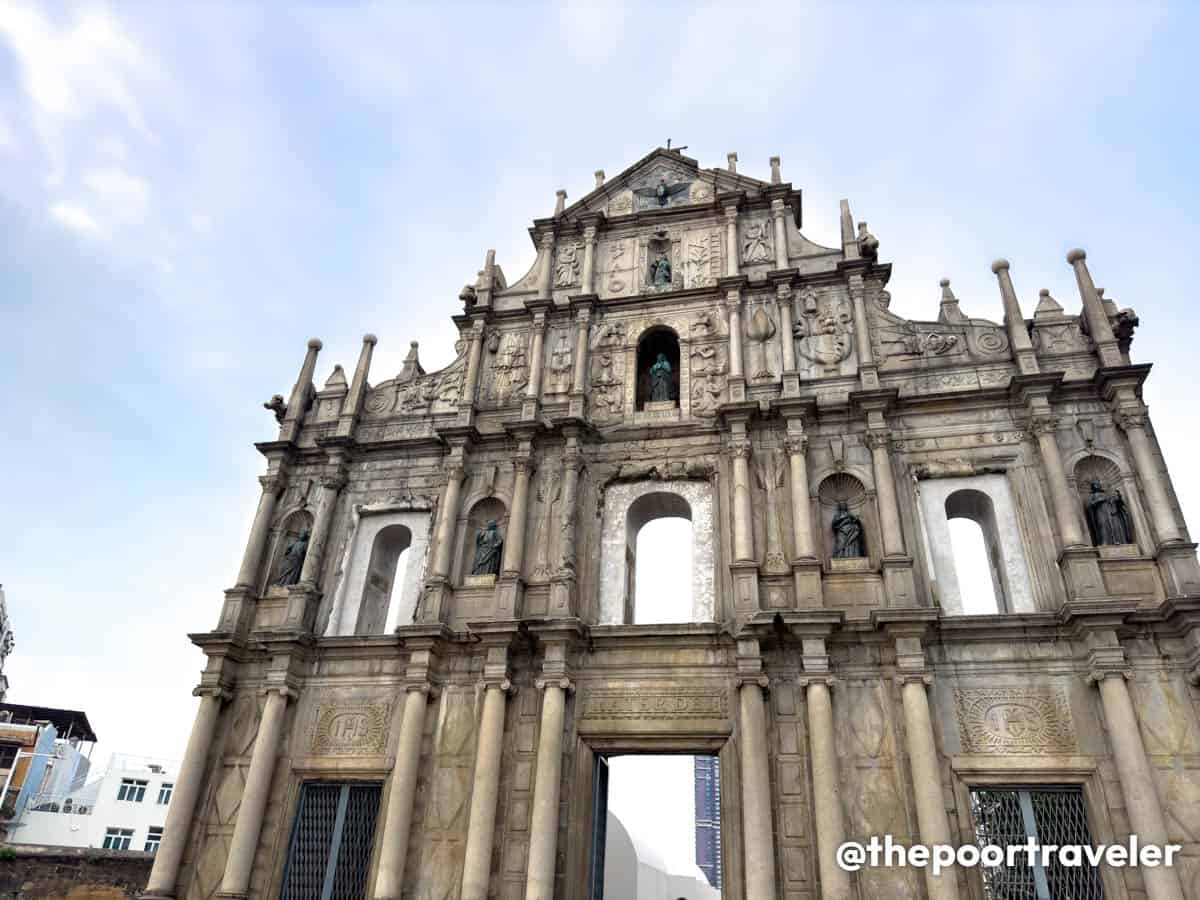
At the end of the main pedestrian street, you’ll find the Ruins of St. Paul’s, Macau’s most iconic landmark. What remains today is the ornate stone façade of a 17th-century Portuguese church, which was destroyed by fire in 1835. Despite being a ruin, the intricate carvings, statues, and Latin inscriptions on the façade still convey the grandeur of its heyday, making it one of the most photographed sites in Macau.
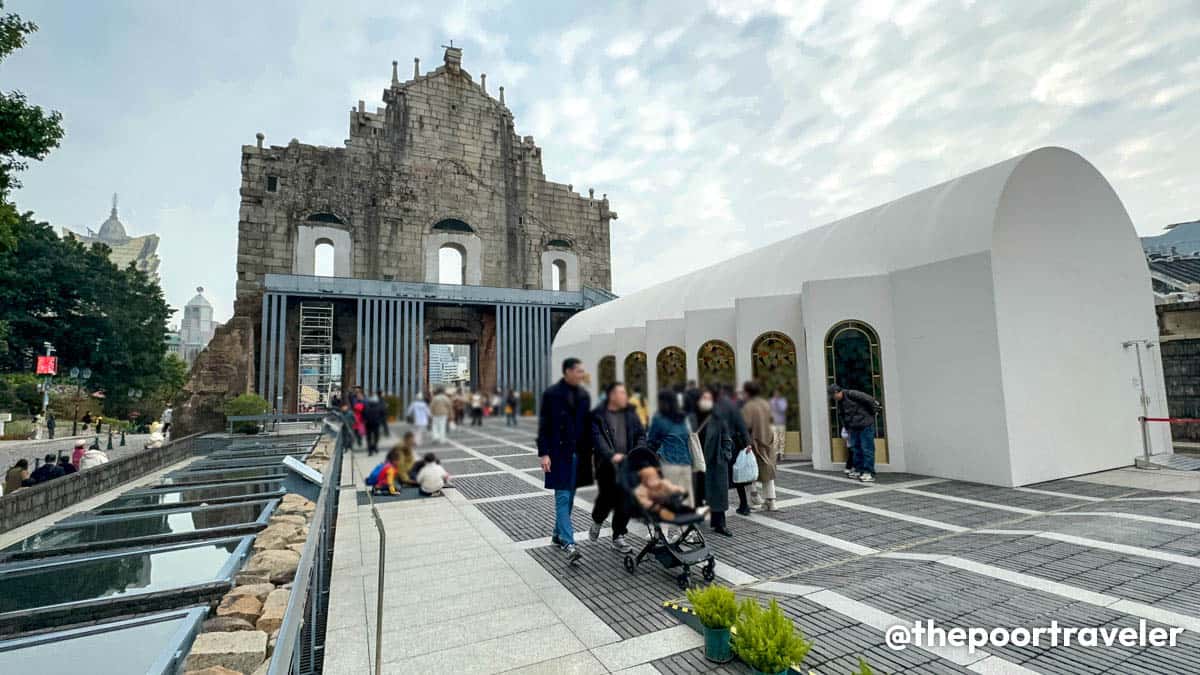
Climbing the steps to the ruins gives you a small museum tucked behind the façade, showcasing artifacts from the original church and monastery, giving context to Macau’s colonial and religious history. From here, you can also take in sweeping views of the surrounding streets of the old city, blending Macau’s Portuguese and Chinese heritage in one frame. And that is perfectly captured when you spot the next item on our itinerary.
Na Tcha Temple
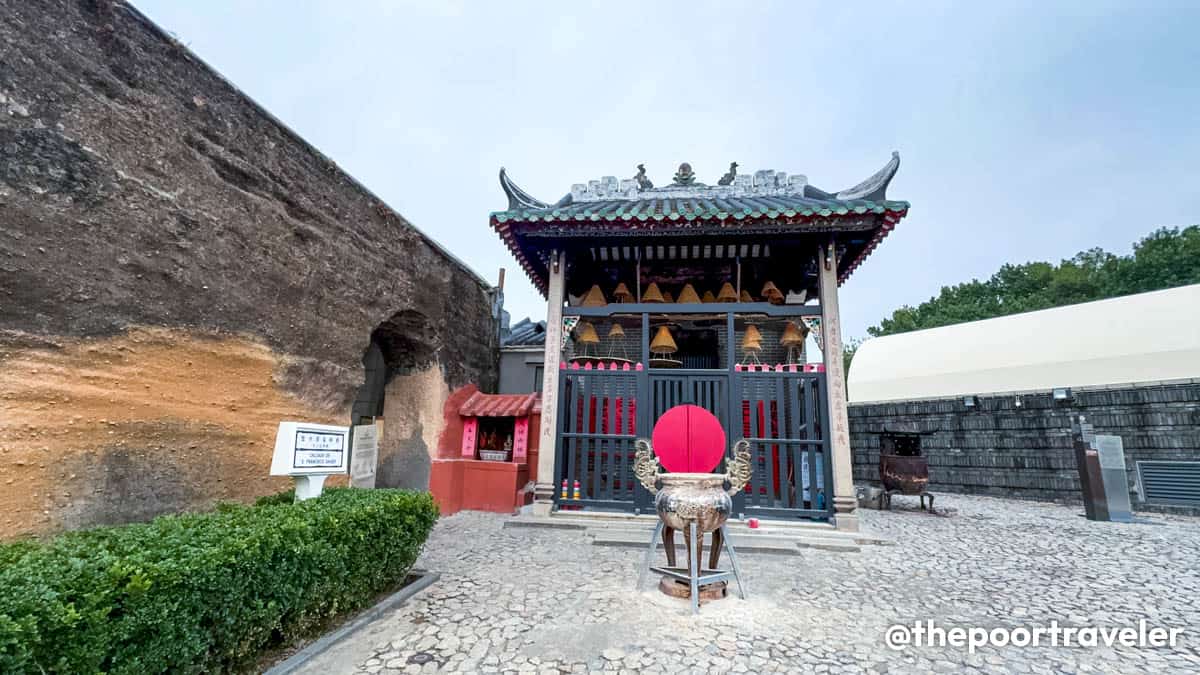
Just next to the Ruins of St. Paul’s is the small, unassuming Na Tcha Temple, creating a powerful visual contrast between Chinese and Portuguese religious traditions in one corner. It was built in 1888 and is dedicated to Na Tcha, a protective deity in Chinese folk religion. And yes, it is also part of Macau’s UNESCO World Heritage–listed Historic Centre.
Architecturally, the temple is small and understated, with a simple stone structure, traditional Chinese rooflines, and incense coils often hanging inside. Despite its size, it played an important role for the local Chinese community, especially during times of illness and hardship, when Na Tcha was worshipped as a guardian against disease and misfortune.
Visiting the temple offers a quiet, reflective pause amid the crowds, and it perfectly symbolizes Macau’s unique identity — a place where Eastern and Western cultures have coexisted for centuries, sometimes literally side by side.
After the temple visit, walk to Praia De Hac Sa Bus Stop and catch Bus 26A to Est. Do Istmo / Londoner stop. The fare is MOP 6.
Cotai Strip
Welcome to Cotai Strip! This is Macau’s take on the Las Vegas Strip, a dazzling stretch of reclaimed land connecting the islands of Coloane and Taipa, packed with mega-resorts, luxury hotels, and entertainment complexes. Cotai has transformed rapidly over the past decade, evolving into the heart of Macau’s modern tourism industry.
Beyond the grand façades, the Cotai Strip is a shopping, dining, and entertainment paradise. High-end brands line the corridors of resort malls, while countless restaurants serve everything from Cantonese dim sum to European fine dining. Visitors can also catch spectacular shows, gondola rides, and light displays — all part of the immersive, over-the-top Cotai experience. But since we only have very limited time, we’ll be making only three stops tonight: London, Paris, and Venice. Well, sort of.
Let’s start with London.
The Londoner Macao
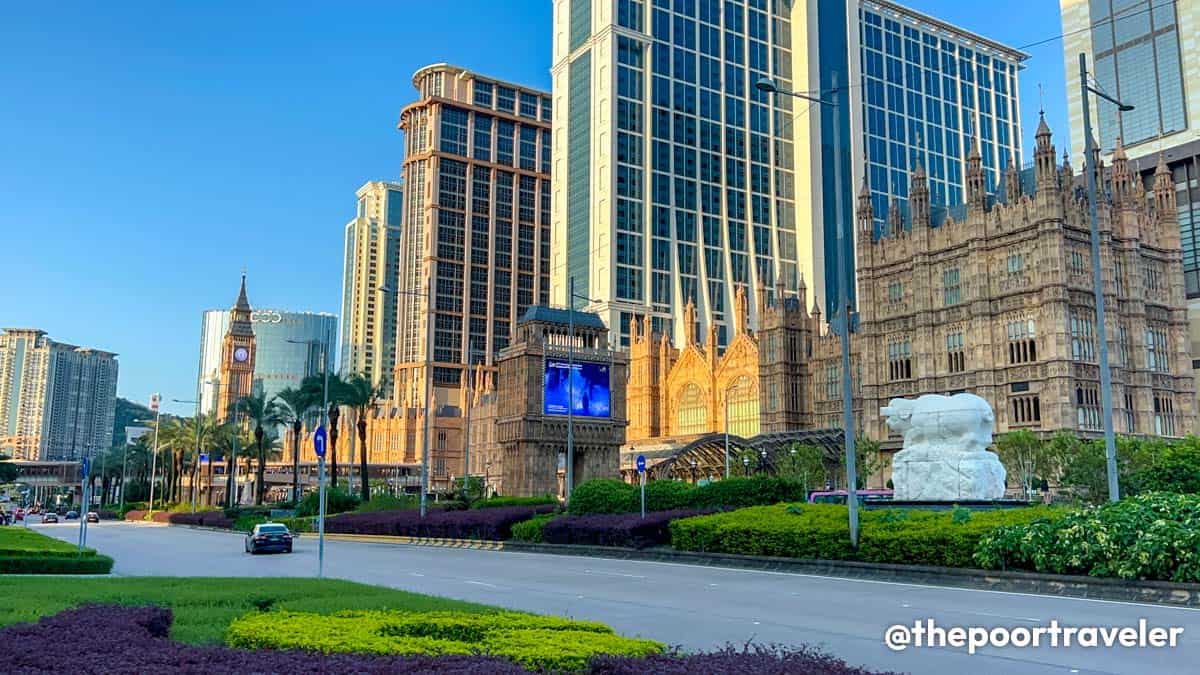
The Londoner Macao is clad in classic British architecture, mimicking the Palace of Westminster and Houses of Parliament. It also has a miniature Big Ben tower, giving you a distinctly London look.
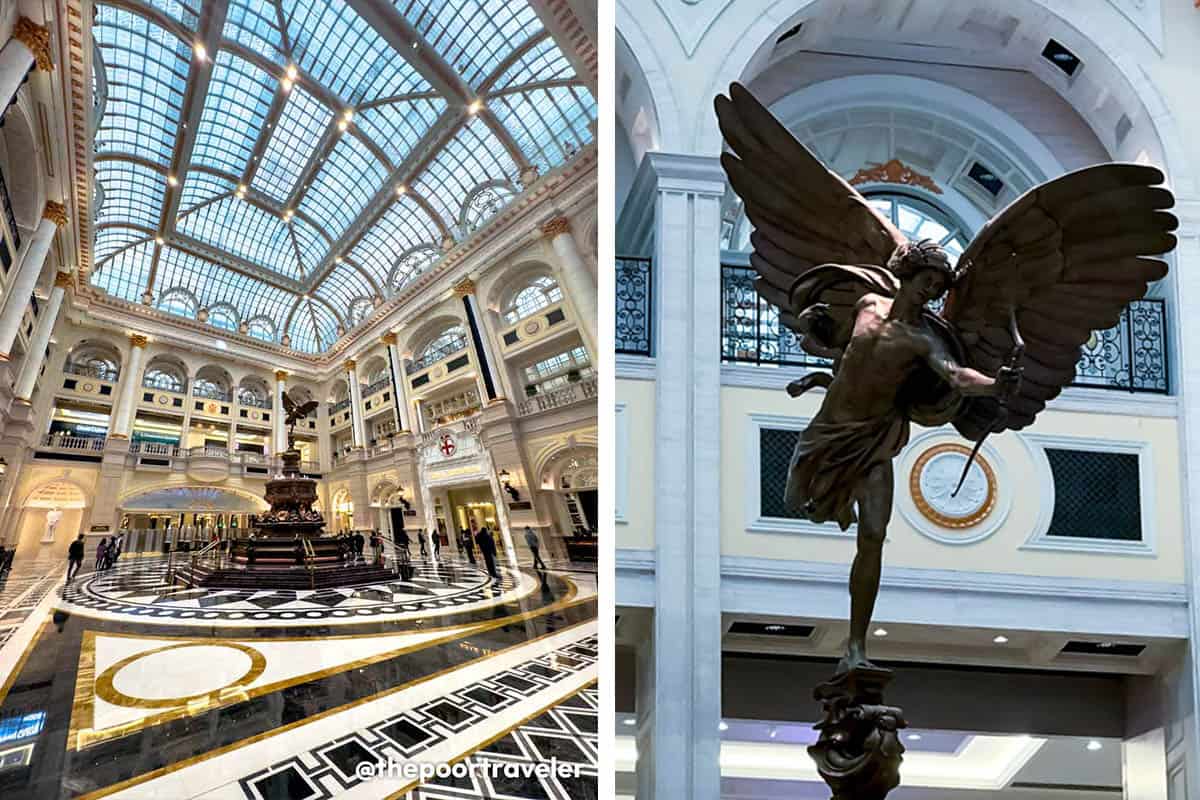
At the main lobby, you’ll find a replica of the Shaftesbury Memorial Fountain! And from here, you could get lost in mini-London and take unli-selfies at the many UK icons scattered around, including a double-decker bus and a statue of Sir Winston Churchill greeting everyone at 10 Downing Street. You can also hop into a taxi for what they call Black Cab Escape, where you’ll get to enjoy a virtual drive with David Beckham. These are just some of the many attractions inside! We were told there’s also a changing of the guards, but we didn’t get to see it.
All these can be accessed for FREE by the way.
There is also the Harry Potter The Exhibition, but this one collects an entrance fee and we don’t have time for that on this trip. For now, let’s cross over to Paris.
The Parisian Macao
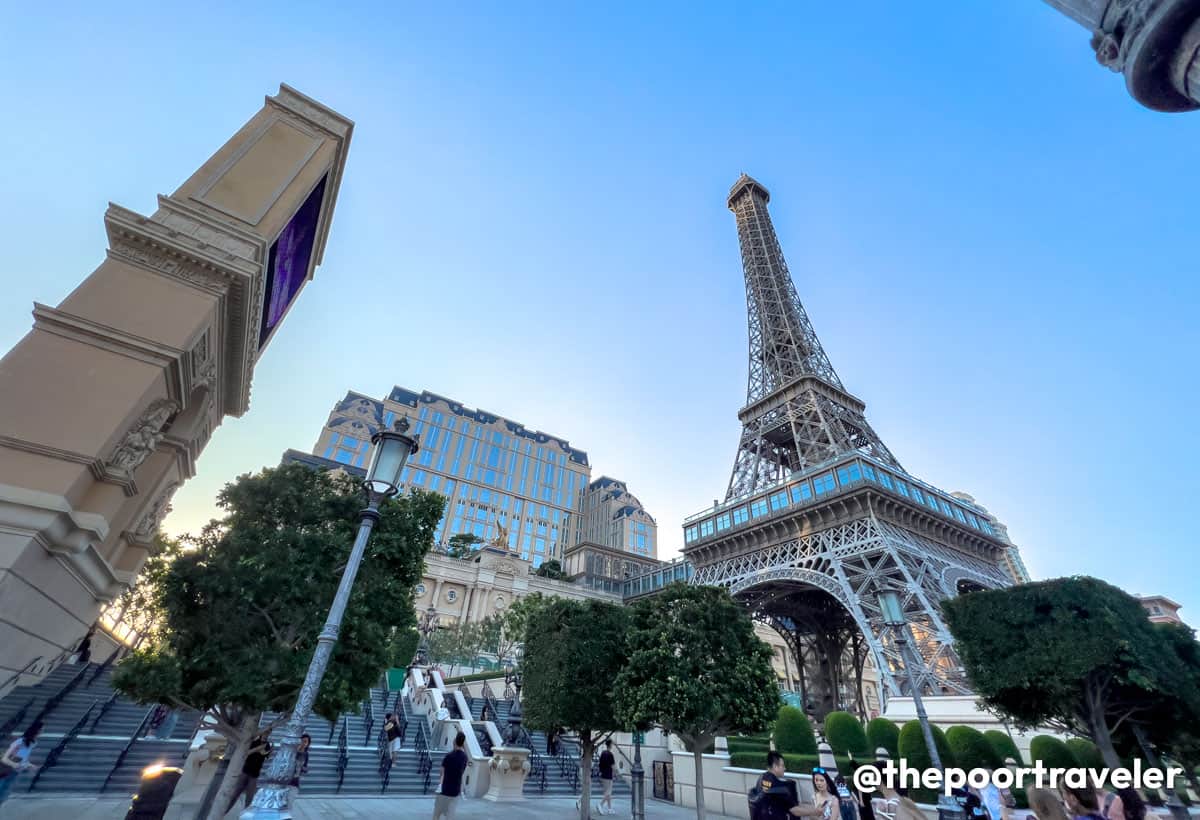
The Parisian Macao delivers on French elegance. The centerpiece is a half-scale replica of the Eiffel Tower. Every 15 minutes from 6:15 PM to midnight, every single night, the iconic landmark is covered in dazzling lights, creating an awesome show that bathes the surrounding area in various colors.
The tower has two observation decks, one on Level 37, which charges MOP 75 per person, and the other on Level 7, which is open to everyone FREE OF CHARGE. As for us, we decided to just stay on the ground, admire it from afar, and snap countless photos with the vibrant structure as backdrop!
And right next door lies Venice.
The Venetian Macao
The Venetian Macao is one of the largest resorts in the world and brings Italy’s romantic Venice to Cotai. With indoor canals, gondola rides, and replicas of Venetian landmarks, it’s a feast for the senses.
Inside, you’ll find teamLab SuperNature Macao, one of the best teamLab branches that we have experienced. But again, maybe not on this trip, as we don’t have time.
The resort also features luxury shopping and over 30 restaurants, including a food court. And yes, this is where we’ll have dinner. Prices here are much higher than usual food court fare, though.
Back to Hong Kong
If you still have time to spare, walk around the mall, maybe shop. Just make sure that you go to the bus pick up point at 8:00 PM. Yes, you will be boarding the bus back to Hong Kong here at the Venetian at 8:30 PM. The bus fare is HK$ 160.
You can book this in advance on Klook, specifically this ride, because this has an 8:30 PM pickup at the Venetian, which is perfect for our itinerary.
In the list of options, choose MACAU VENETIAN HOTEL as the departing point and choose HONG KONG PRINCE EDWARD as the destination.
Again, just like earlier, you’ll need to pass through both the Macao and Hong Kong Immigration inspection, so have your passports handy.
You should arrive in the Prince Edward area in Kowloon by 11 PM. From here, walk and take the MTR to your hotel. The fare from Prince Edward Station to Central Station is HK$ 13.20.
And that’s it! You can easily insert this day trip itinerary into your Hong Kong itinerary! But the question is, how much budget should you prepare?
MACAU DAY TRIP BUDGET BREAKDOWN
Here’s the budget breakdown for our sample 1-day Macau itinerary, including the bus transfers. It assumes you’re a party of two, splitting the cost of shared expenses equally.
IMPORTANT! These are the minimum budgets to prepare. But please note:
Add a buffer (even as low as HKD 200) to cover possible price movements, currency exchange adjustments, and other expenses we might have missed. These do not include personal purchases (shopping budget) and alcohol.
These itineraries should not be taken as official travel advice. Just use these as a guide in building your own. Feel free to tweak to match your bookings, availability, schedule, and preferences.
And there you have it! That’s our sample Macau DIY day trip itinerary if coming from Hong Kong.
While it’s definitely possible to see Macau’s key attractions in a single day, I still strongly encourage you to return and stay longer. In this sample day-trip itinerary, we only barely scratched the surface — we basically just blitzed through the city, hitting the highlights and moving on. Macau is compact, but it’s rich in culture, history, and unique experiences, and a single day doesn’t do it justice. Spending a night or two here allows you to explore at a more relaxed pace, soak in the atmosphere, and really appreciate the city’s blend of Portuguese and Chinese heritage.
There’s a lot more to see beyond what we’ve shared here. It also has peaceful city gardens like Camoes Square and Jardim Lou Lim Ioc; interactive attractions like teamLab Supernature, Harry Potter the Exhibition, Martial Arts Arena and Grand Prix Museum; and historic sites like the Ama Temple and Guia Fortress. Or you can go food tripping. There’s also a thriving food scene beyond the usual tourist spots, from homegrown family restaurants to exquisite fine-dining territory.
Essentially, a day-trip will give you a taste, but staying longer lets you experience the full flavor of Macau.
Protect your finances when traveling!
Getting a travel insurance is optional, but we highly recommend this, especially when traveling abroad. Travel can be unpredictable, and though we hope we’ll never use it, having it gives us peace of mind in case of unexpected delays, cancellations, or emergencies.
For international destinations, consider PGA Sompo’s TravelJOY Plus insurance. You can GET IT HERE. Don’t forget to use WORTHIT for a special affordable rate.
Join The Poor Traveler Support Group
✅ If you have any questions or need travel tips, feel free to post them to the TPT Support Group. The members are very helpful. This Facebook support group has been around for a long time, and many members have found travel buddies through it. You can join too! Just visit The Poor Traveler Support Group. Note that this is different from The Poor Traveler Facebook page.
“Imagine a world based on a different logic; a universe comprised of the absurd and paradoxes,” prompts Bruno Pontiroli, whose paintings explore the sometimes grotesque tension between the familiar and the uncanny.
The artist is known for his absurdist paintings of animals with overly long legs, contorted bodies, or myriad mutant-like heads or limbs. They’re often set amid woodlands or meadows evocative of 18th- and 19th-century academic landscape paintings or depictions of formal hunts. Instead, both domesticated and wild animals graze as normally as they would without dozens of heads or udders attached in unnatural places around their bodies.
“De mal en pis” (2025), 70 x 80 centimeters
There’s something inherently disturbing about an elephant with a body cloaked in trunks or a giraffe with multiple heads and limbs jutting out in all directions. Despite their bucolic settings and generally calm or curious demeanors, as if nothing is amiss, Pontiroli’s paintings evoke a slight sense of dread. What have we done to cause this?
“Les cous montés” (2025), 130 x 97 centimeters“Le trotteur” (2025), 80 x 70 centimeters“Il trompe son monde” (2025), 130 x 162 centimeters“Jo” (2025), 100 x 81 centimeters“L’un dans l’autre” (2025), 130 x 97 centimeters“Copains comme cochons #2” (2025), 60 x 50 centimeters
Dr. John Lott has a new piece at the New York Post. . The media narrative against President Donald Trump’s effort to enforce immigration law was on full display last week at a White House press briefing. . “Earlier you were just defending ICE agents . . . that…
by RW | Jan 22, 2026 | Radio
Dr. John Lott talked to Bill Meyer on Oregon’s KMED about whether the claim that illegal immigrants commit fewer crimes than native citizens is true. See also Dr. Lott’s new op-ed at the New York Post titled “New data reveals the horrific truth about illegal-immigrant…
by johnrlott | Jan 20, 2026 | op-ed
Dr. John Lott has a new piece at the Wall Street Journal. . Blue-state gun laws are back before the Supreme Court. The justices barred states in 2022 from requiring concealed-handgun permit applicants to demonstrate a need for the license. Rather than comply with…
The talent competition will air live on the streamer for the first time, in addition to airing on ABC. It comes as the series, which streams next day on Hulu, has begun its 24th season with stellar ratings.
The show, which now airs on Monday nights, will start airing on Disney+ on March 30. It is the latest ABC show to stream live on Disney+ after Dancing with the Stars.
It’s one of a number of changes for the long-running show, which is introducing live social voting this season for the first time, becoming the first major entertainment show to do so.
Megan Michaels Wolflick told Deadline last month that she has wanted to do social media voting for the last five years, something that no other major entertainment show has done.
“We have to meet the audience where they are. Back in 2002 when the show began, texting was the new hot thing. We also have to meet the technology where it is, as well. We want to make it as easy as possible for people to vote for their favorites, weigh in from their couch with their second screen, in real time,” she said.
The show, which is hosted by Ryan Seacrest with Luke Bryan, Lionel Richie and Carrie Underwood as judges, is also going all in on Nashville this season.
Auditions took place in November at Belmont University, the first time that it has done auditions in only one location. Last season, for instance, featured auditions in New York, LA and Nashville.
American Idol is produced by Fremantle and Sony’s 19 Entertainment, a part of Sony Pictures Television. Executive producers include Megan Wolflick, also serving as showrunner with Eli Holzman and Aaron Saidman serving as executive producers for 19 Entertainment.