Notice: Function _load_textdomain_just_in_time was called incorrectly. Translation loading for the td-cloud-library domain was triggered too early. This is usually an indicator for some code in the plugin or theme running too early. Translations should be loaded at the init action or later. Please see Debugging in WordPress for more information. (This message was added in version 6.7.0.) in /home/releande/public_html/wp-includes/functions.php on line 6170 News Magazine | Get The Most Freshy News Every Day | Page 54
From November 2, 2025, to January 19, 2026, the Museum of Fine Arts, Boston presents the exhibition “Of Light and Air: Winslow Homer in Watercolor”
Source: MFA Boston · Image: Winslow Homer, “The Blue Boat”, 1892. Museum of Fine Arts, Boston
American artist Winslow Homer (1836–1910) transformed the medium of watercolor through his relentless spirit of experimentation. His luminous views transport viewers to the rugged Maine coast, the Adirondack Mountains, seaside England, sun-drenched Caribbean waters, and beyond. The MFA houses the largest collection of Homer’s watercolors in the world, though the works’ fragility and sensitivity to light means they have not been displayed together in nearly half a century.
This exhibition brings dozens of the MFA’s Homer watercolors back into the galleries for a new generation to experience, alongside a selection of related oils, drawings, and prints by the artist. With material ranging from Homer’s childhood drawings all the way to his final canvas, left unfinished at the time of his death, visitors can follow the major chapters in his career and learn about the various environments—ecological, artistic, social, and economic—that shaped his enduring work in watercolor.
Born in Boston, Homer had a long relationship with New England and the MFA, which was one of the first museums to acquire a painting by the artist, Fog Warning (1885), in 1894. The first watercolor, Leaping Trout (1889), came into the collection soon after, and over the 20th century the Museum amassed almost 50 watercolors and 11 oil paintings by Homer, creating one of the most significant collections of Homer’s work across media.
Writer Henry James famously described Homer as an artist “who sees everything at once with its envelope of light and air”—a fitting description of a painter who utilized the unique qualities of watercolor to capture the ephemeral, fleeting nature of his subject matter. From the serene waters in his iconic The Blue Boat (1892) to the drama of Breaking Wave (Prout’s Neck) (1887), “Of Light and Air: Winslow Homer in Watercolor” invites visitors to celebrate the artist’s mastery of the medium and the innovative techniques he pioneered. The exhibition is accompanied by a forthcoming book from MFA Publications.
When your staff is busy, the last thing they want to do is stop and answer the phone.
Imagine you’re in your flow — restocking a warehouse, finalizing a design, or closing a high-commission sale. Then, the phone rings. It’s an interruption. It might be a routine inquiry, a wrong number, or a navigational question that costs you focus.
An automated phone receptionist solves this. It allows specialists and high-value agents to stop fielding routine calls and spend more time on what matters:
Empathetic scenarios
Emergency troubleshooting
Complex technical solutions
High-touch sensitive orders
VIP callers
What an Automated Phone Receptionist Really Is
An automated phone receptionist is an AI-powered technology that answers, greets, routes, and resolves calls without human intervention.
While it may be called by different names — virtual receptionist, AI receptionist, or auto attendant — the core function is the same: it’s an always-on system that handles every call the moment it connects. There’s no upper limit to the number of calls it can handle simultaneously, meaning your customers never hear a busy signal.
Unlike old-school interactive voice response (IVR) systems with limited customizability, modern automated receptionists employ AI and machine learning to understand natural speech, using:
Input: Uses speech recognition to understand intent (“I need to reschedule my appointment”).
Process: Determines the best action based on sentiment and urgency.
Output: Generates a response or routes the call to the best available human, passing along the context so the agent knows exactly why the customer is calling.
How Automated Phone Receptionists Have Evolved
Automated receptionists are no longer just basic navigational aids. Today, you get a full conversation — customer to bot — without frustration.
Capability
Traditional Auto Attendant
Automated Phone Receptionist
Interaction style
Rigid, menu-based prompts
Natural, conversational dialogue
Input method
Keypad only
Spoken language (NLP)
Call management
Routes calls but cannot answer questions
Answers FAQs using your knowledge base
Scheduling
Cannot schedule
Books, confirms, and reschedules automatically
Availability
Always on but with limited utility
24/7 resolution of complex tasks
Scalability
Queues callers, resulting in wait times
Handles unlimited simultaneous calls
The hybrid model
Most businesses now use a hybrid approach. The automated receptionists handle the front line — answering FAQs and routing calls — while live agents step in only for complex, sensitive, or high-value conversations.
What an Automated Phone Receptionist Does Day to Day
Here’s why you need automated reception services as an extension of your team to handle the repetitive tasks that usually clog up your day.
Answers every call
Virtual receptionists are ready to answer any call at any time of the day. This means that your callers get an immediate greeting with no dead air, voicemail, or call forwarding. There are no call queues involved, and you can always add an option to escape the automation and escalate to a live agent.
You get a consistent brand experience, regardless of time or call volume. Automated receptionists don’t get tired or frustrated, and they don’t carry the burden or pressure of trying to turn around the numbers on your call center wallboards. Instead, every call gets answered professionally and can be personalized based on the data you feed it.
Routes calls intelligently
When a new call enters your business, intelligent call routing gets applied based on spoken intent, menu selection, time of day, or caller history. For example, if this is the fifth call to your technical support line in two days, the AI receptionist deduces that it’s best for the customer to get routed to a senior manager straight away. After all, it’s unlikely they’re calling to say thanks.
You can also implement priority handling for important or repeat callers. Say you have a gold-tier customer who pays extra for white-glove assistance. Here, you wouldn’t want them to explain their issue to a bot if their expectation is Rita, your senior third-line engineer.
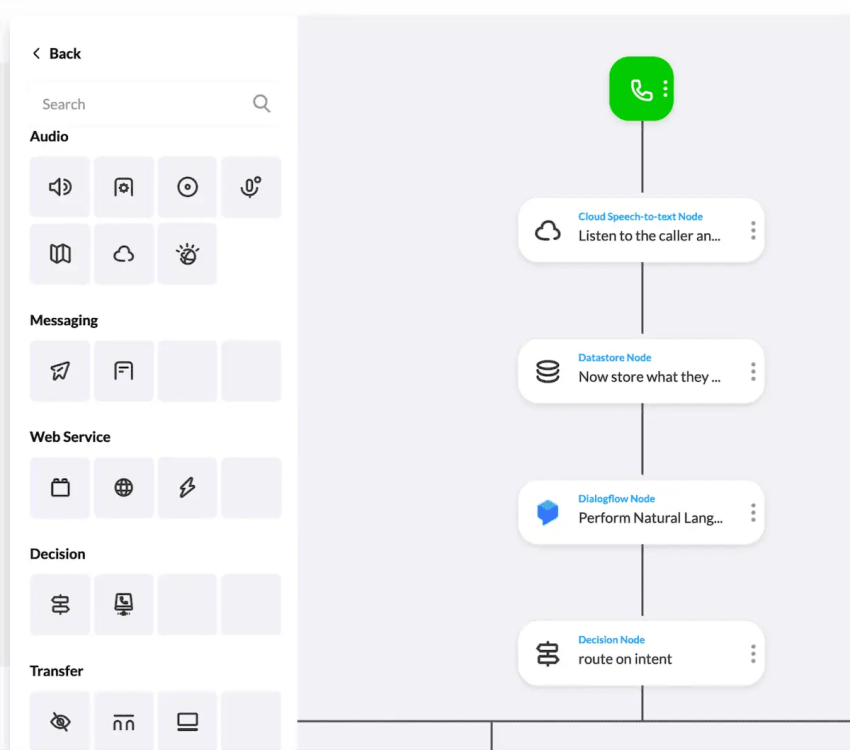
Call routing with NLP.
Handles routine questions
If you ask your staff their least favorite query, it’s going to be the repeat questions like confirming your business hours, directions to stores, what services you offer, and basic pricing.
If you can reduce the repetitive interruptions for your team and the mundane inquiries, they’ll be more enthusiastic when it comes to helping a customer with a complex query. When you look after employee experience, it has a positive impact on customer satisfaction. Let your automated receptionist handle the boring, repetitive queries and free up staff to close deals and help vulnerable clients.
Schedules appointments
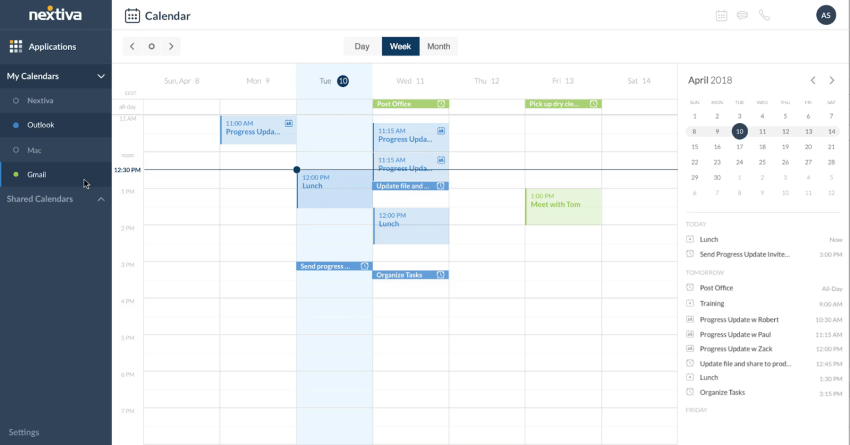
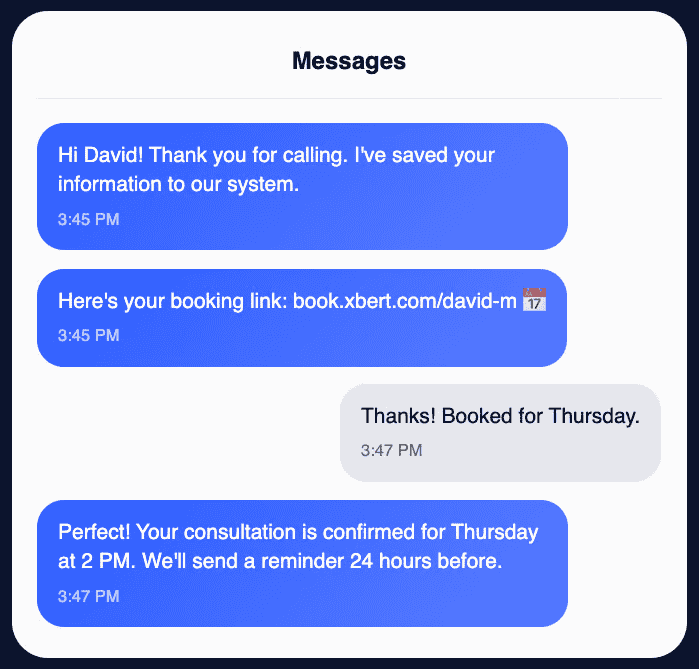
When a customer calls to book, reschedule, or confirm an appointment, your AI receptionist integrates with your calendar system to automatically generate the next convenient appointment. There’s no time lost trying to arrange staffing and find mutually available times. Instead, these smartphone receptionists do a data dip and magically find the next appointment. If the customer confirms, the job is done. If not, they find the next one — all without opening Outlook or calling personnel to confirm their availability.
Captures context for live agents
When it’s clear that your customer needs help from a live human agent, your AI receptionist acts as the information gatherer. It collects names, reasons for calling, and relevant details that your agent or specialist will need to best prepare for the call.
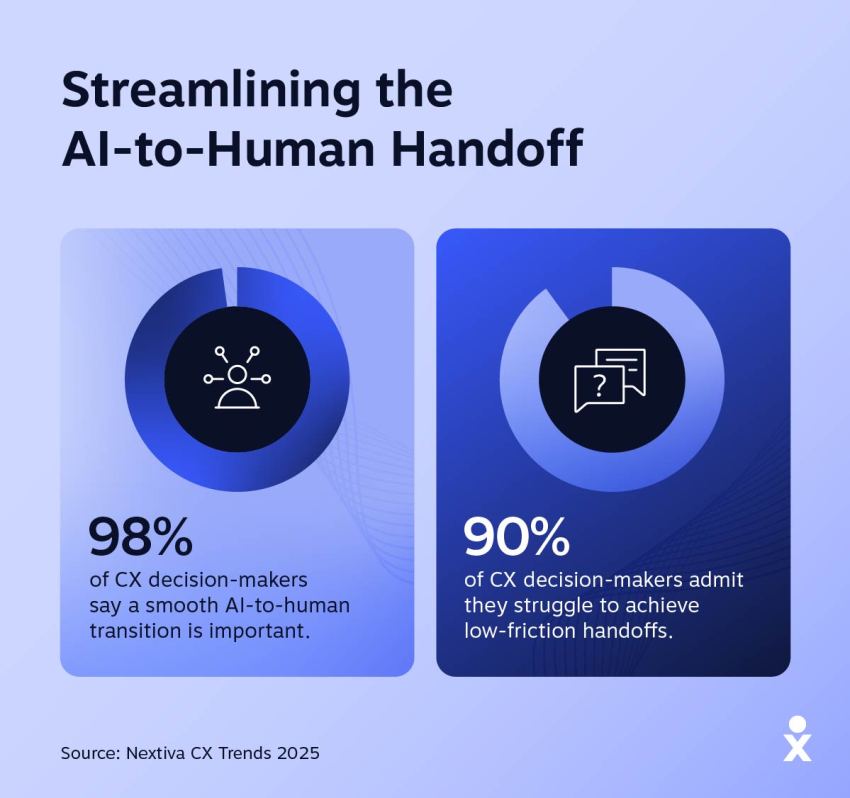
So, instead of spending their time on in-call admin, each agent focuses on the task at hand. What we’re talking about here is a call transfer with full context instead of starting from scratch.
You free up agent time, and your customers will love no longer having to repeat themselves.
Beyond just saving money, businesses deploy automated phone receptionists to solve operational bottlenecks that human teams struggle to manage alone.
Fewer missed opportunities
Missed calls often equal missed revenue. When you implement an automated phone receptionist, you remove all chances of missing calls, except during power outages when you haven’t done appropriate business continuity planning.
Not only does every call get answered efficiently, but they also stand the best chance of getting routed to the right place. Automated reception acknowledges every call and routes them per your configuration rather than with guesswork from staff.
Better use of staff time
How much time would your team gain if they could focus only on meaningful work instead of answering routine business calls? And let’s not even get started on spam calls.
In many businesses, the answer is rather a lot.
Remove the burden and time lag of answering every call, reading the long greeting over and over again, looking up customer details, and transferring calls. Wouldn’t it be nice if everyone could just get on with their job? AI answering services do that very well.
Consistent customer experience
Every caller gets the same professional first impression. That’s Branding 101 and a dream for any customer-facing business.
With no room for interpretation, changing up a greeting, or answering with a lack of enthusiasm (like humans are prone to), an automated receptionist follows the same procedure every single time.
Scales without hiring
If your call volumes are spiraling out of control, the normal first reaction is to hire more call center agents. But that comes with an associated salary just to answer incoming calls.
Instead, consider the option of an automated answering service to handle all inbound calls for a fraction of the price. You keep call spikes under control in a cost-effective manner and generate more staff time instead of hiring new full-time employees.
Compare the costs of a new hire versus an automated phone receptionist:
Check out our AI receptionist ROI calculator.
See how much your business could save with the XBert® AI Receptionist ROI Calculator. Just enter your call volume and staffing costs to find out how quickly an AI assistant can pay for itself and start freeing up your time.
Tradeoffs and Limitations: To Be Honest About
While AI offers speed and scale, it’s not a perfect replacement for humans in every scenario, and understanding its limits is key to successful deployment.
Human empathy still matters
Automation cannot replace emotional intelligence. It’s one thing to implement AI to answer your inbound calls, but we’re by no means suggesting it’s the solution to every call.
Clear escalation paths are essential to give callers the option to leave the automation and speak to a human. Likewise, it pays dividends to configure preset trigger words and sentiment analysis so your AI receptionist knows when it needs help.
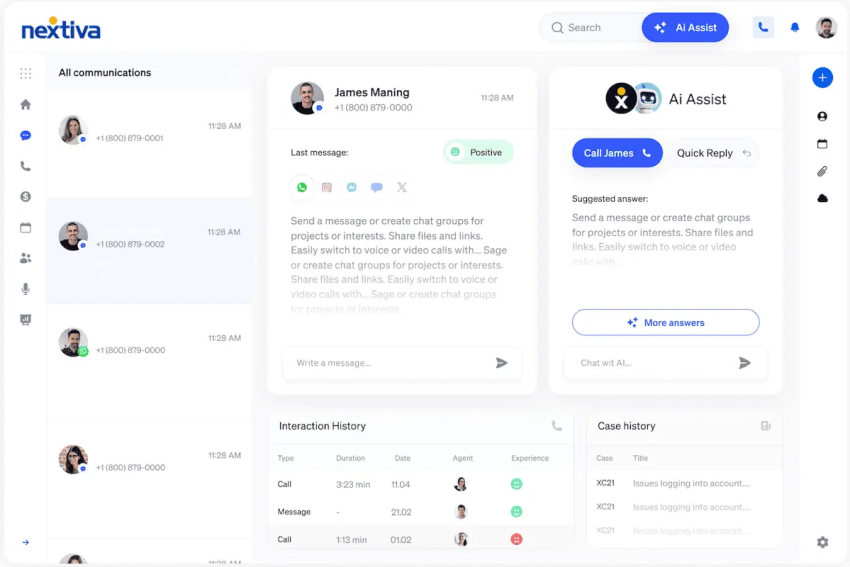
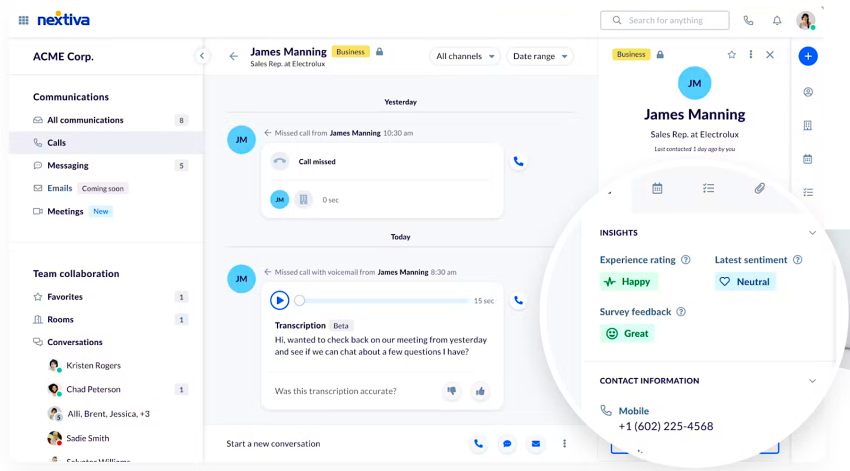
Track every customer interaction in one place—calls, voicemail transcriptions, and real-time sentiment insights side by side in Nextiva.
Poor design creates frustration
It may be tempting to try to shoehorn every customer down a different menu or sub-menu. But remember, overly complex menus and unclear prompts hurt the customer experience.
Simpler flows perform better, so think about making it as easy as possible for your customers to get what they want from the interaction. First-call resolution only improves when queries get satisfied — not just because phone calls get answered quickly.
Transparency builds trust
Callers should understand how the system works. While the goal of any AI receptionist is to sound humanlike, it’s more than likely your customer will recognize they’re talking to a robot.
With this in mind, avoid trying to disguise automation. You’re better off in the long run if customers understand and trust your automation to get them to the right outcome.
Common Use Cases Where Automated Reception Works Best
Certain business models see immediate ROI from automation, particularly those with high appointment volumes or after-hours demand.
Small businesses without front desk staff
Probably the best use case for an AI virtual receptionist is in a business with relatively few staff but high call volumes. Think of industries like retail, salons, and professional services, where there may be plenty of staff, but they’re busy doing other things.
Instead of hiring dedicated staff to answer the phones, you get always-on coverage without a payroll burden. Your floor staff or back-office experts continue doing what they’re good at and only field calls when they’re truly needed.
Appointment-driven businesses
Health care, home services, and professional consultations that rely on booking (and fulfilling) appointments can utilize automatic calendar bookings without the need for a member of staff to be present or answer the phone.
This not only reduces phone tag, where you’re forever trying to get hold of each other, but it also reduces the probability of no-shows. There’s nothing worse than an engineer arriving on time to find there’s nobody home. You either have to come back another day and lose income for that job, or go through the unenviable job of applying a no-show fee and upsetting your customer.
Property management and field services
Gas boilers don’t break down in the daytime. That’s a fact. In fact, everything that goes wrong in a home happens just as your staff clock off for the day. That leaves your patient or customer without their service until you check your voicemail the next day.
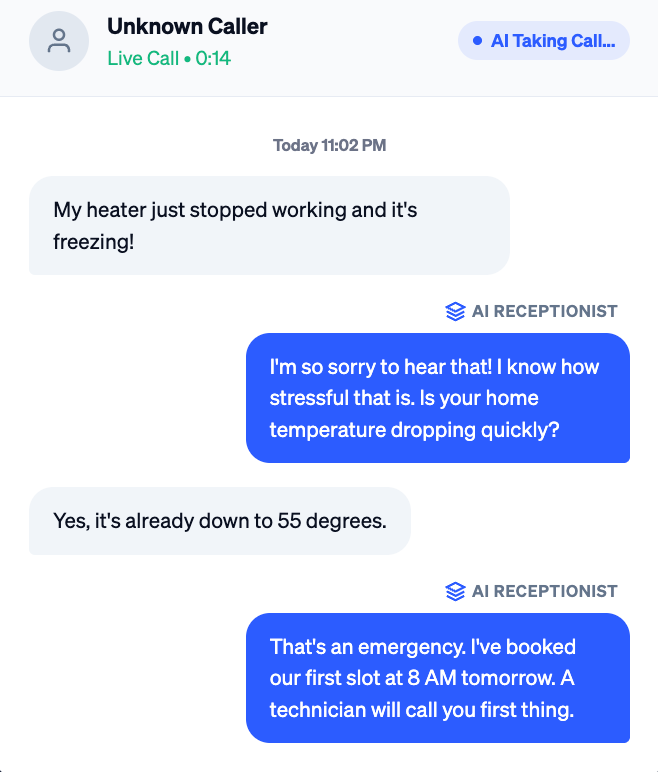
An automated phone receptionist doesn’t go home. So now you can implement after-hours routing and maintenance triage. You can respond to basic queries like rebooting and program how to diagnose first-line queries, so your customers don’t have to wait overnight. Customers get a faster response without you running the risk of staff burnout or having to employ late-night staff.
Here’s a sneak peek into how Nextiva’s XBert AI takes a phone call after hours:
High-call-volume organizations
If it feels like your phones are constantly ringing despite your team members always being on the phone, you will benefit from the filtering and routing of calls before they hit live queues for agents.
The first step of every call is identity and verification, more than likely followed by a transfer to the right person or right department. If you remove these steps from a live agent’s day, you improve efficiency, wait times, and employee morale.
What to Look for When Choosing an Automated Phone Receptionist
Not all AI is created equal; to avoid frustration, ensure your platform meets these core technical standards before you commit.
Natural language understanding
Callers should be able to speak normally without memorizing menus, slowing down their speech, or emphasizing certain words. The goal must be to have a natural conversation. Anything less is a major red flag.
Easy customization
Your chosen software must make it simple to apply updates to custom greetings, hours, and call flows. The best virtual receptionist services offer both a great customer journey and an easy administration process — ideal for last-minute changes or emergency routing when natural disasters occur.
Integrations
At a minimum, you need calendar and CRM integrations to turn calls into tracked interactions and automated activities. A break in this chain reintroduces manual work and the need for humans to tail-end every call.
Reliability and call quality
When it comes to call quality, uptime, and clarity are non-negotiable. There’s no point in turning on an automated phone receptionist if calls drop or if your customer can’t understand the response. Make sure you test your AI receptionist, ask your provider questions about packet loss and jitter before going live, and ensure that it works well with a high-quality VoIP system.
Automate It All With Nextiva
Nextiva takes a unified approach to automated call handling. It isn’t a standalone point solution you have to shoehorn into your stack. It’s a virtual receptionist built into a broader customer experience platform.
With Nextiva XBert, you get:
Automated call answering and personalized greetings.
Intelligent human escalation.
Automatic appointment scheduling.
Sales lead capture and identity verification.
But unlike standalone tools, Nextiva connects this voice data with your SMS, CRM, and analytics in a single interface. This means your automation isn’t just answering calls — it’s feeding your entire business intelligence engine.
Want to modernize your front desk? Explore Nextiva XBerthere. 👇
Your AI receptionist that never misses a call.
XBert is your AI answering service that handles calls, texts, and chats 24/7. It greets customers, books appointments, and captures leads while your business grows.
Seattle police detectives are investigating a double homicide in South Seattle this afternoon.
Just before 4:00 p.m., patrol officers responded to reports of a shooting near Rainier Avenue South and South Henderson Street. There, officers found two males with apparent fatal gunshot wounds.
Police provided emergency medical treatment to the victims until the Seattle Fire Department (SFD) arrived and took over care. SFD pronounced both victims deceased at the scene.
Following the shooting, the suspect fled the area on foot before police arrived. Officers and deputies searched the area yet they did not find the suspect.
Police cordoned off the area until homicide detectives and the Crime Scene Investigation Unit arrived to process the scene.
The King County Medical Examiner (KCME) will take custody of the deceased. KCME will identify the victims.
The circumstances leading up to the shooting are under investigation.
Anyone with information is asked to call the SPD Violent Crimes Tip Line at 206-233-5000. Anonymous tips are accepted.
Nearly 35 years ago, young Kevin McCallister had to defend his family’s home from the wet bandits! Three decades later and a 1992 sequel to boot, the Home Alone movies have become a staple of the holiday season. After the first movie’s success, the sequel Home Alone 2: Lost In New York became just as beloved as the first. Not only did the films cement their child and adult actors as major comedic players, but they have also accomplished so much more.
With two holiday classics, the film has spawned four more sequels. Home Alone 3, released in 1997, didn’t include any of the original cast or characters. Home Alone 4: Taking Back The House (2002) returned to Kevin McAllister and Marv, but the characters were re-cast for the TV movie. Home Alone: The Holiday Heist premiered on ABC Family in 2012, and it also focused on a new family, with no original cast members. The most recent sequel, Home Sweet Home Alone, premiered on Disney+ in 2021. Like the more recent sequels, it features a new family and a fresh batch of characters.
Of course, these stars have also paid homage to their ’90s holiday movie roots. Over the years, families across the country gathered around to watch these ’90s classics and more of their favorite Christmas movies. Take a look at where the film’s stars like Macaulay Culkin and more are today!
Macaulay Culkin
Macaulay Culkin was just 10 years old when Home Alone hit theaters on November 16, 1990. Two years later, he reprised the role of Kevin for the film’s sequel Home Alone 2: Lost in New York. But the young actor was already a bonafide star! Macaulay grew up with a slew of major credits on his resume. In 1991, he starred in the emotional film My Girl alongside Anna Chlumsky. After the swell of success he received at such a young age, fame really began to take a toll on the young actor.
Macaulay struggled with addiction for some time, but has since been clean and sober. His career is also getting new life, with roles on shows like Doll Face and the tenth season of American Horror Story. Macaulay was in a relationship with actress Mila Kunis for nearly a decade before they split in 2010. He’s been in a committed relationship with actress Brenda Song since 2017. On April 5, 2021, he and Brenda welcomed their first child together. The child — a baby boy — was named in honor of Macaulay’s late sister, Dakota, who passed away in 2018. Macaulay and Brenda welcomed a second son in late 2022. Macaulay was joined by Brenda and his two children when he received a star on the Hollywood Walk of Fame on December 1, 2023. During the ceremony, Macaulay called Brenda and their kids his “three favorite people.”
Joe Pesci
Joe Pesci was already a certified living legend by the time he took on the role of Harry in Home Alone, reprising the role in the 1992 sequel. The actor won the Oscar for Best Actor in a Supporting Role for his turn in 1990’s Goodfellas, the same year Home Alone came out — talk about range! Since then, Joe has continued to play sly, commanding characters in films like Casino, My Cousin Vinny, The Good Shepherd, and more.
More recently, Joe appeared alongside Robert De Niro and Al Pacino in the 2019 Oscar-nominated picture The Irishman. The film reunited the three screen legends as well as acclaimed director Martin Scorsese. For his work, Joe was nominated for Best Performance by an Actor in a Supporting Role at the 2020 Oscars.
Daniel Stern
Daniel Stern was Joe Pesci’s right-hand man in Home Alone and Home Alone 2. Daniel played the dim-witted Marv, who worked with Joe’s Harry to rob homes and create havoc around the holidays. In between the two films, Daniel appeared in the film City Slickers alongside comedy great Billy Crystal.
After the success of the Home Alone movies, Daniel went on to appear in small roles in both film and TV. He appeared in Drew Barrymore‘s 2009 directorial debut Whip It, the 2014 series Manhattan, and played Bill Easton on the Hulu series Shrill with Aidy Bryant. He’s also worked behind the camera, with seven directing credits to his name!
Long before Home Alone, Daniel has been married to actress Laure Mattos since 1980. The pair have three children, including their oldest son Henry, who is a California State Senator. Daniel has promoted his son’s political campaigns on Instagram.
Catherine O’Hara
Much like her co-stars, Catherine O’Hara was a bona fide legend in the making when she played Kevin’s mom, Kate McCallister, in Home Alone and Home Alone 2. After flexing her comedy muscles, Catherine appeared in movies like Best In Show and collaborated with Tim Burton and director Henry Selick for The Nightmare Before Christmas.
Along with a number of small voiceover roles in films like Monster House and Over The Hedge, Catherine also returned to her comedy roots. From 2015-2020, Catherine played Moira Rose on the beloved comedy series Schitt’s Creek. For her work in the show’s final season, Catherine earned the Emmy for Outstanding Lead Actress in a Comedy Series.
Unfortunately, Catherine died on January 30, 2026. She was 71.
Kieran Culkin
While his brother was the main focus of the original movies, Kieran Culkin made a few cameos as cousin Fuller McAllister in both Home Alone and Home Alone 2. He also had supporting roles in both Father of The Bride movies, but as he grew up, he got some larger roles, including Igby Goes Down in 2002.
As an adult, Kieran was cast in a wide range of projects including Scott Pilgrim Vs. The World, but his most well-known project came in 2018 when he starred in the critically-acclaimed HBO series Succession as Roman Roy. His performance in the show earned him much acclaim and three Primetime Emmy nominations in 2020, 2022, and 2023. Outside of acting, he’s been married to Jazz Charton since 2013, and they have two children.
John Heard
John Heard, who played Kevin’s dad Peter McCallister in Home Alone and Home Alone 2, was also incredibly well known at the time the two films came out, much like his co-stars. John appeared in films like Big alongside Tom Hanks and even earned an Emmy nomination for his work on The Sopranos. After the Home Alone movies, John continued to appear in critically acclaimed films and TV shows.
In 2000, he played Tony Smith in the Oscar-winning film Pollock, and in 2004 he flexed his comedy muscles once again in the film White Chicks. Prior to his death in July 2017, John worked with Oscar-winner Laura Dern in 2018’s The Tale and was featured in guest roles on shows like NCIS and more. He was mourned by so many in Hollywood after his shocking death at the age of 71.
Devin Ratray
Who would Kevin McCallister be without his big brother Buzz? Actor Devin Ratray was given the task of being the worst big brother in the world in Home Alone and Home Alone 2. As Buzz, Devin mercilessly teased Macaulay’s Kevin, but he also may have prepared the youngster to defend his home at the penultimate moment! After the Home Alone movies, Devin continued to act in a number of films and TV shows.
In 2013, he appeared in the critically lauded and Oscar-nominated film Nebraska and in 2017 he starred alongside funny ladies like Ilana Glazer and Kate McKinnon in Rough Night. That same year, he starred as Nate Henry in the HBO series Mosaic and in 2019 played Stephen in the critically acclaimed film Hustlers.
Devin’s name also appeared in headlines in Dec. 2021, when it was reported that he and his girlfriend went through a nasty split. He was even accused of strangling his ex, according to a police report obtained by Page Six, but no charges were brought against the actor. Following the allegations, New York authorities announced that they were investigating rape allegations brought against the actor in August 2022, per CNN. The actor denied the rape allegations.
I have wanted to lose 10 pounds (~6% of body weight) ever since I started Financial Samurai in 2009. I have come close, dropping five to six pounds in some years, but never quite hitting the double digit goal. As a result, for more than 16 years, I failed to accomplish something that should have been straightforward, especially for a supposedly rational economist and personal finance nerd.
There were even moments when I considered intentionally gaining a lot of weight just to make losing 10 pounds easier. The idea felt similar to racking up a ton of credit card debt to enjoy life to the fullest, then celebrating once it was all paid off. I saw people do this online and get praised like heroes.
Instead of deliberately gaining weight, I eventually decided it was healthier to just lose weight. And surprisingly, all it took was finally applying two economic principles: reduction and substitution. Once I did, the weight came off in six months.
The Basic Economic Principle of Reduction
As the price of a good rises, the quantity consumed tends to fall. This relationship is clearly illustrated by the classic supply-and-demand curve.
If each meal costs $25 and I have $100 to spend on food, I can buy four meals. If the price per meal rises to $33.34, that same $100 only buys three meals. With a fixed budget, the rational consumer must reduce consumption by about 25–30 percent.
Where we get into trouble financially is ignoring this principle. Instead of adjusting behavior, we pay $134 for four meals, absorb the higher cost, and then complain about food inflation.
A more constructive response is to use higher prices as a forcing function to consume less. Fewer meals out can help us stay within budget and, in many cases, improve our health as well. Lower spending and better discipline is a win-win outcome.
Yes, combatting inflation is straightforward but not easy. As investors, we’ve been able to make handsome returns in recent years, thereby making it easier to splurge on food. However, as a rational economist, you change your behavior if you want to change your outcome.
As the price of food goes up, consumption should go down
We Should Have Consumed Less Food During The Pandemic
Based on the simple economic principle that higher prices should reduce consumption, I should have lost a ton of weight during the pandemic.
Instead, starting in 2020, our food spending climbed rapidly as we ordered more delivery. At the time, it made sense. Delivery saved time and reduced exposure risk, especially since our daughter was born in December 2019 and had a still-fragile immune system.
The problem is that food delivery typically costs about 20% more than picking up the same meal and roughly 50% more than cooking at home. With a newborn and a three-and-a-half-year-old, we justified the premium as a necessary time saver.
Five years later, we were still ordering delivery regularly. Not only is it expensive, but restaurant food is also generally less healthy, with higher levels of added sugar and salt.
The Catalyst To Finally Start Losing Weight: Less Money
To lose weight, it helps to have a catalyst. Mine was spending five weeks with my parents in July 2025. My dad, who is about six feet tall and weighs roughly 155 pounds, called me chubby. Thanks dad. I fired back that he should put on some weight and muscle.
But deep down, I knew I could stand to lose some weight. At the time, I was five foot ten and weighed 172 pounds. There is nothing like going to Hawaii and having to take your shirt off at the beach to make you confront excess weight. If you are no longer trying to attract a mate, the natural tendency is to let yourself go because you already have one.
Because we stayed with my parents, we saved at least $20,000 in lodging costs. Initially, I only had food and transportation expenses to worry about. That changed once I decided to remodel my parents in law unit. What I thought would cost $25,000 ended up costing $41,000. It was the most money I had spent in a four-week period since remodeling a prior home from 2019 to 2022.
As I watched the bills pile up, I became acutely aware of every cost around me. When expenses rise, cash flow available for everything else shrinks. And one of the few truly flexible expenses left was food.
As a result, I intentionally decided to spend less on food to improve cash flow. For example, instead of spending $25 for an extra container of poke from Fresh Catch, we made due with less. The funny thing is, in the end, my parents ended up footing 85% of the remodel bill. I just didn’t expect them to, which is why I lowered my expenses.
Related: Everything Is Rational – The Answer To All Things Irrational
A Careful Inspection Of Our Food Budget
When we returned from Hawaii, I finally examined our food spending closely and was stunned. We were spending around $3,500 a month on food for a family of four.
Although I manage our investments and generate supplemental retirement income through this site and book writing, I do not actively manage our household expenses.
In my head, I believed we were spending around $2,500 a month on food. Inflation that accelerated after 2021 changed everything. Even though headline inflation has moderated, our food costs are still roughly 40 percent higher than they were five years ago.
Mentally, I was stuck in a much earlier pricing era until I confronted the actual numbers. Inflation has a great way of sneaking up on us.
Adding Substitution To Lose Weight
Anchoring to outdated price memories is why all of us should conduct a deep financial review at least once a year. What we remember is often disconnected from present reality.
This is the same anchoring mistake many older generations make when they say things were cheap back in their day and that working harder was all it took. They underestimate the compounding impact of inflation relative to wages.
Once I understood our true spending, my wife and I created a monthly food plan. Our target was to return to $2,500 a month and save $1,000 a month while eating healthier. That meant eating less, but also substituting.
The biggest substitution: going from food delivery to more home-cooked meals.
Living in San Francisco, a top three food city in the country, makes this harder. We build the technology that makes food delivery convenient. We are also surrounded by hundreds of excellent restaurants across every cuisine imaginable, all deliverable within an hour.
In fact, I recently discovered a restaurant called Khao Tiew that serves the best khao soi I’ve ever had. Unfortunately, once you add boneless beef short rib and tax, the dish runs about $28 for pickup. So for now, I’ve replaced it with $1.49 instant ramen noodles and call it a lesson in discipline. Substitution baby!
Khao Tiew on the west side of San Francisco has insanely good Thai food
Write Out Your Reasons For Wanting To Lose Weight
After running through your budget and deciding how much to reduce and what to substitute, it’s finally time to write out the reasons why you want to lose weight. Because once you have a why, you can do almost anything.
My reasons are:
Boost cash flow by $1,000 a month as I prepare for tougher times ahead due to AI.
Reduce total cholesterol by 50 points before my next physical in six months.
Stay trim like my dad so I can live to age 80+ and have my kids visit me with hugs and kisses like when they were young.
Reduce impact on my knees and joints when playing supports in order to feel better every day.
Continue fitting into the same clothes I’ve worn for the past 25 years, saving money and sparing myself the time and annoyance of shopping for new ones.
The Final Financial Kick in the Rear to Lose Weight
By mid-October, three months in, my weight dropped from 173 pounds to 168 pounds. I felt good about the progress because I was no longer just losing water weight. It felt real.
Then Business Insider came by to interview me about saving money while raising a family. When I saw myself on camera, I felt newly motivated to keep losing weight. The saying is true: the camera really does add 10 pounds.
After the video came out, I could suddenly empathize with actors and celebrities who obsess over fitness, weight-loss drugs, cosmetic procedures, and extreme diets. When your image affects your livelihood and future opportunities, the pressure to look your best is intense and understandable.
The experience also reinforced my desire to not pursue video to not fall into the trap of external validation. So it’s back to writing and podcasting for me, where the focus is on ideas rather than appearances. But if you want motivation to lose weight, film yourself and watch it.
Thank Goodness For Higher Food Prices
If food prices were falling, food consumption would logically rise. Good food is hard to resist. But when I watched my favorite steak at the supermarket go from $28 a pound to $32 and then $39, I stopped buying it. First I substituted with $12 cheeseburgers. Then I began reducing the consumption of meat altogether.
As delivery fees and menu prices climbed, opting out altogether became simpler. Meals that once cost under $85 for our family of four now routinely exceed $140. At that point, rice porridge with chicken and cabbage for $15 covering two days sounded great.
Now that I am used to a flatter stomach, I have no desire to go back. My endurance on the court has improved and I feel fitter overall. As Steven Tyler once said, “nothing tastes as good as skinny feels.”
Although paying more for food is unpleasant, I am oddly grateful. For too long, I lived comfortably without scrutinizing my food spending and ate whatever I wanted. This is the problem with living in America given there is an abundance of everything.
By eating less, I not only lost weight but also improved my financial discipline. Maybe I’ll even reach 155 pounds one day, like I was in high school, and live to 80 like my dad.
Who am I kidding? 155 pounds is too light. I’m happy staying around 165 pounds, plus or minus two, for the rest of my life. Fight on!
Readers, have you adjusted your consumption or substituted away from higher priced foods as prices surged? How have your habits changed since the pandemic?Are you a rational economist and PF nerd who adjusts behavior to prices?
Suggestions For A Better Life
Ultimately, the goal of losing weight is to feel healthier and live longer. Whether you succeed or not, you can at least protect your family with an affordable life insurance policy through Policygenius. My wife and I both secured matching 20 year term life insurance policies during the pandemic to protect our two young children, and once we did, a tremendous amount of financial worry disappeared.
To expedite your journey to financial freedom, join over 60,000 others and subscribe to the free Financial Samurai newsletter. You can also get my posts in your e-mail inbox as soon as they come out by signing up here. Financial Samurai is among the largest independently-owned personal finance websites, established in 2009.
For background, I was an Economics major at The College of William and Mary and have always loved the subject. If I had not gone into equities, I likely would have pursued fixed income instead. The single most important economic indicator I follow is the 10 year bond yield. The risk free rate tells us an enormous amount about growth, inflation expectations, and risk.
Learn how to make chocolate covered strawberries! Made with just 3 ingredients, this recipe is easy, yet impressive. Perfect for Valentine’s Day!
Chocolate covered strawberries are my favorite Valentine’s Day treat. They’re the perfect balance of indulgent yet fresh, fancy yet so utterly simple at the same time. I love how the rich chocolate coating gives way to the sweet, juicy berries inside.
You’ll see them in grocery stores and chocolate shops around the holiday, but for a fun project (and the best deal), learn how to make chocolate covered strawberries at home! I’m sharing my go-to chocolate covered strawberries recipe below, along with my best tips for success.
This recipe is easy to make with just 3 ingredients. Make it for an elegant dessert for a date night or party, or try it as an activity with kids. You better bet that Ollie and I will be making it this Valentine’s Day. I hope you love it as much as we do!
How to Make Chocolate Covered Strawberries
You need 3 simple ingredients to make this easy chocolate covered strawberries recipe:
Fresh strawberries
Chocolate chips – I love the rich flavor of dark chocolate chips here, but feel free to use milk chocolate if you prefer. A chopped chocolate bar or baker’s chocolate would work well too. To make this recipe vegan, use dairy-free chocolate.
Coconut oil – It gives the chocolate a bit of extra shine and the perfect texture. It still solidifies in the fridge, but it’s ever so slightly soft so that it doesn’t snap and fall off the strawberries when you bite in.
Find the complete recipe with measurements below.
How to Melt Chocolate
The first step in this recipe is melting the chocolate and coconut oil together. You have two options for how to do this:
In a double boiler on the stove: Fill a saucepan with an inch of water. Bring it to a simmer over medium heat and place a heatproof bowl on top. Combine the chocolate and coconut oil in the bowl and let them melt, stirring occasionally, until the chocolate is melted and smooth.
In the microwave: Combine the chocolate and coconut oil in a microwave-safe bowl. Microwave for 1 to 3 minutes, stirring every 20 seconds, or until the chocolate is melted and smooth.
Dip the strawberries into the chocolate mixture one at a time, holding them by the stem so that you can coat them on all sides. (You can also pierce the tops with a toothpick if the leaves feel too delicate.)
Spread them in a single layer on a baking sheet lined with parchment paper, then chill in the refrigerator until firm.
Chocolate Covered Strawberries Tips
Make sure the strawberries are completely dry. If they have any moisture on them, it can cause the chocolate to seize up. After I wash them, I pat them dry, then let them sit at room temperature for 15 minutes or so to finish drying completely.
Dress them up. These chocolate covered strawberries are delicious plain, but you can dress them up with extra coatings too. Immediately after dipping, while the chocolate is still melty, sprinkle them with shredded coconut or crushed nuts like pecans. You can also make a white chocolate drizzle by melting 1/2 cup white chocolate chips with 1/2 teaspoon coconut oil. Drizzle it over the berries after the chocolate has set, then chill until firm.
How long do chocolate covered strawberries last?
Chocolate-dipped strawberries are best on the day they’re made. I recommend storing them in the fridge until they’re ready to serve.
Beyond that, you can store them in the fridge for 1 to 2 days, but the strawberries will get softer and mushier with time. If you’re serving them for a special occasion, I definitely recommend making them day of.
Can you freeze chocolate covered strawberries?
I don’t recommend freezing chocolate covered strawberries. The berries will be very soft and mushy once they thaw.
More Easy Chocolate Desserts
If you love this recipe, try one of these easy chocolate treats next:
Chocolate Covered Strawberries
Prep Time: 30 minutesmins
Total Time: 30 minutesmins
Serves 15strawberries
Learn how to make chocolate covered strawberries! This 3-ingredient recipe is easy, yet impressive. Perfect for Valentine’s Day or making with kids.
Prevent your screen from going dark
Line a baking sheet with parchment paper.
Wash the strawberries and dry them completely. The strawberries need to be totally dry in order for the chocolate to stick to them.
Fill a small saucepan with 1 inch of water. Bring to a simmer over medium heat, reducing the heat as needed to maintain a gentle simmer. In a medium heatproof bowl, combine the chocolate chips and coconut oil. Set over the saucepan to create a double boiler and allow the chocolate to melt, stirring occasionally, until smooth.*
Holding each strawberry by its leaves, dip it into the melted chocolate, rotating it to thoroughly coat the sides. Allow any excess chocolate to drip back into the bowl, then place the strawberry on the baking sheet. Repeat with the remaining strawberries.
Chill in the refrigerator for 30 minutes, or until firm.
Chocolate covered strawberries are best on the day they’re made. Store any leftovers in an airtight container in the refrigerator for up to 1 day.
*You can also melt the chocolate in the microwave. Combine it with the coconut oil in a microwave-safe bowl. Microwave for 1 to 3 minutes, stirring every 20 seconds, until the chocolate is melted and smooth.
Nutrition Facts
Chocolate Covered Strawberries
Amount Per Serving
Calories 82 Calories from Fat 45
% Daily Value*
Fat 5g8%
Saturated Fat 4g25%
Polyunsaturated Fat 0.1g
Monounsaturated Fat 0.1g
Cholesterol 0.1mg0%
Sodium 13mg1%
Potassium 122mg3%
Carbohydrates 9g3%
Fiber 1g4%
Sugar 6g7%
Protein 1g2%
Vitamin A 5IU0%
Vitamin C 18mg22%
Calcium 41mg4%
Iron 0.3mg2%
* Percent Daily Values are based on a 2000 calorie diet.
The original promise of social media platforms was not only reach, but connection. For cultural institutions, they offered a way to speak in a more relatable voice, connect with audiences and invite participation (beyond the limits of geography).
Until around 2022, this felt genuinely transformative. At a time when many institutional websites were clunky and newsletters felt obligatory, platforms like Twitter and Instagram opened new doors. Campaigns like #AskACurator and #MuseumWeek showed what was possible: museums joined public conversations; curators shared scholarship in accessible ways; peers across the sector found one another.
Today, that landscape looks very different.
The beginning of Platform instability
Social media still delivers visibility but it no longer is a reliable as a tool for sustained community building (and engagement).
Take the case of Twitter – its transition to ‘X’, prompted several people to quit the platform. Years of audience building, professional networking and institutional presence fell apart before one could fully grasp the impact of it. Some of us migrated to Mastodon, some to BlueSky, some to both (while testing waters on LinkedIn) and yet some disengaged entirely. I fall into that last category but the experience left me with the larger question about dependence on platforms for community building – if platforms come and go*, will institutions keep investing resources in rebuilding audiences again and again? *Whether technology companies should be political is a separate debate, but the reality is that platforms like X, Meta (who discontinued fact-checking), Substack (who took an anti-censorship stance on neoNazi voices), and others now carry explicit ideological and economic positions that institutions cannot easily separate themselves from.
So what comes after social media as we know it?
In early November 2025, the Financial Times released a report suggesting that we may have passed what it called “peak social media.”
Drawing on data from a global survey of more than 50 countries, the report pointed to slow user-growth, algorithmic fatigue, and a sharp decline in time spent on platforms (most visible among GenZ).
This is not entirely surprising. Who wants a social feed dominated by influencers, advertisements, AI-generated content?! What seems to be shifting is not a desire to disengage completely, but a growing consciousness around how and why we engage online.
In my own experience (and in conversations with colleagues) I’ve noticed a growing tendency to lurk rather than participate. We scroll, save, and read, but post less, comment less, and share less. To be completely honest, I’ve saved more cat-posts last year than culture ones! Platforms like Instagram have noticed this change too. If you notice, Views has become the dominant metric in the Insights tab, normalising ‘visibility without interaction’.
But for museums, libraries, and cultural institutions that have spent nearly a decade optimising for engagement metrics, the implication is deeper than a drop in likes/comments.
Let’s pause for a moment. The shift in social media isn’t an isolated occurrence. It sits alongside two other parallel shifts worth paying attention to – a renewed interest in analog and the steady growth of platforms built around shared interest.
The rise of Analog and why it matters…digitally.
Alongside this digital saturation and fatigue, analog culture is having its own moment. Around the same time that the Financial Times report was released, I came across an Instagram (IG) carousel with a confident prediction for 2026 : ‘analog is making a comeback..’. The post featured visuals of an iPod, a digital camera and other technologies of the past. I saved the post. Over the next few weeks, the algorithm (predictably) surfaced similar posts with an increased frequency. These included opinion pieces from established publications exploring different facets of the discussion: Vogue Business described going offline as a ‘status symbol’. The New Yorker agreed that it is ‘cool to have no followers now’. Eventbrite reported an uptick in board-game events, and Polaroid’s campaign ‘Real Vs Reel’, pushed back against the reign of screens and AI. For 2026, Pinterest has predicted a letter-writing renaissance, amidst the rise of printed zines and newsletters.
Is this nostalgia? Perhaps, but it also represents the values of a slow social era – intentional attention, reflection and engagement.
If we pay attention to where platforms themselves are investing, a different pattern emerges. Meta’s push towards Whatsapp Communities, an algorithmic preference for Facebook and Messenger groups, Instagram’s ‘broadcast channels’ and subscription features – all signal a move away from ‘feeds’ towards smaller, intentional groups. Outside Meta, Reddit (which I’ve grown to love), Discord and (even emails) continue to grow as spaces shaped by shared interest.
These may seem unrelated but together, these signal a shift towards intentional participation. Crucially, these are environments where participation is shaped, moderated, and sustained. The good news I guess, is that museums (libraries and theatres too) are already designed for this moment. Their physical spaces support pause, reflection, and collective experience.
Silent Reading Sundays at Bode Museum Berlin / Photo: Shivya Nath
We’re already seeing this surface in silent reading sessions at Berlin’s Bode Museum, film photography workshops at Museo Camera in Gurgaon, collage-making at Fotografiska, and so on. But there’s also an opportunity to support the making-culture online as well as promote digital collections, which can become central as reference points/inspiration.
The opportunity, then, is not to abandon digital platforms altogether, but to rethink digital communication as an extension of the values museums and cultural organizations already practice offline: community, continuity, and more human-centred forms of engagement.
Rethinking digital communication – beyond the feed
The challenge for cultural institutions is how to translate this shift, and these values digitally, (towards community, continuity, and more human-centred forms of engagement) without defaulting to endless content production.
1. What would it mean for museums & cultural institutions to act as community hosts, and not “content producers” ?
Social media rewards volume: more formats (posts, videos, stories..) and an increased frequency mean more chances to surface in someone’s feed. For lean teams, this is exhausting and unsustainable. Community hosting offers a different framing. It implies responsibility, supporting contributors, and valuing participation.
Let’s take the example of National Gallery’s bicentenary initiative – the Gallery invested in a sustained collaboration through its 200 Creators Network. It invited artists, writers, and cultural practitioners to engage with the collection over time. This has since evolved into a Creative Collaborators programme, working with local social media creators (supported by stipends).
Here, the emphasis is not on constant output. It is on relationship, interpretation, and shared authorship.
Berlin’s Museum of Islamic Art employed a similar approach towards foregrounding creators and collaborators. During the Pergamon Museum’s closure, its CulturalxCollabs initiative used Instagram as a public record of engagement already taking place.
2. Using Social Media as part of a ‘distribution’ ecosystem, not destination.
Many museums and cultural organizations produce content for socials exclusively – a post is published, gathers attention, and then vanishes into the feed. There aren’t many optimisable ways to keep certain posts linked together if they are part of a story. This often results in teams spending significant time creating content that cannot be reused, extended, or meaningfully archived.
With limited resources, perhaps the question becomes “Where does this story travel, and what does it build over time?”
This is where editorial and distribution partnerships matter. Cultural narratives can live across multiple contexts, institutional websites, partner publications, collaborative platforms, and shared-interest communities. For example, in the last year, The Heritage Lab’s editorial collaborations with the German Digital Library and even Wikimedia UK allowed both our audiences access to museum stories while remaining contextualised, discoverable, and archivable. Within social media itself, features like Instagram ‘Collaborations feature’ can support this ecosystem approach to amplify reach without duplicating labour.
3. Owned channels as spaces for continuity
Hosting a community requires at least one owned channel. Again, this isn’t a call to abandon social media platforms altogether, but instead, ensuring that platforms are not the only place where institutional memory lives. Websites, blogs, and newsletters* are not immune to digital fatigue but they offer something social feeds cannot: continuity, context, and ownership.
*Newsletters, in particular, are re-emerging as a form of editorial infrastructure rather than a marketing add-on (if the popularity of platforms like Ghost, Beehiiv is anything to go by). True, promotion and distribution is another question (and maybe a case for a follow up post) but when paired with analog programmes, newsletters can extend the life of an experience. And most importantly, perhaps we should consider that email has endured. We have seen apps come and go, but the email – it has stayed on.
Towards digital infrastructure
As AI-generated content spills across our screens and misinformation spreads even more easily, museums and libraries carry an even heavier responsibility as context-builders and memory-keepers. With social platforms continuing to shift, the more urgent question is not where museums should post next, but what kinds of digital relationships they want to sustain, and on whose terms.
These conversations, like communities, are built over time…
If your team is already experimenting with these approaches, or questioning the limits of social media as we know it, I’d genuinely love to hear what you’re learning.
If you’d like to collaborate, host a workshop or simply share feedback, you’re very welcome to get in touch.
You can subscribe to the RSS feed and get updates on posts such as these.
The dad of a Florida woman charged with posing as a teen to molest five middle-school-aged boys has bizarrely claimed to The Post his daughter is “mentally defective” and the real victim of the sex crimes.
Before Alyssa Ann Zinger, 25, was arrested for allegedly having sex with underage boys, the accused pedophile grew up in a “good Christian home” in suburban Tampa – but dealt with a myriad of mental disorders, including ADHD, ADD, OCD, Tourette’s Syndrome and anorexia, according to her father, Josh Zinger.
“She had a lot of problems growing up. Our daughter has been to 10 to 12 psychologists and psychiatrists throughout her life,” the 55-year-old dad said, adding that Zinger once scored a 72 on an intelligence quotient test – well below the assessment’s 100-point average.
Alyssa Zinger is the “real victim” of the underage sex crimes she’s accused of committing, her father told The Post. Hillsborough County Sheriff’s Office
“She’s defective – mentally defective. And do you know what that means under the law? If somebody is mentally defective and has sex with somebody, no matter their age, it’s illegal to have sex with a mentally defective person,” Josh fumed.
“In all actuality, she is the victim.”
Zinger, then 22, was first arrested in November 2023 for allegedly engaging in at least 30 sexual acts with a boy between the ages of 12 and 15 after creating a fake persona on social media as a homeschooled 14-year-old in order to lure in underage victims, prosecutors said.
But it was the boy — who Josh distastefully dubbed “the little bastard” — who seduced Zinger and even took her virginity, her father alleged.
“That boy found her [social-media] account, found her dancing like a 13-year-old on it and said, ‘Hey, girl, I’ll Uber you to my $5,000-a-month apartment – come on and hang out,’ ” the dad said.
“And then when she got there, she never said she wasn’t 14 to him, but he knew her real age, and he knew she was mentally unstable,” Josh claimed.
The suspect’s father, Josh, says his daughter up in a “good Christian home” in suburban Tampa but dealt with a myriad of mental disorders. Law&Crime
Over the next five months, the young boy “hid” Zinger in his family’s ritzy, downtown Tampa apartment, her dad claimed. The child introduced her to his other middle school-aged friends, four of whom would become additional alleged victims in the state’s case against her.
“The boy who harbored her in his house for five months – he’s the one who introduced her to his friends, and they all were like, ‘Hey, this girl is 14,’ wink, wink, high-five, high-five, ‘Your turn, bud,’ ” Josh said, adding that “this all will be proven in court.
“There will be no plea deal, there will be no sex offender registry, she’ll get time served and adios,” the father predicted.
Five months after Zinger’s first arrest, in April 2024, authorities identified the four more alleged victims, all of whom reportedly attended Wilson Middle School in Tampa’s Hyde Park neighborhood.
Since then, Zinger has remained in jail without bail on felony charges of lewd or lascivious battery, lewd or lascivious molestation, possession of child pornography, in-state transmission of child pornography by an electronic device and sexual cyber harassment.
According to her father, the clink hasn’t treated the accused predator well — with there being “sh-t in her food all the time; fingernails, hair, objects, plastic, because whoever was making her food knew who she was, and they knew that that food was going to a pedophile,” he said.
Zinger has remained in jail without bail since she was arrested for a second time on underage sex crime charges in April 2024. WFLA
“When we go to court, we’re going to chem ‘em all up, flip this around,” Josh said.
Zinger’s trial is scheduled to begin May 26.
The first victim told police he and Zinger had sex multiple times and that she sent him explicit photos and videos, while another said she sent a video depicting sexual intercourse to several children through Snapchat, according to arrest documents.
She also told one of the victims that she’d had sex with other teens, the docs stated.
Catherine O’Hara has died at age 71, PEOPLE confirmed on Jan. 30
Her Home Alone costar Macaulay Culkin reacted to the sad news on Instagram
A cause of death has yet to be revealed
Catherine O’Hara’s Home Alone costar Macaulay Culkin is reacting to the sad news of her death.
The Emmy-winning actress’s manager confirmed to PEOPLE on Friday, Jan. 30, that she has died at age 71. A cause of death has yet to be revealed.
In Home Alone, the 1990 holiday classic, O’Hara played a mom who accidentally leaves her son (played by Culkin) at home. They also starred together in the 1992 sequel, Home Alone 2: Lost in New York.
“Mama. I thought we had time,” the star’s onscreen son said in a sweet tribute on his Instagram.
“I wanted more. I wanted to sit in a chair next to you. I heard you but I had so much more to say,” he captioned side-by-side photos of himself and O’Hara in Home Alone and in 2023. “I love you. I’ll see you later.”
Never miss a story — sign up for PEOPLE’s free daily newsletter to stay up-to-date on the best of what PEOPLE has to offer, from celebrity news to compelling human interest stories.
Culkin, 45, has previously called O’Hara a mother figure when recalling his time working with her on Home Alone, when he was only 10 years old, and its sequel.
The Canadian star supported Culkin at his Hollywood Walk of Fame ceremony in December 2023, marveling at how he was “older than I was when I played his mother.”
“Home Alone was, is and always will be a beloved global sensation… the reason families all over the world can’t let a year go by without watching and loving Home Alone together is because of Macaulay Culkin,” she said that day.
O’Hara and her husband, Bo Welch, once had a real Home Alone-like scare with their sons Matthew and Luke (who are now adults.) “We were in New York once; I think it was New York,” the Schitt’s Creek star told PEOPLE in January 2024.
“Bo and I got on the subway, we turned around, the doors are closing, and they weren’t on… I screamed and people screamed with me,” she recalled. The doors then reopened, and the boys joined their parents. “It makes me sick to think what could have happened,” said O’Hara.
No further details have been shared about O’Hara’s death. She is survived by her husband and children.


























:max_bytes(150000):strip_icc():format(jpeg)/Macaulay-Culkin-Catherine-Ohara-tout-1-120123--e88df4cb37de4855af877c358fb383ba.jpg)