




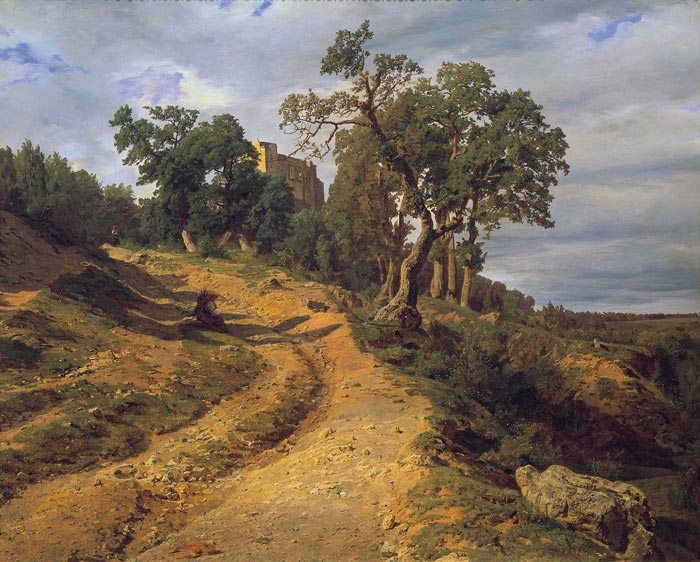
From 27 February to 14 June 2026, the Lower Belvedere presents the exhibition “Ferdinand Georg Waldmüller: True to Nature”
Source: Ferdinand Georg Waldmüller. Image: Ferdinand Georg Waldmüller: “The Ruins of Liechtenstein Castle near Mödling”, 1848
Landscape painting experienced a heyday across Europe during the nineteenth century. Ferdinand Georg Waldmüller was part of this development, capturing people’s yearning for the natural world in his intimate portraits of trees, sweeping landscapes from the Vienna Woods, and iconic views of the Salzkammergut. This exhibition sheds light on Waldmüller’s landscapes in the context of his time. Trailblazing contemporaries, such as John Constable and Jean-Baptiste Camille Corot, inspire us to explore Waldmüller’s depictions of nature against the backdrop of wider European developments.
The exhibition
In the first half of the nineteenth century, many progressive artists across Europe issued a clarion call that art should be true to life. Artists increasingly turned their attention to their native landscapes because, in the age of industrialization, people wanted to spend more time in the natural world, to learn about it, and to bring nature into their homes in the form of pictures.
Ferdinand Georg Waldmüller (1793–1865), a pivotal Austrian painter from the Biedermeier period, made it his goal to paint “nature that surrounds us, our time, our customs.” His true-to-life portraits, genre scenes, and landscapes polarized opinion. Landscape was key in his art—as a background, a subject in its own right, and as an expression of the connection between humanity and nature. It was an interest that endured until the end of his life.


