Notice: Function _load_textdomain_just_in_time was called incorrectly. Translation loading for the td-cloud-library domain was triggered too early. This is usually an indicator for some code in the plugin or theme running too early. Translations should be loaded at the init action or later. Please see Debugging in WordPress for more information. (This message was added in version 6.7.0.) in /home/releande/public_html/wp-includes/functions.php on line 6170 News Magazine | Get The Most Freshy News Every Day | Page 39
From California to New York, juvenile detention systems struggle to protect the youth they house.
Barry J. Nidorf Juvenile Hall in Sylmar, Calif. Jamiles Lartey/The Marshall Project
This is The Marshall Project’s Closing Argument newsletter, a weekly deep dive into a key criminal justice issue. Want this delivered to your inbox? Sign up for future newsletters.
On a sunny day in late January, Judge Peter A. Hernandez briefly interrupted testimony in his Los Angeles County courtroom, sounding genuinely baffled.
In the case before him, the state of California was arguing that the Los Angeles County Probation Department, which runs the county’s juvenile detention halls, had done such a poor job, and for so long, that the court should authorize a leadership takeover — called a receivership.
The lawsuit over detention conditions, first filed in 2021, was assigned to Hernandez in the summer of 2024. And despite dozens of hours of prior testimony in his court on the minutiae of daily operations, Hernandez said it was the first time he’d been briefed about how the department had failed to master the most basic of workplace functions. Probation Chief Guillermo Viera Rosa testified that until recently, “there was no database in which people were being scheduled,” no dependable way to track which employees were supposed to show up, who called out, and where staff were posted once a shift began. Viera Rosa said in some cases, between callouts and staff medically unable to perform essential functions, as much as 85% of employees had been effectively unavailable.
“I’m a bit troubled and alarmed,” Hernandez said. “It’s kind of hard for me to understand how this kept going with no one saying anything.”
While scheduling databases may sound banal, many of the scandals that have long-plagued juvenile justice — not just in LA County, but across the country — turn on these kinds of dry, administrative questions. Basic staffing problems have led to violations of standards and safety in juvenile detention centers in many states.
When excessive callouts lead to understaffing, other employees call out too, afraid that they will be left vulnerable to violence. Then others call out to avoid being “held over” past their shifts to cover for their colleagues’ missed shifts, LA County officials have said. It’s the very definition of a vicious cycle, and it has devastating effects on youth in the care of the county.
Without adequate staff, youth miss school, recreation and medical appointments. They spend more time stuck in cells, which breeds frustration and sometimes violence, again feeding back into the loop, according to the testimony of Michael Dempsey, the independent monitor who was hired in 2025 to oversee youth detention in the county. At the end of last year, the department had a 36% vacancy rate for sworn officer positions, with 70% of all new hires leaving within their first year. The union that represents corrections officers says the churn is a function of untenable work conditions,along with mismanagement.
Los Angeles County’s juvenile justice system is hardly alone. New York Focus reported earlier this month that understaffing in New York’s state-run facilities has grown so severe that one site was operating with roughly one-tenth of the staff it was supposed to have. In interviews with the news outlet, staff members said the chronic shortages pushed them into 24-hour shifts and forced them to leave youth locked in cells for long stretches. Like in Los Angeles, these long spells of confinement sometimes left young people with no other option than to relieve themselves in bottles, bags and trash bins when no one is available to let them go to the bathroom, according to staff.
Asked about the conditions, one frustrated employee said to a reporter, “Why are we here? We are part of the problem,” before breaking into tears.
New York regulations generally restrict youth isolation and require additional approval when confinement extends beyond a day. A federal class-action lawsuit filed earlier this year alleges that a kind of de facto solitary confinement frequently persists simply because there is not enough staff to run the facility safely.
In Tennessee’s Shelby County, home to Memphis, unchecked youth isolation has also been a central scandal. An investigation by the news organization MLK50 last year found that youth held in the county’s detention center between 2023 and 2025 were often kept in “23-and-1” conditions — confined in their cells for 23 hours a day. In response, county leaders have floated a new local ordinance to limit juvenile isolation. But some youth advocates are pushing back on the proposal, arguing that it contains no way for the county to enforce the limits, and no independent oversight.
Multiple detention centers in North Carolina have also routinely held youth in their cells from 22.5 to 24 hours a day, according to a report released Thursday by a local advocacy group. The findings follow a federal lawsuit filed in 2024 that claimed that teenagers held at Cabarrus Regional Juvenile Detention Center, near Charlotte, endured this level of isolation for weeks or even months, let out mainly for brief showers, limited recreation and short stretches of school. State officials denied the report’s findings to NC Newsline.
Staffing shortages also played a key role in other North Carolina juvenile detention facilities. The state’s largest detention center in Mecklenburg County, which includes Charlotte, was closed in 2022 due to insufficient staff, and the teenagers who were housed there were transferred to other facilities. Last month, North Carolina Health News reported that some advocates for youth want the facility to reopen, arguing that sending teenagers long distances away from their families is damaging to their mental health.
“At a really critical point in their growth, they have to be shipped away, and they don’t have access to those people that are central in their lives,” Mecklenburg County Commissioner Susan Rodriguez-McDowell told the outlet.
While officials and experts worry about the mental health toll of long-distance placements and prolonged isolation, detention is increasingly serving as a backstop for the youth mental-health-care system.
A survey released last week by the office of Georgia Sen. Jon Ossoff found that, across 25 states, 75 juvenile facilities reported incarcerating young people who were eligible for release to mental health programs because actual programming was not available. In addition, 20 facilities surveyed reported holding youth beyond their expected release date or the duration of their sentence, due to a lack of suitable mental health placement.
“This should shock America’s conscience,” Ossoff said. “Children with special needs, locked up for extended time, instead of getting the mental health care that they need.”
Following the death of Eric Dane, the actor’s friends have set up a GoFundMe to support his daughters, but some have met the gesture with criticism.
The late Euphoria star’s friend Mike McGuiness explained why he started the crowdfunding campaign as he shared some heartfelt memories from a recent trip they took to Toyko before his death.
“Covid and ALS did a number on his work life and he sadly couldn’t leave his family with the resources he had hoped,” wrote McGuiness in the caption. “A GoFundMe is being made and I will post it on my story for anyone able to help. Love the ones you’ve got.”
McGuinness also wrote in part, “My friend of almost two decades just left us after a brutal battle with ALS. I’m the positive spin guy and can come up with something hopeful in most any situation. This one broke me. I had nothing to say, it’s about as hopeless an affliction one could get. I truly don’t know if I could muster grace or dignity in that spot. Eric did. Candidly, I didn’t know he had it in him.”
Seeking to raise $250,000, the GoFundMe has surpassed $187K as of Saturday morning, with Sam Levinson, Alyssa Milano and Randall Emmett donating. The Euphoria creator and wife Ashley Levinson were to top donors, contributing $27,000.
The campaign notes funds will be used “to support his girls and their future needs.”
They continued, “Any contribution, no matter the size, will help provide stability during this incredibly difficult time and in the future for Eric’s wonderful daughters. Thank you.”
Known for his roles on Euphoria and Grey’s Anatomy, Dane’s family announced that he died on Thursday, after he revealed his ALS diagnosis last April.
Dane is survived by actress wife Rebecca Gayheart and their two daughters, Billie and Georgia.
Once defined solely by a critical lack of supply, Canada’s
housing crisis
now faces the compounding challenge of plummeting sales.
Sales over the past year have dropped in major centres across the country, particularly in the Greater Toronto Area (GTA), where the housing shortage remains most acute. Home sales in the GTA fell 11.2 per cent in 2025, according to the
63 per cent for single-family homes and 89 per cent for condos versus the 10-year average. In January, year-over-year home sales declined by 19.3 per cent.
Sales aren’t falling because Canadians have given up on homeownership, but because consumer confidence has dipped amid trade tensions and a softening economy. Buyers are also confused by delays in the implementation of government policy, such as the promise to remove sales tax from new homes for first-time buyers.
If those sales volumes fail to rebound, then
housing construction
will continue to grind to a halt.
But Canada can’t afford to stop building — even in a downturn. We simply need more supply of all types of housing too much. We need it for those Canadians who want to buy homes and for those whose jobs are to build them.
The federal government is already removing its portion of the
GST
/
HST
from all new homes for first-time buyers, a measure that has been delayed by the long timeline to pass the legislation. Ontario is also planning to remove its portion of the HST, again only for first-time buyers.
Housing is an ecosystem and to really get the sector moving, we need to encourage all consumers, not just first-time buyers. Both governments can do this by immediately expanding the GST/HST cut to all new homebuyers, as new polling conducted for Mattamy Homes by Abacus Data in January affirms.
Specifically, of the 52 per cent of Canadians who intend to purchase a home, one-third say they have delayed buying in the past year because homes are too expensive, according to the survey of nearly 2,500 people. Among these reluctant but active buyers, 59 per cent say an expanded GST rebate would make them more likely to buy.
Among Canadians who have previously owned or currently own a home, 39 per cent say they would be more likely to buy if the GST rebate were extended to them. The impact is strongest among cost-constrained, non-first-time buyers who want to buy, but have delayed their purchase due to high costs: 79 per cent say the cut would make them more likely to buy a new home.
In Ontario, the numbers tell a similar story: extending the rebate to all new home buyers would improve sales. In that province, 65 per cent of hopeful buyers say they would be at least somewhat more likely to buy if the HST were eliminated. That jumps to 76 per cent among those who delayed a purchase over cost.
These Canadians are more than just numbers on a page. They are families in condos that are too small and are delaying having another child because they cannot afford somewhere large enough to accommodate their growing family. They are seniors who would love to move closer to their grandkids and free up their single-family home for a condo in the city. They are people commuting hours each day to work because the cost of moving closer to their job is prohibitive.
These are just some examples of the Canadian homeowners for whom both levels of government need to extend the HST cut.
In addition, if sales don’t increase, thousands of good, well-paying jobs could be on the line.
If housing construction stalls, a total of 41,000 jobs would be lost in the GTA, according to a
for the Building Industry and Land Development Association. Of that, 18,500 jobs are directly associated with housing construction (a little less than half of the GTA’s direct housing construction workforce) and another 21,000 indirect jobs would be lost.
The same report said the combined fiscal impact on all three levels of government of those job losses, through reduced tax revenue, would be approximately $6.5 billion per year.
The reality is that many builders have shovel-ready projects, but lack the sales numbers to move forward. Unwinding decades of red tape and hidden taxes (such as development charges) embedded within the housing system is important, but those measures will take time to have a full impact.
Only expanding eligibility for the GST/HST rebate will have the immediate effect needed to drive housing sales and, in turn, keep shovels in the ground and create the jobs that move them.
Canadians need less taxation on their homes. Our country needs more housing supply and our economy needs the jobs that come from a healthy home construction industry. Government can act by expanding the HST rebate to all new homebuyers and creating the conditions for the entire housing ecosystem to thrive. The time to act is now.
Canada’s home sales plunge in January, led by Ontario
Garry Marr: For young Canadians who bought at peak of market, Home Buyers’ Plan was invitation to disaster
Brad Carr is chief executive of Mattamy Homes Canada.
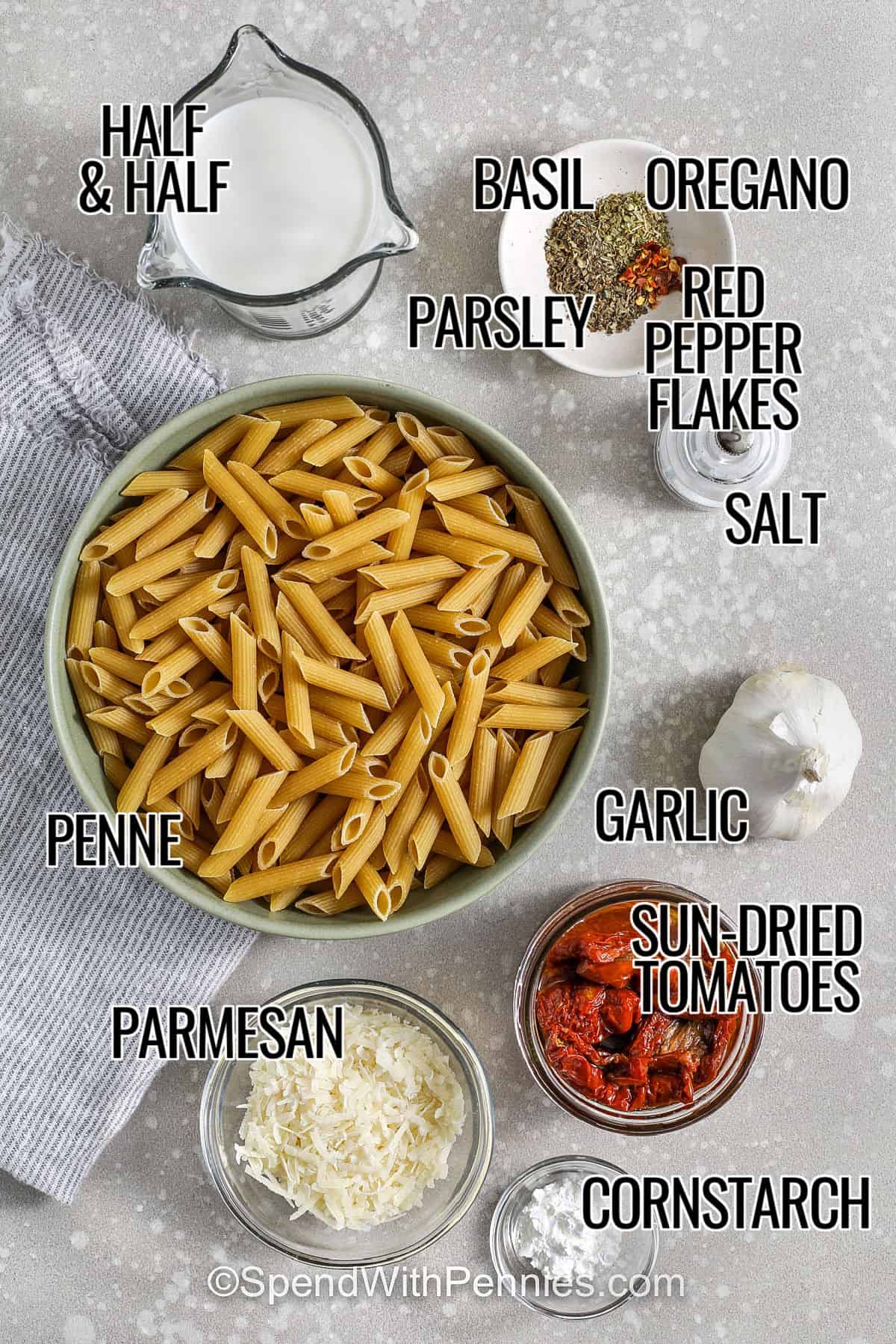
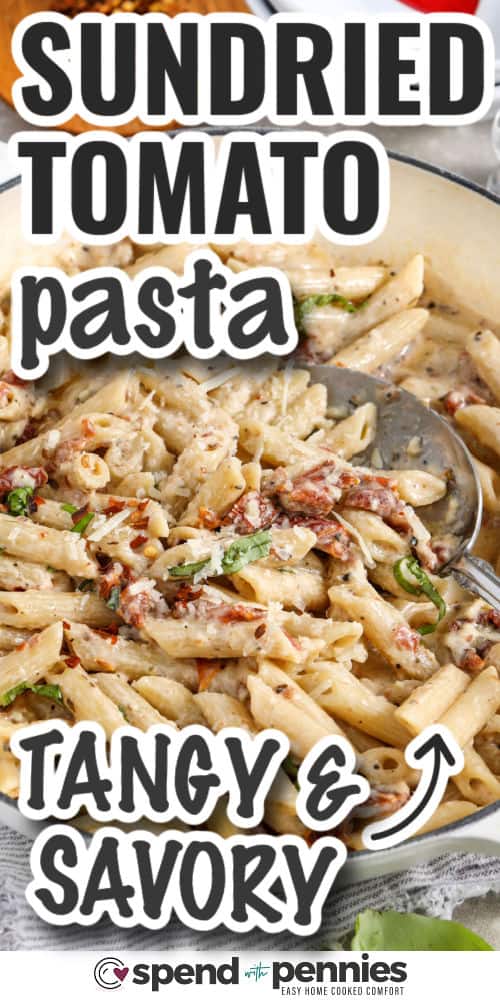
This Sun Dried Tomato Pasta is a quick weeknight dinner that’s ready in about 20 minutes. Penne is tossed in a garlicky Parmesan cream sauce with oil-packed sun-dried tomatoes for a cozy, savory bite.
Flavor: A creamy, garlicky sauce with tangy sun-dried tomatoes, savory Parmesan, and homemade herby goodness.
Skill Level: This beginner-friendly recipe is super quick, easy to make, and very forgiving.
Serving Suggestions: Serve with cooked chicken, salmon, or Italian sausage, and a side of garlic bread and a Caesar salad.
Ingredients and Easy Swaps
Penne or Other Medium Pasta: Ridged shapes hold creamy sauce well. Swap the pasta for rotini, rigatoni, shells, or farfalle, or another favorite pasta shape.
Sun-Dried Tomatoes: Choose a jar of tomatoes in oil, not dry-packed, and chop them into small pieces so the flavor spreads evenly.
Sun-Dried Tomato Oil: This is the main flavor builder for creamy sun-dried tomato pasta, so use 3 tablespoons for the base, then add more if needed.
Half-and-Half: Half-and-half stays a bit lighter, or swap in some heavy cream if you want a richer sauce.
Parmesan: Finely grated melts more smoothly, as thick shreds can clump. Replace with Asiago or a Romano and Mozzarella blend.
How to Make Sun Dried Tomato Pasta
Cook pasta al dente, reserving some pasta water.
Cook garlic and herbs in the sun-dried tomato oil, and add chopped tomatoes.
Stir in the half-and-half mixture, toss with drained pasta and Parmesan.
Stir in pasta water to smooth out the sauce as needed.
Whisk the cornstarch into cold half-and-half first, so your sauce won’t get lumpy.
Keep the heat on medium and be careful not to let the garlic scorch to keep it sweet and fragrant.
Chop your sun-dried tomatoes small and even so every bite is balanced.
Stir in the Parmesan once the sauce is hot but not boiling, so it melts nicely.
Taste after adding cheese and tomatoes, and then add salt as needed.
Storage and Leftovers
Cool and store in an airtight container in the fridge for up to 4 days. Reheat gently on the stove over low heat or in the microwave at 50–70% power, stirring often and adding a splash of milk, half-and-half, or water to loosen.
Freezing is not recommended
Creamy Pasta Night Lineup
Did you make this Sun-Dried Tomato Pasta? Leave a comment and rating below.
Prep Time 10 minutesminutes
Cook Time 10 minutesminutes
Total Time 20 minutesminutes
In a large pot, cook pasta according to package directions, reserving 1 cup of pasta water. Drain well, but do not rinse.
Drain the sun-dried tomatoes, reserving the oil. Chop the tomatoes and set aside.
Add 3 tablespoons of the reserved sun-dried tomato oil to a large skillet over medium heat.
Add garlic, basil, oregano, and red pepper flakes. Cook for 1 minute or until the garlic is fragrant. Stir in the sun-dried tomatoes and cook for 2 minutes more.
Whisk the half-and-half and cornstarch in a small bowl and add to the skillet. Continue whisking until bubbly and it begins to thicken. Let simmer until thickened.
Stir in the pasta, cheese, and salt, then simmer for 2 more minutes. Slowly add the reserved pasta water, a little at a time, until the sauce reaches your preferred consistency. Garnish and serve.
This pasta is lightly salted as the salt in sun dried tomatoes can vary by brand. Taste and season with additional salt if needed before serving.
You can feel it in everyday conversations: the coworker you meet on Monday who’s already counting down to Friday, that friend who cancels plans because they’re “exhausted.”1 There’s no question about it — more and more people are struggling with chronic fatigue and work-related stress. In fact, 6 out of 10 employees in major global economies now report rising levels of workplace stress.2
In response, many of us try to regain balance by eating better and moving more. But beyond these familiar strategies, there’s a surprisingly simple habit that might offer greater benefits: hobbies. While people often turn to them as a way to unwind, new research suggests they do more than just lift your spirits.3
A study by researchers at the University of East Anglia and Erasmus University Rotterdam4 examined leisure crafting — this involves using a hobby more intentionally through small goals, learning something new, or connecting with others. Published in the journal Human Relations, the study explored how this intentional approach to hobbies might shape people’s daily experiences.
The researchers aim to remind people that it is possible to use their hobbies to enjoy work more or possibly be more creative. Lead author and Associate Professor of Work and Organizational Psychology at Erasmus University Rotterdam, Paraskevas Petrou, Ph.D., said:5
“It’s already known that hobbies are good for your well-being, but our study shows that hobbies don’t just make you happier, they can also help you feel more fulfilled and creative at work. This goes beyond just relaxing or having fun — like binge-watching Netflix — and turns the hobby into something that helps people grow.”
• The study followed nearly 200 working adults — Participants were mid-career employees with an average age of 46. Adults aged 61 and older were included as well, to explore how hobbies affect people at different life stages.6
• How the five-week hobby program worked — One group watched a short hobby-focused intervention video that guided them to approach their hobbies more intentionally by setting personal goals for their hobby, learning something new through it, and building social connections by practicing their hobby with others. Meanwhile, a control group did not watch the video and did not receive any guidance or planning tools.7
• A surprising boost in meaning and creativity — Each week, participants reported how their hobby practice was going, and their answers were compared to that of the control group. The researchers found that those who followed leisure crafting reported greater meaning and creativity at work.8
“We were surprised to see that leisure crafting had a stronger effect at work than in people’s personal lives. We had expected equal benefits in both areas … One possible reason is that people who took part in our study were already fairly satisfied with their lives outside work, but their work life had more room for improvement,” Professor George Michaelides, a study co-author from UEA’s Norwich Business School, said.
• Why do these findings matter? As more workplaces focus on well-being, this study is “the first to be conducted among a mature working population and to demonstrate that leisure crafting can be understood, learned, and displayed by employees.”9 The researchers point to practical steps organizations can take, such as offering hobby-related masterclasses and allocating development funds for learning outside work.10
Get Creative and Be Kind to Your Mind
If you’re thinking about trying a new creative hobby, you’re not just adding something fun to your routine — you’re giving your mind something new to play with. Writing by hand, dancing, painting, or even simple coloring encourages your brain to spot patterns, make new connections, and stay more engaged day to day.
• Creativity can be a ‘fountain of youth’ for your brain — Researchers from the Global Brain Health Institute11 published a major study in Nature Communications, examining nearly 1,500 adults across 13 countries to see whether creative engagement might slow brain aging. Participants ranged from tango dancers in Argentina and musicians in Canada to visual artists in Germany and real-time strategy gamers in Poland.
Creative individuals showed “younger-looking” brain function, with brain imaging and machine learning pointing to stronger connectivity and greater mental flexibility compared to non-creatives.
• Strategy games stimulate the brain — In a second arm of the study,12 non-experts completed 30 hours of training in StarCraft II, a complex real-time strategy game. Within three to four weeks (about five to 10 hours a week), their brain activity showed measurable improvements in areas tied to planning, focus, and learning. A comparison group trained on Hearthstone, a simpler, turn-based game, did not show the same gains.
• Handwriting helps boost memory function — Handwriting supports stronger memory because the physical act of forming letters activates multiple senses and engages brain regions involved in motor control and perception, helping you recognize shapes, process words more deeply, and build lasting neural connections.13
• The colorful benefits of painting — Painting isn’t just about making something pretty; it’s a chance to express yourself. It’s also beginner-friendly, with endless room to grow, no matter your skill level. And when you paint with others, the social connection becomes just as enjoyable as the art itself.14
Enjoy Reading More Books
As more people look for calming ways to unwind, many are rediscovering their love for reading; The Sun15 even dubbed it “the hot new hobby for 2026.” But beyond the trendiness, reading has always been one of the most satisfying and affordable pastimes you can get lost in.
• Reading gives your brain a daily workout — Reading sharpens critical thinking, sparks creativity, expands vocabulary, and deepens knowledge — all while stimulating imagination and keeping your mind active and resilient.16
• Reading can delay Alzheimer’s disease by up to five years — A 2021 study published in Neurology17 followed 1,903 seniors over seven years and found that those who engaged in cognitively stimulating activities like reading developed Alzheimer’s five years later than those who didn’t. Participants with high cognitive activity developed dementia at an average age of 94, while those with low activity saw onset around age 89.18
• It protects you against cognitive decline — A 14-year longitudinal study in International Psychogeriatrics found that older adults who read at least once a week were significantly less likely to experience cognitive decline. The researchers found out that:19
“[T]hose with higher reading frequencies (≥1 time a week) were less likely to have cognitive decline at six-year (AOR: 0.54), 10-year (AOR: 0.58), and 14-year (AOR: 0.54) follow-ups … across all educational levels.”
Reading has also been known to help people sleep better, improve their eyesight, and even reduce gadget use. To learn more about these findings, check out “The Surprising Benefits of Daily Book Reading.”
Cook Up a Storm at Home
Cooking isn’t just a practical skill; it’s a fun, relaxing way to get creative and make meals that you’ll love eating. Even if you’re new to the kitchen, there are plenty of easy, enjoyable ways to get started. No matter how you begin, cooking is a rewarding, confidence-boosting hobby. It’s also a more enjoyable way to eat healthy and be able to avoid eating ultraprocessed foods every day.
• Cooking may support your mental health — Beyond saving money or improving nutrition, cooking at home may offer real mental health benefits. A 2021 meta-analysis published in Frontiers in Psychology reviewed 13 studies involving over 11,000 participants to explore how home cooking affects psychosocial outcomes like self-esteem, mood, and overall well-being.20
“Cooking at home is associated with higher diet quality and nutrient intake … Biological pathways through which improved diet might enhance mental health and well-being include improvements in markers of inflammation, increased intake of antioxidants, which reduces oxidative stress, and changes in the microbiota gut-brain axis,” the authors explained.
• Experiment with ingredients and get comfortable — Start with simple, easy-to-follow recipes that use just a few ingredients and basic techniques. As you get more comfortable in the kitchen, you can experiment with more complex flavors and dishes. Try adding herbs like oregano, ginger, or dill to your next meal — not only will they add depth, but offer health benefits as well.
• Make time for tea — Sipping a cup of tea daily could help lower your risk of diabetes. Researchers from the University of Adelaide found that regular tea consumption may improve blood sugar control, making it a small but powerful dietary habit.21 As the world’s most-consumed drink after water, tea has been valued for centuries.22
One standout variety is Pu-erh, a fermented dark tea also known as Chinese black tea. Its unique fermentation process increases levels of bioactive compounds, including polyphenols, amino acids, and polysaccharides, offering antioxidant and anti-inflammatory benefits.
You can also sip on some green tea or matcha to help you feel more relaxed. Green tea is rich in antioxidants and, like black tea, contains potent polyphenols — especially a catechin called epigallocatechin-3-gallate (EGCG), which has been shown to have even stronger antioxidant activity than vitamins C and E.23
Dance Freely and Move with Intention
Free-form dance is more than art or fun; it’s a powerful and accessible form of exercise that supports both physical and mental health. Unlike structured workouts, this unchoreographed style engages the whole body and brain, allowing for emotional expression, spontaneity, and cardiovascular conditioning all at once.
• Free-form dance has the same intensity as traditional cardio workouts — A new study in PLOS ONE24 found that free-form dancing can match the intensity of traditional aerobic exercise. The research involved 48 adults ages 18 to 83, who were asked to dance freely in five-minute sessions at both moderate and vigorous effort levels.
The participants reached an average of 76% of their maximum heart rate, and vigorous dancing hit 7.5 metabolic equivalents (METs) — like jogging or cycling — while moderate dancing reached 5.6 METs.
• What sets this study apart? Most earlier studies looked only at formal styles like ballet or hip-hop, leaving out how every day, improvised movement might help regular people — this study finally tackled that. The findings indicate that even without strict choreography or a flashy studio, free-form dancing has its benefits, especially when you set weekly movement goals.
Finding a Hobby That You Love
In an article in The Guardian, Daisy Fancourt, professor of psychobiology and expert in social prescribing, explains that hobbies do far more than just pass the time. If you’re thinking of starting one, it helps to reflect and ask yourself:25
• How much time did I actually spend on a hobby last week? Compare this to how much time you wish you’d spent. Noticing that gap can help you be more intentional going forward.
• What aspect of my health am I hoping to improve? If you’re seeking calm, exhilaration, connection, or a sense of purpose, clarify that upfront. The more specific your goal, the easier it is to find a hobby that fits.
• What did I love doing as a child — or wish I’d pursued as a career? Old passions can offer clues. If you dreamed of performing, try local theater. If you wanted to work with kids, look for volunteer roles or intergenerational activities.
• What do I need to get started? You might need a taster session, a how-to video, or just a friend to come along. Local newsletters and social prescribing directories can help you find options.
• Which core needs are currently not being met? Think about what’s missing: autonomy, creativity, physical movement, fun, or purpose. Choose something that balances what your work or daily life lacks.
• What kind of challenge would I enjoy right now? Look for “moderate novelty” — something slightly outside your comfort zone but not overwhelming. That sweet spot tends to deliver the most joy and fulfillment.
Trying out a new hobby always comes with learning curves, and yes, it can feel awkward at first. Hobbies aren’t performances, and they aren’t about perfection. So be proud that you started and go at your own pace.
Supporting Your Health While You Explore New Hobbies
If you’re trying new hobbies, routines, or ways to add purpose to your day, keep in mind that the same intentionality you apply during your free time should also be reflected in how you take care of your body.
1. Rethink your cooking oils — The oils you use in your meals have a major impact on how your cells make energy. Seed oils like canola, soybean, sunflower, safflower, corn, and grapeseed are high in linoleic acid (LA), which can interfere with mitochondrial function. Swap them for more stable fats like grass fed butter, ghee, or tallow.
Poultry and pork are also high in LA, so choose grass fed beef, lamb, or wild-caught fish to support cleaner energy production at the cellular level. These small changes help you feel clearer, steadier, and more energized throughout the day.
2. Nourish your body with the right carbs — Your brain runs best on glucose, but the type of carbohydrates you eat makes a difference. Start with easy-to-digest options like fruit and white rice, then gradually reintroduce root vegetables, legumes, and whole grains. Aiming for around 250 grams of clean, whole-food carbohydrates per day can support steady energy.
3. Don’t sit your life away — Prolonged sitting and a sedentary lifestyle make you a moving target for conditions like hip pain and osteoarthritis. That’s why I suggest walking at least 7,000 steps a day. You don’t need high-intensity workouts; walking, light strength training, or stretching can do the job.
4. Enjoy the sun — Get direct sun exposure on bare skin each day, ideally without sunscreen for short, safe periods. However, if your diet is high in canola, soybean, sunflower, or generic vegetable oils, you may be flooding your tissues with LA, which builds up in your skin and oxidizes easily.
This increases your sensitivity to sun damage, especially during peak hours between 10 a.m. and 4 p.m. To protect your skin and support healthy vitamin D production, remove seed oils from your diet for at least six months before spending extended time in high-intensity sunlight.
Leisure isn’t about checking out or doing nothing; it’s time meant to help you reset. But when most of it turns into scrolling, napping, or zoning out, you often end up feeling more drained than restored.
Leisure crafting offers a better alternative: it’s low-effort but still intentional, giving you a way to unwind without slipping into habits that sap your energy. And when you choose how to spend your downtime instead of letting it disappear, you create a fuller life — one that supports your health, strengthens your relationships, and leaves your days feeling more intentional than wasted.
Frequently Asked Questions (FAQs) About Hobbies and Leisure Crafting
Q: What is leisure crafting, and how is it different from having a hobby?
A: Leisure crafting means approaching hobbies with intention — setting goals, learning something new, or doing them socially. Research shows this purposeful mindset can boost meaning, creativity, and even work satisfaction.
Q: Can hobbies improve mental and brain health?
A: Yes. Studies show that creative hobbies like dancing, painting, reading, cooking, and even strategy gaming are linked to better mood, stronger memory, and brain function that looks biologically younger.
Q: I’m not artistic. Can I still benefit from creative hobbies?
A: Absolutely. Creativity isn’t about talent; it’s about engagement. Handwriting, doodling, rearranging your space, or even making tea with intention can all activate the brain and support mental well-being.
Q: How can I find the right hobby for me?
A: Start by asking what made you happy as a child, what kind of energy you want more of, and what gently challenges you. The best hobby is one you’ll enjoy enough to return to.
Q: What are some small lifestyle shifts that support my hobbies?
A: Simple changes like walking daily, cutting back on seed oils, getting sunlight, and eating nutrient-dense whole foods can improve energy and focus — helping you stay present and engaged in the hobbies you love.
The heart wants what it wants — and for many travellers that’s the chance to fall in love whether it be with your travelling companion, your chosen destination, or the charming people you meet along the way. Facing new challenges together builds greater connections and travel is basically a string of fresh hurdles in a beautiful destination.
Hold hands and dive in to snorkel with playful sea lions in the Galápagos! Catch your first Costa Rican wave with cool new travel buddies! Reconnect in Bali with the person you love most. (Um, that’s you!) All you need to do now is take our hand as we guide you through our favourite places to feel and spread love around the world.
For that first big adventure together as a couple
Hike higher, dive deeper, cement your love, and take on the world together — one unforgettable experience at a time.
1: Get to know each other better in the Galápagos
There’s no better way to nurture a budding romance like sailing aboard a comfy catamaran surrounded by incredible marine life. Plus, there’s even a hot tub and three kinds of boobies!
Feel the love on tours like: Galápagos – Central and East Islands aboard the Reina Silvia Voyager (Cruise Only)
2: Act like lovebirds sailing the Canary Islands
Embark on a sailing adventure together where you can dip in crystal clear waters, dine al fresco at island ports, and let the salty air whip your hair as you snuggle on deck.
Feel the love on tours like: Sailing the Canary Islands
For couples already going the distance
You’ve got the miles already. Now add the kind that come with altitude, dirt, and unforgettable views.
3: Feel your love (and legs) burn in Patagonia
You’ll appreciate your lifelong travel partner even more when you’re taking in iconic views or they’re pep talking you through demanding Patagonian climbs past glaciers, lagoons, and jagged peaks.
Feel the love on tours like: Patagonia Hiking
4: Trod fresh ground together on the Trans Bhutan Trail
Been everywhere with your significant other? We bet you haven’t trekked the Trans Bhutan Trail in the happiest country on Earth as it’s now open for the first time in 60 years. Swoon!
Feel the love on tours like: Highlights of the Trans Bhutan Trail
For solo travellers looking to meet new people
Come solo. Leave with new friends, shared stories, and a group chat that lives on long after the trip.
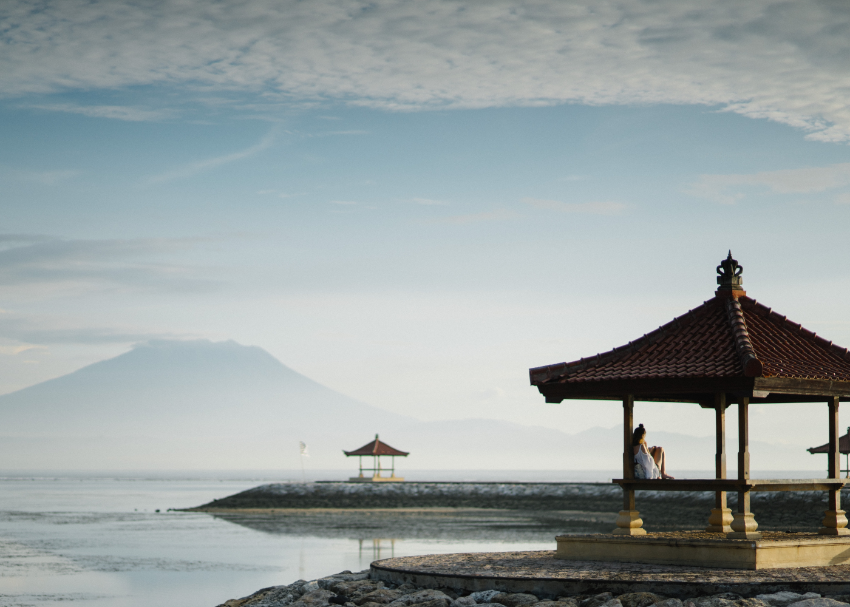
5: Spend some quality time with yourself in Bali
As RuPaul famously says, “If you can’t love yourself, how in the hell you gonna love somebody else?” Plus, we think looking inward is best done looking outward at serene Balinese settings.
Feel the love on tours like: Wellness Bali
6: Get your heart pumping with new pals in Utah
Never feel alone with a small group of people as you tackle five of North America’s most compelling national parks. Boulder over rocks, dip in waterfalls, and hike past petroglyphs.
Feel the love on tours like: Hiking Utah’s Big 5
For big-hearted adventurers wanting to do good
Travel that gives back as much as it gives you. Real experiences, real impact, in the places you visit.
7: Directly support communities you visit in Sri Lanka
Not only will you get a guided tour of Sri Lanka’s famous Sigiriya Rock Fortress but you’ll share a meal made by the local village community. Plus, you’ll lend a hand at a homestay farm in Digana.
Feel the love on tours like: Sri Lanka Encompassed
8: Help beaches in the Maldives stay sparkling clean
In the spirit of leaving places better than you found them, you’ll disembark from your dhoni boat cruise to participate in a beach cleanup on one of the Maldives’ many idyllic atolls.
Feel the love on tours like: Maldives Dhoni Explorer
For those looking to grow their friend groups globally
Meet people from everywhere, travel like you’ve known each other for years, and leave with friendships that span continents.
9: Hang ten in Costa Rica and then hang out
Learning new things and meeting people from all over is even easier with our Roamies adventures. Catch a surf lesson in Tamarindo and socialize at your incredibly cool hostel.
Feel the love on tours like: Costa Rica: Beaches, Wildlife & Wild Times
10: Strengthen your bonds on Thailand’s west coast
Hang out with a group of your mates on an adventure that includes numerous island hops, rafthouse floats, kayak paddles, and bustling night market jaunts in Thailand.
Feel the love on tours like: Classic Thailand – West Coast
You’ve probably heard the idiom, “the elephant in the room,” to describe when there’s some uncomfortable and obvious problem that no one is addressing—the kind of issue that feels as though it’s taking up all available space. But what if yet another megafauna came stampeding onto the scene? That’s where Berlin-based artist Itamar Gov’s large-scale installation comes in.
The Rhinoceros in the Room is a towering, inflatable sculpture that fills a medieval church nave at Kunstmuseum Magdeburg in Germany. Gov draws inspiration from Renaissance engraver Albrecht Dürer’s iconic rhinoceros woodcut, which the artist created in 1515 without having ever seen one of the animals himself. His rendering is wildly inaccurate in terms of anatomy, depicting an extra horn at the creature’s shoulders and armor instead of a thick leather hide, but thanks to the ability to replicate it in print, it captured the public’s imagination.
Dürer’s image persists as a symbol of imperial might and prestige. The animal itself represents power and vigor, and one was even gifted from Sultan Muzafar II of Gujaratm, India, to King Manuel I of Portugal in 1515, providing the inspiration for the artist’s rendering.
The rhinoceros has also been hunted and poached nearly to extinction, and several species remain critically endangered today. For The Rhinoceros in the Room, Gov “combines historical events, philosophical ideas, and local legends and questions the fragile boundaries between fact and fiction; memory and imagination,” the museum says.
Portrayed in monochrome gray, the gentle giant lumbers amid the 11th-century Romanesque colonnades, assuming a spectral guise. On one hand, it’s somewhat absurd in its sheer size and sense of being out-of-place, yet on the other, the creature invokes curiosity and wonder and stands sentry as an icon of brawn and resilience.
The Rhinoceros in the Room remains on view through July 5. Find more on Gov’s Instagram.
Seattle police officers arrested a 42-year-old man, armed with a knife and machete, after he cut through the wires on a telephone pole in the Chinatown-International District.
At about 9:40 a.m., patrol officers responded to reports of an erratic, stumbling man cutting a phone cable on a utility pole with a machete near the Yesler Way overpass over Interstate 5.
Officers approached the suspect, yet he refused to drop the weapon. They deployed a taser to take him into custody for Unlawful use of weapons. Police also found the suspect to have a $30,000 felony warrant for Burglary.
Officers booked the suspect to the King County Jail. Police recovered the knife and machete as evidence.
Incident Number: 2026-48130
Seattle police officers recover a knife and machete as evidence of a crime.
Notice: Function wp_get_loading_optimization_attributes was called incorrectly. An image should not be lazy-loaded and marked as high priority at the same time. Please see Debugging in WordPress for more information. (This message was added in version 6.3.0.) in /home/releande/public_html/wp-includes/functions.php on line 6170
[ad_1]
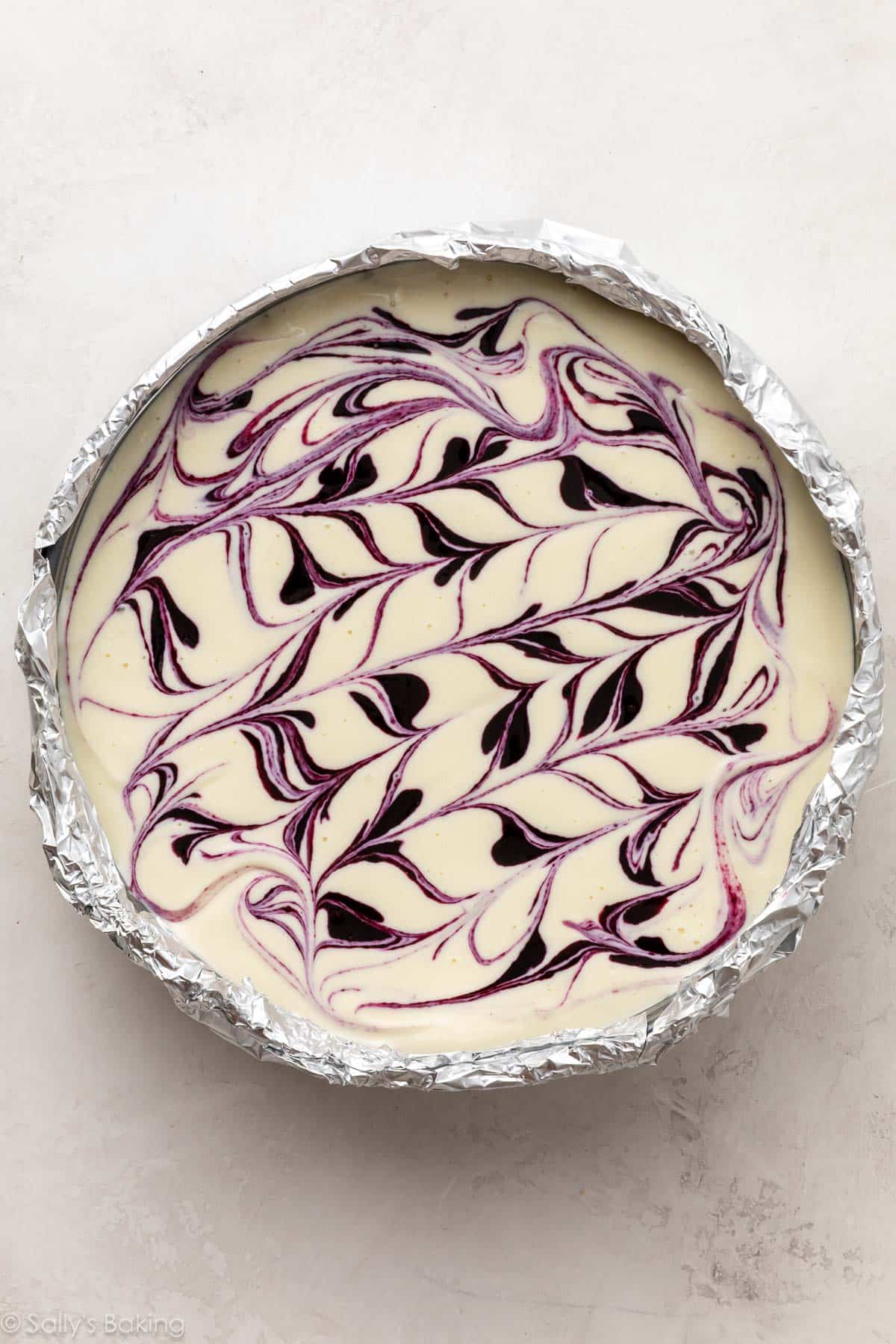
This blueberry swirl cheesecake features a buttery graham cracker crust, ultra-creamy classic cheesecake filling, and thick ribbons of homemade blueberry sauce baked right into the top. The texture is rich and smooth without being heavy, and the bold blueberry flavor perfectly balances the tangy cream cheese base.
If you’ve ever felt intimidated by making cheesecake from scratch, this approachable recipe (with my detailed video tutorial and water bath tips) will guide you step by step for crack-free, bakery-quality results.
I originally published this recipe in 2014, and I’ve since updated it with new photos, a video tutorial, and extra success tips for consistently excellent results.
One reader, Katie, commented: “This is THE BEST recipe for blueberry cheesecake on the internet. Do the advanced techniques as described and you’ll come out with a perfect cheesecake. I let mine sit for 2 days in the fridge, set up perfectly. I was immediately asked by picky bf to make another in 2 weeks. ★★★★★”
This show-stopping blueberry swirl cheesecake needs to come with a warning label. Really, it does. Cheesecake so creamy, a graham cracker crust so buttery, and blueberry swirls sooo swirly.
The best part: you can easily use frozen blueberries, making this a fruity dessert you can enjoy year round!
What Makes This Blueberry Cheesecake Special?
Year-round: Use frozen blueberries, so you can make this anytime.
Never watery: The blueberry swirl is strained for a silky, jam-like ribbon — no thin, streaky swirls.
Beautiful presentation: Vibrant blueberry ribbons make this cheesecake as stunning as it is delicious.
Dreamy texture: Dense, rich, and ultra-creamy—never dry or fluffy.
Baked like a pro: A water bath ensures a smooth, bakery-style finish.
Perfectly balanced flavor: Sweet blueberries, tangy cream cheese, and bright lemon in every bite.
Make-ahead friendly: Cooling and chilling are essential, making this the perfect dessert to prepare in advance.
Are you intimidated by making a whole cheesecake? Don’t be! Yes, cheesecake seems fancy, but with a little patience (and a water bath to keep cracks at bay), this is totally doable—even for beginners.
Love blueberry cheesecake but don’t want to mess with a springform pan or water bath? Try these lemon blueberry cheesecake bars instead!
Ingredients You Need
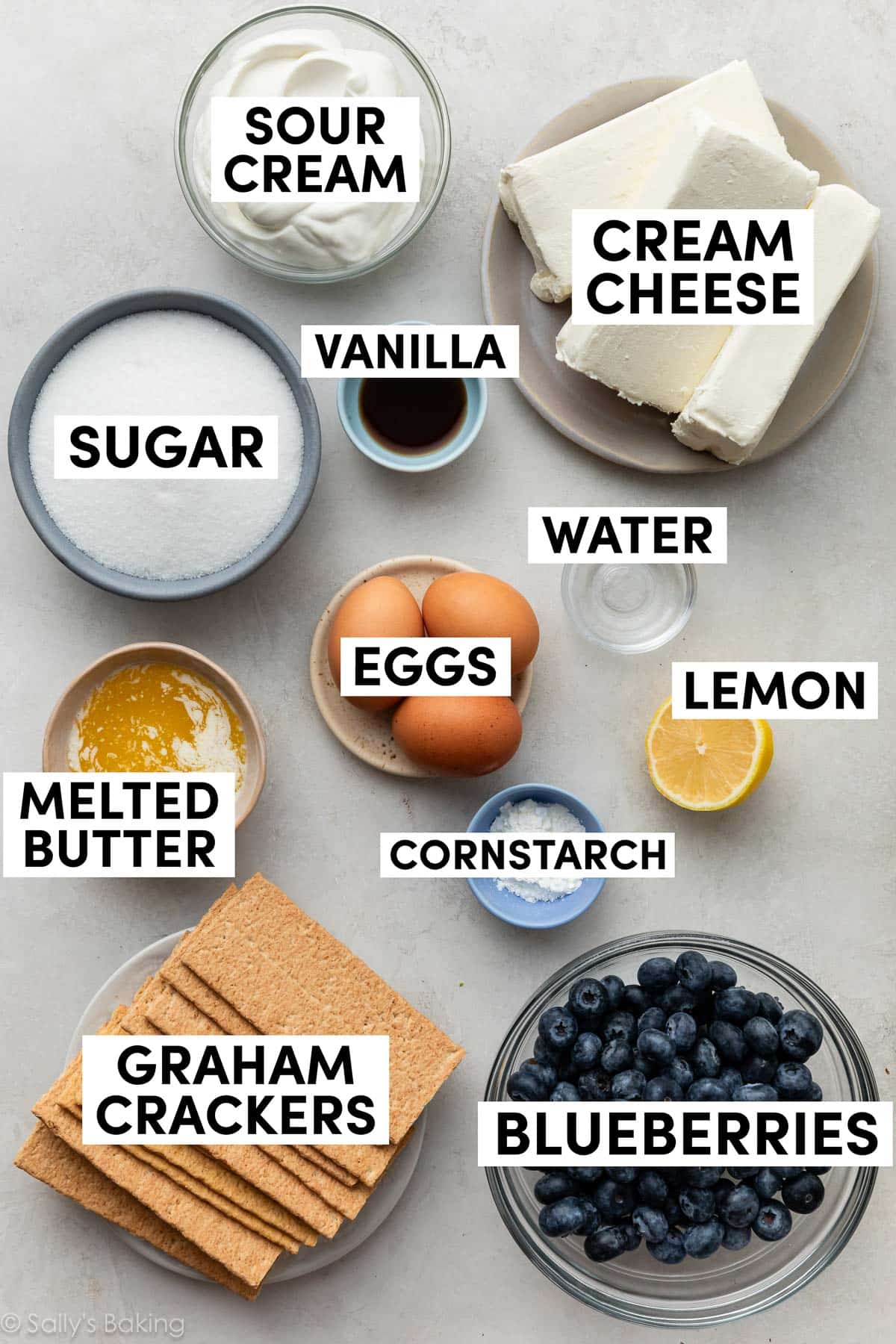
Each ingredient plays a role in creating this ultra-creamy blueberry swirl cheesecake.
Blueberries: Fresh or frozen both work, so you can make this year-round.
Lemon Juice: Brightens and enhances the blueberry flavor.
Cornstarch + Water: Thickens the blueberry sauce so the swirls stay defined instead of sinking.
Graham Crackers: Crushed into fine crumbs for the crust.
Unsalted Butter: Melted to bind the crust together and give it rich flavor.
Granulated Sugar: Sweetens the blueberries, the crust, and the cheesecake filling.
Full-Fat Brick Cream Cheese: Use three 8-ounce blocks. Avoid spreadable cream cheese in tubs because it won’t set properly.
Full-Fat Sour Cream: Adds tang and keeps the filling creamy and smooth.
Pure Vanilla Extract: Enhances the cheesecake’s flavor.
Eggs: 3 large eggs bind everything together. Add them one at a time and mix just until incorporated to prevent over-mixing.
Crucial Success Tip: Make sure the cream cheese, sour cream, and eggs are at room temperature. Room-temperature ingredients blend smoothly and help prevent a lumpy batter or cracked cheesecake.
How to Make Blueberry Swirl Cheesecake
Make sure you plan ahead because this cheesecake has a few stages. First, it takes a while to bake through. Second, it must sit in the oven after baking as the oven cools down—this is another trick to avoid cheesecake cracks. Then, once the cheesecake is room temperature, you must chill it. Because of all these steps, this is a great recipe to begin the day before.
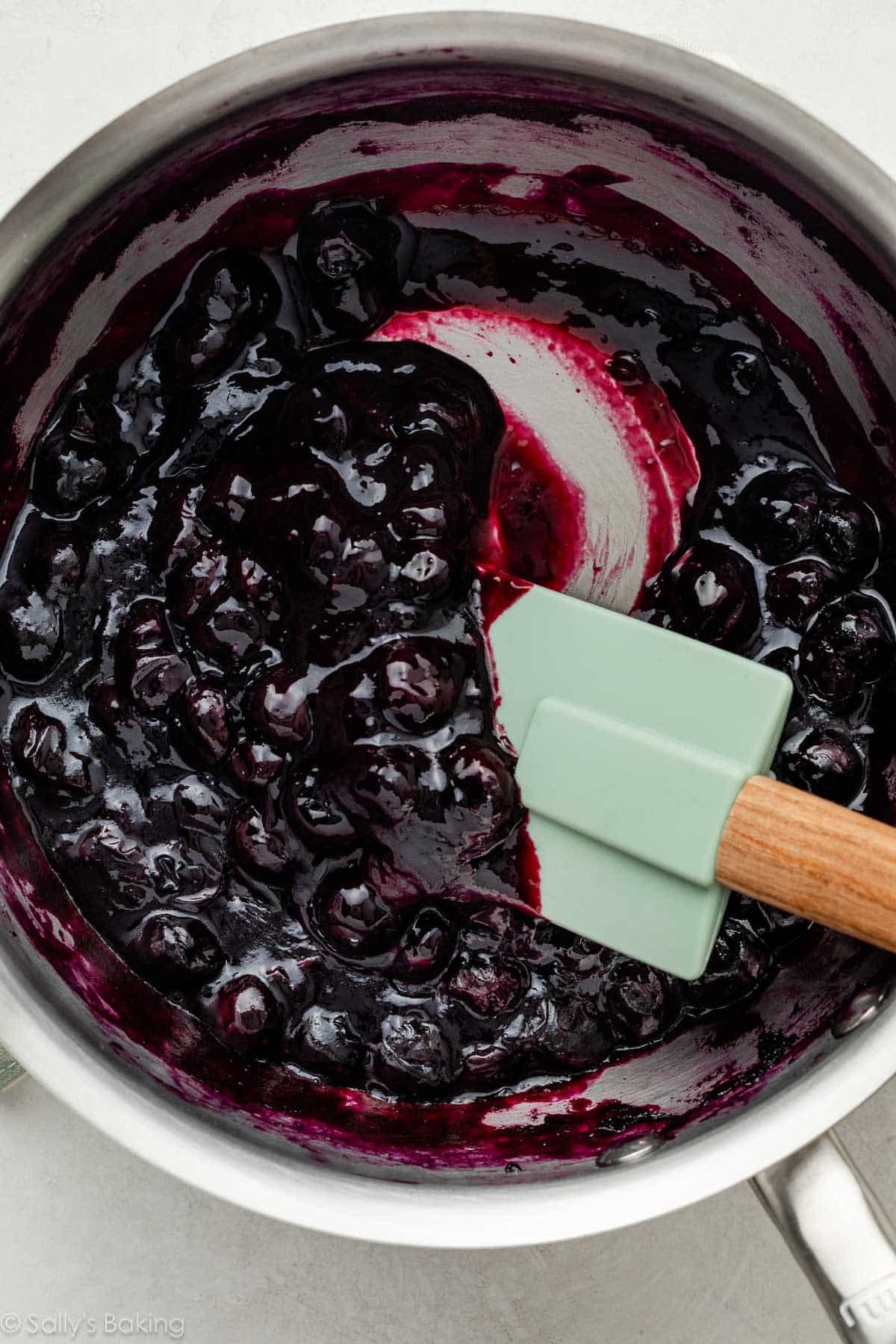
Let’s begin by making the blueberry sauce for the swirl. The blueberry swirl is similar to my blueberry sauce recipe; today’s is a bit thicker for the cheesecake.
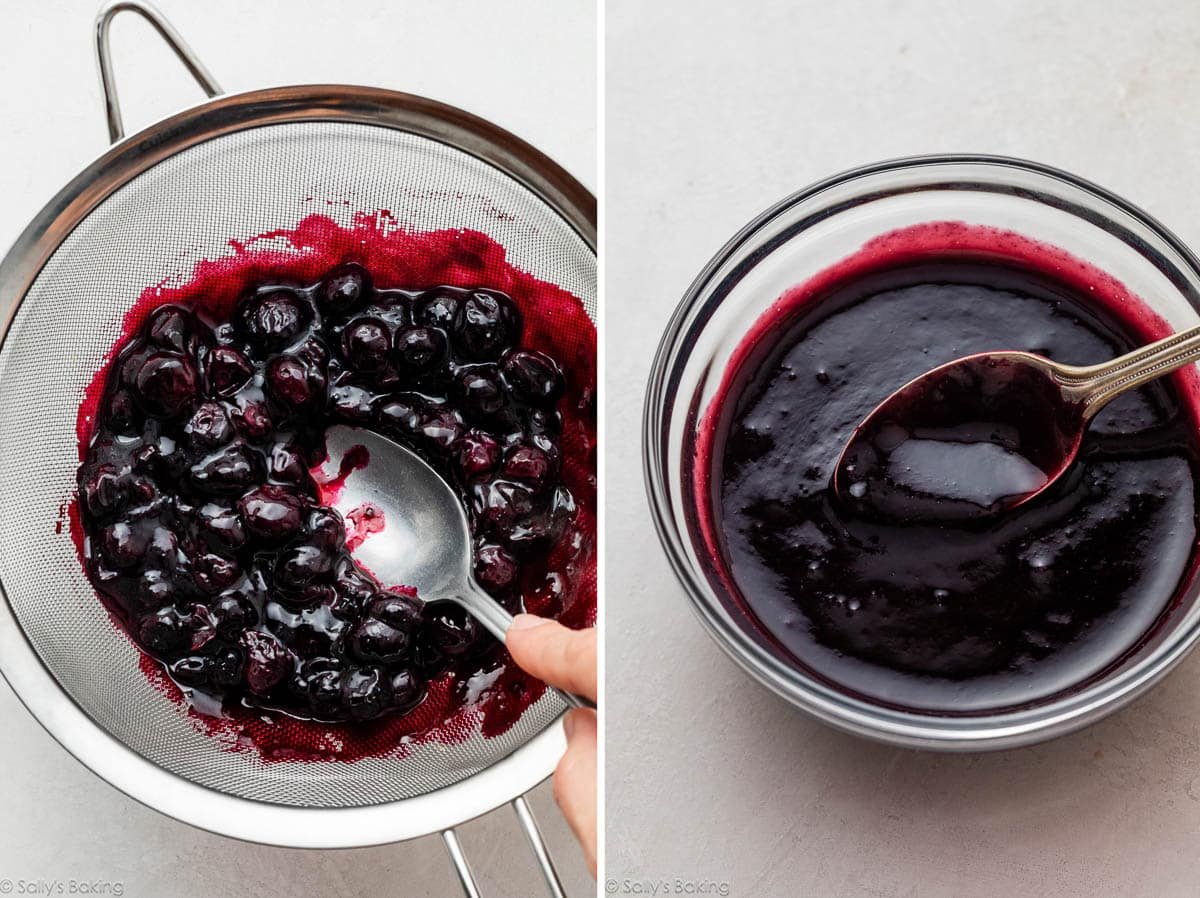
After cooking on the stove, you’ll remove it from heat and press the mixture through a fine mesh strainer. Why? This is to separate the cooked berries from the juice.
The thickened blueberry juice is what you’ll swirl into the cheesecake batter for smooth ribbons. The cooked berries can be stirred back in for a chunkier topping, if desired, or saved for topping the cheesecake slices.
Set both aside while you continue.
How to Make a Graham Cracker Crust
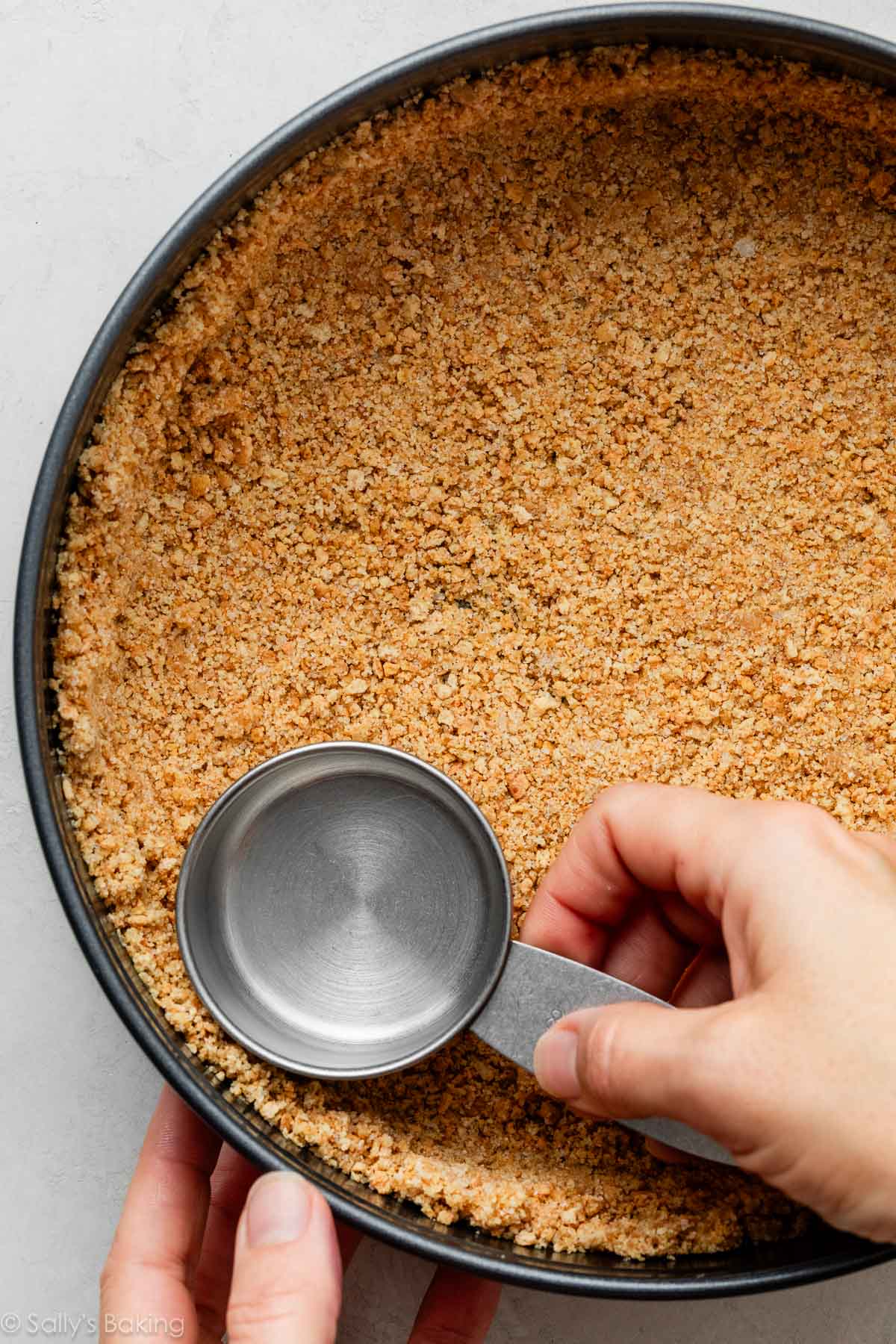
Next, make the graham cracker crust. The recipe is basically the same as my traditional graham cracker crust, but with slightly less butter since cheesecake is so heavy and wet. The crust turns out buttery, soft, and crunchy at the same time.
Pour the crust mixture into a 9-inch or 10-inch springform pan and pat the crumbs down into the bottom and partly up the sides to form a compact crust.
Wrap aluminum foil tightly around the bottom and sides of the pan, then bake the crust for 10 minutes. Allow the crust to slightly cool as you prepare the filling.
Cheesecake Filling
Now, make the cheesecake filling. The cheesecake filling is nearly identical to my classic cheesecake recipe, but today’s version doesn’t use quite as much cream cheese. The texture is creamier, but it still sets beautifully. Do not over-mix the filling after you have added the eggs.
Time-saving tip: You’re going to bake this cheesecake in a water bath, so get a kettle of water boiling during this time.
Pour the filling into the crust and smooth the top. Then drop spoonfuls of the smooth blueberry sauce onto the filling and gently swirl with a knife.
If you have leftover blueberry sauce, mix it with the cooked blueberries you set aside and save it for topping the cheesecake when it’s time to serve.
Cheesecake Water Bath
I actually have an entire post and video tutorial for How to Make a Cheesecake Water Bath. I promise that it’s nothing too complicated. All you’re doing is placing the springform pan in a roasting pan, filling it with hot water, and baking.
But what’s the point, you ask? The hot water in the roasting pan creates a steamy, humid environment. This helps the cheesecake bake slowly and evenly, reducing cracks and preventing sinking.
Place the wrapped pan in a large roasting pan, pour in boiling water until it reaches about halfway up the sides, and bake in the roasting pan until the center is almost set—it should still slightly wobble.
When baking is complete, turn off the oven, crack the door open, and let the cheesecake cool inside for 1 hour. Then cool completely at room temperature and refrigerate for at least 6 hours or overnight before serving.
When you’re ready to serve, loosen the sides, remove the ring, and slice. Decorate with whipped cream if you’d like, and spoon the reserved blueberry sauce over the top.
For clean slices, use a sharp knife wiped clean between cuts!
Success Tips for Perfect Cheesecake
To summarize, here are some tricks we reviewed above:
Make sure cheesecake batter ingredients are room temperature.
Do not over-mix the cheesecake batter after you add the eggs.
Bake in a water bath.
Let cheesecake cool in the (turned-off) oven for 1 hour.
Cool completely at room temperature, then chill.
Print
Description
Ultra-creamy blueberry swirl cheesecake with a buttery graham cracker crust and thick homemade blueberry sauce swirled into every slice. Bake in a water bath for smooth, crack-free results. Top with the leftover cooked blueberries and optional fresh whipped cream.
Blueberry Sauce
Crust
Filling
Adjust the oven rack to the lower-middle position and preheat oven to 350°F (177°C). Tightly wrap 1 or 2 sheets of of heavy-duty aluminum foil around the bottom and sides of a 9-inch or 10-inch springform pan and set aside.
Make the blueberry sauce first: Whisk the cornstarch, lemon juice, and warm water together in a small bowl until the cornstarch has dissolved. Set aside. Warm the blueberries and sugar together in a small saucepan over medium heat. Stir continuously for about 3 minutes, until the blueberries begin to release their juices. Add the cornstarch mixture and continue to stir for another 2–3 minutes, smashing some blueberries as you go. The mixture will begin to thicken. Remove from heat and press the mixture through a fine mesh sieve into a small bowl to separate the cooked berries from the thickened juice. Transfer the cooked blueberries to another bowl and set both (the cooked berries and the juice) aside.
Make the crust: If you’re starting out with full graham crackers, use a food processor or blender to grind them into fine crumbs. Pour into a medium bowl and stir in the sugar until combined, and then stir in the melted butter. The mixture will be sandy. Try to smash/break up any large chunks. Pour the mixture into the prepared pan. With medium pressure using your hand, pat the crumbs down into the bottom and partly up the sides to make a compact crust. Tips: You can use a small flat-bottomed measuring cup to help press down the bottom crust and smooth out the surface, but do not pack down with heavy force because that makes the crust too hard. Simply pat down until the mixture is no longer crumbly. For more shaping technique tips, see the graham cracker crust recipe page.
Bake the crust for 10 minutes. Allow to slightly cool as you prepare the filling.
Make the filling: In a large bowl using a handheld or stand mixer fitted with a paddle attachment, beat the cream cheese and granulated sugar together on medium speed until the mixture is smooth and creamy, about 3 minutes. Add the sour cream and vanilla extract and beat until fully combined. With the mixer running on low speed, add the eggs one at a time, beating after each addition until just incorporated. Stop the mixer as soon as the final egg is incorporated; over-mixing can cause the cheesecake to deflate.
Pour the cheesecake batter into the crust and smooth the top. Drop spoonfuls of the smooth blueberry sauce onto the batter. Using a knife, gently swirl as shown in the photo above. If you have leftover blueberry sauce, mix it with the cooked blueberries you set aside, tightly cover, and refrigerate until you serve the cheesecake.
Prepare the water bath: (If needed for extra visuals, see How to Make a Cheesecake Water Bath; the visual guide and video will assist you in this step.) Boil a kettle/pot of water. You need 1 inch of water in your roasting pan for the water bath, so make sure you boil enough. I use an entire kettle of hot water. Place the wrapped springform pan inside of a large roasting pan. Carefully pour the hot water into the roasting pan and place it in the oven. (Or you can place the roasting pan in the oven first, then pour the hot water in—whichever is easier for you.) Quickly shut the oven door to trap the steam inside.
Bake the cheesecake for 55–65 minutes, or until the center is almost set. If you notice the cheesecake browning too quickly on top, tent it with aluminum foil halfway through baking. When it’s done, the center should still slightly wobble when you gently tap or shake the pan.
Turn the oven off and open the oven door slightly. With the door ajar, let the cheesecake sit in the oven in the water bath as it cools down for 1 hour. After 1 hour, remove the cheesecake from the oven and water bath, discard the foil, and place the springform pan on a wire rack to cool completely at room temperature. After it has cooled, cover and refrigerate the cheesecake for at least 6 hours or up to 2 days.
Run a knife around the edges of the springform pan to help loosen the cheesecake, then remove the outer rim. Using a sharp knife, cut into slices for serving. For neat slices, wipe the knife clean and dip it into warm water between each slice. Top with reserved blueberry sauce and whipped cream, if desired.
Cover and store leftover cheesecake in the refrigerator for up to 4 days.
Notes
Freezing Instructions: After the cheesecake has cooled completely at room temperature (no need to refrigerate first), you can freeze it with or without the springform pan base. To freeze with the base, remove the outer rim and wrap the cheesecake (still on the bottom of the pan) tightly in several layers of plastic wrap, followed by a layer of aluminum foil. To freeze without the pan, run a sharp knife under the crust to release it, carefully slide it onto a parchment-lined piece of cardboard or a plate, and wrap tightly in several layers of plastic wrap and a final layer of aluminum foil. Freeze for up to 3 months. Thaw overnight in the refrigerator before serving.
Blueberries: If using frozen blueberries, do not thaw.
Alternate Water Bath Method: This method works as well, and you don’t have to bake the cheesecake IN water. Boil a kettle or pot of water. You need 1 inch of hot water in your roasting pan for the water bath, so make sure you boil enough. Place the cheesecake on the center oven rack of the preheated oven. Place a large metal baking or roasting pan (do not use glass—I usually use a 9×13-inch baking pan or an extra-large cast iron skillet) on the bottom rack. Pour boiling water into the empty pan, about 1 inch deep. Immediately close oven to trap the steam inside. This unique water bath adds steam to the oven without having the cheesecake sit inside the water itself. No need to wrap the springform pan in foil. See How to Make a Cheesecake Water Bath for more information.
Avoid Over-baking the Cheesecake. When the cheesecake is done, there will still be a 2- or 3-inch wobbly spot in the center; the texture will smooth out as it cools.
Non-US Readers:Don’t have graham crackers where you live? Use 200g ground digestive biscuit crumbs (about 2 cups; 13–14 biscuits), 1/3 cup (67g) granulated sugar, and 6 Tablespoons (85g) melted butter. Pre-bake the crust for a bit longer, about 12–14 minutes. And from what I understand, spreadable cream cheese sold in a tub in countries outside of the US is a little different from the spreadable cream cheese in the US. It’s thicker, sturdier, and more solid and should be OK to make this pie. I have no experience with it, but this is what I’ve heard from other non-US readers. If you try it, let us know how it turns out!
In this fifth installment of our series, we compare 1985 to 2025 through themes of hope and despair, or what I call hope/lessness. For some, the year’s worst news was learning, “Those of us born before 1985 are now officially older than Mr. Belding,” and for others the best thing about 1985 was the premiere of Bill Watterson’s Calvin and Hobbes.
Hope is found in our past, present, and future.
For those like film critic Sarah Welch-Larson, it was “a dark year in a dark decade in history.” Or, in the words of my writer friend Kristin Saatzer, good times can quickly devolve into “years like this one. Perhaps it left your heart tender and soul tired. You walked through valleys you didn’t choose and carried questions with seemingly no answers.”
Even while writing last year’s 1984 vs. 2024, I was dreading 2025. Sure enough, between political news, the fact that I still can’t afford to buy a house, and a host of other garbage, it was pretty bad. Nevertheless, in addition to finding hopecore videos, I also found hope.
In a sermon titled “Christmas Hope,” (my) Pastor Dale Garland explained how hope is found in our past, present, and future.1 As we’ll see, those themes are entwined with fun artifacts like The Golden Girls, Stranger Things, Lady Gaga and Bruno Mars’s “Die with a Smile,” and Tina Turner’s “We Don’t Need Another Hero (Thunderdome),” alongside serious issues like dystopian democracies, women in church leadership, and the Satanic Panic.
Hope in the Past: Dystopian Democracies
Chronicling Zohran Mamdani’s epic election to the office of New York City Mayor, journalist Sam Sifton quotes, “‘Hope is alive,’ Mamdani said in his speech. Voters, he said, chose ‘hope over tyranny’ and ‘hope over despair.’” Mamdani intuitively knew to use words like “despair” and “hope.” In one sense, these are universal themes that can be used almost any time, any place. In another sense, the degree with which we feel their applicability was greatly intensified in 2025.
Events like Elon Musk’s bang and burn with DOGE, Epstein’s files, tariffs, and (with limited relief from inflation) a seemingly hopeless economy, plagued public consciousness. I remember reading about ’80s inflation in history books but didn’t realize the impact until I lived it. All things being equal, a family could sink below the poverty line simply because of grocery inflation. Reversal was one of Trump’s campaign promises, but inflation was at its highest since 2022, partly because of his tariffs.
For many, especially the underprivileged, the year felt dystopian due to uncertainty in a variety of arenas. In an article on Trump bombing Iran, syndicated columnist and son of Ronald Reagan—Michael Reagan—immediately compared 2025 to his father’s 1980 campaign.
Admitting President Reagan was “a more dignified…prequel to Donald Trump,” Michael explains how his father never detailed what he would do to Iran and how it “paid off.”2 Michael believes Trump’s “dogged public uncertainty” is an “art of the deal tactic” and concludes: “Let’s hope and pray that Trump’s infamous unpredictability ends this crisis so Iran becomes nuke free.”
People were conditioned to avoid 1984 scenarios (because of communism’s easy comparison to Big Brother) but missed our culture actually becoming Huxleyan.
The same day I read Michael Reagan’s column, someone sent me Mike Brock’s article “The Moral Imperative Of Clear Language,” explaining how crucial it is to be honest and straightforward. Brock quoted George Orwell, but in my opinion, his fears align more with Aldous Huxley’s Brave New World. In 1985, Neil Postman’s Amusing Ourselves to Death (which I never found very funny) contrasted Orwell and Huxley in light of current events.
Postman’s son believes people were conditioned to avoid Nineteen Eighty-Four scenarios (because of communism’s easy comparison to Big Brother) but missed our culture actually becoming Huxleyan. Apparently, seeds were planted in the ’80s because (1) our president was an actor and polished communicator and (2) information wasn’t digested from printed newspapers (where words can be reviewed and discussed) but via screens (information disseminates quickly, is less nuanced, and is entertainingly image-based).
Postman’s analysis matches the plot of Max Headroom: 20 Minutes into the Future. As one of the best things I watched from 1985, Headroom tells the futuristic story of an investigative journalist’s consciousness uploaded into an AI hologram talking head. The TV movie illustrated Huxleyan entertainment-based “news,” as the elder Postman decried, seeing facts “drowned in a sea of irrelevance.” With predictions like virtual assistants, AI talking heads, video surveillance, and greedy corporate networks, my wife asked if art imitated 2025 or 2025 imitated 1985.
Michael Reagan’s hope was in Trump’s unpredictability, which is one way to handle foreign policies, but how does domestic chaos and disinformation help U.S. taxpaying citizens plan their lives? Making progress towards a freer society while removing unnecessary uncertainty was on the heart of one powerful Russian forty years ago.
Mikhail Gorbachev became leader of the Soviet Union in 1985, actively sketching out two reforms: Glasnost (openness for free expression) and Perestroika (economic restructuring). Two podcasts, “The Redefector” and “Wind of Change,” released five years apart, discuss a young Putin’s displeasure at Gorbachev’s handling of the USSR in the ’80s.
According to Wind of Change, ex-CIA agent John Sipher says, “[Putin has] been very, very successful about creating the same cynicism in the West that he thrives on there in Russia.” The hosts emphasize this by explaining there was “a hope, even an expectation” by Russians who grew up as the Cold War ended that democracy would permeate Russia. Instead they’ve seen Russian “authoritarian rule, corruption, and propaganda” pervade the U.S.
Like Putin, it’s easy to view the past nostalgically, trying to force people and situations back to how they were (some of which never existed since our memories are fickle). And while recapturing a “golden age” is impossible, it doesn’t mean we shouldn’t enjoy good memories. Pastor Garland’s first point on the hope of our past, used scriptures like Psalms 103:11-12, Romans 8:1-2, Ephesians 1:7 to focus on our forgiven sin. Salvation from sin’s enslavement and death might be a Christian’s greatest restoration.
Upon viewing a gravestone inscribed “In Hope,” the protagonist of The Handmaid’s Tale ponders, “Why did they put that above a dead person? Was it the corpse hoping, or those still alive?” Only a resurrected believer could entertain the audacious thought that a corpse had hope. What if it was both? Could a corpse who had died to sin provide hope for survivors still struggling through life in the present?
Hope in the Present: Can There Be Biblical “Feminism”?
God of Hate or Hope: Pursuit of a Golden (Girls) Age
One dystopian tome not mentioned by Postman (probably because it also came out in 1985) is Margaret Atwood’s The Handmaid’s Tale. The story tells of a United States where women lose all independence and are mostly used for breeding, like the protagonist “handmaid” Offred. Hulu’s adaptation was incredibly popular when it premiered in 2017 (as were book sales3) primarily because of viewers’ concerns around Trump’s first term. It should be no surprise then that the 2025 series finale had some of the highest viewing numbers in Nielsen’s history!
Golden Girls was sympathetic toward found family, independently-dependent people, and was approachably feminist. And people love(d) it.
Sadly, some of women’s rights won over forty (and more) years are being jeopardized (as in the SAVE Act). Taylor Jenkins Reid’s 2025 novel Atmosphere is a retrospective on women at NASA in the mid-eighties. Hero Joan Goodwin’s arduous journey of becoming an astronaut is compelling, especially considering readers must painfully wait through half the book knowing what Joan can’t fathom: she’s a lesbian. After Joan acts on her feelings, the author does a phenomenal job of showing the closeted side of gay culture. It leads to conversations about the existence of a God who hates gay people (spoiler: they land on pantheism), harassment, and AIDS.
Golden Girls, a beloved sitcom that innovated TV by portraying empowered women, bravely advocated for other marginalized groups like the LGBTQ+ community, addressed the AIDS crisis, and confronted ageism. Remarkably, the show “reflected the progress made by society toward accepting women as equals to men,” filled the gap in the lull after the feminist movement’s second wave, and seems to have been instrumental in galvanizing the movement’s third wave. How could a show about elderly women be widely watched in 1985 and continue to be popular in 2025?
Humor and empathy. Golden Girls makes us laugh while demonstrating how to care for others. The serious subjects add gravitas but the humor relieves the tension so the audience feels good about learning how to love others.
Golden Girls was sympathetic toward found family, independently-dependent people, and was approachably feminist. And people love(d) it. In other words, many women found their strength in more than power suits.
Evangelicalism’s Heretics: Becoming the Pastor’s Wife
Beth Allison Barr’s 2025 book Becoming the Pastor’s Wife: How Marriage Replaced Ordination as a Woman’s Path to Ministry is a balanced history on women in church leadership and how they were outlawed. Barr quotes historian Elizabeth Flowers: “To fully understand American evangelicalism in the post-war period…it is essential to cast our gaze on Southern Baptists [SBC].” (Although I am an SBC member and a centrist conservative Christian, I hope by reviewing the following history we can make better, God-inspired decisions for the future.)
Barr, who has a PhD in medieval history, finds it difficult to stomach the lie that “women in church leadership was a product of the 1960s feminist movement.”
By 1984, the SBC had ordained 200 women, which was on the same trajectory as “mainline, liberal denominations.” But suddenly the SBC reversed course, saying “the Bible excludes women from pastoral leadership because”4 woman was created second and was first to sin. That’s it!
Certainly, this reasoning ignores Scriptures like Romans 5 where Saint Paul frames the Fall as squarely Adam’s fault, but I would have expected the SBC to include a few New Testament references (although, as Barr shows, any of Saint Paul’s questioned verbiage doesn’t fit complementarianism very well either). Barr, who has a PhD in medieval history, finds it difficult to stomach the lie that “women in church leadership was a product of the 1960s feminist movement.”
Her book is chock-full of examples from every century including the early church (Priscilla, Junia, etc.), medieval times (Milburga, Hildegard of Bingen, Catherine of Siena, etc.), and…well, the 1980s (Nancy Bartley Gatlan, Sarah Wood Lee, Kathy Hoppe, the SBC’s 1,600 women in seminaries and aforementioned 200+ ordained women). Barr explains, “Modern Protestantism owes much to these brave women who chose to become heretics…in the eyes of their communities as they simultaneously became grassroots symbols of hope for the spread of evangelicalism.”
Admittedly, I wrestle with how to biblically understand women’s roles in church leadership—a position I’m privileged to have as a white man, but not a luxury many women who were called by God had. If women overcoming struggle (you know, little things like imprisonment and execution) brought hope, we should resolve that as abysmal as times may be now, we can create hope by investing in future generations. And I believe a vast amount of that improvement will come from women.
Interestingly, Barr finds hope for the present in an SBC policy from the past: “Instead of declaring that God calls women primarily to dependent ministry roles as homemakers and pastors’ wives or declaring that God calls women primarily to independent ministry roles as pastors and missionaries, the SBC made room for both.”
Almost in disbelief she excitedly queries, “Can you imagine if, when SBC women expressed a call to ministry, they weren’t told it was probably a call to marry a minister? Can you imagine if women like Joyce Rogers, who loved her role as a pastor’s wife, hadn’t insisted that all women called to ministry do what she felt called to do?” (See Alisa Ruddell’s excellent article “The Making of Biblical Womanhood and the Missing Mother of God (Part 1),” which gives more background on Barr and other authors’ thoughts.)
I am saddened that we seem closer to Atwood’sdystopia, certainly regarding Christian nationalism’s misogynistsasserting dominance in deed if not directly calling women “heretics” and troublemakers. And how pathetic that I’m just grateful Barr’s book even got published when women evangelizing should be a normal part of Western Christianity. Can’t theology and evangelism come from college and commoners regardless of gender?
Running Up That Hill Toward Glory (with Grandma)
God’s truths don’t have to come from scholarly minds.
I loved R.C. Sproul’s The Holiness of God; maybe it was because it mixed pop culture (he wasn’t afraid to say it was okay to go to horror movies—in 1985—to Christians!) with hardcore theology in an accessible manner. Sproul talked about Saint Paul’s conversion and “immediate benefits—fruits of justification,” quoting Romans 5:1-2. It’s no coincidence that these verses were also on Pastor Garland’s list. After all, we currently stand in “undeserved privilege,” while looking toward future glory.
In a recent video, writer and rapper Sho Baraka makes the case that God’s truths don’t have to come from scholarly minds.
I call it colloquial theology: ways in which people articulate a heavy truth with a simple statement…[D]on’t insult the hermeneutics of my grandma or the saints who came before us because their theology didn’t come from the seminary and they didn’t have all the right words, but their theology came from suffering and trust. It’s the negro spirituals, it’s despite the conditions we live in right now, I see greater conditions with my spiritual eyes.
Baraka defends the recently dismissed idea that “God is still on the throne” by asserting, “The throne symbolizes: (1) covenant faithfulness, (2) it communicates hope, and (3) divine presence.” The truth that God reigns is not diminished by coming from Baraka’s grandma; instead, hope is strengthened and proved because it was born out of “suffering and trust.” This hope of liberation can come in a variety of forms.
Resurrected in Stranger Things Season 4 and pivotal to this year’s final season, Kate Bush’s “Running up That Hill” is part of a greater work. Toby Manning celebrated Kate Bush’s 1985 Hounds of Love album, saying:
Dreams and imagination, as expressions of liberation and rejections of convention, will always represent a threat to the men in power, who will repress such utopian impulses and reassert the ‘realism’ of the status quo. Bush, with her intimate connection to childhood, to nature and the uncanny, runs gleefully contrary to such constriction and contraction, and she never expressed this more joyfully, more eccentrically or more commercially than on Hounds of Love.
It’s not a coincidence that the Duffer Brothers used Kate Bush’s hit as Max’s strength and compass (Night Rider has one of my favorite covers). Stranger Things has a history of portraying strong women (I love this meme where Erica would give Pennywise a run for his money) and making music an integral part of its storytelling (here’s every song from the series).
Music: Hope in Hallelujah
Heavy Metal Mania: Hardcore Hope
Many of us might relate to music’s importance as Poker Face’s Natasha Lyonne admitted, “[I’d] be dead without it,” so it’s no surprise that visual media relies on it so heavily. Twenty-twenty-five’s Freaky Tales is a perfect representation of the mid-eighties (albeit from an Oakland, California perspective). Portions heavily homage 1981’s Scanners, 1984’s Repo Man, 1985’s The Last Dragon, and 1985’s Krush Groove. Loosely based on Russel Simmons’s life, Krush Groove is notable just for featuring Run-D.M.C. (and their smash hit “King of Rock”), LL Cool J, Kurtis Blow, and the real Russel Simmons.
That punk mentality, one of rebellion and yet a desire to protect, seek justice, and reform society, is a remarkably precise description of Jesus, Christians, and God’s kingdom.
But whereas Krush Groove focuses on rap (specifically in New York), Freaky Tales includes many types of music, including punk (Operation Ivy, MDC, Soup, etc.). And yet, punk is not just music but a mentality, as seen in the way James Gunn’s 2025 Superman has been universally dubbed “punk rock.” Somehow that is an accurate description for the film’s fun and revolutionary spirit (check out Christianity Today’s “Why Superman Matters” review for, among many things, a theme of hope).
That punk mentality, one of rebellion and yet a desire to protect, seek justice, and reform society, is a remarkably precise description of Jesus, Christians, and God’s kingdom. It’s not about adhering to social norms of power, misogyny, and dystopia, but about God’s kingdom of the upside down, where the poor and humble are the victors.
As a metal fan I’m always interested in how harder music influences culture and Christianity. The 2025 podcast “Devil and the Deep Blue Sea” centers around the Satanic Panic (which we’ll get to) and if you want a great summary on the Church’s aversion to rock and roll, listen to Episode 5 (the episode also covers religion’s propensity to cover up real evil, like sexual predators and power-hungry narcissists).
In 1985’s fearful climate of asserting that metalheads worshipped Satan (especially considering conservatives’ grip on, and incessant commentary about, culture), it’s a wonder rock survived. But there were bastions of hope, as Kurt Wolff explains: “When we think of metal on MTV, we think Headbangers Ball…However, that program grew out of another, Heavy Metal Mania, which debuted in 1985 and ran for about a year. It was hosted mostly by Dee Snider of Twisted Sister. The show featured guests like Lemmy of Motorhead and Bruce Dickinson of Iron Maiden.”5
One of the most fun links between the decades was the sequel to the ’80s masterpiece This is Spinal Tap, released this year as Spinal Tap II: The End Continues. But when it comes to real bands who are actually good, Her Last Sight’s recent album SEASONS // WINTER features an uplifting intro speaking about hope, which segues into the song titled “HOPE.”
And even Parkway Drive, a band I think of as cynical, rang in their new single “Sacred” with hopeful lyrics. Lead singer Winston McCall explained,
Our lives and the way we exist in the world has been pushed further and further through the lenses and frames of negativity and hopelessness…We sell the unique parts of us most precious just to buy back manufactured pieces of self in order that we may feel whole again. ‘Sacred’ is our identity…Never lose sight and never lose hope.
Like a normal human, I often think about that image of Turner commanding Mad Max’s fictional Thunderdome, while simultaneously crafting a real song about broken societal systems with a post-idealism tone that could actually top pop charts.
ExtraOrdinary and Interpersonal Pop
Generally, pop music is fluff, providing escapism through themes of partying or romantic love, like 2025’s ROSÉ & Bruno Mars’s “APT.,” and Shaboozey’s “A Bar Song (Tipsy)” and 1985’s “You Spin me Round (Like a Record)” by Dead or Alive and Madonna’s “Like a Virgin.” I’ve learned this shallowness doesn’t mean the artists or songs are bad; if anything, it shows society’s search for hope and salvation.
Many 2025 lyricists were focused on the internal: mental health and identity (with little to no public awareness about either of those in 1985). Top performing songwriters in 1985 were more resigned about external concerns (like society and those in power) with songs like Turner’s aforementioned anthem, Wang Chung’s “To Live and Die in L.A.” (from the 1985 film of the same name), and Tears for Fears’ “Everybody Wants to Rule the World.” But one common denominator was relationships, and interpersonal dynamics are a sure money-maker.
In 2025, Lady Gaga and Bruno Mars rode Beyonce’s 2024 overalls with their countryesque song “Die with a Smile,” which reached Billboard’s number one song of the year. The lyrics take hope as permission to say “I don’t know,” which is dependent upon actively living in the moment.
This was my soul-searching question: In the midst of hopelessness, can I still truthfully offer hallelujah (Hebrew for “praise God”)?
Benson Boone recognized gratitude and peace while begging God not to take away the “Beautiful Things” in his life. I’m not planning on doing backflips to show I appreciate my family, but I could stop ignoring their texts. However, it was early in 2025 when I realized that the theme of this article would be hope/lessness that my fifteen-year-old daughter introduced me to Alex Warren’s “Ordinary.”
Even though I wasn’t listening to it every day as the song topped charts for months, the lyric “hopeless hallelujah” haunted me. This was my soul-searching question: In the midst of hopelessness, can I still truthfully offer hallelujah (Hebrew for “praise God”)? Or is my praise hopeless because God can’t or won’t answer me (as the ladies of Atmosphere concluded)?
I believe the answer, and therefore our hope, is found in glorifying the Holy One. As the L.A. Times says, “Alex Warren’s ‘Ordinary’ might be the most improbable: A stark and brooding ballad full of lurid Christian imagery—‘Shatter me with your touch / Oh Lord, return me to dust,’ goes one line—it’s about a guy seeking the kind of sexual-spiritual fulfillment not typically found on the beach or at a barbecue.” Not exactly what R.C. Sproul was thinking, but he would have agreed with Warren’s theory of finding extraordinary hope in God in the midst of the ordinary.
Interlude: The Satanic Panic—Fanatical Hope & the Militant Minority
To truly understand the ’80s we must acknowledge the Satanic Panic, a conspiracy theory that Satanists were sacrificing children across the United States. As the podcast “Devil and the Deep Blue Sea” describes, the seeds were sown as far back as the ’60s, but were ignited by the 1980 book Michelle Remembers. Late 1983 saw a new wave of panic when employees of a large daycare, the McMartin Preschool, were accused of ritual sexual abuse.
The Moral Majority were “more accurately the Militant Minority…America’s new old-fashioned zealots.”
According to the L.A. Times, “At the height of the highly publicized McMartin case in 1985, authorities said they had identified as many as 1,200 alleged victims of sexual abuse and 56 uncharged suspects. Scores of others were accused by preschoolers and their parents.” Even as some members of the prosecution expressed doubts (September 1985), journalists continued reporting on the case as fact. Naturally, secular media was enthralled, turning to Christian “experts” like Mike Warnke, who, “in 1985…was featured on an episode of ABC’s 20/20 titled ‘The Devil Worshippers.’”
But Warnke was a fraud, as was often the case with Christian “authorities” during the Satanic Panic.6 It’s worth mentioning that once the Panic was over, the FBI/NCCAN determined none of the 11,000 cases were credible. Although grifters were only one of many costs to society from the Panic, high-profile church leaders became the captains of American Christianity—men like Jerry Falwell Sr., Paige Patterson, and Paul Pressler.
Jerry Falwell Sr., along with Tim LaHaye, Charles Stanley, D. James Kennedy, Greg Dixon, and Paul Weyrich founded the Moral Majority, a powerful political bloc which, in 1985, had just re-elected Reagan and campaigned heavily on anti-LGBTQ+ and anti-abortion platforms. But historian Haynes Johnson felt they were a misnomer, full of fanatical hope and intolerance,7 the Moral Majority were “more accurately the Militant Minority…America’s new old-fashioned zealots.”
Cosper’s thesis is that the Satanic Panic’s obsession with “externalized evil” allowed true evil to prey on Christians and non-Christians.
Mike Cosper, host and producer of “Devil and the Deep Blue Sea,” spends significant time unraveling how church leadership affected the Satanic Panic. Cosper explains that “in 1984, [Pressler and Patterson’s SBC takeover] was being framed even by the moderates in the convention as a holy war.” However, Pressler was eventually accused and reached settlements for sexual abuse and assault (including pedophilia and rape), and Patterson was accused of covering up many cases of abuse. Cosper’s thesis is that the Satanic Panic’s obsession with “externalized evil” allowed true evil to prey on Christians and non-Christians.
Barr and Cosper don’t mention each other8 but it is fascinating that both talk about earthshaking movements inside the SBC in 1984. It appears the ramifications felt in 1985 (such as the sudden about-face on women in ministry) happened in part, whether directly or indirectly, because of Pressler and Patterson’s hyper-conservative makeover-takeover.9
Since “clergy trust has dropped steadily…from a high of 67 percent in 1985,”10 it’s no surprise that the biggest factor in low clergy trust is sex abuse scandals. And, in full transparency, this includes more liberal/progressive churches and movements too. Highest clergy trust is found in churches that allow the ordination of women and “at least half of the lay leadership” are women (as opposed to lowest levels of trust where women aren’t allowed ordination and women in lay leadership are a minority). I’d wager Falwell, Patterson, and Pressler began with good intentions, but they allowed fanatical hope and fear and political power to rule their decisions.
Capitalizing on fearmongering (as we saw in 1983 vs. 2023), they became Pharisaical, preaching a Republican Christianity and exchanging the hope of God for building a foundation of Christian Nationalism and conspiracy theorists. But all was (and is) not lost. Many conservative congregations didn’t become far-right racist/homophobic/misogynist crusaders. God’s upside-down kingdom, the one of spiritual power eschewing political control, of disarming arrogance with humility, of compassion rather than hatred, continues to provide hope.
Hope in the Future? We Can Only Hope
What if Christians held onto hope in God with a focus on serving others instead of themselves?
I’ve criticized the Church sharply in this article because self-critique coupled with humility in listening to outside views is a beautiful, distinctive tradition. I’m allowed indignation as long as it’s righteous, right? But, as I learned from Brett McCracken’s Uncomfortable, our common interpretation of authenticity as purely deconstruction, isn’t a complete perspective.
There were Christians in 1985 who didn’t believe a politician or religious leader was their savior. There were those who, despite fears of satanic ritual abuse and nuclear war and culture war, still held onto hope in God (my parents were among them). What if Christians in 2025 (and now 2026) held onto hope in God with a focus on serving others instead of themselves?
Film critic Sarah Welch-Larson confided: “The way that rage gets channeled is what makes me personally hopeful. I see it in direct action, in neighbors helping neighbors, and in art that speaks truth to power.” In a special edition of The Handmaid’s Tale, Margaret Atwood disclosed, “Offred herself has a private version of the Lord’s Prayer and refuses to believe that this regime has been mandated by a just and merciful God. In the real world today, some religious groups are leading movements for the protection of vulnerable groups, including women.”
What if all Christian women were able to serve however God led them, whether that was through leading efforts to protect vulnerable groups or assisting in their households or leading in churches? Barr acknowledges American evangelicalism is a majority-white movement and that it’s time to “learn from its Black sisters and brothers on their terms, in their space.” Believing it so firmly, she actually builds her final chapter around this, saying, “I think the Black pastor’s wife role offers hope for the future.”
From my experience and research, Barr is correct; but, to clarify, simply having white women copy Black women would deliver poor results. Instead, dynamics must shift. Diverse women and men must be welcomed into church leadership with such authority they’re realistically considered “one of the primary decision makers, to the point that they could make some changes you would be uncomfortable with.”11
It’s okay to say, “I don’t know.” There is a powerful powerlessness in giving the past, present, and future over to God.
I know the God of peace is “our source of hope.” This isn’t solely based on a future hope of heaven but is also a tangible hope in positive change now where man’s agenda of makeover-takeover conservatism, under the guise of biblical inerrancy,12 burns away as dross under the flame of unbiased biblical interpretation properly married to church tradition.
And after casting our votes for equitable leadership, how now shall we (plebians) live? Remember Kristin Saatzer’s disillusionment with the year? Her devotional concluded: “Even in the cruelest years, God is faithful. We bow in thanks, not only for the victories but for His steadfast presence in the in-between. God was here. God is here. And God will be faithful still.”
How perfectly Saatzer’s “was, is, will be” gratitude mirrors the three types of hope I’ve covered here, not only because we’re both geniuses, but also because it’s biblical. Maybe our lesson from 1985 and 2025 is to be strengthened in the three hopes of Scripture, and whether we’re interpreting a verse or attempting to plan for the future, it’s okay to say, “I don’t know.” There is a powerful powerlessness in giving the past, present, and future over to God.
The pay off, as I mentioned here in 1981 vs. 2021, was that on the day Reagan took office, the Iranians released the American hostages. ↩︎
Shortly after Trump started his first term, Atwood penned: “In the wake of the recent American election…Basic civil liberties are seen as endangered, along with many of the rights for women won over the past decades.” (Margaret Atwood, The Handmaid’s Tale, Introduction, 2017 Edition, pp. xviii-xix). ↩︎
H. Leon McBeth, “Role of Women in Southern Baptist History,” 1977; quoted by Barr, Becoming the Pastor’s Wife, p. xx. ↩︎
1985 was a milestone for Christian metal with the founding of HM Magazine (then called Heaven’s Metal) with the purpose of “honestly and accurately cover[ing] the current state of hard music and alternative culture from a faith-based perspective.” ↩︎
Like Beatrice Sparks from 1971’s Go Ask Alice and 1978’s Jay’s Journal, Lawrence Pazder and Michelle Smith from 1980’s Michelle Remembers, Lauren Stratford from 1988’s Satan’s Underground, etc. ↩︎
Haynes Johnson says, “Without realizing it, Hoffer had described the elements that made up the Moral Majority, or Christian right, thirty years later” and quotes Eric Hoffer from 1951’s The True Believer: “All mass movements… irrespective of the doctrines they teach and the programs they project, breed fanaticism, enthusiasm, fervent hope, hatred, and intolerance…” ↩︎
I don’t remember Barr mentioning the Satanic Panic, but Cosper mentions women’s ordination in the context of Pressler and Patterson’s takeover of the SBC in Episode 8: “Forgetting What Happened.” ↩︎
Granted, there were other factors too. In 1983 the IRS challenged clergy tax exemption and in 1984 Congress stepped in, protecting pastors. But the writing was on the wall and the “SBC shifted to a more conservative view…that refused to ordain women, thereby excluding women from the tax exemption” (Barr, Becoming the Pastor’s Wife, 2025, p. 141). It was at this exact moment in 1984 that the SBC, who had 200 ordained women working in ministry, restricted women from ministry. ↩︎
Chuck DeGroat, When Narcissism Comes to Church, 2020, IVP, p. 20. ↩︎
Steve Chang, quoted by Brett McCracken in Uncomfortable: The Awkward and Essential Challenge of Christian Community, Crossway, Wheaten, Illinois, 2017, p. 143. ↩︎
To be clear, I believe the Bible is inerrant. What infuriates me is that people like Patterson and Pressler used inerrancy to push homophobic, racist, misogynistic, and presidential kingmaking agendas, and yes, also used biblical inerrancy as a guise for pedophilia, child porn, rape, and covering up abuse (as mentioned above, see “Devil and the Deep Blue Sea,” especially Episode 5, among other references. ↩︎