Notice: Function _load_textdomain_just_in_time was called incorrectly. Translation loading for the td-cloud-library domain was triggered too early. This is usually an indicator for some code in the plugin or theme running too early. Translations should be loaded at the init action or later. Please see Debugging in WordPress for more information. (This message was added in version 6.7.0.) in /home/releande/public_html/wp-includes/functions.php on line 6170 News Magazine | Get The Most Freshy News Every Day | Page 48
A parrot confined to a too-small cage, jellyfish floating above fungi and ferns, and a spotted octopus resting as the centerpiece to a flourishing bouquet are a few of the surreal scenes in the works of Martin Wittfooth. The artist is known for his enigmatic paintings that meld flora and fauna to consider interconnection and nature’s endurance.
Wittfooth currently splits his time between Savannah and Brockville, although he plans to relocate permanently to the latter this year. Before he begins preparing for a solo exhibition in spring 2027 with Hashimoto Contemporary, the artist is completing a few larger commissions.
“Dam”
He enjoys the balance between larger bodies of work and singular pieces: “A unified field of concepts and vibes, to have all of the pieces in an exhibition have a kind of kindred dialogue going on between one another, and then when the dust settles in between shows, to have singular works to focus on, where I can slow down just a bit and let the new ideas start to form for the next show,” he says.
Along with Yuko Shimizu, Wittfooth will also mentor at the unique Quarantine residency this April. This is his third time participating in the program, and it’s one that informs much of the way he thinks about connection. He’s always impressed by “how quickly bonds form between the students, between the mentors, between the students and the mentors, and with the whole crew that runs the show,” he says, adding:
There’s been a lot of emphasis on this notion that community is important—as a species, we’ve appreciated this in our various ways for as long as we’ve been around—but for artists, this is often a bit of a struggle to develop and to maintain, considering the isolating nature of how we work. It’s also something that seems to have become more broadly murky and confused in this era of social media, with person-to-person contact being replaced by virtual interactions and projection of virtual selves—methods of communication that I personally feel are missing the essential ingredient of connection.
You can find more about the program on Colossal, and explore Wittfooth’s work on his website and Instagram.
Franklin called out church leaders silence by reminding them of what Jesus preached.
Kirk Franklin is reminding church leaders what Jesus stood for in this current time of political strife.
The Gospel music staple appeared on the Grammys red carpet with a message of urgency for his fellow disciples. He noted how many leaders of the Christian faith have remained mum on the current immigration enforcement across the U.S., which has otherwise sparked anti-ICE protests nationwide.
At music’s biggest night, Franklin gave his response of disappointment with the silence, reminding leaders that Jesus was an immigrant himself. Baller Alert shared footage of Franklin’s provocative words.
Kirk Franklin shares his thoughts on what the Church could be doing during today’s climate. He reminds people that Jesus’ parents were immigrants and emphasizes that the mission isn’t just about saving souls, it’s also about protecting lives.
“I think that we should be intentional about being very vocal about, first of all, Jesus’ momma and daddy were immigrants,” Franklin said. We need to be very careful to not be arrogant and prideful. We need to get in the streets and to be able to save and love as many people as we can. And when I say ‘save,’ I’m not talking about just their souls. I’m talking about their lives.”
In his call to action, Franklin wanted Christianity’s biggest voices to stand up for humanity, deeming it an essential part of their religion. As for his assertion of Jesus being an immigrant, biblical accounts dictate that Jesus’ parents traveled to Egypt out of fear of persecution of the infant prophet in Bethlehem.
He added, “We need to be feeding people, taking care of people, looking out for people… we need to be more compassionate about the human race.”
However, not all were receptive to Franklin’s words, with social media having its own debate on his message, and the authenticity of his claims.
“OK [Kirk], don’t the Bible say that we have to follow the rules of the land so if people are coming illegally, that means they’re not following the rules of the land that’s what God says,” wrote one opposer.
Churches, especially those run by Black clergy, have been instrumental in other civil rights and social causes throughout U.S. history. More recently, faith leaders such as Pastor Jamal Bryant have led boycotts against major retailers amid the anti-DEI push. However, as anti-ICE advocacy becomes prevalent, Franklin wants the pulpit to become a platform for this cause, which impacts people of all backgrounds, as well.
Despite the backlash, others believe that the pushback to Franklin’s encouragement to love and support all people as Jesus would may say more about the current state of Christian leadership than the singer himself.
RELATED CONTENT: Steve Bannon Says ‘Damn Right’ ICE Will ‘Surround the Polls’
Dr. John Lott has a new piece at the Wall Street Journal.
.
Blue-state gun laws are back before the Supreme Court. The justices barred states in 2022 from requiring concealed-handgun permit applicants to demonstrate a need for the license. Rather than comply with the New York State Rifle & Pistol Association v. Bruen in good faith, Hawaii and four other states sharply restricted where concealed carry is allowed. On Tuesday in Wolford v. Lopez, the court will hear oral arguments in a challenge to the Hawaii law.
.
Hawaii’s statute flips the traditional concealed-carry rule on private property open to the public, such as grocery stores, restaurants, malls and gasoline stations. Instead of allowing permit holders to carry unless a property owner objects, the law imposes a default ban on carrying unless the owner consents to firearms’ being brought on his property. The Ninth U.S. Circuit Court of Appeals upheld the law, pointing to a “national tradition” of banning firearms on private property “without the owner’s oral or written consent.”
.
That approach has no historical foundation. Neither in 1791, when the Second Amendment was adopted, nor in 1868, when the 14th Amendment applied it to the states, were there laws broadly barring people who could legally carry firearms from ordinary businesses. Nevertheless, Hawaii’s attorney general argues the law preserves a historical tradition in which concealed weapons “were not commonly carried in public.”
.
Hawaii defends its law on public-safety grounds, but those claims collapse under scrutiny. Attorneys general for 17 states and the District of Columbia assert in a friend-of-the-court brief that many major retailers “generally prohibit” firearms in their stores. But some stores the brief mentions—such as Walmart, Walgreens and Kroger—reference open, not concealed, carry in their store policies.
.
The public-health research cited in briefs supporting Hawaii’s law is similarly flawed. A brief filed by two gun-control advocacy groups cites data from Philadelphia stating that people in possession of a gun are more than four times as likely to be shot in an assault. But the data lumped together law-abiding concealed-carry permit holders and criminals or gang members carrying illegally.
.
Americans use guns defensively roughly 1.7 million times each year. While less than 0.2% of adults in Hawaii hold concealed-carry permits, nationwide there are approximately 21 million permit holders. Outside California and New York, more than 9% of adults have a permit—and more carry concealed weapons in “constitutional carry” states, where no permit is required.
.
Permit holders are extremely law-abiding. Permit holders are extremely law-abiding. In Florida and Texas, for example, those with licenses lose their permits for firearm-related violations at rates of thousandths or tens of thousandths of 1%. Police rarely commit firearms crimes, but concealed-handgun permit holders are even more law-abiding. Those with permits in the same two states face a conviction rate for firearms offenses that is only 1/12th as likely as police officers to be convicted of firearms offenses.
.
Another CPRC analysis highlights how concealed-carry permits actually enhance public safety. We used the FBI’s active-shooter definition—incidents in which a gun is fired in public and not part of another crime—but included incidents from several sources outside the FBI’s own list of active shooting events and used ChatGPT to verify that these cases met the FBI’s criteria. According to this data, armed civilians stopped 199 of 562 attacks from 2014 to 2024, amounting to 35.4% of incidents. By comparison, police stopped 167 incidents, or 29.7%. Armed civilians consistently proved both safe and effective—arriving on the scene faster than police, resulting in fewer people killed.
.
In the 199 civilian interventions, bystanders were accidentally shot only once, and civilians never interfered with police. Civilians died in only two incidents and suffered injuries in 49 cases. In 58 incidents, civilians stopped attacks that otherwise would have become mass shootings.
.
Uniformed police, despite superior training, faced greater risks and higher error rates in the 167 incidents they stopped. Officers accidentally shot bystanders or fellow officers five times. Nineteen police officers were killed and 51 were wounded. While neither group stops every attack, the data shows that the presence of armed civilians improves outcomes.
.
Police play a critical role in stopping crime, but during active shootings their uniforms create a tactical disadvantage. Attackers can delay until police leave the area, pick another location, or target officers first. Because police are less likely than concealed-handgun permit holders to be immediately on the scene, six times the number of victims are shot in incidents stopped by police compared with civilians on average.
.
Hawaii’s law is a clear effort to nullify the right to carry, but a Supreme Court ruling in favor of the plaintiffs could clearly define where guns can be banned and eliminate many gun-free zones across the country. If states can’t provide real protection with more than a “Gun Free Zone” sign, they must allow people to protect themselves.
.
Mr. Lott is president of the Crime Prevention Research Center. He is a co-author of a friend-of-the-court brief in Wolford v. Lopez with the Peace Officers Research Association of California and the California Association of Highway Patrolmen.
This regional pizza-taco mashup, which has become Iowa’s de facto state dish, originated at Happy Joe’s, an Iowa-based chain. It’s characterized by a crispy, chewy crust topped with refried beans, ground beef, cheese, iceberg lettuce, tomato cubes, and canned olives. A topping of seasoned tortilla chips brings crunch, and a sturdy same-day dough ensures a crisp crust that can support heavy-duty toppings.
Editor’s Note: This article is a reprint. It was originally published May 28, 2023.
This interview was recorded in November 2018 at the annual Academy for Comprehensive and Integrative Medicine (ACIM) convention in Orlando, Florida, but it was only last year that it ran on the site. At the time there was concern that the topic was too controversial, but now that six years have passed and COVID changed the controversial landscape, we thought it would be good to release the video on this important topic.
I had the opportunity to interview two experts on autism and dirty electricity, Peter Sullivan and Dr. Martha Herbert, who cowrote “The Autism Revolution: Whole-Body Strategies for Making Life All It Can Be.”1 Here, we discuss some of the toxic factors that contribute to the development of autism, especially the role of electromagnetic frequencies (EMFs) and dirty electricity.
Sullivan’s Journey
Sullivan has struggled with electromagnetic hypersensitivity, and still does to some degree, which was his primary motivation for learning more about it. He’s become a fount of knowledge as a result. As a software engineer in Silicon Valley in the 1990s, he was passionate about personal technology.
“I studied in Stanford. I did all kinds of human-computer interactions. I worked at multiple companies: as a troubleshooter in Silicon Valley, an engineer and a software designer at the very end. I worked at Netflix and some other companies people would know of,” he says.
In the early 2000s, problems began to take root. Fatigue and food allergies cropped up, and his children were struggling with developmental delays. He eventually realized he had toxic levels of mercury in his system.
“I eventually just took time off from work, in about 2005. I just said it’s ridiculous, with all these things going on, to have two people in the family working. I was focusing on my kids’ health and my health and really had some time and energy to really go deep and find out what was really out there.
I had a great doctor, Dr. Raj Patel … an integrative medical doctor who would talk about Candida overgrowth, mercury, and all that stuff. He got us on track. Eventually, the kids slowly got better, but even after detoxing, I did not. I kept getting worse.
I got down to 131 pounds. I became electrically sensitive. My brain kept telling me, ‘All the stuff is safe and well-tested. I love technology.’ But my body was reacting like there was something really wrong. I was catching myself just throwing a cellphone away — feeling cellphones and then transformers when I plugged them in.”
He eventually learned about dirty electricity, and once he started addressing his exposure, he regained 10 pounds in a couple of months, along with his health. Today, he’s passionate about sharing information about the dangers of EMFs and dirty electricity, and how to address electromagnetic hypersensitivity.
“We’re just trying to share the information, make the field credible, because it’s very credible, and make sure people don’t have to suffer,” he says.
He even created an EMF-free tent that he brings with him to different seminars and conferences that people can sit in, as many of these events are held in places where you’re exposed to very high amounts of EMF. He’s also funded some of Herbert’s research.
Herbert’s Story
I first met Herbert at a Cure Autism Now event (now Autism Speaks) in 2009. Herbert’s two children struggled with symptoms of autism when they were young. Today, they’re both grown and have fully recovered. Her initial focus was on mercury toxicity, looking at ways of doing noninvasive screening for toxic metals.
A lifelong environmentalist, Herbert went to medical school after getting a Ph.D. in history of consciousness at the University of California Santa Cruz. She studied pediatric neurology, and fell into working with autism after inheriting magnetic resonance imaging (MRI) scans from the first MRI study performed on autistic children in 1989.
“I was one of the first people — but not the only one — to identify white matter abnormalities in autism through brain imaging, not through gray tissue,” Herbert says. “That really violated the paradigm that behavior comes from the cortex. I was already kind of a whole-body person. I was seeing patients.
[Few of them] had these rare neurogenetic diseases that you’re trained for in pediatric neurology. But everybody was coming in with diarrhea and eczema, and they couldn’t sleep. It was almost like primary care in neuropsychiatry. That’s where I sort of edged my way into the whole-body approach.
I had an epiphany in 1999 … that all the stuff I was seeing in my patients really could connect with the environment … I started putting together and figuring out that this was really a systems [biology] approach to these conditions.”
A Systems Biology Approach to Autism
Systems biology looks at everything in biology as a web, in which everything is connected to everything else. When you tug at one part of the web, the rest of the web changes. In conventional science, individual components and variables are studied in isolation. That’s how clinical research is designed.
“We’re looking for pure forms of disease. But mostly in these conditions that we’re talking about, it’s a mess,” Herbert says. “Everybody has a bunch of different [symptoms], some of which are more prominent than others. Early on in figuring out autism as a systems problem, I was looking at specific language problems or developmental language disorder.
But if you look at these people carefully, they have coordination issues … You see this subtle breakdown of the precision and fine-tuning of the brain … I finally … I found a great article about the networks in the brain that are messed up in psychiatric illnesses (not just autism but also schizophrenia, depression, and so forth).
The hubs of these networks have very high-frequency gamma frequency … It turns out that this gamma frequency is driven by cells that are very high-energy demand mitochondrially centered cells …
We now have enough studies showing that the metabolic stuff going on in the brain match onto the networks going on in the brain. The proportion of network disturbance in some of these cases has been shown to be proportional to the amount of mitochondrial dysfunction.”
The Transcend Research Program
Herbert has created a brain research program at Harvard called TRANSCEND2 (Treatment, Research, and Neuroscience Evaluation of Neurodevelopmental Disorders). They use MRI, magnetoencephalography (MEG), and electroencephalogram (EEG). MEG measures the magnetic activity of the brain, whereas EEG measures the electrical activity.
“When you have electrical activity, the magnetic is at 90 degrees. They measure the same thing, but in somewhat different ways,” Herbert explains. Her hypothesis is that autism is not something you’re born with. It’s something you develop in response to environmental factors.
“In order to study that, I started studying babies from the time they were in their mother’s womb. We got biosamples from the mothers. We got biosamples at birth, and then — until the mothers stopped nursing — we get biosamples from them, plus EEG and autonomic … using wristbands … to see how things deteriorated in the kids who developed autism.
What we found was something that could be interpreted in a variety of ways. We’re working on publishing this. We have EEG data of 2-week-old babies, predicting their outcome at 13 months.
Now, I just finished saying that I think that autism is something you developed. That would sound like something you’re born with, but you can’t say that they have autism. The way I think about it is if their brains are really excited and irritated. So, it matters very much what happens [in their early environment to make them] more predisposed.”
Whole-Body Wellness Approach Can Minimize Autism Risk
Using this early predictive ability, a small number of primary care pediatricians have started implementing whole-body approaches to the parents and children, showing that when whole-body lifestyle modification is implemented, such as avoidance of toxins and allergens, virtually none of these predisposed babies actually develop autism.
“My feeling is what we need is a public health intervention where people are taught how to keep healthy from preconception to pregnancy to infancy. If they get an EEG that says that their brain is irritable, you don’t want to do a drug … You want to do safe and healthy things, because [drugs and toxins are] the problem in the first place,” Herbert says.
There are many anecdotal stories from families with autistic children suggesting EMF causes problems, and Herbert and Sullivan are working on setting up an online database to capture this data.
“That when you reduce the Wi-Fi, the symptoms abate a lot. I know a kid who was stimming like crazy. He liked to stim by the dishwasher. Guess what, there was dirty electricity in this dishwasher. They fixed it and he stopped that, and a lot of his symptoms remitted,” Herbert says.
Common Risk Factors
Essentially, Herbert believes autism can be predicted by looking at the level of brain irritability in the child. But what might contribute to this kind of irritability? Sullivan believes mercury, EMF, and glyphosate are three major triggers, even more so than vaccines.
Herbert believes processed food is another major contributor. “Simply reducing allergens in the mother’s diet from preconception to pregnancy is a really big deal,” Herbert says. That said, it’s really the total load that matters, not any particular given factor.
“There are 10,000 different ways to injure mitochondria. It all piles up. All these little seemingly innocuous exposures add to the pile, so they all matter,” she says. Sullivan has created a video talk and booklet, “Simplifying Autism Improvement and Recovery,”3,4 which includes a list of suspects for parents to consider.
One big one that few people consider is de novo mutations resulting from sperm being exposed to wireless radiation from cellphones and laptops. Men desiring healthy children would do well to avoid carrying their cellphone in their pants pocket while it’s on, as the cellphone radiation can mutate the genes in the sperm. If you’re going to keep it in your pocket, make sure it’s off or in airplane mode.
Herbert is currently enrolling patients for her Child Health Inventory for Resilience and Prevention (CHIRP) study, which will gather information about the associations between the total burden of environmental stressors and exposures and chronic disease in children. If you have a child between the ages of 1 and 15, you can apply5 by filling out two prescreening questionnaires to determine your eligibility.
Most Parents Start Treatment at the Wrong End
Herbert and Sullivan have worked with autistic children and have advised parents for a long time. What are some of the common mistakes they see people make? Sullivan replies:
“People assume it’s a problem with the child. They jump in and start treating the child. They assume it’s genetic or whatever, and they’re doing behavioral therapy. The things that I would do again for myself, if I could do it all again, is I would start with the environment. I would start with EMF, especially at night.
We turn off the baby monitor, the cordless phone base station, Wi-Fi, and even sometimes the circuit breaker for the bedroom … A wired baby monitor is safe … Plug everything into a power strip. Put the strip in the wall. When you go to bed, just pull out the power strip. In the morning, plug it back in. It’s not hard. Or, put it on a timer.
I would say it’s a state of overload not just for the kids, but for the entire family … There are [many] things you need to do [to clean up your environment]. The key is in the sequence. Do the easiest things that get you the most impact.
That’s why we’re starting with EMF. Because once you reduce that, you start sleeping better, and then you start to have more capacity. You want to build a spiral of capacity. You start an upward spiral …
Martin Pall’s paper6 on the neuropsychiatric effects from microwaves and EMFs show it’s a big factor, as is sleep, because sleep and [lowering] inflammation are fundamental to good mental health.”
More Information
For more information about autism and wireless radiation, how EMFs affect sleep, and recommendations for EMF meters and tips for EMF safety, see Sullivan’s website, ClearLightVentures.com. On Herbert’s site, drmarthaherbert.com, you can find information about how to improve your overall health and lower your total body stress burden for a healthy pregnancy and baby.
It isn’t often that a book series written by a conservative Catholic goes viral on BookTok and BookTube.
One of the series’ boldest thematic choices… has to do with what the protagonist believes God has sent him to do: To wipe out an alien race.
But after nearly getting canceled due to low sales, Christopher Ruocchio’s Sun Eater series has become a surprise hit, garnering tens of thousands of raving reviews, and even boasting a “Best of BookTok” badge on Amazon. Nor can this be chalked up to the author hiding his faith. The longer the series goes on, the more theological it becomes, as the protagonist fights demons (described like Ezekiel’s infamous vision of wheels filled with eyes), confronts God himself in a Job-like sequence, and comes to view himself as God’s chosen representative.
Perhaps one of the series’ boldest thematic choices, however, has to do with what the protagonist believes God has sent him to do: To wipe out an alien race.
From the first page, Hadrian Marlowe tells readers directly how the seven-book series will end. “The light of that murdered sun still burns me,” he reflects. “It is like something holy, as if it were the light of God’s own heaven that burned the world and billions of lives with it […] You want to know what it was like to stand aboard that impossible ship and rip the heart out of a star.” (Empire of Silence, 1). We learn shortly after that Hadrian destroyed the star to exterminate an alien race. It isn’t for nothing that he’s called genocidal.
A series about an alien race being exterminated at God’s directive may stir up memories of a key biblical event. “Genocide” is also the term many skeptics use today for the Israelites’ conquest of Canaan. And over the course of the recently-completed series, the alien Cielcin are depicted with several eerie similarities to the Old Testament Canaanites.
It leads one to wonder whether Ruocchio’s series may help us better understand one of the most controversial parts of the Old Testament.
Many Christians likewise wrestle with the moral implications of God’s commands… How can such an act be morally justified?
“Is God a moral monster?” This question forms the title of one of the more famous book-length treatments of the various moral questions raised by the Old Testament (including the destruction of the Canaanites). It’s not just a question for unbelievers; many Christians likewise wrestle with the moral implications of God’s commands, especially the destruction of women and children. How can such an act be morally justified?
This question also pervades the moral landscape of the Sun Eater series. Early on, Marlowe is given a vision of blowing up a sun to destroy virtually all of the Cielcin, women and children included. As the story unfolds from there, Marlowe wrestles with the moral implications of such an act. Would destroying their entire race really be a heroic deed—or does that make him another in the long parade of history’s horrific villains?
It’s hardly a spoiler to say that Marlowe does decide it is morally justified (he tells us on the first page of the first book that he did indeed blow up the sun). What’s fascinating is how readers are slowly drawn over the course of the series to agree with his decision.
The primary point in favor of Marlowe’s choice has to do with the Cielcin’s sheer barbarity. The Cielcin feed off human flesh, raiding planets to devour humans like cattle. And that only touches the surface of their grotesque wickedness. They gleefully rape and mutilate human bodies for their pleasure. And it becomes clear over the course of the series that they have little sense of morality, viewing the world merely in terms of the right of the strong to dominate the weak.
One can readily draw comparisons with the depravity of the ancient Canaanites. The Scriptures paint a bleak picture of their propensity to practice child sacrifice (Lev. 18:21), bestiality (Lev. 18:23), and gang rape (Gen. 18). “Do not defile yourselves with any of these things,” God commands, “for the nations which I am about to drive out before you have been defiled with all these things. Therefore the land has become unclean and I have brought the punishment for its iniquity upon it, so that the land has vomited out its inhabitants” (Lev. 18:24-25). The Cielcin and the Canaanites alike display great wickedness.
What has driven the Cielcin to such grotesque displays? Illuminatingly enough, it is their allegiance to demons (“The Watchers”). As the series unfolds, we learn that they have sworn themselves to the Watchers, and their ruler eventually becomes possessed by one. Nor are these just any demonic forces. One particular demon, Ushara, is depicted in the following fashion:
It was as if the sky opened, as if that light from nowhere made straight the coiled paths from other time and revealed that higher plane—if only for a moment. The space beyond teemed with eyes lidless and pitiless, eyes that might have been carved of marble and set with gems. They slide across the heavens, fixed to great bands of glittering black, rotating rings within rings like the characters of her celestial speech—eyes seeing all (Disquiet Gods, 249).
It’s hard not to see such a depiction as directly pulling from Ezekiel 1. And in a later scene, Marlowe learns of Ushara’s creation: “She had been made to shepherd the stars. Her task had been their maintenance and command, and she had forsaken it so she might rule the Vaiartu as a queen. As a god. In doing so, she had rebelled against her master, her maker, against the Quiet himself” (Disquiet Gods, 374).
It sounds eerily similar to the way that theologians like Michael Heiser (The Unseen Realm) understand and describe the pagan gods of the Old Testament.
In The Unseen Realm, Heiser argues that God appointed a divine council to rule over the world, with “the rest of the nations placed under the authority of members of Yahweh’s divine council” (114). When those members rebelled, they represented themselves as gods: Baal, Ashtoreth, and so on. And this in turn explains why the Israelites were commanded to wipe out the Canaanites: They had allied themselves with (and in some cases chosen to be possessed by) literal demons. And the only way to wipe these demons and the human-demon offspring from the earth was complete annihilation. As Heiser posits, “The rationale for annihilation was the specific elimination of the descendants of the Nephilim” (210).
Under such a reading, the core of both narratives is the same: a race mixes with demonic forces so deeply that they become vilely depraved. And as a result, their destruction becomes justified.
One may question whether Ruocchio’s Cielcin should be interpreted as analogous to a human race. In a Reddit exchange, his wife mentioned that “the Cielcin aren’t meant as a Muslim caricature or stand-in. It would be pretty gross to intentionally depict any real world people groups as (possibly irredeemably) pure evil. Happy to report I am not married to someone who feels that way.” Such a statement suggests that Ruocchio is not intending to write a direct allegory of the Canaanites.
But the intensity of the parallels may lead us to explore whether we may learn something about our own faith through this poignant fictional picture.
The Sun Eater is not a retelling or an allegory of the destruction of the Canaanites.
One final piece of the puzzle is notable when analyzing the Cielcin’s destruction. As Marlowe struggles to accept God’s command, he attempts other methods of ending the war that don’t lead to their annihilation. But (mild spoiler) what ends up convincing him of the morality of his decision is not only the wickedness of the Cielcin, but the fact that the Absolute (his word for God) has commanded it.
This explicit command from God becomes a pivotal factor that uniquely justifies his decision to destroy the sun. At a separate point in the book, Marlowe is given an opportunity to wipe out a world that is arguably just as evil as the Cielcin. Yet despite every pragmatic reason seeming to justify such an act, Marlowe refuses. “Legitimacy must lie not in power for power’s sake, but in something else. Was not power a consequence of something higher? Its visible sign?” (Shadows Upon Time, 836)
The resulting picture then becomes clear. Within the world of Sun Eater, the extermination of the Cielcin is justified because their subordination to demons has turned them into a grotesquely wicked race powerful enough to destroy all human life if unchecked. In light of such depravity, the Absolute in his protection gave humans special permission to wipe them out entirely to save themselves.
The Sun Eater is not a retelling or an allegory of the destruction of the Canaanites. The plot of Sun Eater is entirely unique, the Cielcin share several key differences from the Canaanites (including their lack of human nature), and the protagonists are far from an allegory of Joshua or Israel. While the number of parallels may lead readers to wonder if some of these connections were intentional, this article does not mean to argue for Ruocchio’s intentions.
[Fiction] primarily moves us not through logical arguments meant to persuade the mind, but through examples and pictures meant to reach our hearts.
That being said, given the parallels, the way that Marlowe comes to peace with his own decision to exterminate the Cielcin may help Christian readers with their own unease when it comes to the conquest of Canaan. Fiction presents moral arguments in a way distinct from nonfiction. It primarily moves us not through logical arguments meant to persuade the mind, but through examples and pictures meant to reach our hearts. We shouldn’t form our theological opinions on the basis of fictional works like Sun Eater or go to it as a justification for our beliefs. Nonfiction presents clearer arguments on this front.
Yet the value of a work like Sun Eater is in helping our hearts accept truths where it can be difficult to align head and heart. C.S. Lewis alluded to this potential in fiction in his famous article on fairy stories, where he described how stories can slip past our automatic defenses (the “watchful dragons”) and resonate more powerfully with us. With regard to these particular themes, our minds can more readily grasp that God has the right to judge and exterminate a civilization for their sins; yet our hearts can struggle at the seeming-harshness of such a move.
When presented with a picture of an ensouled alien civilization which, through an alliance with demons, devotes itself to brutal conquest and revels in terrible depravity, the vividness of the image helps us see mercy and protection in the decree of the Absolute to eradicate them for their sins. That in turn assists us when we read theological justifications for God’s decisions in the Old Testament to more easily see the goodness of his decrees.
Sun Eater has helped me personally better settle my unease with the end of the Canaanites. Which is not a thematic conclusion I expected when I first picked up this viral mainstream sci-fi series. But perhaps the medium of fiction allows certain ideas to slip under the gaze of watchful dragons.
No matter if you’re flying solo, hitched, somewhere in between — or don’t identify with any of it at all — Valentine’s Day has a way of putting love front and centre. But this isn’t a love letter about roses, chocolates, or restaurant reservations…
It’s about the kind of love you feel on the road. The kind sparked by rolling, wide-open landscapes, early mornings or late nights, and moments that make you stop mid-step.
These aren’t places you rush through or reduce to just ticking a box or grabbing a photo. They’re landscapes that can’t help but ask for your full attention — and give you something back in return.
This is a love letter to the places that really make you pause. To scale, stillness, and the kind of travel that stays with you long after you return home. Get ready to ‘Travel Your Heart Out’.
The view that really steals the conversation
There are views that people tell you about — “just wait until you see this” — and then there are the ones that still manage to surprise you.
Standing atop a remote, snow-capped mountain pass, walking along a vertigo-inducing coastal cliff, or reaching a viewpoint at the end of a long hike tends to have the same effect: conversations trail off. Phones come out of pockets, then swiftly go away again. Everyone just stands there for a minute longer than planned.
This is why hiking and trekking remain some of the most rewarding ways in which to experience a destination. The effort creates context, the elevation creates perspective, and the view feels earned — not staged.
From famous alpine routes and dramatic coastal lookouts to trips to actual ‘lost cities’, these are the places that don’t need any kind of explanation once you’re there. Just a combo-platter of silence, atmosphere, and pure, uninterrupted magic.
Experience epic views on: Trekking Mont Blanc or Torres del Paine — Full Circuit Trek
The sunrise you really don’t regret waking up for
Some mornings are worth the early alarm — trust us! Before the day fills up with noise and hustle and bustle of people, there’s a short window where everything feels softer. Beaches are empty. Hills sit under a thin layer of mist. The light changes slowly, and you notice it because there’s nothing else vying for your attention.
Whether you’re watching the sun rise over coral-dappled coastlines, lush rice paddies, or snow-covered forests, these moments reward those who step outside early. They don’t demand anything from you — just that you’re there to see them. You might head back for breakfast afterward. Or a nap. Or both. Either way, you’re already glad you made it out of your bed and went.
Watch incredible sunrises on: Laos: Sunrises & Street Food or Morocco Kasbahs & Desert
The places where photos and videos just don’t cut it
Let’s face it, we’ve all tried to take photos that really don’t translate to a screen. Waterfalls are louder and mightier than expected. Glaciers feel closer and more awe-inspiring. Wildlife moves on its own schedule. The scale is off, and the depth disappears. Eventually, you decide to lower your phone or camera and just try and soak it all in.
These are the landscapes that really work best in real time — Iceland’s raw terrain, Patagonia’s shifting weather, Mongolia’s vast rolling plains, the unique Ngorongoro Crater — places where the environment changes hour by hour. They’re dynamic, unpredictable, and impossible to fully pin down. You don’t leave with the perfect photo, but you leave with the memories of being there — which are a reward in itself.
Put the camera down in: Nomadic Mongolia or Tanzania Uncovered: Wildlife of the Serengeti & Ngorongoro Crater
The silence you didn’t know you needed
Silence hits differently when it’s natural. Far away from the hustle and bustle of city life, traffic and timelines, places like the remote Scottish islands or highlands, the deserts of Morocco, and polar regions like the Arctic and Antarctica offer a different kind of quiet that feels rare and unique.
We’re not talking about being empty — just uninterrupted. Think wind whistling over water, footsteps crunching on crisp grass, long pauses between conversations, and perhaps a distant bird cry every once in a while.
It’s in these settings that you stop filling every moment with your own noise, and just let the environment set the pace. Wildlife sightings feel more meaningful. Landscapes feel less like a backdrop here; instead, they invite you in as a willing participant. It’s not about escaping the world — it’s about reconnecting with it on simpler terms.
Experience the silence on: Expedition Through the Scottish Isles: Where Land Meets Legend or Antarctica Classic
The night sky that makes you feel small
When the sun sets and the city lights fade, the night sky becomes a universe of its own — an open ceiling of stars, constellations, and celestial phenomena that remind you how vast the world really is. When you’re out of the city and away from light pollution, the Milky Way stretches into view, bright constellations arch overhead, and shooting stars make elusive but unforgettable appearances.
Some destinations like Canada, Norway, Finland and Iceland even offer the chance to witness nature’s most electric light show: the Aurora Borealis — AKA the Northern Lights — shimmering curtains of green, blue, and purple that appear when charged particles from the sun collide with Earth’s atmosphere near the poles. Even without auroras, places with open skies — from high mountain plateaus to remote wilderness — offer some of the best stargazing on Earth, where just looking up is enough to put everything else into perspective.
Test your luck on: Iceland Northern Lights & Golden Circle or Canadian Rockies: Northern Lights Winter Explorer
The warm feeling that you carry home with you
Then, when you do return home, it’s not just the memories of the trip you begin to unpack. It’s a quieter, slower, more intentional way of travelling. You slow down. You linger longer. You choose experiences that go deeper rather than faster. These aren’t trips built around ticking boxes, grabbing content for TikTok, or rushing between highlights — they’re immersive journeys shaped by wide-open landscapes and time spent truly being present and ‘there’.
Travel that asks for your full attention and gives something back in return. Long after the trip ends, that feeling stays with you — a reminder of scale, stillness, and why we keep choosing to explore the world this way and ‘Travel Your Heart Out’.
A series exploring the feeling of nostalgia by New York-based photographer Emmalyn Pure. Selected as one of the featured folios at Photopolis Photo Festival in Greece, “It Didn’t Used to Feel Like This” encompasses a variety of images taken over the last few years. As we get older, Pure observes, nostalgia is often imbued “in the very common moments in life”:
“I have always sought to find meaning, and beauty, in the mundanity, and over time I have only found myself leaning in deeper to the idea that we can find the most meaning in the ordinary. As visual artists we have the ability to shape and manipulate single moments: the images in this series all possess a dream-like quality, and by choosing photos in black and white, I hope to transport the viewer to somewhere that feels safe or familiar.”
Missed calls cost small businesses real revenue. Owners and teams juggle meetings, job sites, and daily business operations, which makes it impossible to answer every call. Voicemail feels safe, but customers expect immediate responses, and most callers do not wait.
Small businesses get one chance to connect before customers move to a competitor who answers faster. This leads to unanswered calls, lost clients, missed business opportunities, and puts pressure on small teams with limited availability and rising customer expectations. You cannot stay on the phone all day, but you also cannot afford to lose most inbound leads.
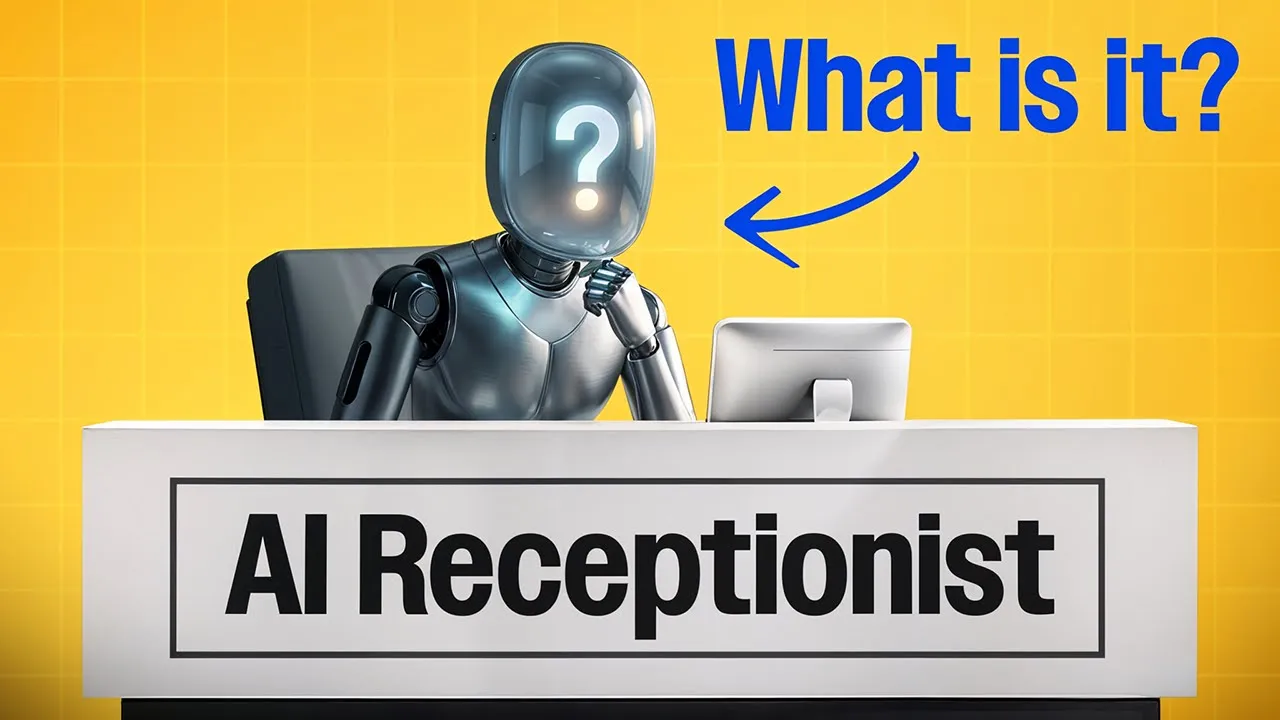
Online virtual receptionists fix this problem by answering every call instantly and capturing leads without increasing staffing costs. This guide explains how they work to protect revenue and meet client expectations.
Turn missed calls into customers with XBert AI
Missed calls means missed customers. XBert handles incoming calls even when you can’t.
What Is an Online Virtual Receptionist?
An online virtual receptionist is a remote or automated receptionist service that answers calls, screens inquiries, manages call flows, schedules appointments, routes messages, and performs other tasks on behalf of a business.
These services function like a virtual assistant, auto attendant, virtual phone system, or front desk solution within a virtual office environment, no matter the time. They ensure no calls go to voicemail, even after hours, on weekends, or during holidays, which improves client satisfaction.
There are two main types of virtual receptionist services:
Live virtual receptionist service: Real people performing remote work to handle customer calls and manage voicemails.
AI virtual receptionists service: Digital assistants powered by artificial intelligence (AI) and natural language understanding. They answer calls to your business phone number and handle the entire conversation.
Hybrid options exist, where you might outsource your business-hours calls to a real person (live receptionist team) and rely on digital assistants for out-of-hours, but AI receptionists increasingly outperform traditional services in speed, availability, and reduce extra cost. After all, they never need lunch or sleep, so they’re always ready.
Live virtual receptionist vs. AI virtual receptionist
Feature
Live Virtual Receptionist
AI Virtual Receptionist
Who They Are
Real people working remotely to answer calls, manage schedules, and handle admin tasks.
Software assistants powered by AI and natural language understanding.
Availability
Limited to business hours, though some services offer 24/7 coverage.
Available 24/7 without breaks or downtime.
Scalability
Requires hiring or expanding the team for increased volume.
Easily scales to handle thousands of calls simultaneously.
Cost
Usually higher due to human labor costs.
More cost-effective long-term after setup.
Integration
Limited to manual systems or supported software.
Integrates seamlessly with CRM, calendars, and ticketing tools.
Data Handling
May require human discretion; prone to error or privacy risk.
Secure and automated data logging (depending on setup).
Businesses prioritizing efficiency, cost savings, and availability.
How Online Virtual Receptionists Work
Unlike a basic answering service that answers phone calls and takes messages, an online virtual receptionist looks after the entire interaction. For example, instead of simply improving your answer speed, taking a message, and getting an expert to call back, these digital assistants help with troubleshooting and navigation.
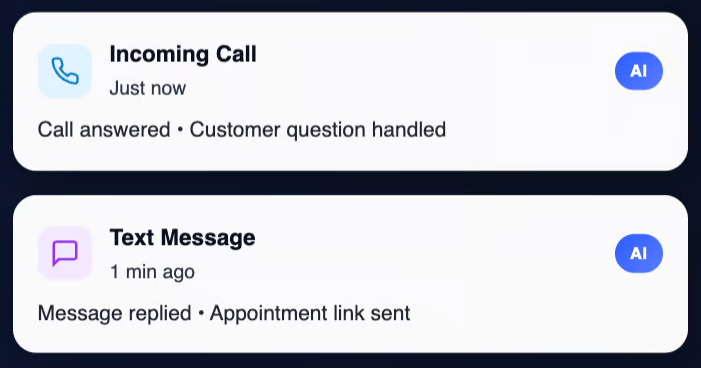
Call or message intake: The system instantly answers incoming calls, chats, or texts.
Natural conversation: Using speech recognition and conversational AI technology, it generates AI responses and handles common inquiries.
Smart call routing: For complex issues, it routes the call to the appropriate department or staff member across different locations.
Calendar sync: Integrates with scheduling software and automatically books, reschedules, and confirms appointments.
CRM updates: It captures customer info and logs every interaction for new businesses and future context, ensuring you receive messages and follow up with clients quickly.
How it works
Of course, there’s a lot of complex programming and data processing happening in the background of an online virtual receptionist. These tools act like highly trained receptionists, combining a multitude of technologies into a single digital assistant that constantly self-optimizes.
AI models trained to interpret intent and sentiment.
Text-to-speech and voice cloning for lifelike responses.
Integration with business tools (Google Calendar, Outlook, Salesforce, HubSpot, etc.).
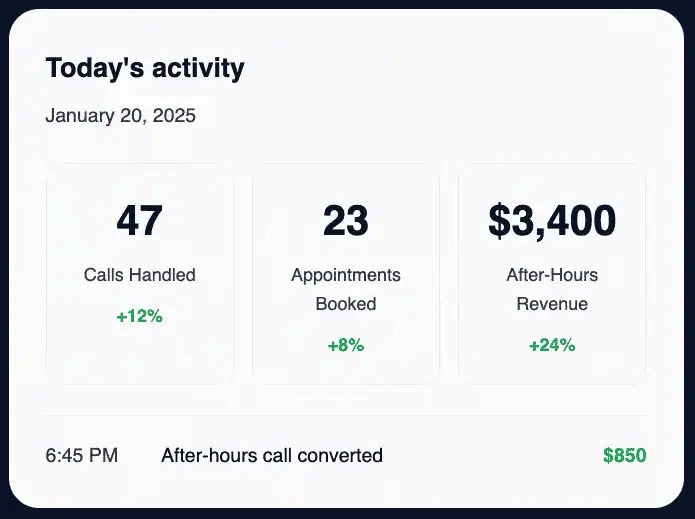
Real-time analytics dashboards tracking customer calls, bookings, and revenue impact.
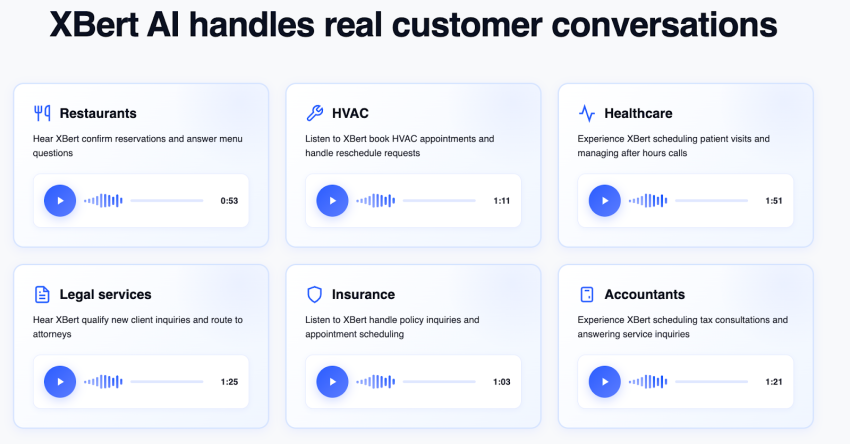
Hear a natural, professional AI and see how the AI Receptionist fits into your workflow.
Common Use Cases for Businesses
While viewed as one of the best AI tools for small businesses, online virtual receptionists have use cases across a variety of verticals.
Home and field services
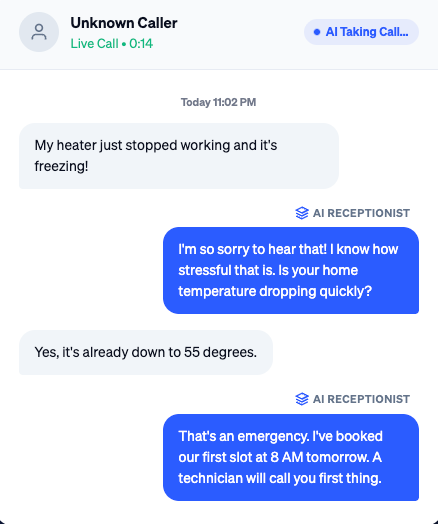
Heating, ventilation, and air conditioning (HVAC) specialists, along with plumbing, electrical, and landscaping businesses, use virtual receptionists to handle 24/7 appointment booking, emergency calls, and after-hours requests.
Example: When a customer reports a broken air conditioner at 10 p.m., the online receptionist troubleshoots and then books the next available technician, sends a confirmation text, and logs the job in the company’s CRM.
Healthcare and dental offices
Healthcare providers can schedule patient appointments, answer insurance questions, and maintain HIPAA compliance while freeing up front-office staff.
Example: Patients can simply confirm or reschedule cleanings through automated SMS links, while the AI provides accepted insurance details and updates patient records securely in the practice management system.
Law firms and professional services
AI virtual assistants can qualify new client inquiries, schedule consultations, and route calls to attorneys or accountants with full context.
Example: When a client calls about a personal injury case, the system collects key details, checks attorney availability, and books a consultation. This ensures the lawyer receives a complete summary before the meeting and isn’t going into it cold.
Restaurants and hospitality
Like a professional receptionist, AI receptionists can take reservations, confirm bookings, answer menu or policy questions, and maintain a consistent call answering service when staff are busy serving guests, without missing a call.
Example: A busy restaurant uses a virtual assistant to manage incoming calls during peak dinner hours so staff can focus on providing great in-person service. The virtual receptionist confirms table availability, takes reservations, and answers your call and common questions like “Do you have gluten-free options?”
Fitness and wellness centers
These businesses can use AI receptionists to save valuable time, manage class bookings, membership inquiries, and reduce administrative workload through automated message taking and scheduling, while trainers stay focused on clients.
Example: When a member cancels a yoga class, the system automatically opens the spot and notifies the next person on the waitlist, keeping the schedule full without staff involvement.
Key Benefits of an Online Virtual Receptionist
An online virtual receptionist keeps your business connected and responsive. Explore the benefits below to see their impact on productivity and customer satisfaction.
24/7 availability
You won’t miss customer or prospect calls if you have the best virtual receptionist service that’s genuinely always on (and not prone to burnout like humans).
AI assistants like XBert respond instantly after hours, on weekends, and during holidays. This means you can adjust your virtual receptionist service level agreements or offer priority customer support solutions.
How much revenue are you missing from missed calls?
Missed calls quietly drain revenue every month. Estimate the real cost of unanswered calls with our free calculator.
Professional image
Creating a positive first impression is vital as customer experience standards grow more demanding. The best answering services create great experiences through personalized greetings, professional tone, and branded messaging tied to your company name.
Write your script, upload it to XBert, and let AI take care of the rest. Your new receptionist then handles the phone calls while you get on with running your business. (Take a listen to these conversationshere!)
Cost efficiency
You might want to sit down for this nugget of ROI gold…
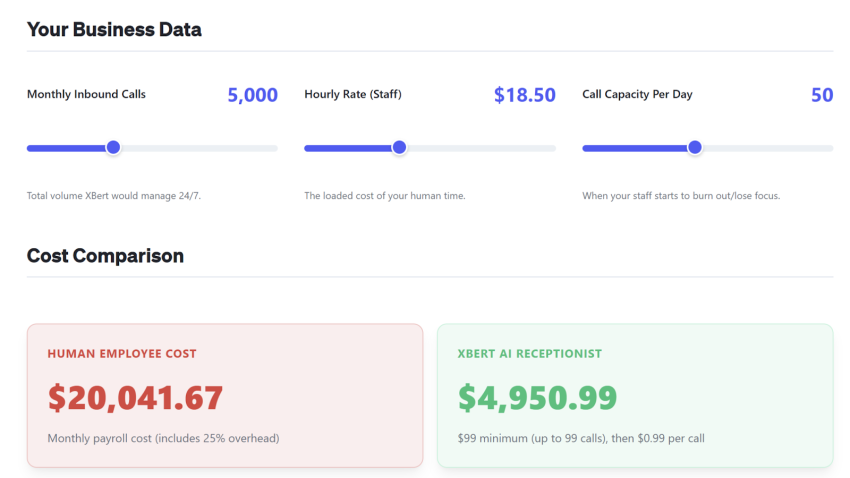
According to Indeed, the average call center agent’s hourly rate is $18.55. If your call center handles 5,000 calls a month and each agent handles 50 calls per day, your total human cost is $20,000 per year per employee. If you had used the XBert AI online receptionist, this would come in at under $5,000.
Moving to a pay-per-interaction model instead of a per-hire solution helps businesses avoid extra costs while introducing 24/7 personalized service.
The cost of an answering service is also put under the microscope when compared to the best virtual receptionists. Outsourcing specialists like MoneyPenny or AnswerConnect may offer tailored answering solutions, but with tons of staff manning the phones, there’s a high cost associated with being always on and maintaining a steady level of all the services.
👉 Calculate Your Cost Savings: AI Receptionist ROI Calculator
Multichannel communication
Sure, your current receptionist handles a variety of tasks while waiting for incoming calls. And so do online virtual receptionists. They can handle voice, SMS, chat, instant messaging, and email using a unified phone system or virtual phone system, ensuring context never gets lost.
But we’re not talking about replacing your receptionist. Removing their repetitive and mundane tasks means they’re free to spend time on more human-focused tasks. They’ll thank you for the number of times they no longer have to say, “Thanks for calling ABC,” and see their productivity boosted in other areas.
Lead capture and CRM sync
Did you know that XBert automatically collects client information, qualifies leads, and updates CRM records, ensuring every opportunity is followed up on?
Using an AI assistant dramatically reduces the potential for:
Incorrect information entry
Manual duplication across systems
Assignment to the wrong sales personnel
It also speeds up the data entry time and helps funnel sales material and context to the right teams for follow-up calls and emails.
Intelligent scheduling
Take away the constant back and forth to find mutual times, and let smart calendar integrations handle confirmations, reminders, and rescheduling. This automated diary and calendar management is proven to reduce no-shows and manual work.
Instead of waiting for colleagues to respond, XBert can find gaps where sales reps, customer service staff, or technicians are free and schedule in line with customer demand.
Scalability
Whether you receive 20 or 20,000 business calls a day, AI receptionists can handle rising call volumes and unlimited interactions simultaneously, helping businesses scale and deliver more value. There’s no need to schedule breaks or time for meetings. Simply implement your chosen online virtual receptionist, and let it take care of the time-consuming (and let’s be honest, energy-sapping) work for you.
With market-leading tools like XBert, there’s no upper limit on calls handled, and you can manage multiple inbound calls, texts, and chats simultaneously, scaling instantly without wait times or busy signals.
How Businesses Train and Customize Their Virtual Receptionist
When digital receptionists were first introduced, they were robot-centric and prone to errors with real-time customer interactions. That is very much in the past, with today’s superior models boasting considerable credentials:
Setup simplicity: Get started in under three minutes with plug-and-play onboarding.
Personalization: Choose your AI’s voice, greeting scripts, recorded greetings, and hours of operation.
Knowledge base: Train it on FAQs, service info, pricing, and company tone.
Multilanguage support: Enable bilingual receptionists for diverse audiences. Choose the languages to support your customers.
Testing and optimization: Monitor transcripts and refine responses continuously.
Integration: Sync seamlessly with NextivaONE, CRMs, phone system platforms, and scheduling tools.
How to Choose the Right Online Virtual Receptionist
All virtual receptionists produce different outcomes. Protect your brand and revenue by evaluating providers using this four-step framework. This approach maximizes more business opportunities, streamlines the handling of new business inquiries, and maintains your professional identity through your existing business number.
Latency and speed
Speed builds trust in conversational AI. When response time exceeds one second, callers lose confidence and assume the line is dead or automated. Choose ideal solutions that deliver ultra-low latency. The industry benchmark for natural conversation stays under 500 milliseconds.
Call the demo line and say “Hello?” If the system pauses for two or three seconds, end the call. Your customers will do the same. High latency also causes interruptions where callers and the AI speak over each other, creating a frustrating experience.
Context retention
Basic IVR systems treat every sentence as a new request. High-quality AI receptionists follow the full conversation and reduce repeated questions during customer calls.
During a demo, ask to book an appointment for next Tuesday. Two minutes later, say, “Can you make that day 2:00 PM?” A strong system understands that “that day” refers to Tuesday. A weak system forces the caller to repeat information.
CRM integration depth
Many providers claim they integrate with CRMs, but only send an email summary after the call. That approach limits growth. Look for deep, two-way CRM integration. Strong systems keep records updated, manage online account details, and help you handle more clients without delays.
Confirm that the virtual receptionist updates contact records, triggers automated workflows after calls, and checks real-time calendar availability to prevent double booking. If the system depends on lightweight automation tools for primary functions, expect delays along with reduced performance and data accuracy.
Customization
Your receptionist represents your brand. A flat or robotic voice signals low quality, while a warm, natural tone builds trust.
Confirm that you can adjust tone and formality for different industries, select accents that match your region, and define escalation rules. Strong systems let you set trigger words such as cancel, refund, or emergency that route calls directly to the right person.
XBert AI: The Future of Reception Is Online and AI-Driven
We used to miss 10–15 calls a day. Now every single call gets answered, and our weekly lead count is up 40%.
~ Franchise owner, Fitness Studio
As humans, we all have our limitations. It’s taken some time to realize this. But with the acceleration of AI development, we can see that it’s obvious that systems are better suited and more productive.
AI receptionists such as XBert are revolutionizing the way businesses operate. They replace reactive, labor-intensive call handling with proactive, intelligent engagement. That’s a win for both your customers and your staff. Nextiva’s XBert AI embodies that shift: an always-on, customer-ready employee that scales with your business needs and never takes a break.
More than a traditional live answering service, the platform acts as your front desk team, excellent customer service representative, and scheduler in one intelligent system that scales from small businesses to large corporations, managing thousands of daily calls.
What does this mean for your business?
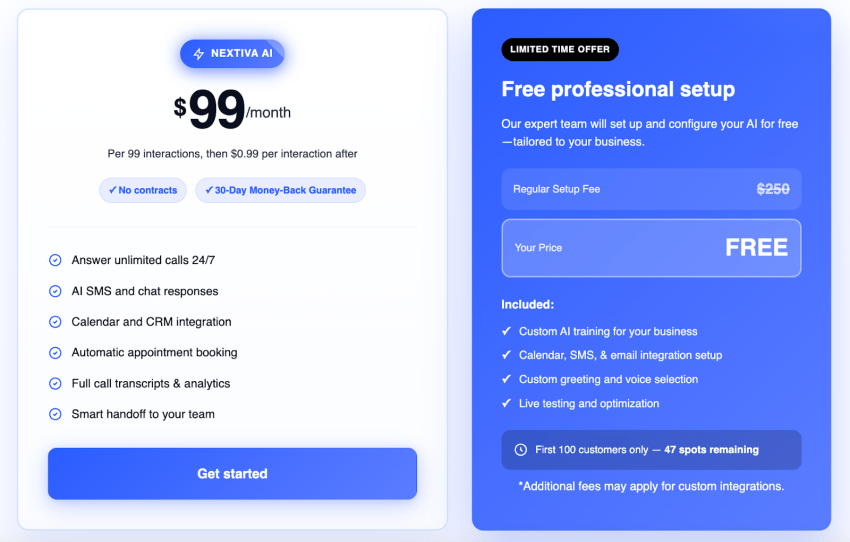
Businesses that adopt AI receptionists early gain a competitive edge, like faster response times, happier customers, and higher revenue per lead. You can set up your AI receptionist in minutes. And if you’re not satisfied with the service, a 30-day money-back guarantee is also available.
Run your business instead of answering calls all day
Nextiva’s AI receptionist software handles routine calls so you can stay focused on business growth.
Frequently Asked Questions About an Online Virtual Receptionist
What is the difference between a virtual receptionist and an answering service?
Both handle incoming calls, but their capabilities differ. A traditional answering service performs basic message taking, such as names and phone numbers. A virtual receptionist acts as an extension of the business. It answers FAQs, routes calls, schedules appointments, and resolves customer needs without a callback.
Is an online virtual receptionist secure and compliant with data privacy regulations?
Online virtual receptionists protect customer information through encrypted data transmission, secure cloud infrastructure, and role-based access controls. Many platforms support HIPAA, GDPR, and SOC 2 requirements. AI receptionists also log interactions automatically, which reduces lost messages and human error compared to voicemail or manual note-taking.
What happens if the virtual receptionist doesn’t understand a caller?
Online virtual receptionists identify intent, ask clarifying questions, and hand off issues when needed. If a caller asks something outside the system’s training, the receptionist routes the call to a staff member, collects details for follow-up, or uses fallback responses. Businesses can review transcripts and refine responses to improve accuracy over time.
Will customers know they are speaking to an AI receptionist?
Businesses control the experience. Some choose transparency, while others focus on fast, helpful responses using natural voices, conversational language, and custom scripts. In most cases, callers value quick answers and resolution more than who answers the call. Still, transparency about AI use helps customers feel valued.
How long does it take to set up an online virtual receptionist?
Most platforms become operational in under 30 minutes. Businesses connect a phone number, set call flows, upload FAQs or service details, and sync calendars or CRMs. Unlike hiring staff, setup requires no training period, onboarding delays, or extra costs.
Can an online virtual receptionist replace in-house receptionists or front desk staff?
Online virtual receptionists support staff rather than replace them. They handle repetitive tasks such as answering calls, booking appointments, and handling basic inquiries. This frees in-house teams and live receptionist services to focus on customer relationships, problem-solving, and in-person service. Many businesses use virtual receptionists as the first point of contact.
Warren Shell Gas Station on Dequindre murder: Al Curtis Williams charged with the murder of Brandon Zaner, after the two had an argument outside the station | Bonnie’s Blog of Crime



:max_bytes(150000):strip_icc():format(jpeg)/__opt__aboutcom__coeus__resources__content_migration__serious_eats__seriouseats.com__recipes__images__2015__01__20150109-meatball-pizza-small-balls-8-dd117c6ec66c4cc396abad0f5e9516e4.jpg)