Notice: Function _load_textdomain_just_in_time was called incorrectly. Translation loading for the td-cloud-library domain was triggered too early. This is usually an indicator for some code in the plugin or theme running too early. Translations should be loaded at the init action or later. Please see Debugging in WordPress for more information. (This message was added in version 6.7.0.) in /home/releande/public_html/wp-includes/functions.php on line 6170 News Magazine | Get The Most Freshy News Every Day | Page 60
There are about 26 million vegans sprinkled all over the world. And while they are certainly capable of traveling to any destination they wish, a new report by The Vegan Society says there are a few key spots vegans may want to consider for their next getaway.
In January, The Vegan Society released its Veganism Around the World report, which offered a comprehensive analysis of how “plant‑based living is shaping global culture, travel, and commerce.” The report, the team explained, came together through “desk research to build a robust database of cross-national data,” along with original surveys across 10 countries to show “where veganism is gaining ground and why it matters for the future of food, hospitality and business.”
And in that data, the team ranked the top vegan travel destinations based on vegan-friendly dining per capita, with New Zealand coming out on top, which is little surprise to Plabita Florence, the co-owner and chef at Forest Restaurant in Auckland.
“We have really good quality fresh produce here, which is, of course, important for all food, but especially when you’re cooking and eating without the assistance of animal products,” Florence told Travel + Leisure. “We also grow a lot of produce locally, and because it doesn’t have to travel far, the flavors and textures retain a really special, delicate quality, which makes my job so much easier.”
As Florence noted, New Zealanders are also fortunate to have really mild seasons, which means plenty of access to a greater variety all year round. “I imagine cooking vegan food in a place that sees frozen winters might have very tough limitations as far as access to good-quality local produce goes,” Florence added.
Despite being recognized as the top spot for vegan foods, Florence explained that it is “pretty slow going” for the vegan movement in the nation. “We have a few specialist places in New Zealand, but they’re few and far between,” Florence said, specifying that while her restaurant is technically vegetarian, not purely vegan. “That said, we quietly serve about 95 percent fully vegan food, but find that keeping a small amount of dairy on the menu helps get more hesitant diners through the door who otherwise would never step foot inside were we totally vegan and loud about it.”
Food, Florence shared, is meant “above all else to make people happy.” And who knows, maybe a bite of vegan food may surprise even the most ardent carnivore.
Beyond New Zealand, The Vegan Society named Taiwan another top spot as it “leads on fully vegan restaurants per capita,” along with Iceland as Europe’s standout nation, where 43 percent of restaurants offer at least one vegan dish, and Portugal, which ranks as No. 2 globally for fully vegan restaurants per capita.
The U.S. also made the list, as it has the most vegan restaurants in absolute terms, meaning you really can find an excellent meat-free dish just about anywhere. But if you need this story to serve as an excuse to book a trip to New Zealand, that’s OK too.
“Some people say that my work questions dominant notions of cultural identity, and perhaps that’s true,” says Bolivian photographer River Claure. “But I’m drawn to many things, such as thinking about landscapes, or the way clouds appear in a bright blue sky in some of my photographs.”
Claure’s atmospheric photos capture daily life and dream-like scenes in Bolivia, infused with magical realism, that prompt our curiosity about community, narrative, and the land. He’s based in a valley called Cochabamba, where his grandparents immigrated in the 1970s to escape political conflicts in their former home, an Indigenous Andean community called Calacota.
“Palliri”
Growing up, “I was not very conscious—nor did I value my Indigenous roots at all; in fact, it is something I specifically denied,” Claure says in an interview with koozArch. “I remember episodes in my teens where I didn’t want my friends in high school to know that my grandmother was Chola. It was something of which I was ashamed, although of course now, I find that ridiculous.”
When Claure began committing himself seriously to making art, he was awakened to his ancestry and local community in a new way, realizing that what he had tried to suppress in his youth was actually exactly what he most needed to explore. His work is often informed by Christian symbolism, such as in the Virgin Cerro works, in which a figure sits within a mound of sand and assumes the form of a religious icon.
Play is another feature of his practice, not just in the tableaux he captures—such as soccer players and expressive local children—but also in his approach. “I would say I play a lot: I play professionally,” Claure says in a statement. “I play in a kind of grand contemporary theater, blending everything: my family’s history, my Indigenous roots, my post-internet contradictions, fashion, literature, the Latin American colonial archive, foundational myths, and much more.”
His work is imbued with a sense of nostalgia—a longing for connections to “the mystical, the epic, and the sacred, in order to create rituals of my own invention,” he says. In scenes that volley between happenstance and choreography, he explores time, community, and relationships between reality and fantasy.
“Villa Adela”
Claure’s images emphasize individuals, Indigenous customs, the earth, and belief systems as a way of resisting capitalistic influences. And through compositions that feel dreamy and mysterious—even timeless—he generates his own myths as a way to question values and the forces of transition.
As part of the 2026 Vital Impacts awards, which support photographers who illuminate environmental challenges within their communities, Claure is the recipient of the E.O. Wilson Fellowship. The fellowship supports his project titled A Boat for the Future of the Mountains, which he describes as “a time capsule project” focused on communities in the Bolivian Andes where lakes and rivers are disappearing. See more on his Instagram.
If you’re leading a sales or revenue team, you already know how quickly planning breaks down, territories drift out of balance, quotas stop matching capacity, and forecasts shift from confident to speculative the moment assumptions change. I’ve seen this pattern across high-growth teams and mature enterprises alike. The real issue isn’t effort, it’s the tools: static spreadsheets, siloed data, and disconnected planning cycles that make it impossible to adjust in real time.
Family members of people who died behind bars are a critical part of the reporting process. They can help establish a timeline of events by sharing what complaints they heard leading up to the death and providing access to much-needed documents such as medical records. Including these details in your reporting can help readers understand the emotional toll of deaths behind bars. Families may also be pursuing a lawsuit when deaths are presumed to be wrongful, which can provide you access to additional documentation.
Speaking with families opens up two main lines of reporting. The first is accountability-focused. Reporters can identify the information gaps families face while trying to learn what led to a death and the policy-driven obstacles involved with acquiring the remains and keepsakes of their loved ones. The second is service-oriented. With families in mind, The Marshall Project created a guide on the steps families can take to get information or seek accountability after a loss. Both of these lines of reporting were powered by a callout that connected us with people wanting to share their stories.
Below, we’ve summarized recommendations from Engagement Reporter Aala Abdullahi on how to reach and work with families who have lost someone in custody. News creators can request a consultation to brainstorm any part of this process. If you would like further guidance on investigating deaths in jails and prisons, check out this reporting toolkit, which includes public records strategies, expert sources, a free illustration and a webinar.
Start with pre-reporting
All of The Marshall Project’s reporting on what families go through after a death in custody was powered by a simple callout. Feel free to adapt this language for your local coverage needs (just please credit The Marshall Project somewhere on your callout).
Like most reporting projects, the first step of creating a callout is doing an initial clip search. Clips can help identify specific reporting themes or questions to address in your callout. Reading past coverage can also help you identify important sources and trends — whether it’s the same facility showing up repeatedly, certain types of deaths happening across your state or recurring names (lawyers, organizations, medical examiners or other death investigators) that could become sources. You can use these initial findings as the basis for more specific questions in your callout.
Clip searches can support targeted background reporting. In addition to surfacing themes, past coverage often reveals the same lawyers, advocates and investigators across multiple cases. Speaking with those sources before launching a callout can help clarify what families typically need first, which documents they usually do or do not have and where the process most often breaks down. That context makes it possible to turn broad patterns into practical, family-facing questions, so a callout doesn’t just ask what happened but also engages where people are getting stuck.
Review policies on carceral deaths
When an incarcerated person dies, there are procedures that staff are mandated to follow. Abdullahi contacted every state corrections department and the Bureau of Prisons to track down these policies, ultimately hearing back from 26 states.
You can view those policies here. While there are several policy outliers that we’ve noted in this resource sheet, there are some overarching themes worth exploring, including:
The timelines tend to be vague. Many families, advocates and lawyers say that having clear timelines for processes such as investigations, the release of the body and the release of property would be more humane.
Basic communications with the family may not be required. When families call a facility to ask questions, they’re often met with silence if there isn’t a designated contact responsible for returning their calls.
The financial burden of funeral arrangements is systematically placed on families. Costs for transport and burial are significant and can impact a family’s decision to claim their loved one’s remains.
Design a callout
The callout is an opportunity to both solicit more information and build trust with potential sources. To achieve both aims, it is important to be transparent about the next steps of the reporting process. At minimum, the callout should include:
A statement on privacy or how you’ll use the information provided.
A note explaining how/if the reporter will follow up to request an interview.
An assurance that respondents’ stories will not be made public without their permission.
Incorporating trauma-informed language is another essential step for building trust. Consider making clear that families can share as much or as little as they want. Reminding people that they’re in charge of their own narratives fosters a sense of agency about a situation that has likely felt out of their control. Here is some sample language:
We understand that sharing your story or revisiting painful details can be difficult. You can share as much or as little as you’re comfortable with, and you can stop at any time.
You can also keep the process easy and focused for respondents by using conditional logic, which allows question branching. This prevents respondents from seeing questions that aren’t relevant to them and can keep the callout short. Conditional logic is available for most form builders, including Google Forms and Airtable. Start by having respondents answer basic questions, such as:
Who died? i.e., their first and last name.
Where did they die? i.e., in their cell, in a hospital, in a prison medical facility.
What is the name of the facility? i.e., the official name of the facility. This is helpful in case you’re looking at specific facilities in your state.
How did they die? i.e., the specific type of death, such as suicides, homicides or drug overdoses.
What happened? i.e., a general overview of the details they know about the death.
Based on their responses to these initial questions, you can reveal additional questions and/or you can ask respondents if they want to opt in to a set of more detailed questions, which will be unlocked if they answer “yes.”
For more guidance on working with justice-affected sources, check out this reporting toolkit, which includes language, style and ethical guidance.
To make the callout work it has to reach the people you’re trying to hear from! For deaths in custody, that usually means getting it in front of families through trusted advocates. These are people and groups who already have relationships with those who are grieving and looking for answers.
Consider using multiple distribution channels:
Trusted advocates: Prioritize outreach to lawyers, advocacy groups, organizers and community leaders who regularly support families after deaths in custody. These intermediaries can share the callout directly with people, and their willingness to pass it along can signal that the project is legitimate and intentional.
Facebook groups and community spaces: Families often gather in private or semi-private online groups to share updates, advice and other information. When joining or posting in these spaces as a journalist, it helps to contact group admins first, explain the reporting project and ask permission to share. If allowed, posting the callout directly (and staying available to answer questions) can reduce skepticism and confusion.
Existing lists and past contacts: If your newsroom already has an email list of families, advocates or community partners from prior coverage, use it. A direct email can reach people more reliably than a social media post and gives recipients a clear way to verify the newsroom and follow up.
Stories that have already been publicly shared: Some families have already posted about a death in custody through platforms like GoFundMe, Change.org or public social media posts. Those posts can function as a reporting lead list. Outreach through these platforms is imperfect — messages may not be seen — but it’s possible to contact petition organizers to let them know about the project you’re working on. Keep in mind that families and loved ones may be at different stages of the grieving process, so look for clear language or signs that suggest they are actively seeking support, attention or accountability.
Conduct your interviews
If you have capacity, conducting a short intake call with a respondent can help build rapport before scheduling the formal interview. Either way, consider creating a simple script that helps respondents understand the reporting process before the interview gets underway. We’ve found that expectation-setting is helpful to keep sources from getting cold feet and backing out at the last minute.
Explain your timeline. Will the story take weeks or months to publish? Will you update them along the way? At what interval?
Explain the stakes of going public. Make sure your source understands what they are signing up for if they agree to be interviewed. This includes safety considerations, such as if there’s any possibility of blowback.
Set clear boundaries. Discuss what journalists can and can’t do, so expectations are clear. It’s helpful to note that journalists can investigate, verify facts and ask tough questions, but we can’t force agencies to release documents, bring legal action or guarantee justice.
Engage the lawyers. Ask if the family is seeking legal action, in which case they should tell their lawyer what they can share with the media and when. You may also want to talk to the lawyer to corroborate their story.
Explain the fact check. Let sources know you’ll have to corroborate what they say and ask if they have supporting evidence. Clarify that only factual errors can be changed once a story is published.
Explain their role. Remind sources that participation is voluntary and they can set boundaries regarding what they choose to share. Tell people if there’s a chance you won’t use their story.
The best-case scenario is that you walk away from each interview with both the chronological and emotional narratives. We suggest that you ask a mix of personal and logistical questions, ending with reflective questions to get a sense of what they wished had been different and what they would tell other families.
Pin down the facts
It can be challenging to corroborate certain details that families share with you. Here are fact-checking strategies to deploy as early as possible:
Ask families to provide any documentation they have. This could be the death certificate, the autopsy report, any communications the family has had with agency officials over email and lawsuit filings. You could also ask to speak with their lawyer.
Think outside the box on other records requests. Along with state policies on carceral deaths, there may be other procedural documents you can get, such as property return procedures, paperwork about body disposition and unclaimed remains, and any training documentation related to specific scenarios, like how staff should handle a crime scene. Avoid blanket records requests, which can cause delays, by reviewing our toolkit on how to figure out the paper trail.
Submit lingering questions for official comment or confirmation. This should be done as you’re nearing publication while still offering agencies enough time to respond, perhaps about two weeks beforehand. When seeking comments from agencies, frame questions around the underlying facts and records rather than relaying a family’s specific allegations, so families are not exposed or put at risk prior to publication. Within the story, explain what facts you were able to verify through official channels and documentation. If you’ve exhausted these approaches and are unable to confirm an allegation, you may need to omit that detail or attribute it solely to the family.
Credits
REPORTING Aala Abdullahi
ADDITIONAL REPORTING Nicole Lewis
PROJECT MANAGEMENT Michelle Billman
EDITORIAL DIRECTION Ruth Baldwin
EDITORIAL GUIDANCE Nicole Lewis
PRODUCT Elan Kiderman Ullendorff, Ana Graciela Méndez
Blake Lively’s Attorney This Case Is About Blake, Not Taylor!!!
Published
TMZ.com
Blake Lively‘s trying to keep her famous friends out of her lawsuit fracas … because this case isn’t about them, it’s about Justin Baldoni‘s treatment of her — this according to her lawyer.
Sigrid McCawley — Lively’s high-profile attorney who famously represented victims of Jeffrey Epstein — spoke to reporters outside a Manhattan courthouse Thursday after a hearing in the case wrapped.
McCawley told the assembled media Lively’s standing up for all the young women out there … becoming a real-life example for those who might be afraid to reveal they’ve been sexually harassed in the workplace.
This makes a settlement more difficult to come to, Sigrid explains … because she says this case is about more than money — there are principles at stake here, too.
As you know … earlier this week, court documents came out containing a text Taylor sent to Blake referring to Baldoni as a “bitch.” We heard Taylor would be called as a hostile witness in the trial — though the Baldoni team later said they probably won’t need her.
Bottom line … celeb superfans may want all the tea about Blake’s famous friends — but her team says the court system just needs to focus on Lively herself.
B.C.-based couple Tina*, 38, and Brian, 37, are busy. They have three young children under the age of five, including a newborn. Still, they are trying to think long-term and save for
retirement
, but keeping up with expenses doesn’t leave much.
“How can we invest smarter and be more tax efficient?” asked Tina.
Ideally, Tina and Brian would like to retire by age 60, but said their online research suggests they would need to save $3,000 a month for the next 20 years to generate an annual retirement income of $100,000 after tax – something that is simply not doable for them. Their current monthly expenses are about $10,000 including $2,200 in mortgage payments.
The couple’s home is valued at about $1.1 million with a mortgage of about $506,000 at 2.3 per cent, which matures next fall. “We are aiming to upgrade in the next five to 10 years, but is it better to stay where we are and pay off the mortgage? Or should we consider buying sooner while we can still get a low-rate mortgage?”
Tina and Brian both have employer defined benefit pension plans that are indexed to inflation. Brian earns $78,000 a year after tax. Prior to the birth of her youngest child, Tina, who had worked full-time for a public sector employer, decided to set up a private consulting practice and now splits her time between the two. She earns about $102,000 a year before tax as a contractor and $46,800 a year after tax working two days a week for her public sector employer. She started maternity leave this past summer and receives $30,000 in employment insurance payments.
“I earn much more through my private business, but I wanted to keep the benefits from my public sector job. Was this a good decision? Should I go back to working full-time in the public sector or should I incorporate and focus on growing my business and save on my own? Or, is it possible for me to scale back and work part-time while the kids are little?” she asked.
Tina bought back her maternity leave, paying to restore lost pension contributions while she was still working full-time. Now that she is only working part-time for that employer, should she buy back another to further increase retirement income down the road?
The couple have saved $78,000 in
tax-free savings accounts
(TFSAs) and about $90,000 in
registered retirement savings plans
(RRSPs), all invested in stocks. They also established a
registered education savings plan
(RESP) for their children, which has about $19,000 invested in
exchange-traded funds
(ETFs) and stocks. They have saved $13,000 in cash earmarked for Tina’s 2026 income tax.
Brian has a $750,000 life insurance policy through his employer and Tina has $230,000 employer-funded life insurance. “Should I buy supplemental coverage because I am the primary earner?” she asked.
Over the past five years as the couple have grown their family and Tina has left the workforce during maternity leaves, they have not been able to save much money. They contribute $3,000 a year to Tina’s RRSP to repay the funds she withdrew through the home buyer’s plan and they try to make one extra mortgage payment a year to pay down the principal.
“What should we be investing in: ETFs or property? How strict should our budget be?” asked Tina. “We’re a young family and want to ensure we are making the right financial decisions for today and tomorrow.”
What the expert says:
“Research shows that working with a financial professional to create a financial plan reduces stress and anxiety around money, increases hope and leads to better financial readiness, but most Canadians do not work with a financial professional. This is especially true for young people like Tina and Brian,” said Eliott Einarson, a retirement planner at Ottawa-based Exponent Investment Management.
Einarson said the rate of savings their online research revealed likely shows they will need about $2 million in investable assets at retirement to meet their current spending needs, which are typically greater than what their retirement spending will be.
“These types of simple retirement calculators also often fail to consider other sources of retirement income, such as work pensions or savings plans, the Canada Pension Plan (CPP), and Old Age Security (OAS) payments, or the effect of income tax and tax changes for retired seniors.
That said, if Tina and Brian do need the projected $100,000 in retirement income, Einarson’s preliminary planning suggests if they stay in their current jobs until age 60, they will likely have enough defined pension income, coupled with CPP and eventual OAS payments, to meet all their after-tax retirement needs. Their defined benefit pension plans will provide the bulk of future income needs.
“If they see this mapped out in a retirement plan, they can make more informed decisions,” said Einarson.
“Their plan will also integrate the best use of all account types, like RRSPs, locked-in retirement accounts, TFSAs and unregistered accounts. This becomes important in deciding what investments to place in each account type for maximum efficiency based on individual planning goals. For example, an elderly person who is looking for short-term savings would hold different investments in their TFSA than a couple who is looking for estate growth and tax efficiency.”
When it comes to what they should do when their mortgage matures, Einarson suggested that at this stage in their lives it is better to stay where they are and focus on using low interest rates to pay down their current mortgage. This may change in five years when the children are older and Tina has likely gone back to full-time work hours. They should wait until they have extra cash flow before deciding on upgrading the house, he said.
A financial plan can also help them assess the tradeoffs between each of Tina’s career options, Einarson said. “If Tina enjoys the private business more and can make much more money, she can use those funds to purchase any health and life insurance benefits she has forfeited and invest for the future by contributing more to her RRSP.”
Einarson said buying back her current maternity leave is likely a good decision but again there are tradeoffs. In this case, it is the security of future pension income versus the flexibility of having and controlling her own investments.
Given their young family, Einarson said the couple should prioritize a life insurance analysis as part of a comprehensive financial plan. This will help them determine the appropriate level of coverage to meet their needs.
“The planning can include budgeting, education planning, investment management, risk analysis and retirement planning. A big advantage of the planning process is that it encourages individuals to clarify their priorities before any recommendations are made.”
Is $15,000 for cross-border tax help too much?
Is a $2.75 million portfolio enough for Halifax empty nesters to retire early?
*Names have been changed to protect privacy.
Are you worried about having enough for retirement? Do you need to adjust your portfolio? Are you starting out or making a change and wondering how to build wealth? Are you trying to make ends meet? Drop us a line at wealth@postmedia.com with your contact info and the gist of your problem and we’ll find some experts to help you out while writing a Family Finance story about it (we’ll keep your name out of it, of course).
No big ovenproof skillet? We regularly make this in a 9×13-inch pan: same baking time, same servings.
Crust
2 cups (260 grams) all-purpose flour
1 teaspoon instant yeast
1 teaspoon kosher salt (I use Diamond brand kosher salt; use half of other brands)
1 cup lukewarm water (100° to 115°F)
Olive oil
To finish
3/4 cup tomato sauce, prepared or homemade
6 ounces coarsely grated or torn mozzarella cheese (1 1/3 cup grated)
1/4 cup grated pecorino romano or parmesan cheese
Seasonings such as salt, pepper flakes, and dried oregano
Handful fresh basil
Make the dough: In a large bowl, whisk together the flour, yeast, and salt. Add the water and 1 tablespoon olive oil and use a spoon or dough whisk to bring it together, stirring the mixture a few times to ensure there are no unmixed pockets of flour. Cover the bowl with plastic wrap and let it rise until it doubles and moves a lot when jiggled, about 1 1/2 to 2 hours at room temperature. If you won’t need the dough until later, you can transfer it to the fridge a little while before it’s fully doubled and let it finish there for a few hours or overnight.
Assemble the pizza: Heat your oven to 450°F (230°C). Coat a 12-inch (30-cm) round cast-iron skillet with 3 tablespoons olive oil. Scrape dough into the pan, then turn it over once so it’s oiled on both sides. Dip your fingers in the oil to coat them and dimple the dough out to the edges as best as you can; it’s okay if it doesn’t fully stretch at this point. Set it aside, loosely covered, for 30 minutes to finish proofing.
To assemble: Spoon the sauce generously over the dough, covering it all the way to the edges of the pan. Sprinkle with mozzarella, then pecorino or parmesan. Season as you wish with salt, pepper flakes, and oregano, then drizzle a final tablespoon of oil over the top before transferring it to the oven.
Bake the pizza: For 30 minutes, until deeply golden brown at the edges and toasty on top. Yes, this baking time and temperature is correct. It sounds very long but I’ve made a hundred of these pizzas and always regret when I take it out before 30 minutes, as the edges have a less satisfying crunch.
To serve: Scatter with fresh basil. You can serve it right in the pan, but I prefer to protect my knives. Loosen the pizza from the pan and slide it onto a cutting board before cutting it into wedges.
Do ahead: Leftovers reheat fantastically. I heat leftover slices on a foil-covered sheet pan at 350°F or 375°F for 5 to 10 minutes.
Green, open spaces within urban environments, like Central Park in New York City, pictured here, can help people exercise more, which is one of the ways to prevent heart disease.
Kena Betancur/AFP via Getty Images
hide caption
toggle caption
Kena Betancur/AFP via Getty Images
About every 34 seconds, someone, somewhere in the United States dies from heart disease — which remains the leading cause of death for both men and women, according to the American Heart Association. But a new study from the AHA says deaths caused by strokes and other heart conditions are on the decline.
There were about 25,000 fewer deaths from cardiovascular disease and strokes in 2023, compared to 2022, the most recent data available, the annual report released Wednesday says.
Deaths due to heart disease rose during the pandemic.
“I think the last five years, as health overall was impacted by the COVID pandemic, was something of an anomaly,” says Dr. Stacey Rosen, a cardiologist who is the executive director of the Katz Institute for Women’s Health at Northwell Health in New York, and the president of the American Heart Association.
So, what will it take to keep the positive momentum going?
Rosen says a preventive strategy should encompass the health care system and each person as an individual — and it should focus on the conditions that set the stage for heart disease.
For instance, everyone should know whether or not they have high blood pressure — also known as hypertension.
“When you look at the U.S. statistics, there’s actually almost 50% of Americans who have the diagnosis of hypertension,” says Rosen. “And it is truly, aside from quitting tobacco, the most modifiable risk that we have.”
Many people don’t realize they have high blood pressure because it doesn’t bring on any specific symptoms. That’s why check-ups are important — and the good news is that treating high blood pressure with medicine and lifestyle changes can literally prevent heart disease, explains Dr. Sadiya Khan of Northwestern University. She’s part of the team behind the new report.
“Improving high blood pressure with medicine has never been easier,” Khan says. “There are so many inexpensive therapies available, and getting blood pressure under control can add years to life as well as prevent heart disease, stroke and dementia.”
Two more drivers of heart disease are obesity and diabetes, which can also be managed with a combination of medicines and changes in lifestyle habits including eating better and moving more. Community-level policy changes, like adding green spaces where people can exercise safely is important, Khan says.
“Having environments that promote activity can help us make healthier choices,” Khan says.
Public health experts have laid out lots of ideas of policy changes that could support healthy communities and help lower the risk of heart disease. Initiatives include things like reducing sodium in the food supply (given excess salt in food is a driver of hypertension), and expanding health care initiatives focused on diabetes prevention, obesity treatment, and financial incentives to achieve cardiovascular risk factor reduction.
“”There are many options and ways to move forward,” says Dr. Anand Parekh of the University of Michigan. Parekh wrote the policy paper for the AHA.
None of us can make policy changes on our own, but there are lots of opportunities to tweak our daily habits in a way that can protect our hearts. The American Heart Association promotes “Life’s Essential 8,” which includes a focus on diet, physical activity, sleep, quitting tobacco, as well as managing blood sugar, blood pressure, cholesterol and weight.
“There’s tremendous data that shows the importance of Life’s Essential 8,” says Rosen, pointing to the “enormous” impact in reducing your risk of heart disease by following this advice.
Changing your habits can feel overwhelming, so Rosen recommends starting with small, specific, bite-sized goals: “So rather than saying, ‘I’m going to lose weight’, ‘I’m going to exercise more’, say ‘I’m going to take the stairs twice a day, every day’, ‘I’m going to not have a breadbasket if I go out for a meal’.”
Celebrating small wins is a nice on-ramp to healthier habits, which can help fend off heart disease. Rosen points to an example in her own life, when the evidence became clear that sufficient sleep can help protect the heart.
“I was somebody who didn’t focus on sleep as being a personal priority,” she says. A few years ago she changed her habits and routines, aiming to get plenty of rest . “It has absolutely made a difference.”
I grew up on a steady diet of Star Wars long before I had words for genre or myth. I couldn’t have explained archetypes or Campbellian beats, but I understood the pull of it, the sense that something old and immense lay just under the adventure. Luke gazing at the twin suns on Tatooine felt like an ache I didn’t yet know how to name. As a child, Star Wars was simply the world I wanted to live in, a place where goodness and danger and mystery lived side by side across deserts and starships, quiet homesteads and impossible, far-off worlds.
The gunfighters and lone riders in L’Amour’s novels felt strangely at ease beside smugglers, bounty hunters, and Jedi, as if they belonged to the same moral landscape.
By the time I was a young teenager, that same pull had drawn me to Louis L’Amour’s paperbacks. I tore through them—Hondo, Shalako, Kilkenny, and more—sometimes finishing one and reaching straight for the next. A Latin teacher once told me, with the kind of academic pity only a classics instructor can muster, “You could be studying Latin instead of reading Louis L’Amour.” I thought it pretentious at the time, and my assessment hasn’t softened one iota in the years since (that’s Greek, incidentally).
I couldn’t have named it then, but threads were already running between that galaxy far away and the dusty frontier towns of the American West. The gunfighters and lone riders in L’Amour’s novels felt strangely at ease beside smugglers, bounty hunters, and Jedi, as if they belonged to the same moral landscape. Years later, when I learned that George Lucas had drawn not only from samurai films and Flash Gordon serials but from classic Westerns as well, something finally settled into place. The stories that shaped my adolescent imagination were the very stories that had shaped his. I’d spent my childhood absorbing tales of knights in space only to discover they owed as much to the hard-edged ethics of the frontier as to any fairy tale.
But that overlap is more than just literary trivia. It reveals how deeply the Western continues to shape the way we tell stories about right and wrong, and why that matters for Christians trying to think carefully about the culture that forms us.
Westerns tend to be stories about borders, thin places where civilization frays and the wilderness presses in, where law rubs against chaos and justice is something a person has to carry for themselves. The frontier strips away the padding of society and leaves character exposed. Star Wars slides into that framework so easily you can miss it if you’re not looking. Picture Luke Skywalker stepping out onto his moisture farm, watching the twin suns dip toward the sand. The image could sit alongside any lone cowboy framed against the horizon. Tatooine itself is built on Western logic: a hard land ruled by crime lords, patched together by settlers, raiders, marshals, and drifters.
Western heroes often start self-serving but become protectors when faced with injustice that threatens people they’ve come to care about.
“Mos Eisley spaceport,” Obi-Wan tells Luke. “You will never find a more wretched hive of scum and villainy.” He might as well be warning him about Deadwood or any frontier town where the law has worn thin. The cantina scene that follows, one of the most iconic in the entire saga, plays like a page lifted from a pulp Western: a stranger steps through the doors of a rough saloon, the locals size him up, fists or weapons are drawn, and after the dust settles everyone drifts back to their drinks as though nothing happened. Swap blasters for six-shooters and Han Solo becomes the same sly, dangerous charmer who’s been swaggering through frontier tales for generations.
But more than set dressing, it’s the moral architecture of the Western that gives Star Wars its discernable spine. The best Westerns understand that wide open spaces don’t make life simpler. On the frontier, there’s nowhere to hide who you really are. A man’s character isn’t protected by institutions or excuses. Instead, it’s revealed whenever trouble rides into town. A rancher who refuses to bend to corruption, a gunman who finally hangs up his weapon, a sheriff who stands his ground when the rest of the town scatters—these traits define them more than the outcome of any gunfight or duel ever could.
Likewise, Star Wars is filled with moral clarity born from the same crucible. Han Solo stands right where the Western and the space opera overlap. He begins the classic wandering gun-hand, cut from the same cloth as L’Amour’s Lance Kilkenny or Hondo Lane, self-reliant, suspicious, interested only in profit. He’ll draw his blaster in a heartbeat. He shoots first. He’s the man who insists he “ain’t in this for your revolution.” But like so many of L’Amour’s protagonists, Han is not morally static. Western heroes often start self-serving but become protectors when faced with injustice that threatens people they’ve come to care about. Han’s arc sees him become something even more recognizably Western: a good man forged in a bad land.
And though the Jedi borrow language and imagery from samurai culture and monastic traditions, they fit just as naturally into the Western mold as lone wanderers dispensing justice, answering calls for help, or intervening when the law is powerless or corrupt. Obi-Wan Kenobi in A New Hope is essentially an aging gunslinger in the tradition of Shane or John Bernard Brooks (The Shootist), hiding in the hills, reluctant to take up his weapon again. Luke’s brief appearance in The Mandalorian channels the old Western image of the mysterious stranger who rides into town, puts the world right, and slips away before anyone can thank him. Even the notion of The Force, a binding moral reality beyond societal laws, is akin to the Western’s instinct that justice ultimately flows from something beyond human systems, be it providence, fate, or just the moral order of the universe.
Boba Fett, from his very first appearance in The Empire Strikes Back, arrives on screen with the taciturn menace of the Man With No Name. His armor functions like a poncho and hat, his terse dialogue mirroring Clint Eastwood’s granite delivery. He lives by a simple code: take the job, collect the bounty, survive. Cad Bane, by contrast, is pure Lee Van Cleef. His voice, his hat, his swagger all evoke the archetype of the elegant, snake-like gunfighter who enjoys the duel as much as the payday. If Fett nods toward Eastwood’s iconic antihero, then Bane draws directly from Van Cleef’s gallery of Western rogues. Together, they embody the darker edges of the Western, the hired guns whose presence reinforce the idea that the frontier is not only a proving ground for heroic virtue, but also a landscape where moral ambiguity walks on two legs.
The Western understands the mixed reality of human nature. The frontier reveals people to be a mix of bravery and selfishness, capable of compassion and violence in turn.
Perhaps no modern Star Wars story makes the connection with the Western genre clearer than The Mandalorian. Its very first episode begins with the Mandalorian stepping into a bar filled with rough men. Duels, bounties, and dusty frontier towns follow soon after. Din Djarin (whose name looks suspiciously like Django), the titular Mandalorian, embodies the archetype of the laconic gunslinger whose moral compass slowly finds true north. His initial mantra, “This is the Way,” functions like an honor code, giving him stability in a chaotic galaxy. But that code becomes challenged and softened through his bond with Grogu, similar to how weary gunfighter Shane is transformed by young Joey’s trust. In both tales, a hardened wanderer finds his humanity in the eyes of a child who sees something good in him long before he sees it himself.
Din’s path eventually crosses with that of Cobb Vanth, who functions as the quintessential Western marshal—part Matt Dillon, part Will Kane—armed with decency and stubborn courage. Introduced in Chuck Wendig’s Aftermath novels before appearing in The Mandalorian and The Book of Boba Fett, Vanth protects a small desert settlement from raiders, wearing Mandalorian armor he doesn’t quite deserve but uses to defend the defenseless. His story is straight from the pages of a Western dime novel: a man with no authority except the badge he earns himself, standing between his town and the chaos beyond its borders.
Vanth’s arc is less flashy than the Mandalorian’s, but is nonetheless morally potent. He is a civic hero in a world without a functioning civic order. His decency isn’t supernatural or mystical, but neighborly. He stays and fights because someone has to, and he becomes marshal less by election, more by necessity. There is a Christian resonance here worth noticing. The call to love one’s neighbor does not vanish simply because the structures of justice are broken. Vanth’s story reminds us that virtue often expresses itself through ordinary faithfulness, protecting home, community, and the vulnerable.
Westerns are often dismissed as simplistic or morally naïve, full of white-hatted heroes and black-hatted villains. But the best Westerns (and the Western DNA within Star Wars) offer a vision of moral clarity without drifting into moralism, and virtue without perfectionism. In a cultural moment that sees clarity often confused with rigidity, or conviction with narrowness, those distinctions matter.
The Western understands the mixed reality of human nature. The frontier reveals people to be a mix of bravery and selfishness, capable of compassion and violence in turn. The Western rarely presents characters who are purely virtuous, and its heroes tend to have pasts they aren’t proud of. But they are capable of change. This resonates with the Christian understanding of sin and redemption. The human heart is bent, yet redeemable. Grace works on flawed material. Characters like Han Solo, Din Djarin, and Cobb Vanth stand as pristine examples of this dynamic, imperfect men whose courage grows precisely because they are tested.
The Western also values boundaries, which define the frontier setting, whether territorial or moral or communal. Western stories tend to dramatize what happens when those boundaries collapse.
The Western also values boundaries, which define the frontier setting, whether territorial or moral or communal. Western stories tend to dramatize what happens when those boundaries collapse. Lawlessness invites injustice and chaos ultimately harms the innocent. Civilization, flawed as it may be, is worth defending. This parallels the biblical vision of boundaries as gifts, not prisons, meant to protect the vulnerable and restrain evil. Star Wars mirrors this struggle in its depiction of crime syndicates and failed republics, where the fight for justice often looks like preserving and protecting real communities.
And many Western heroes ultimately become guardians, people who risk themselves for others. This is the territory of men like L’Amour’s Hondo, who repeatedly step into danger for those they barely know, or the drifters who protect besieged towns in The Magnificent Seven or Pale Rider. They stand alone against outlaws. They return to danger when it would be easier to walk away. Their heroism is less internal enlightenment than it is concrete action. This aligns with the Christian conviction that love is sacrificial and embodied—incarnational, if you will—and not merely emotional. Christ lays down his life for his friends. Western heroes often do the same. And it’s no accident that some of the most moving moments in Star Wars mirror this logic: Obi-Wan’s sacrifice, the Mandalorian’s protection of Grogu, Luke facing down the First Order alone to buy his friends time to escape.
The true power of Star Wars lies in its moral imagination. And that imagination was shaped in no small part by the Western. The Western gives Star Wars its sense of frontier, its fascination with outlaws and lawmen, its focus on virtue under pressure, its understanding of justice as protection for the weak, and its conviction that courage is often lonely but always necessary.
For Christians, these themes land close to home because they mirror the moral terrain we actually walk. Scripture describes life in contested space, on a frontier of sorts, where faithfulness is possible, but never effortless, and the choices made there shape the kind of people we become. Christian character is hammered out in the places where life pinches, not in the moments when everything sits neatly in place.
In all these stories, virtue emerges in the places where certainty thins out and the conditions turn harsh… The frontier they describe is sometimes a place on a map, sometimes the contested ground inside a person’s own heart.
Paul writes that “affliction brings about perseverance; and perseverance, proven character; and proven character, hope” (Rom. 5:3–4). Peter says that various trials result in the proof of one’s faith (1 Pet. 1:6–7). James goes further and instructs his readers to “consider it all joy” when they encounter trials, “knowing that the testing of your faith brings about perseverance” (Jas. 1:2–4). These are frontier realities, not abstract theological ideas, and Paul, Peter, and James all say the same thing in different keys. Hardship has a way of exposing what’s real in us and strengthening what’s fragile. That is the terrain of ordinary life. It’s the place where the line between good and evil cuts through our own hearts, and where the decisions that shape us most profoundly are usually small ones that no one else sees.
The Western knows this terrain well. Its heroes don’t grow in peace and plenty. They grow because the world around them forces their hand. Integrity shows up when no one else will confront the men doing harm. Restraint matters when pulling a trigger would only widen the wound. Courage appears because someone has to hold the line or the whole town falls. Star Wars puts its characters in the same crucible: Luke standing before the Emperor and refusing the easier, violent path; Din Djarin deciding the safety of a child matters more than his own code. Pressure reveals them, just as it does in every good Western.
In all these stories, virtue emerges in the places where certainty thins out and the conditions turn harsh. Both the Western and Star Wars imagine a world where character must be forged and not assumed, where goodness is real, but never cheap. The frontier they describe is sometimes a place on a map, sometimes the contested ground inside a person’s own heart. Christians recognize that terrain. It’s the place where God does quiet, steady work in us, shaping a faith that can stand when the world feels uncertain, and revealing in the process more than we ever expected about who we are and who He is.
I did my first ever holiday gift guide for travelers a few years ago, which was fun to compile. Readers seemed to enjoy the various items, and I was happy to share some of the products that accompanied me on the road.
Now that my life is a little different – something all of you already know – my gift suggestions are less about souvenirs from abroad or reading about travel, and more things I use day to day or found wonderful.
I hope you’ll find something you like in them!
Holiday gifts for the season
There are a lot of birds in here, you’ve been warned.
Hands free shoes and boots
It was a fellow leak patient who first told me about Kizik shoes, and I have used them ever since. Made with patented technology that allow for hands-free use, these sneakers come in different styles and colours, and are available in kids, women, and men’s options.
A note that their newer models aren’t as good for my spinal CSF leak because the heel drop is higher; I find the Lima model to be the most comfortable, though my shoes are their Cairo model that has since been discontinued.
Once you tie the laces on Kiziks the first time, you simply step into the shoes thereafter. To get out, you use your other foot to hold the base steady and slowly pull out of the shoe. They’re excellent for people with disabilities, for pregnancy, for seniors, and generally for those who hate having to crouch to get their shoes on and off.
And for this holiday season, they also have winter boots for the first time, and a new Chelsea boot that goes to the ankle.
The Lima Kizik women’s shoe in grey.
More information: You can find these shoes and boots on their website, Kizik.com. Using this link gets you $20 off (it also gives me $20 off, but I don’t see myself getting any more shoes as I have several pair!). They ship to Canada and USA. Follow them on: Instagram
A pencil to end all pencils
Do you know someone who is particular about their writing implements? The New York Times calls the Blackwing 602 the “Rolls Royce” of pencils, a previously popular choice from many a writer—including John Steinbeck. First created in the 1930’s, the Blackwing was also used by Chuck Jones, who proudly used Blackwings to create Bugs Bunny and many other Looney Tunes characters. After 1998, the pencil couldn’t be found, and devotees were paying $40 a pop when they did locate a stash. Thankfully, in 2010, a California company brought it back for “a new generation of writers, musicians, and others seeking a more natural existence” (not sure what they mean by that, but yes — it’s a great pencil!).
They brought back the cult-favourite mainstays: comfortable grip, a replaceable eraser in a very satisfying rectangular shape (why is this so satisfying!?), and a pencil crafted from California cedar and Japanese graphite. It writes like a dream, and makes doodling a pleasure. It’s not cheap but it’s not $40 a pencil expensive. Still, if you’ve got a family member or friend who loves to draw or handwrite, it’s a fun gift.
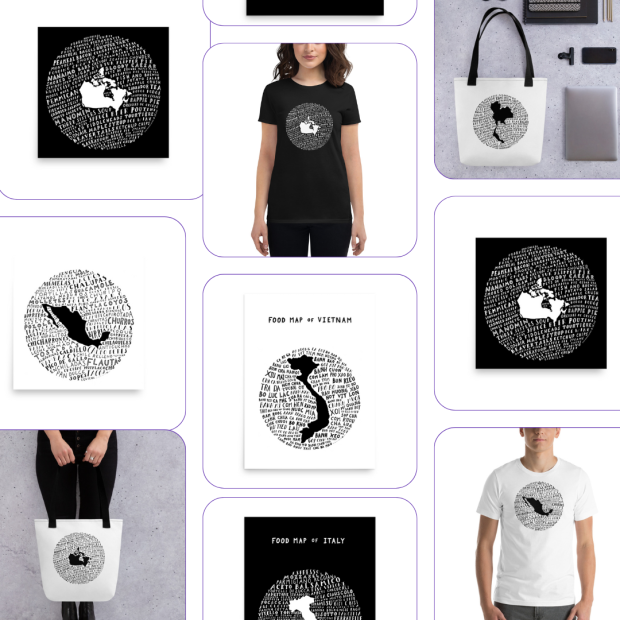
Yes, yes—I have included my own maps in this guide as well! My food maps get compliments whenever people visit, and make great holiday gifts for anyone who loves to eat.
In addition to Canada, above, I’ve got Vietnam, Portugal, Thailand, Japan, Italy, and Mexico art in the shop!
Despite my work hours being limited these days, one of the tasks I keep working hard at is the gluten free cards project. I started these cards when I got sick while eating in Japan with a short gluten free card in Japanese. I realized I needed to include more information, local ingredients names (not just “I can’t eat gluten”), and cross-contact (not just foods that are gluten free).
The result, 15 languages and counting with Bahasa Indonesia, Croatian, Lithuanian, and Swedish coming soon and over 12,000 cards sold.
Each card goes through 2 sets of translations for accuracy, with one translator at minimum being familiar with celiac disease. I’m in the process of adding PDF downloadable versions too, instead of just the PNG files. More and more people want to print the cards, not just have them on their phones.
Perfect for the celiac who loves to travel!
More information: Where to buy: the GF Cards shopfront, with free country guides here. Shipping to: Worldwide because they’re digital cards!
A great new card game for travel
Another fun gift that is perfect for the traveler: Trip Chaser, a new card game, beautifully designed. Trip Chaser is the love child of Dalene and Pete Heck, who you may also know from their site Hecktic Travels.
The game lets you figure out who’s the most travel-savvy of your group by buying, bartering, and gambling your way to various destinations. The more challenging a destination is to get to from North America, the more points it’s worth.
The game is already sold out in Canada, but you can order it on backorder or via the US, where there is still stock.
I have a great set of Global knives that I slowly accumulated over my years of lawyering. The problem is, with a spinal CSF leak I cannot use them because they are too heavy.
Instead, I’ve gotten a chef’s knife from Nakano, which is lightweight and comfortable—so much so, that anyone who comes in to help in the house only opts to use that one. It’s their “classic chef knife” and weighs in at 6.5 oz / 185g. Lightweight, but sturdy enough to cut many a great thing in the kitchen. They’ve got a 30% sale going on right now, too.
Nakano also has santoku knives and other sets on offer; I’m sharing the one I got and use because that’s the only one I have experience with. But it’s been a great addition to my knife block, and light enough to use even when my spinal CSF leak is in rough shape.
Please use code JODI at checkout for a 30% off deal on your knife purchase. Instead of an affiliate payment to me, I asked for a discount code for readers. It’s valid for the Nakano site generally, not just this knife that I use and love.
My friend Candace sent me a few Joytop notebooks when I first got sick. She said the lines are just perfectly placed, and the notebook’s seams were satisfying to use; I can’t disagree at all. There’s something about the size and lightweight matte texture of these books that makes me want to write in them all the time. I used to love Moleskine books but I got frustrated with the size, always wishing I could spread out my creativity and not be cramped to the side of the page.
These books allow me to do that, and for some reason, I haven’t used anything since. Honestly, these books are lovely but why are they so satisfying?! The just are. Regardless of why, Candace was right, and I wanted to include them so you all can enjoy the satisfaction we get from writing in them.
Always a whimsical cover, plus satisfying to write on.
More information: Where to buy: In Canada, Yuyu.ca sells these, and they ship to the USA and internationally as well. In Australia, you’re in luck: Maconii carries them too.
An elegant straw system for your plants
When a friend in Sweden mentioned plantstraws as an option for me because I’m a notorious #plantkiller, I was intrigued. I know many of you love your plants and do far better at not murdering them than I do, so I thought you’d be interested too.
Plantstraws is the brainchild of Sweden’s Elin Fyhr, who wanted to make plant care effortless and believes that “design should be playful, curious, and unhurried”. Can’t find fault there.
The straws work by putting one end into a water jug and the other into the soil of your plants, allowing a cotton rope inside each brass tube to slowly add moisture to the soil without overwatering. This means you can put thirsty plants like swamp and rainforest native plants,on a similar care schedule as succulents, cacti or Mediterranean plants. They also add a fun look to any room with the brass tubes and glass jars:
More information: Where to buy: the Plantstraw website Shipping to: Canada, USA, and International. (Shipping outside Europe is costly, though), so you can also consult one of their resellers. For some reason the only ones in Canada are in Alberta; hopefully that changes one day soon! Follow them on: Instagram
Knitted cacti
With a mission to bring greenery to “every struggling plant parent”, Kelsea’s whimsical knitted cacti caught my eye at a local flea market. The business came about when Kelsea knitted her sister some cacti for Christmas, after seeing how her sister couldn’t keep plants alive.
Taking inspiration from real plants, Kelsea carefully crafts knit cacti and succulents in a variety of sizes, colours, and shapes. She also tries to use sustainable materials for other parts of her products: upcycled packaging, sustainable yarn and stuffing, plus reusing cardboard inside the pot to make them lighter weight for shipping.
The company is fully family-supported, including the build for the displays at the market stall I met her at.
I bought myself a mini cacti (though I’m having cactus regret that I didn’t get a larger one), and thought you may want one too.
More information: Where to buy: via their Instagram page Shipping to: Canada, USA, and International.
Fowl language puzzle
One of two options (see Effin Birds below) for those who, like me, are in that sweet spot of Venn diagram overlap between swearing and birds. This time, a 1000-piece puzzle for you to put together once dinner is over.
I loved the colour (it matches my logo), and it has birds so I’m not really a tough sell here. For those in the winter cold, a puzzle is always a great way to pass a few hours of your time.
I bought Nessie the tea guardian the moment I saw her, and I am obsessed with it. I use Nessie whenever I have loose tea, and the satisfaction of watching her peek out from the cup rim will, I suspect, never get old.
For the tea lovers and whimsy lovers alike!
Also unmissable (if you’re me): the same company’s spaghetti monster strainer. I love it so much.
More information: Where to buy: Nessie: Amazon Canada, Amazon US. The spagetti monster strainer: Amazon Canada, Amazon US. This is the same company that also makes the mushroom funnel I currently own. Yes, I’m a statistic and I don’t care. You can also buy their products on the OTOTO Design website, but they only ship to the US. Follow them on: Instagram
Hummingbird ring
I enjoyed the symmetry and joy from this cute hummingbird ring, which can be ordered in 18K plated gold, or sterling silver. It’s from Little Rooms, a shop launched by designer Ester Delug in 2007. The shop has expanded quite a bit since then, but if you’re in the market for some fun and tasteful jewelry, you’ll certainly find something here.
They also sell beautiful hair accessories and ear cuffs, in addition to jewelry standards like necklaces and earrings.
I’ve had the pleasure of meeting the genius behind Birdstrips, Jess, in person in Montreal twice before we each moved elsewhere. Her illustrations have grown a huge following on Instagram due to their whimsical, relatable messaging.
In Jess’ words, the shop comprises “the existential distress of the flightless through the eyes of the flighted.”
Below, two prints from her shop: one a vintage-style poster of 33 “rarely seen” gulls, including the elusive popsigull, peagull, and pierogigulls; and the second, therapy “before and after”—in classic Birdstrips style.
I wasn’t sure if I could tolerate red light therapy with a mast cell disorder, but everything I read suggested that if I stayed at higher wavelengths of light, my mast cells would be less disrupted.
So I sought out a portable LED red light device that I could lift with a spinal CSF leak, but also that had options for higher nm of red light, so that I could hopefully tolerate it. That theory did bear out with my use of the FlexBeam, where I can use their Setting 3 for 20 minutes a day on my front and back when needed. I had to work up to that—I started at only 5 minutes—but now I can do the full 10 minute session twice without issue. I do use it earlier in the day in case it disrupts my mast cells enough to affect sleep, but most people actually use it right before bed because they say it helps them sleep.
I opted for this devices because from everything I read, its lamps didn’t get hot, and unlike laser light, I didn’t risk any tissue damage from the studies I looked at. While a combo of red and near-infrared wavelengths are recommended for most uses of the device, I opted for only level 3, its longest wavelight, which penetrates deeper but most importantly does not disrupt mast cells as much. I’ve found it increases my energy, helps with sleep (when I do it earlier in the day), and most importantly really takes down any nerve pain I have. I was sceptical when I started using it, but I have really come to enjoy how much it helps the spine pain from my leak.
The device comes with velcro bands that you attach at the handles, for when you want to loop it around a leg or your spine, as well as a slender carrying case. I use it as is (without the velcro) because I just place it on my spine or stomach where my leak sites are, but many people I’ve chatted with use it on their thigh or at lumbar while moving around.
The company is from Norway, but the device is made in Chiang Mai, Thailand.
More information: Where to buy: the FlexBeam website Shipping to: Worldwide Follow them on: Instagram
Birds + curse words
These illustrations of birds that swear in creative ways are popular all over the web, with good reason. As Twitter implodes and the world feels like it’s doing the same, the bird outrage by Aaron Reynolds says all that we are bottling up inside.
That doesn’t stop people from getting pissed off about the cursing, but … did you expect anything else from a company called Effin Birds?! He also now has wax candles, a new addition to his “shitmas” collection for people who dislike the holidays.
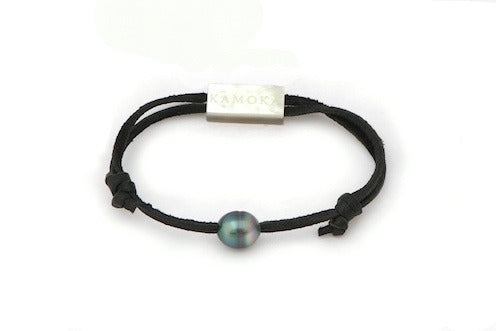
My friend Celeste is not only a great travel writer, but also runs an environmentally-friendly Tahitian pearl company, Kamoka, that adheres to the strictest levels of sustainable farming in the world. Their pearls are from oysters grown in the nutrient-rich lagoon of Ahe Atoll, 300 miles northeast of Tahiti, with electricity supplied by solar and wind power. And if you needed more convincing about supporting their enterprise: a National Geographic study found that their farming methods helped increase the area’s fish population in recent years.
One of their products I wear often: the Mana Bracelet. At $99, it is an investment, but a durable and beautiful one.
Celeste said that this bracelet was initially crafted for surfers. Now, it’s one of their best sellers for active people who want a beautiful pearl bracelet without worrying about fragility. The adjustable band is made from kangaroo leather (the strongest leather in the world), and is a great choice for the fashionable wanderer and the active fashionista alike.
They also now offer a new collection, featuring Tahitian blacklip oyster shells and jewelry made from their own sustainably produced mother-of-pearl. The earrings below are more affordable than the pearls alone, and are a beautiful gift for those who want something sustainable and different.
Many of Kamoka’s products are one of a kind, and are put together by Celeste and her team each year.
More information: Where to buy: The Mana Bracelet is available here. The full mother-of-pearl collection is here, with the earrings above here. If rings are your fancy, they’ve got a lovely aqua crescent ring this season as well. Shipping to: Worldwide Follow them on:Instagram
Embroidered heart maps
I met the lovely couple behind Sadie and June when at a flea market in Ottawa, and appreciated their fun offerings as a traveler with a lot of places I miss deeply. They sell hand-embroidered maps for 900 locations (and counting), either as stand-alone “I love this place” style, or connecting hearts, where there is a thread connecting two places. They also do custom maps, if your favourite destinations aren’t on offer presently.
The couple, whose names are actually Steve and Kendall, are a cross-border couple—something quite common here in the towns that border the US! She’s from New Jersey and he’s from Ottawa, but they met in Florida. Extremely popular any time I’ve seen their booth around town, they capture the nostalgia of leaving pieces of ourselves in places we loved.
Says Kendall, “Our hand-embroidered heart maps were born out of this love and our belief that love knows no borders. The concept: I began embroidering through paper vintage map prints that meant something special to me and Steve.”
The couple have a post about how they went from being ‘flat broke’ in 2014 to building a full-time business around their sewing skills. When I met Kendall at the market, she mentioned that as the business picked up she was struggling to get orders done … until she taught Steve how to sew, and that helped get the maps completed much faster. Now they are both working on their popular maps, and adding cities all of the time.
More information: Where to buy:the Sadie and June website Shipping to: Canada and the United States, as well as Europe Follow them on: Instagram
Those are my most cherished holiday gift picks! I hope you enjoy at least some of them.

:max_bytes(150000):strip_icc():format(jpeg)/TAL-vegan-noodles-TOPCNTRYS4VEGANS0126-4a245719c326436dbe4486931f147b4a.jpg)