Notice: Function _load_textdomain_just_in_time was called incorrectly. Translation loading for the td-cloud-library domain was triggered too early. This is usually an indicator for some code in the plugin or theme running too early. Translations should be loaded at the init action or later. Please see Debugging in WordPress for more information. (This message was added in version 6.7.0.) in /home/releande/public_html/wp-includes/functions.php on line 6170 News Magazine | Get The Most Freshy News Every Day | Page 45
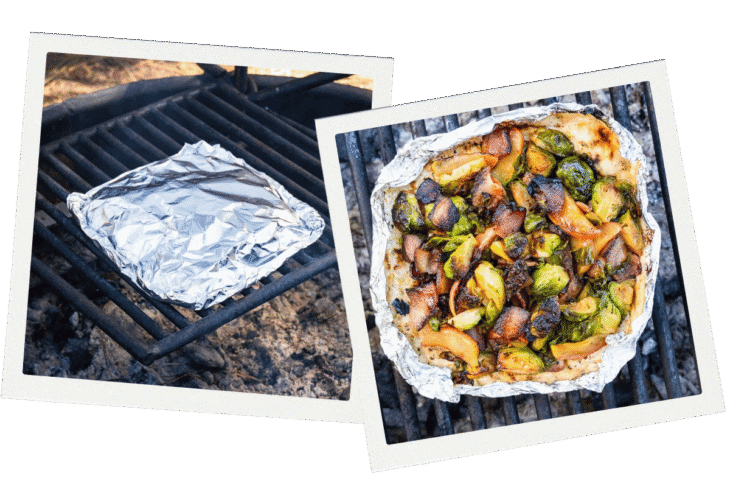
Sweet, smoky, and savory! Brussels sprouts, bacon, and apples roasted together in a foil packet for the perfect fall side dish.
This foil packet is the epitome of fall camping food: crispy bacon, tender Brussels sprouts, and tart apple slices all cooked together with a drizzle of maple syrup.
It’s a perfect balance of smoky, salty, and sweet flavors that makes a simple side dish feel special. Prep everything ahead of time at home, then let the fire (or grill) do the work while you relax.
Serve it alongside grilled steak, sausage, or chicken. It pairs great with roasted or mashed potatoes or grilled bread. It’s the perfect autumn-style side dish to help you start channeling those Campsgiving vibes!
I knew this recipe was going to be a hit because Megan was already sneaking bites before I was even finished photographing it! This post would have more photos, but there wasn’t anything left!
-Michael
Tips for making this camping
Chop all the ingredients and then toss them together in a bowl. This will ensure everything is evenly coated.
Use heavy-duty foil to prevent tears, especially when cooking over a campfire.
Cutting slits in the foil packet (after you flip it) will help release steam and allow the bacon to crisp up better.
When it’s done, the Brussels sprouts should be tender when pierced with a fork, the bacon should be crispy, and the apples should be soft but not mushy.
Pre-trip Prep
Chop, mix, and assemble the foil packets at home. Make sure you have a good crimp around the edges. Place them in waterproof zip-top bags and keep them in the cooler while transporting.
Ingredient notes & substitutions
Cut Brussels sprouts in half or quarters depending on size so they cook evenly with the other ingredients.
Choose firm apples like Honeycrisp or Pink Lady that won’t turn to mush during cooking.
If you don’t have maple syrup, a bit of brown sugar or honey works well as a substitute.
2cupsBrussels sprouts
4slicesbacon cut into 1″ pieces
1applesliced
2tablespoonsmaple syrup
1tablespoonolive oil
¼teaspoonfine sea salt
⅛ -¼teaspoonred pepper flakesoptional
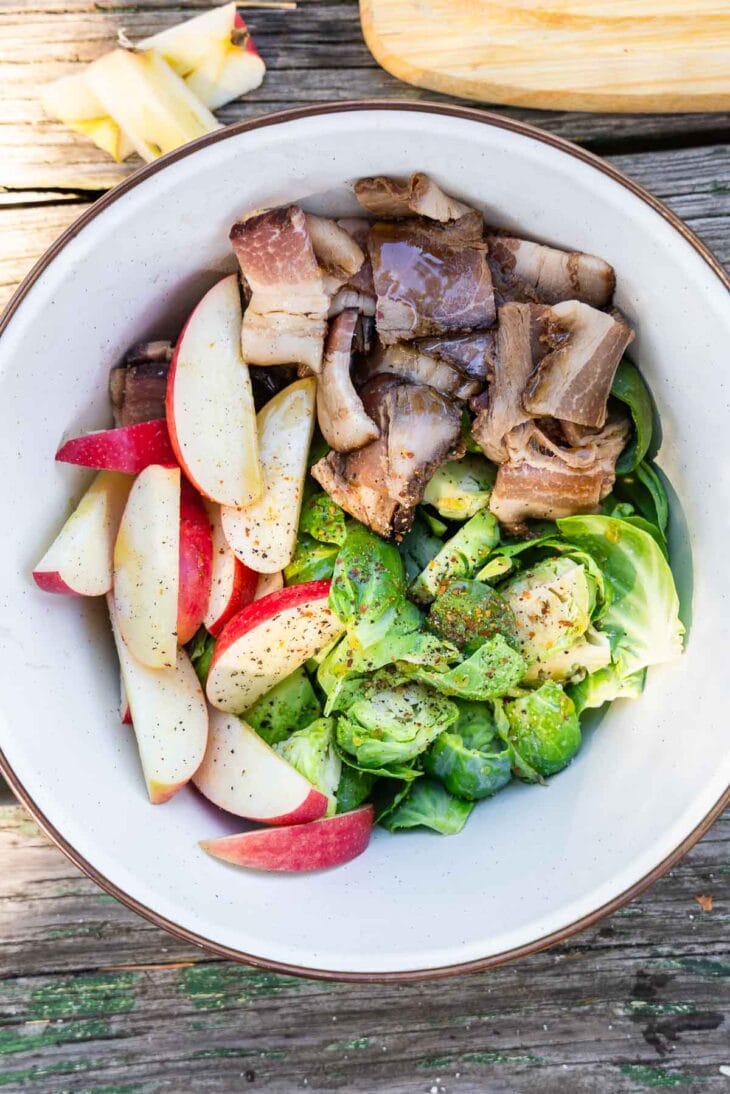
Halve or quarter the Brussels sprouts, cut bacon into 1″ pieces, and chop the apple. Place everything in a medium bowl along with the maple syrup, olive oil, salt, and red pepper flakes. Toss to coat.
2 cups Brussels sprouts, 4 slices bacon, 1 apple, 2 tablespoons maple syrup, 1 tablespoon olive oil, ¼ teaspoon fine sea salt, ⅛ -¼ teaspoon red pepper flakes
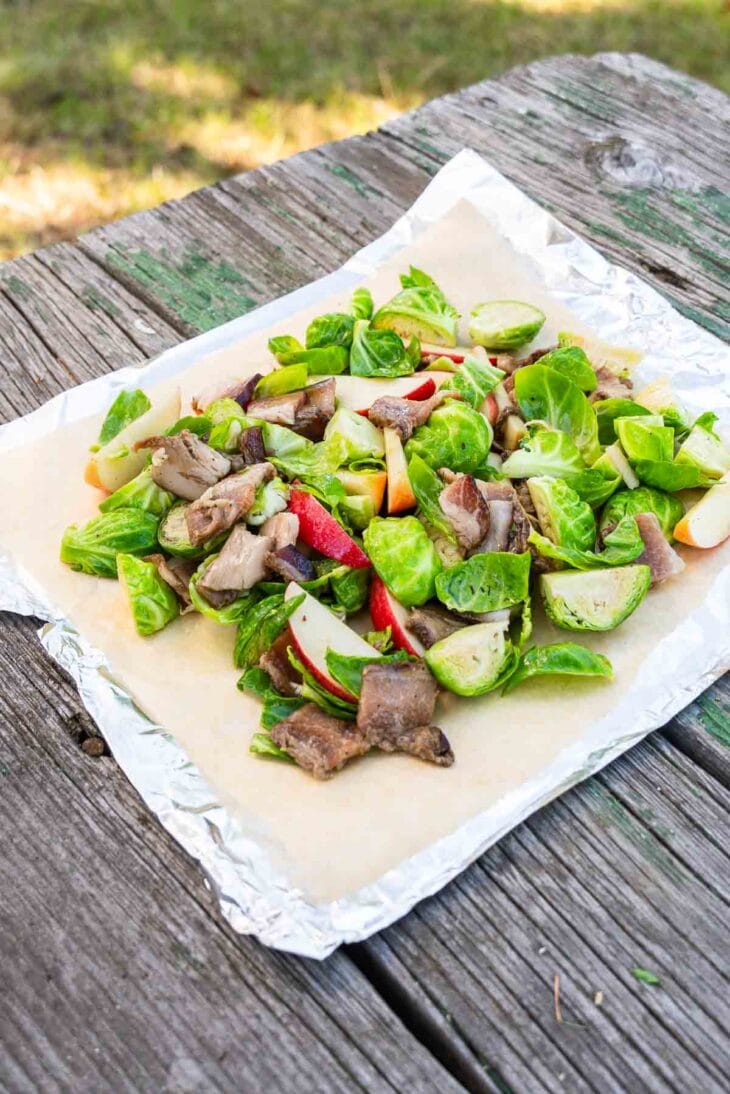
Tear off 2 sheets of heavy-duty aluminum foil (10-12 inches long). If using regular foil, double-layer for extra strength. Place the foil on a flat surface and add the Brussels sprout mixture to the center. Top the packets with the second sheet of foil, and fold down in 1/2-inch folds to create a tight seal. Leave some room inside for steam circulation.
Place the packet on a grill grate over medium coals or embers. Cook for about 20-25 minutes, flipping once halfway through. After flipping, use a knife to cut vents in the top sheet of foil. This will help some steam escape so the bacon can crisp up.
Once the Brussels sprouts are tender, remove the packet from the grill. Carefully open packets (watch for steam!) and serve.
The Echo of Disciplines in a Contemporary Practice
The artistic practice of Denis Yashin stands at the intersection of multiple creative traditions, shaped by more than two decades of sustained engagement with experimental culture. Based in Vienna, he operates within a city known for its layered artistic history, yet his work resists nostalgia or fixed stylistic inheritance. Instead, it reflects an ongoing dialogue between sound, image, theory, and material exploration. His current body of work, developed under the long-term project Making Sound Visible, signals a commitment to transforming auditory experience into tangible visual structures. Painting, in this context, functions not as an isolated discipline but as part of a broader system of translation, where sensory perception is reorganized into form, color, and spatial tension.
Yashin’s academic foundation at the Academy of Fine Arts Vienna, where he completed his studies in Art and Digital Media in 2017, continues to exert a quiet yet persistent influence on his work. The institution’s emphasis on critical theory and cross-media experimentation offered him tools that extend far beyond formal technique. These conceptual frameworks inform his decision-making, sometimes through deliberate reflection and at other times through intuition developed over years of practice. Encounters with artists and thinkers across sound art and media art communities have further refined his sensitivity to process, material behavior, and the subtle relationships between systems that appear distinct but remain deeply connected.
This layered background manifests in works that feel restrained yet charged with underlying complexity. Acrylic paint applied to acrylic glass, often paired with custom 3D-printed frames in matching hues, produces objects that feel both industrial and contemplative. Other works on traditional canvas maintain the same rigorous reduction of elements. The physical clarity of these materials reinforces his interest in analog processes, even when the conceptual origins trace back to electronic sound or digital experimentation.
Denis Yashin: From Electronic Sound to Visual Reduction
Long before painting became a central focus, sound defined Yashin’s creative identity. In the early 2000s, he worked primarily as an electronic musician and DJ, exploring generative systems through software environments such as Max/MSP and Native Instruments Reaktor. These tools allowed him to construct evolving sound structures governed by rules rather than fixed compositions. This approach fostered a mindset oriented toward systems, repetition, and variation, all of which later found visual equivalents in his paintings. Sound never receded into the background; it remained an active force that continues to guide his sense of rhythm, density, and restraint.
Minimalism plays a defining role in how these influences are distilled into visual language. Yashin’s paintings aim for reduction without emptiness, favoring geometric clarity and carefully balanced color fields. The goal is not aesthetic purity for its own sake but an exploration of how much can be communicated through limited means. Conceptually, his work examines the threshold where sound becomes image, insisting that this passage remain physical and analog. Paint replaces waveform, surface replaces speaker, and the act of painting becomes a form of translation rather than representation.
This philosophy is especially evident in his approach to live painting. Although these situations unfold in public settings and share temporal qualities with performance, he resists identifying as a performer. Instead, he positions himself as a mediator between sound and visual outcome. The presence of an audience introduces feedback loops, chance encounters, and unpredictability that cannot be replicated in isolation. These variables alter the final work in subtle yet lasting ways, embedding traces of time, place, and collective presence into the painted surface. Each piece becomes a record of interaction rather than a solitary gesture.
Influences Between Cinema, Art, and the Physics of Sound
The range of influences shaping Yashin’s work reflects his refusal to confine inspiration to a single field. In sound and music, figures such as Carsten Nicolai, Alexei Borisov, and Franz Pomassl have provided important reference points, not only through their sonic output but through their conceptual rigor. Pomassl’s role as his sound instructor at the Academy further deepened this influence, reinforcing an understanding of sound as spatial, physical, and architectural. These ideas translate into visual compositions that feel measured, structural, and attentive to internal logic.
Visual art and cinema contribute equally to his thinking. Minimalist film, particularly the work of Andrei Tarkovsky, has informed his sensitivity to duration, stillness, and the emotional weight of reduced imagery. Artists including Constanze Ruhm, Daniel Richter, Brigitte Kowanz, Peter Kogler, Keith Haring, and Erwin Wurm offer diverse perspectives on how visual language can operate conceptually, politically, or spatially. Rather than borrowing motifs, Yashin absorbs these influences as attitudes toward material, scale, and the relationship between viewer and work.
Sound itself remains his most consistent source of inspiration, extending far beyond conventional musical structures. He distinguishes clearly between music and sound, emphasizing that while music is always sound, sound encompasses a far wider spectrum. Non-melodic electronic textures, ambient environments, noise, soundscapes, and everyday acoustic phenomena all feed into his visual thinking. Because sound is usually generated by something visible, this latent connection often surfaces in his paintings. Lines, planes, and colors appear as residues of acoustic events, transformed into silent yet resonant objects.
Denis Yashin: Process, Memory, and Future Directions
Some of Yashin’s most meaningful works originate from live painting contexts, where the process unfolds in real time and under observation. These situations alter his relationship to control and experimentation. When working alone, pushing personal limits and testing material boundaries often take precedence. In front of an audience, communication becomes integral to the work. Conversations, spontaneous comments, and even interruptions can redirect decisions, embedding social interaction directly into the visual outcome. The resulting paintings carry layered memories that remain inseparable from their physical form.
These works often accumulate stories that linger long after completion. He recalls moments such as visitors attempting to purchase unfinished paintings, or instances where color choices unintentionally mirrored surrounding objects in the exhibition space. One finished piece became notable because many viewers perceived a female face emerging from its lines and chromatic structure, an image he himself never recognized. Such moments highlight the gap between intention and perception, reinforcing his interest in unpredictability and shared authorship between artist, process, and audience.
In daily practice, Yashin’s workflow has evolved into a highly layered system rather than a linear routine. Painting typically occupies his focus one work at a time, while parallel material studies explore new possibilities. Custom 3D-printed frames have become a defining element, integrated seamlessly into the composition rather than treated as secondary supports. Experiments with priming techniques on canvas and acrylic glass continue to expand his visual vocabulary. Sound remains ever-present, whether analog or digital, electronic or environmental. Looking ahead, he is actively preparing an exhibition and event program for 2026, with multiple collaborations already underway, signaling a future shaped by sustained experimentation and interdisciplinary exchange.
Hi everyone! I thought I would let everyone know what is going on, since I have not posted in about a week and a half. I have not even updated any posts. It is very exciting…I have COVID!!! I have been so sick. All I have done is laid in bed or on the couch and watched TV or played games on my phone. Of course I also slept a bit. I have been grouchy as well because I don’t like being sick, especially like this. I am getting better now and I expect to start posting by Monday. I hope everyone else is doing well!!!!!
Any stories I have missed that you want me to cover, just let me know!
Filed under: non crime related | Tagged: personal |
The 2026 Milano Cortina Winter Olympics commenced on February 6, and since then, it’s been game on. Each country is vying for the gold as they represent their nations. Athletes from around the world are competing in several winter sports, either by carving up the ice or hitting the slopes.
With multiple recognizable stars such as Lindsey Vonn having competed, viewers have been tuning into their local NBC stations and Peacock to watch each match and its outcome. So, as of right now, who has the most medals so far in the 2026 Olympics?
Find out the updated Olympic medal count here for Team USA, Canada, Italy and more countries as everyone goes for the gold.
Which Country Has the Most Athletes in the 2026 Winter Olympics Milano Cortina?
Team USA has the most athletes — 235, including three alternates — in this year’s Winter Olympics, followed by Canada, which has 211 athletes, per CBS News. Host country Italy has the third most athletes with 195.
Updated Olympic Medal Count 2026
The following consists of the updated medal count for the 2026 Olympics at the time of publication:
Gold Medal:
Sweden – 4
Switzerland – 4
Norway – 7
United States – 4
Austria – 3
Italy – 6
Japan – 2
Germany – 3
Czechia – 1
France – 3
Netherlands – 1
Silver Medal:
Sweden – 3
Norway – 2
Italy – 2
USA – 6
Switzerland – 1
Austria – 5
Japan – 2
Germany – 3
Czechia – 1
France – 4
Netherlands – 3
China – 1
Republic of Korea – 1
Slovenia – 1
Bronze Medal
Italy – 7
Norway – 5
USA – 3
Japan – 5
Germany – 2
China – 1
Canada – 2
Bulgaria – 1
Team USA, Canada, Sweden, Switzerland, Norway and several other countries have earned gold and silver medals. Host nation Italy currently holds gold, silver and bronze.
Olympics 2026 Schedule for Figure Skating, Alpine Skiing, Hockey & More
The following list contains the dates for each Winter Olympic sport:
Ice Hockey
Figure Skating
February 6–19: Team event, ice dance, singles, and pairs programs
Snowboarding
February 6–21: Slopestyle, halfpipe, snowboard cross, big air and parallel giant slalom
My primary goal for this site is to help you achieve financial freedom sooner rather than later. And if you’re still on your path to financial freedom, sending your children to private grade school often works against that objective.
I’ve experienced freedom from bosses, work travel, rush hour commutes, and client pressures since 2012. And I can unequivocally tell you the sacrifices you make to reach FIRE are well worth it. Your health improves. Your happiness increases. And you finally have the space to find something meaningful to do with your one and only life.
In this post, I want to highlight the latest private grade school tuition figures out of New York City and remind you to run the numbers before taking the plunge. The opportunity cost is not pretty.
The last thing you want is to sacrifice 10+ years of retirement just to send your child to private grade school, only for them to graduate, attend the same colleges, and pursue the same careers as everyone else who didn’t pay an arm and a leg for education.
The Private Grade School Debate Began Before Our Children Were Born
Paying for private grade school tuition is something I’ve debated since 2016, a year before my son was born. We visited a couple of private grade schools in Honolulu, and I wrote about whether paying for private school was worth it.
Like most parents, we initially paid for private preschool because cities don’t provide free childcare to families not in poverty. Then COVID hit, and my wife and I homeschooled our son for 18 months both because we could and to protect our baby daughter.
It was refreshing to get a break from tuition. But as our investments grew and our desire for bilingualism increased, we decided to send our kids to a Mandarin immersion school.
Today, the cost is about $44,000 per child per year, or $88,000 in after-tax income for our two children. At a 30% effective tax rate, that requires roughly $125,000 in gross income just to cover tuition.
That’s a lot of money, taking up about 34% of our passive income. As a result, I’m still constantly reassessing each year whether it’s worth it.
The Value Of Mastering A Second Language Matters To Us
That said, our kids are happy, the school is excellent, and we highly value learning a second language. I’d personally pay $500,000 or more to be fluent in another language. When you can truly speak a second language, your world expands.
I loved living in Taiwan for four years as a kid and studying abroad in China for six months in 1997 during college. Learning to think and dream in another language is a gift. It’s almost like being FIRE, where you get to live two lives before and after retirement, but mentally.
Just imagine how much more you would’ve enjoyed the 2026 Super Bowl halftime show featuring Bad Bunny if you understood Spanish.
Debí tirar más fotos de cuando te tuve. Debí darte más beso’ y abrazo’ las vece’ que pude. As a FIRE practitioner who is sensitive to how fleeting life is – and how quickly our kids grow up – I feel these lyrics from the song, DtMF.
Too bad, after four years of studying Spanish in high school, and two years living in the Spanish House at William & Mary, my Spanish is terrible. I wish I started studying sooner.
Paying Private Grade School Tuition At The Expense Of Your Financial Health
Let’s be honest. Learning a second language is no longer necessary, especially if you don’t plan to live abroad. English dominates, and technology now translates languages instantly and for free.
Much like college, mastering a second language has become a growing luxury. There are also public schools that teach second languages for free, though very few start as early as preschool.
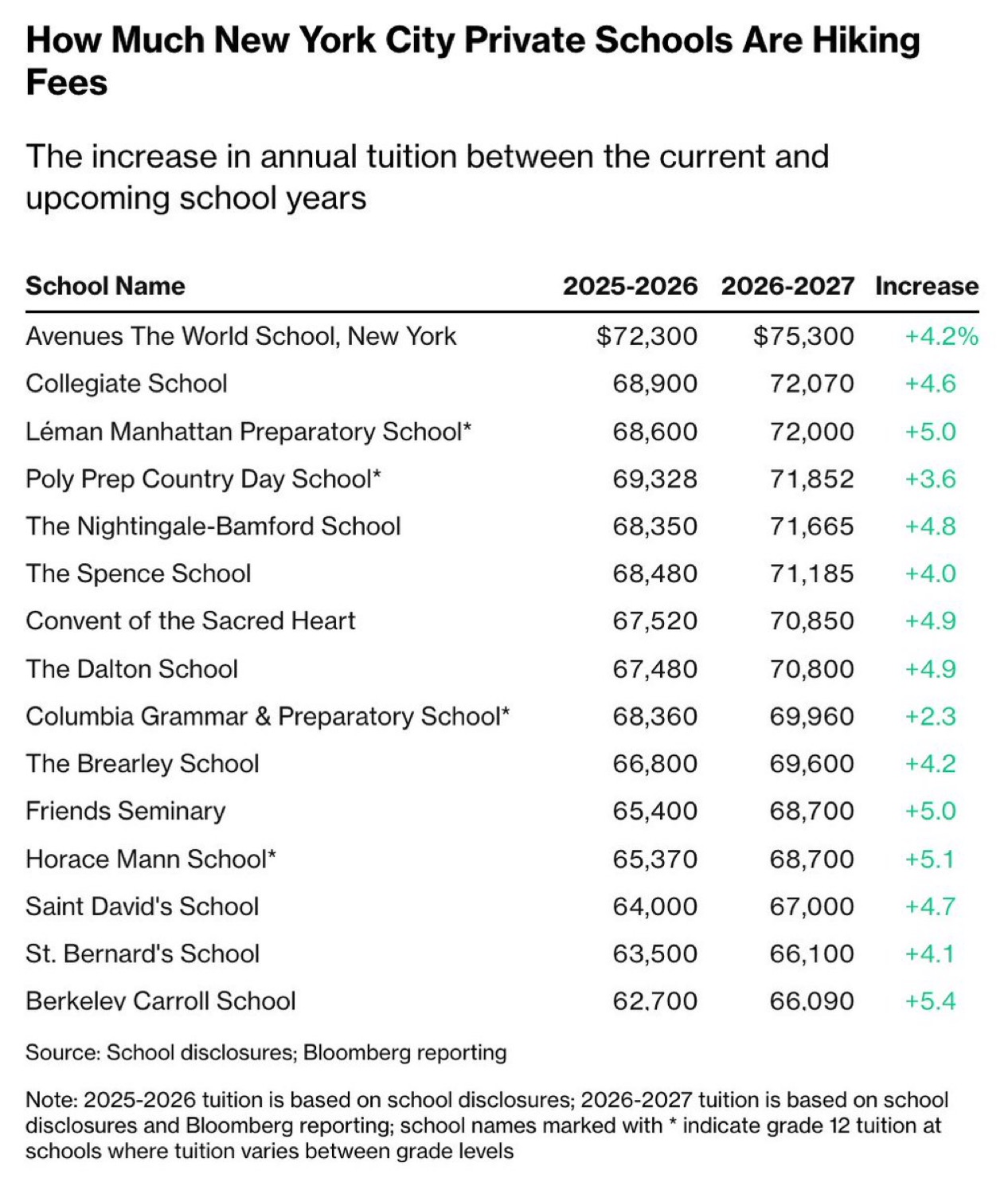
So when I saw the latest New York City private school tuition for 2026–2027, I was impressed. Even though some debate it, New York City is at least 20% more expensive than San Francisco. Seeing schools charge $70,800 to $75,300 per year is staggering.
At a 30% effective tax rate, a family needs to earn at least $100,000 in gross income just to pay annual tuition for one child.
Three Types Of Families Who Send Their Children To Private School
After four years of private schooling and speaking with hundreds of parents, there are three main groups who send their children to private school:
The ultra-wealthy, earning well over $1 million a year and/or with net worths well north of $20 million. To them, $70,000+ per child barely registers. They’re happy to spend freely on education. I estimate they make up about 20% of all private school families.
Lower-income families, typically earning under $200,000, who receive substantial financial aid. These families often make up about 20% of the student body. The $200,000 cutoff aligns with standards used by elite universities like Yale and Harvard. I estimate they also make up 20% of all private school families.
The mass affluent, or HENRYs, earning roughly $300,000–$600,000. They earn too much for meaningful aid but not enough to feel comfortable paying full tuition. This is the type of family who has a chance to FIRE, but ends up working 60 hours a week and grumbling about life, partially due to private grade school. I estimate these make up the bulk of private school families, about 60%.
If you’re ultra-wealthy or heavily subsidized, private school is manageable. It’s the mass affluent class that gets squeezed, paying 80%–100% of tuition while deciding whether private school is worth the tradeoff.
Run The Numbers On What Private School Tuition Really Costs
Let’s assume when your child turns five and enters kindergarten, you start investing $70,000 a year for 13 years instead of paying private school tuition. Your contributions increase by 5% annually, and you earn an 8% annual return. By the end of that period, you would accumulate roughly $2.1 million nominally. Adjusted for 3% annual inflation, that equates to about $1.43 million in today’s dollars.
Reduce the starting contribution to $50,000 under the same assumptions – 5% annual contribution growth, 8% annual returns, invested for 13 years beginning at age five – and the ending value comes out to roughly $1.5 million nominally, or about $1.02 million in today’s dollars after adjusting for 3% inflation.
That’s the real cost of private school, not just the tuition price. And I haven’t even included 1-3 years of preschool tuition, which can easily run $25,000 to $60,000 a year.
If you’re middle class, sending your kids to public school and investing the difference is often the smarter move. Giving each child $1 – $1.4 million in today’s dollars when they turn 18 is hard to argue against.
Ask your kid if they’d rather have a million dollars at 18 and attend public school, or attend private school and receive nothing. The answer is obvious.
If you are not already rich or are getting heavily subsidized tuition, paying this much tuition for one child will debilitate your financial future
Years Taken Away From Retirement
Now let’s apply this to a real household.
Assume a $500,000 household income in New York City. Two children require roughly $200,000 in gross income annually for private grade school tuition alone. After taxes and living expenses, the household saves $50,000 a year, or 10 percent of gross income. Respectable, but not exactly aggressive if your goal is financial independence.
Let’s assume that $50,000 is invested annually at an 8 percent return.
To accumulate $1.02 million after tax (roughly the lower-end inflation-adjusted opportunity cost for one child), it would take about 12 to 13 years of consistent saving.
To accumulate $1.43 million after tax (the higher-end inflation-adjusted opportunity cost), it would take about 15 to 16 years.
That is per child.
If you have two children, you are looking at roughly 15 to 20 additional working years to replace the lost compounding, assuming markets cooperate and you stay disciplined.
Do you really want to work an extra decade or two so your child can attend private school from age five to eighteen?
If you already have the wealth or substantial free financial aid, the decision is easier. But if you are middle class and grinding toward freedom, you must be honest about the tradeoff.
You are not just buying education. You are potentially selling years of your life.
$500,000 Household Income And Budget
To give you a crystal clear view of how quickly a $500,000 household income disappears, I’ve put together an updated budget chart with reasonable expenses for a family of four. Instead of assuming $70,000 plus per child in private grade school tuition, I used a more conservative $60,000.
Their home is a modest three bedroom, two and a half bathroom house with about 1,900 square feet in a good neighborhood. The couple saves a combined $40,000 a year in their 401(k) plans and another $10,000 a year across two 529 plans.
After covering all expenses, they are left with about $20 a year. Let’s hope there aren’t any emergency expenses that come up.
Now imagine how many more years the parents have to work if they only make $300,000 a year? A lifetime!
And remember, when you spend this much on private education, expectations rise. Parents naturally hope for elite colleges, exceptional careers, and financial outperformance. When outcomes end up similar to those of public-school peers, disappointment can creep in.
The Rich Are Really Rich
Now you see how wealthy families comfortably afford $70,000 per year for 13 years. To them, spending $1–$2 million per child doesn’t materially dent their net worth.
A $20 million portfolio growing 10% produces $2 million in gains. That single year of returns can cover decades of tuition.
For these families, private school is the default choice. Even if there’s only one fewer student on average per class, it’s worth the tuition.
The top 20 percent of families are effectively expected to subsidize the bottom 20 percent through donations on top of full tuition. Meanwhile, the remaining 60 percent of families earning upper middle class incomes are the ones getting stretched the thinnest.
Income And Net Worth Guidelines
If you want the option to retire before 60, earn at least 7X net tuition per child. Paying $70,000 means earning roughly $490,000 with one child, or $980,000 with two. With a $20,000 discount, $350,000 for one or $700,000 for two, may suffice.
After 2020, I raised the guideline from 5X to 7X as education ROI declines due to technology. However, you can still use the 5X guideline if you wish.
For net worth, aim for 25X net tuition, excluding your primary residence. In other words, Paying $71,000 requires at least $1.78 million in investable assets per child.
While 25X is a bare minimum for FIRE, tuition is temporary, and assets usually compound faster than tuition inflation. Further, I assume you’re still working and adding to your retirement portfolio.
If these guidelines sound harsh, don’t worry. They are guidelines, not rules of law. If you choose not to follow them, just be honest about the tradeoff and model more years of work and fewer years of retirement. That approach works well if you truly love what you do.
Why I’m Still Uncomfortable Paying So Much
As FIRE parents in San Francisco, we’re considered middle-to-low income but have high net worths after decades of compounding. We pay full tuition, donate what we can, and feel the squeeze. Nearly all of our passive income now goes toward living expenses.
That’s normal post-FIRE. Kids are excellent decumulators of wealth. Still, spending this much after 20+ years of aggressive saving is uncomfortable. I’m making progress, but probably still need a few more years to be fully comfortable.
Long term, I’d rather relocate to Honolulu before high school, where tuition in San Francisco is currently around $60,000 a year. Private tuition there is closer to $36,000 per year through high school, saving between $8,000 – $24,000 a year after tax per kid.
That tradeoff alone could let me fix my 11-year-old car stress free and buy endless amounts of the best Hawaiian poké and mangos. I gotta say, that sounds pretty amazing to me!
Are you a mass affluent parent paying private grade school tuition? If so, how do you justify the cost, and are you prepared for you or your spouse to work many more years than necessary? And have you ever asked your child whether they would rather attend public school and receive over a million dollars at 18, or attend private school and receive nothing?
Suggestions For A Better Life
If you have debt and children, protect your family with an affordable life insurance policy through Policygenius. My wife and I both secured matching 20 year term life insurance policies during the pandemic to protect our two young children, and once we did, a tremendous amount of financial worry disappeared.
If you want to hedge against AI disrupting your children’s livelihoods once they graduate, check out Fundrise Venture. It invests in some of the top private AI companies, including OpenAI, Anthropic, and Databricks. Investing in AI has made me feel much better about all the disruption ahead. The minimum investment is just $10.
To expedite your journey to financial freedom, join over 60,000 others and subscribe to the free Financial Samurai newsletter. You can also get my posts in your e-mail inbox as soon as they come out by signing up here. Financial Samurai is among the largest independently-owned personal finance websites, established in 2009. Both Policygenius and Fundrise are affiliate partners of FS.
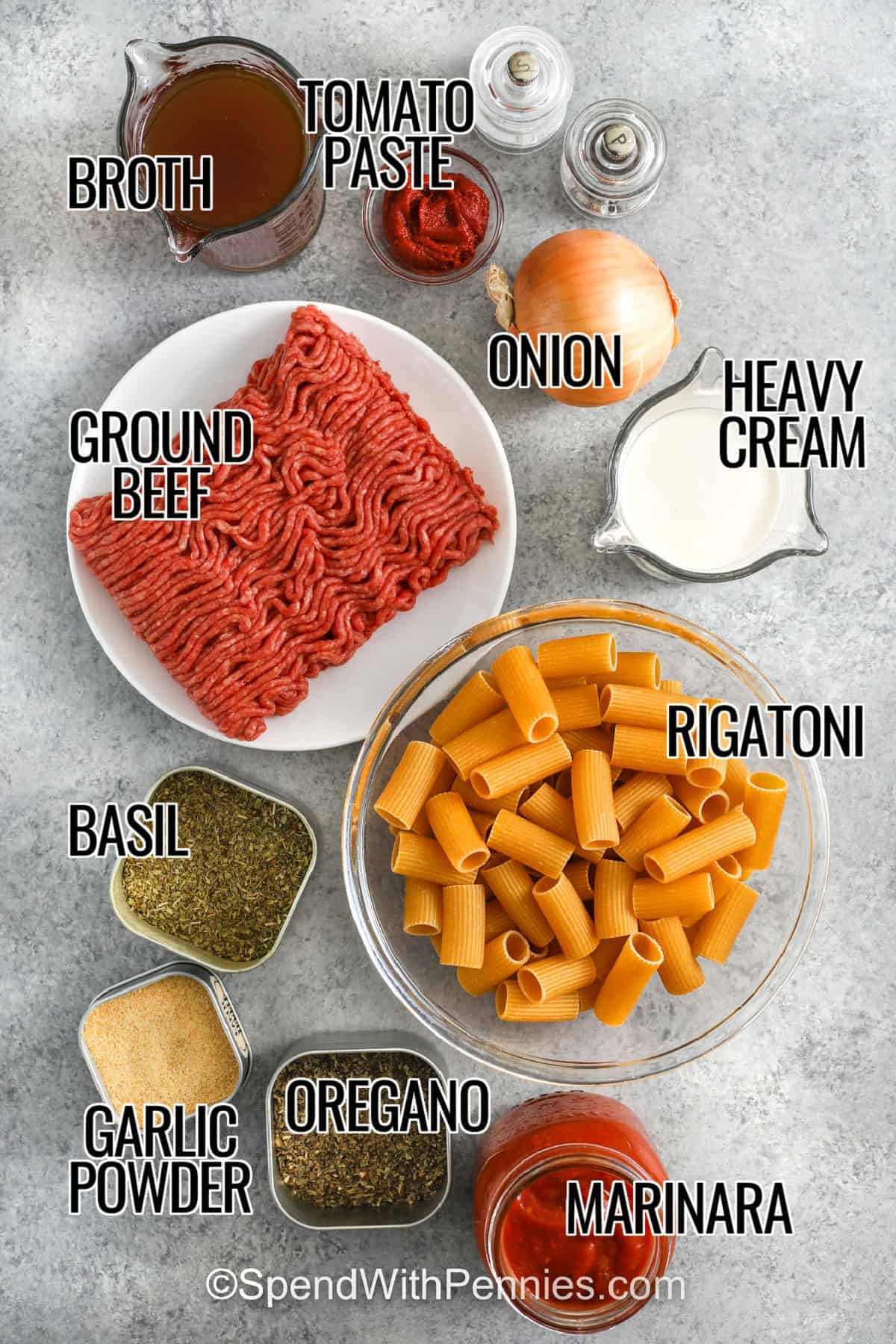
This creamy ground beef pasta is an easy one-skillet recipe that comes together in less than 30 minutes. Made with pantry staples, it’s a cozy weeknight favorite with a rich tomato cream sauce.
Flavor: Beefy marinara sauce with herby notes of basil and oregano, finished with heavy cream, then tossed with pasta.
Skill Level: This beginner-friendly recipe is easy-to-make and so forgiving.
Serving Suggestions: Garnish with Parmesan, parsley, or red pepper flakes, and serve with Homemade Garlic Bread and a Caesar Salad for a hearty meal.
Yield: Feeds up to six people as written, or double to feed a crowd.
Best Ingredients, Easy Swaps
Pasta: Use short shapes that hold creamy tomato sauce well. Rigatoni grabs the most sauce, but rotini, penne, or other medium pasta work well, too.
Lean Ground Beef: 85-90% lean keeps the sauce creamy, not greasy, but still flavorful. For a lighter version, use lean ground turkey or chicken.
Marinara Sauce: Use a marinara you already love, or make this homemade marinara sauce.
Heavy Cream: Heavy cream makes the smoothest tomato cream sauce. Swap in half-and-half, but keep the simmer gentle and expect a slightly thinner sauce.
Herbs & Spices: Basil, oregano, and garlic powder give this dish a classic Italian flavor. Swap in Italian seasoning if that’s what you have, and add in some red chili flakes for heat.
Variations
Cheesy Version: Stir in a cup of shredded mozzarella at the end, and top with Parmesan for extra-cheesy flavors.
Veggie Boost: Add in some fresh mushrooms while browning the beef. Or stir in some baby spinach at the end, just until wilted.
How to Make Creamy Ground Beef Pasta
Brown the ground beef with onions, and add the spices.
Add broth, marinara, tomato paste, and salt, and allow to thicken.
Add heavy cream to the sauce and lightly simmer (full recipe below).
Add cooked pasta to the sauce and stir to coat.
Always salt the pasta water well for a flavorful base that won’t taste bland under the sauce.
For creamy, not oily sauce, be sure to drain the beef well after browning, especially if you are using anything but extra lean.
Marinara, tomato paste, and beef broth are the secret ingredients that make this sauce taste so good. Let them simmer together for a bit before adding the cream.
Reserve some pasta water to use to thin out the sauce, if needed. It also helps the sauce cling to the noodles.
Keep the pasta al dente, especially if you are planning to have leftovers. Otherwise, the pasta will get too soft when reheated.
Leftovers That Stay Creamy
Refrigerate leftovers in an airtight container for up to 4 days. Creamy pasta can be frozen, but it keeps a better texture if the sauce is frozen on its own for up to three months. Then, just cook fresh pasta when ready to serve.
Reheat slowly on the stove or in the microwave with a small splash of liquid, giving it a good stir. If you plan for leftovers, save a little extra sauce since the pasta soaks it up overnight.
Quick Comfort Food Pasta Dishes
Did you make this creamy ground beef pasta? Leave a comment and rating below.
Prep Time 5 minutesminutes
Cook Time 21 minutesminutes
Total Time 26 minutesminutes
In a large skillet, brown the beef and onion over medium heat until no pink remains. Drain any fat.
Stir in basil, oregano, and garlic powder. Cook 1 minute.
Add marinara, beef broth, tomato paste, and salt. Bring to a simmer and cook 5 to 7 minutes until slightly thickened. Add heavy cream* and let simmer an additional 5 minutes.
Meanwhile, cook rigatoni in salted water according to package directions, al dente. Reserve ½ cup pasta water and drain well. Do not rinse.
Add the cooked pasta to the sauce and toss to coat, adding pasta water if needed. Simmer 2 minutes to thicken.
Season with additional salt and pepper to taste.
*After adding cream, simmer the sauce gently, since dairy can separate if boiled.
When Hurricane Helene struck Western North Carolina in September 2024, the storm didn’t just damage buildings and roads. It disrupted the economic fabric of the region, shuttering small businesses that had served their communities for generations, displacing workers from jobs they’d held for years, and leaving families uncertain about their financial futures.
In Helene’s immediate aftermath, Cisco Crisis Response quickly mobilized to restore connectivity and help local organizations meet the urgent needs of affected communities. But as the region began transitioning from relief to recovery, we worked alongside local leaders to identify priorities and understand how we could best support that work.
In Western North Carolina — the first site in Cisco’s 40 Communities initiative — that meant aligning our engagement with long-term economic recovery efforts and supporting partners who were already positioned to advance that work. Now, a little more than a year after the storm, we’re proud to partner with the Local Initiatives Support Corporation (LISC) and Per Scholas, two community-centric organizations with deep experience working in areas to build and maximize economic opportunities. Together, we’re working to strengthening the resilience of hundreds of small and medium businesses, train a new generation of tech workers, and build the economic capacity Western North Carolina needs to recover and thrive.
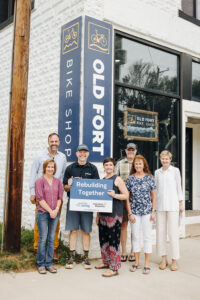
LISC works with organizations like Mountain BizWorks to strengthen the resilience of small businesses across the region.
Supporting small businesses: Western North Carolina’s economic backbone
For more than 40 years, LISC has connected communities with resources they can’t easily access on their own, bridging capital and opportunity by working through trusted local partners who know how to put resources to work. In Western North Carolina, where small and medium businesses form the backbone of the local economy, that expertise is critical.
Through our partnership with LISC, we’re working to strengthen both the small businesses themselves and the local business development organizations (BDOs) that already serve as trusted intermediaries in the region. LISC is building the capacity of BDOs across the region, equipping them to better serve small businesses through disaster recovery and beyond. In turn, these organizations are providing assistance to hundreds of small and medium businesses on everything from financing and disaster planning to digital tools that can help them reach new customers. For these businesses — many of which were already struggling before the storm — this support can make the difference between closing their doors and finding a path forward.
“Small businesses are the heart of our country. They employ our neighbors, keep local dollars circulating within communities, and give local regions, like Western North Carolina, its character,” said Michael Pugh, president and CEO of LISC. “Through our partnership with Cisco, we’re helping to ensure that more small business have resources available to them to ensure that they are able to not only rebuild after disasters strike, but also uncover new pathways to build more sustainable, stronger businesses in the process.”
The tech partnership upskilling Western North Carolina’s workforce
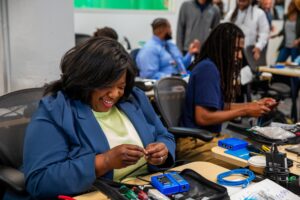
Per Scholas provides hands-on tech training to help Western North Carolina residents build skills for the digital economy.
While supporting existing businesses is critical, long-term economic recovery also requires developing the skilled workforce that can support the region’s growth. That’s why Cisco is partnering with Per Scholas, a national nonprofit with three decades of experience creating pathways to tech careers and connecting skilled workers with employers who need them.
In the aftermath of Hurricane Helene, Cisco is supporting Per Scholas as it expands its footprint in Western North Carolina. Over the next year, Per Scholas will provide rigorous training, at no cost to the learner, for aspiring tech professionals statewide, including residents in the western part of the state. As a Cisco Networking Academy, Per Scholas incorporates both Networking Academy and Splunk curriculum in their programming, ensuring participants receive training in IT skills critical to businesses and essential services. In a region recovering from disaster, these aren’t just marketable skills; they’re the technical capacity communities need to stay connected and operational during crises and beyond.
“What makes this partnership powerful is our shared commitment to lasting impact,” says Per Scholas North Carolina Senior Managing Director Michael Terrell. “By leveraging Cisco’s technology and expertise, we’re creating pathways to opportunity for people in Western North Carolina who are ready to rebuild not just their own futures, but their community’s future, and power the region’s long-term recovery.”
Moving forward together: A long-term commitment to recovery and resilience
The work in Western North Carolina through Cisco’s partnerships with LISC and Per Scholas shows what recovery can look like when technology, local knowledge, and committed partners come together. It’s not about quick fixes or temporary interventions. It’s about building the foundations — skilled workers, resilient businesses, reliable digital infrastructure —that allow communities to not just bounce back, but to grow stronger.
As a testament to this commitment, in December 2024, Cisco selected Western North Carolina as the first of 40 Communities — our ambition to bring the full force of our capabilities, technology, and people to engage, support, and invest in 40 communities worldwide. These partnerships with LISC and Per Scholas exemplify that approach: working alongside trusted organizations who understand their communities and are committed to creating lasting change.
Long-term recovery takes time. The road ahead is long, but Western North Carolina isn’t walking it alone. Working alongside partners like LISC and Per Scholas, Cisco remains committed to helping rebuild the economic foundations the region needs — not just to recover, but to thrive for years to come.
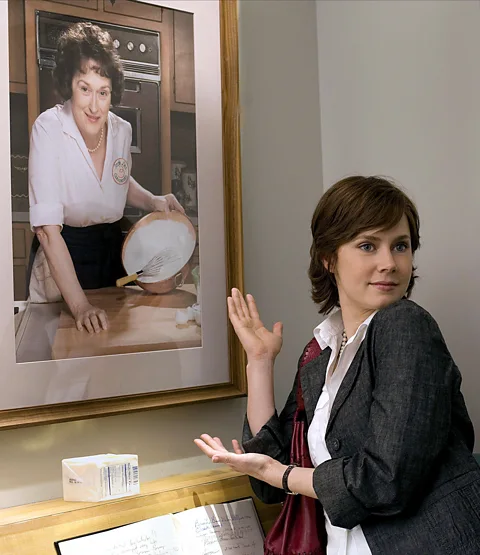
Nora Ephron wrote When Harry Met Sally and she wrote and directed Sleepless in Seattle, so you might not think of this as her most romantic film. But Julie & Julia is a buttery, unconventional love story. On the surface, it’s a time-lapsed fantasia of beautiful food, but beneath all the basting montages is a swooning ode to parasocial love: it illuminates how a role model can rescue you when you feel adrift. As Julie Powell (Amy Adams) works her way through Mastering the Art of French Cooking, her imagined bond with the book’s author, Julia Child (Meryl Streep), becomes a lifeline, even when the real Child disapproves. There’s something achingly romantic in that yearning: the idea that you can discern your purpose by loving another person’s work from afar. The film suggests that connection, even asymmetrical connection, can make existence more delicious. (Riley Farrell)
Alamy
WALL-E (2008)
The eponymous robot in WALL-E isn’t in the best of shapes when we first meet him, which is one of the many delightful things about Pixar’s Oscar-winning cartoon. Stranded on a post-apocalyptic Earth that has been ruined by human overconsumption, he diligently cleans up humanity’s mess while salving his loneliness by rewatching the 1969 musical Hello, Dolly!. His only friend appears to be a kind of pet cockroach, until another robot, EVE, makes her entrance and a will-they-won’t-they romance begins. They’re the perfect cinematic odd couple, with WALL-E looking like something out of Soviet-era Russia, and EVE very much the type of 21st-Century creation that Steve Jobs might have dreamed up. But in true Hollywood fashion, this doesn’t stop the little-robot-who-could from trying. He pursues EVE across the galaxy to cement their love, which for WALL-E seems to mean the rather charming act of just holding hands. (Cal Byrne)
Alamy
Human Traffic (1999)
A surreal, low-budget rave comedy may not immediately scream romance. But inside Human Traffic – written and directed by Justin Kerrigan and set in Cardiff – is a sweet love story between two friends. Jip (John Simm) opens the film with a direct address to camera, outlining his own difficulties – his dead-end job, complicated home life and “sexual anxiety” – and introduces his four friends, all of whom have their own reasons for living for the weekend. One of those is Lulu (Lorraine Pilkington), who has split up with her boyfriend and doesn’t have a ticket for that evening’s rave. Over the course of the night’s drug-fuelled hedonism, the two come together – and realise that it’s only ever been each other. Kerrigan’s film can be seen as a love letter to so much: to youth, friendship, late-90s rave culture. But the grounded romance between Jip and Lulu stands out, and sticks with you long after the party’s over. (Amy Charles)
Alamy
Sing Street (2016)
Oh, the things people would do to have a song written about them – even if it is written by a teenage boy like Conor (Ferdia Walsh-Peelo). He’s going through a rotten time in 1980s recession-hit Dublin: his parents are divorcing and money is tight. He waves goodbye to his private-school education and says hello to a rougher inner-city Catholic school, where the principal shoves his head in a sink for wearing brown shoes. To adjust to his new reality, Conor forms a rock band with some schoolmates, while also seeking to win the heart of the mysterious wannabe-model Raphina (Lucy Boynton), who is fighting battles of her own. Lo and behold, his perseverance eventually pays off – because what’s more romantic than honouring someone in your art, and sharing a dream? Written and directed by John Carney, Sing Street is a charming coming-of-age story brimming with teenage love and friendship, hope, and importantly, feel-good music. It will leave you warm and fuzzy inside. (Molly Gorman)
Alamy
The Blond One / Un Rubio (2019)
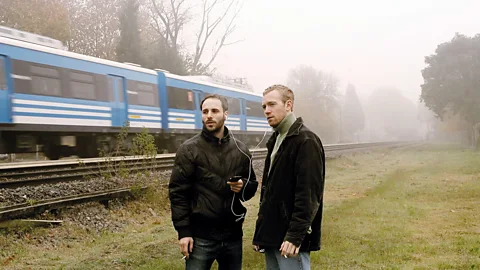
Marco Berger is the Argentinian master of erotic tension – and The Blond One is his most impossibly romantic film. It’s set in an old house in a working-class suburb of Buenos Aires. When his brother moves out, Juan (Alfonso Barón) needs to rent out his old room to help pay the rent. His shy factory colleague Gabriel (Gaston Re) moves in. After work every day, Juan flaunts his body – and various girlfriends – often while staring provocatively at Gabriel, who sits quietly, reading books and listening to music. Gabriel, who has a daughter and a girlfriend of his own, doesn’t know how to interpret Juan’s cocksure gaze, especially when Juan’s laddish mates are around, blocking any opportunity for romance. But when the men are alone, the sexual tension gives way to deep emotion, identity exploration, and the most complex and conflicted feelings. (Javier Hirschfeld)
—
If you liked this story, sign up for The Essential List newsletter – a handpicked selection of features, videos and can’t-miss news, delivered to your inbox twice a week.
For more Culture stories from the BBC, follow us on Facebookand Instagram.
Paralympic bronze medallist, model, motivational speaker – Allison Lang is many things, but first and foremost, she’s a passionate disability advocate whose travels have changed how she sees herself and shows up for others too.
Take a scroll down Allison Lang’s Instagram feed and you’ll see a woman who embodies the term ‘badass’. Action shots from her Paralympic sporting career with Team Canada are interspliced with beaming selfies, fashion-shoot stills and an array of envy-inducing travel snaps.
Anyone can see that she’s outgoing, adventurous, clearly comfortable in her own skin – and just so happens to wear a prosthetic leg.
Social media rarely gives you the whole picture, of course. Her captions are candid about the challenges she’s faced around her limb difference – Allison was born with fibular hemimelia, a rare condition that meant her left leg hadn’t fully formed and was later amputated – and she’d be the first to tell you that she hasn’t always been so self-accepting. It’s been a journey – one that’s taken her from the beaches of South East Asia to the volcanoes of Central America and shown her the power of living authentically.
The road to role model
Allison was always sporty and grew up playing soccer, swimming and snowboarding in her home province of Alberta, Canada. But by the time she reached her early teens, insecurities about her disability had started to creep in.
‘I struggled with my body image. I was badly bullied at school for being different, which really dimmed my spark. All I wanted was to blend in. I ended up quitting sports around the age of 13 because I couldn’t hide my leg when I was wearing a bathing suit or playing soccer. I was just so insecure.’
A couple of years later, the Canadian national sitting volleyball team invited Allison to try her hand at the new adaptive sport. She wasn’t keen: ‘I didn’t want to play a sport that emphasised my disability and I was worried what kids in high school would think,’ she says. But with her mum’s encouragement, she gave it a go. This decision would ultimately change her life.
‘Although I didn’t fall in love with the sport at first, I quickly fell in love with the community around it. I met women that I aspired to be; women who had disabilities, yes, but also partners and children, their own homes and careers. I’d never seen women like that in the media. It was like a switch flipped in my head. I thought to myself, OK, if they can be my role models, hopefully I can be that for someone else in the future.’
Finding her place in the world
At 16, Allison found herself representing her country on the world stage, travelling to Europe and South America to compete for Team Canada. She soon caught the travel bug and from the age of 18, took every opportunity between volleyball seasons to go backpacking in places like Bali and Central America, either with friends or solo.
While she still grappled with insecurities, Allison knew that if she wanted to become the kind of role model she’d found in her teammates, she’d have to fake it ‘til she made it. On a trip to Thailand, emboldened by the fact she was a world away from home, she posted a photo of herself in a bikini on the beach with her prosthetic on show, along with a jokey hashtag: #hoparoundtheworldwithme.
This was back in the 2010s, when Instagram was a different beast. Allison was using it as a personal travel scrapbook. So, when she received a message from a new mother who’d just given birth to a baby with one arm, thanking Allison for showing her that her daughter has the potential to lead a fulfilling life, she was shocked. ‘I still get goosebumps thinking about that. That message shifted everything for me. It showed me the real impact sharing my story could have. You can use social media for good.’
From that moment, Allison decided to use her platform to nurture a community – for anyone, disabled or not, to learn about and share in the highs and lows of life with a disability.
Read more: After long Covid, I thought I’d never travel again. Luckily, I was wrong
People with disabilities travel too
Normalising disability became a big part of Allison’s mission – especially in the context of travel. ‘[People with disabilities] are citizens of the world as well. We’re often left out of the conversation just because we might travel a little bit differently, but we want to do it just as much as the next person.’
She also points out that the obstacles she faces could one day affect you too. ‘My fun fact is that the disabled community is the largest marginalised community in the entire world and we don’t discriminate. Anybody can become disabled at any moment in time due to illness or accident. And we may all experience a lack of mobility if we have the privilege to grow very old.’
People with disabilities are citizens of the world as well. We want to travel just as much as the next person.
Despite this fact, like so many others with disabilities, Allison is often underestimated. Family friends have asked, ‘should she be doing that?’ when they hear about her adventures. And while Allison knows she has nothing to prove, there’s also a part of her that says, ‘Watch me.’
She’s gone zip lining and surfing in Costa Rica, sailed from Panama to Colombia, and hiked up dunes in the Sahara. She’s carried her own heavy bags on solo trips across Europe and joined small-group trips with Intrepid through Jordan, Egypt, Morocco, Vietnam and Cambodia. Doubters, be gone.
As her confidence grew, she also stopped trying to hide the fact she wears a prosthetic, often opting to wear an unfinished metal leg – the perfect conversation starter when she’s on the road.
‘Fellow travellers often ask what happened to my leg or remark on how cool it is that I can travel the way I do. By being open and creating space to just be myself, I’ve been able to make more meaningful connections.’
Read more: Travelling with ADHD? Try a group trip
Small-group travel can support you
While she loves travelling independently, Allison is also a big fan of joining small-group trips and is quick to point out the benefits for those with additional accessibility needs.
‘When you have a disability, having to anticipate and plan for every eventuality can be exhausting. Small-group travel alleviates a lot of that stress. On my latest Intrepid trip in Vietnam, our leader Ning was able to advise me on what prosthetic to wear for different activities ahead of time – such as a swim leg for a waterfall visit – which meant I could participate fully. I also think group trips are great for people who just want to show up and enjoy what’s happening in the moment.’
So, where’s next for Allison? ‘I’m going to China for the sitting volleyball World Championships – that’ll be my 40th country. Then hopefully South Korea or Japan.’
By sharing her experiences openly and travelling the world on her own terms, Allison has given herself the greatest gift – of finally feeling at home in her own skin.
She has some advice for anyone who craves adventure but can’t quite find the confidence to go after it. ‘If you want to travel and you’re not doing it out of fear – of what other people might think, or something else – who are you truly living this life for? You can do hard things. We only get one opportunity to experience life. Travelling set me free in so many ways. My wish is for everyone – in the disabled community and beyond – to experience that for themselves.’
Allison Lang helped shape Intrepid’s Ethical Marketing Guidelines. Find out more about accessible travel and see if Intrepid has the right adventure for you.