Notice: Function _load_textdomain_just_in_time was called incorrectly. Translation loading for the td-cloud-library domain was triggered too early. This is usually an indicator for some code in the plugin or theme running too early. Translations should be loaded at the init action or later. Please see Debugging in WordPress for more information. (This message was added in version 6.7.0.) in /home/releande/public_html/wp-includes/functions.php on line 6170 News Magazine | Get The Most Freshy News Every Day | Page 484
Skills on Wheels, an Indiana University program, features a carnival where participants can play games, eat food, and connect with manufacturers for free wheelchair repairs.
Elizabeth Gabriel/Side Effects Public Media
hide caption
toggle caption
Elizabeth Gabriel/Side Effects Public Media
Around 3.7 million wheelchair users live in the United States, each pushing themselves an average of 2,000 to 3,000 times a day. Some of that is straightforward, but wheelchair navigation sometimes includes negotiating unexpected curbs, stairs, steep hills and other obstacles— and most wheelchair users don’t have access to formal training to learn how to smoothly navigate on their own.
A unique, free program called Skills on Wheels run by Indiana University Indianapolis aims to address the gap for young people. Around 20 kids ranging from age 8 to 17, spend multiple days on campus learning how to navigate props like ramps and speed bumps. Then they take those new skills for a test run outside.
Savannah Healton, 12, has spina bifida, a neural tube defect in the spine. She needs a wheelchair, and lately, she’s been practicing how to do wheelies.
“It’s basically where you push two times, and then you pop into your wheelie,” Healton said. “So if you’re going up a curb, you can get into your wheelie so you can go up the hill or the curb or wherever you’re going.”
There’s little research about the use of wheelchairs by children, but one study shows that 75% of adults who use a wheelchair have a fear of falling. Nearly 65% reported falling out of their chair, and more than half had incidents resulting in an injury. Even without accidents, improper technique can injure muscles and nerves.
A child’s confidence can take a big hit if they don’t know how to maneuver their wheelchair or fear falling out of it, says program director and Indiana University occupational therapy researcher Tony Chase. Kids may decide to skip certain activities at school or with friends if they know there will be obstacles like narrow doors or stairs.
“We would love to change the world, and just make it all of a sudden accessible, but that’s a little bit too lofty of a goal,” Chase said. “So instead, let’s try to make kids more confident in navigating this inaccessible world.”
Researchers have developed a list of 33 core skills that are essential for navigating a wheelchair in a variety of environments, but kids might not learn these skills in school or in physical and occupational therapy.
Maria Fuchs, an occupational therapist volunteering with the program, said she didn’t learn much about hands-on wheelchair training during grad school.
“A lot of times wheelchair training isn’t a main focus…other things like feeding or dressing or play skills, things like that, are kind of the priority,” Fuchs said.
Occupational therapist and Skills on Wheels volunteer Maria Fuchs guides 12-year-old Savannah Healton through some wheelchair skills.
Elizabeth Gabriel/Side Effects Public Media
hide caption
toggle caption
Elizabeth Gabriel/Side Effects Public Media
Kids often learn only the basics of wheelchair operation, she said, like using the wheel locks and taking the device apart, and even then only if insurance covers it.
Kerri Morgan, an occupational therapy and neurology researcher at Washington University in St. Louis, said some people’s insurance won’t reimburse them for rehab to learn how to use a wheelchair.
“There’s this gap in education, [and] there’s the gap in actually having the environment in the medical model where clinicians know how to justify it in their notes, so that health insurance pays for it,” Morgan said.
Morgan said it’s common for wheelchair users to learn new skills through other people with disabilities or watching online videos. But that isn’t always safe if someone isn’t advanced enough to try a new skill, if their wheelchair is set up differently, or if they don’t have someone behind them to catch a fall.
Participants practice for several days before test-driving their new skills outdoors, in situations they’re likely to encounter in everyday life.
Elizabeth Gabriel/Side Effects Public Media
hide caption
toggle caption
Elizabeth Gabriel/Side Effects Public Media
Even with a spotter, practicing some skills can be dangerous. Large wheelchairs can weigh between 15 and 50 pounds, not including the weight of the person inside it.
That’s why Savannah’s mom, Chanda Healton, holds onto a strap that connects to the back of her daughter’s wheelchair so it’s safe for Savannah to practice wheelies.
The program isn’t just helpful for Savannah, it allows her mom to learn proper techniques in case the wheelchair starts to tip backward. Healton says she plans to bring her daughter back again next year.
“It’s amazing,” Healton said. “First time I watched her I had tears in my eyes. I’m like oh my gosh, that’s my baby girl.”
Side Effects Public Media is a health reporting collaboration between NPR and public radio stations in Indiana, Missouri, Iowa, Ohio and Kentucky.
Choosing the right cell phone plan is important for budgeting and, of course, your phone needs. When comparing Visible vs. US Mobile, they are both great options, but which of these options is best for you?
Check out the differences between Visible and US Mobile to determine which suits your needs the most.
Visible vs. US Mobile: Overview
Visible is a carrier that operates on Verizon’s network and is also owned by them. The great news is that you’ll still have access to Verizon’s vast 5G network but at a more budget-friendly price point.
Visible takes a simplified approach by offering 2 plans. The Visible plan and the Visible+ plan.
The key difference between these plans is that the Visible+ plan offers unlimited premium data on Verizon’s 5G Ultra Wideband network, 50 GB/month of premium data on Verizon’s 5G and 4G LTE networks, calling to 30+ countries, unlimited texting to 200+ countries, smartwatch service, higher hotspot speeds, and one global pass day per month included.
US Mobile offers more flexibility when it comes to picking a plan that best suits your needs. So if whether you’re a data junkie or someone that doesn’t use much data, you’ll likely find a plan that’s a great fit. US Mobile also offers coverage on both Verizon and the T-Mobile network, so you can choose which network best fits your location.
Another thing to note is that there are multi-line discounts with US Mobile, which is not the case with Visible.
Visible vs. US Mobile: Pros & Cons
Looking at the pros and cons of Visible vs. US Mobile is the key to determining which option is best for you.
Visible Pros & Cons
Pros
Unlimited talk and data
Fixed payment every month with no contract
Uses the Verizon 5G and 4G LTE network
Cons
Only two plans to choose from
Deprioritized data if in a busy area
US Mobile Pros & Cons
Pros
Multi-line discounts are available
Access to both the Verizon and T-Mobile network
Multiple plans to choose from so you can find the exact fit for your needs
Cons
Most affordable plan is only available via an annual plan
Multi-line family plans are not eligible for annual pricing discounts
Visible vs. US Mobile: Plans and Pricing
A big part of the decision between Visible vs. US Mobile is the pricing. Understanding what each plan includes and its cost can help you decide.
Visible
Visible has two plans, Visible and Visible+. Their plans are a fixed price and include taxes and fees, so there aren’t any unpleasant surprises when you get your monthly bill.
Visible: $25/month
Unlimited talk, text, and data using Verizon’s 5G and 4G LTE network
Unlimited hotspot
Unlimited talking and texting to Canada and Mexico
Blocks spam calls
Visible+: $45/month
Unlimited premium data on Verizon’s premium 5G Ultra Wideband network (no deprioritization)
50 GB/month of Verizon’s 5G and 4G LTE data when Ultra Wideband isn’t available
Blocks spam calls
Unlimited hotspot at up to twice the speed of the Visible plan
Unlimited talking and texting to Canada and Mexico
Up to 500 minutes per month texting to 200 countries and calling to 300
One Global Pass day per month eligible for 140 countries($10 savings)
Can get $10 off each month for Verizon Home Internet
Smartwatch service included that can save up to $10/mo
US Mobile
US Mobile has multiple plans depending on the features you need and the number of lines required.
10 GB Plan: $15* for one line
Includes 5G Ultra Wideband, plus 5G and 4G LTE where Ultra Wideband isn’t available
10 GB of Premium Data
Unlimited talk and text
Unlimited talk and text to 200+ countries, including Mexico and Canada.
International eSIM available for purchase
*Only available on the annual plan. $180 for 12 months. No multi-line discount is available.
Unlimited Starter: $29* for one line
Includes 5G Ultra Wideband, plus 5G and 4G LTE where Ultra Wideband isn’t available
35 GB of Premium Data
Up to 10GB of mobile hotspot data
Unlimited talk and text
Unlimited talk and text to 200+ countries, including Mexico and Canada.
International eSIM included
1 GB International Data
*Can get the cost down to $23/month with an annual plan, $276 for 12 months. No multi-line discount is available.
Unlimited Premium: $50* for one line
Includes 5G Ultra Wideband, plus 5G and 4G LTE where Ultra Wideband isn’t available
100 GB of Premium Data
Up to 50GB premium mobile hotspot
Unlimited talk and text
Unlimited talk and text to 200+ countries, including Mexico and Canada.
International eSIM included
Up to 10 GB of International Data
*Can get the cost per line down to $40/month with 3+ lines
Keep Reading: How to Lower Your Cell Phone Bill
Visible vs. US Mobile: Features
Next to pricing, the features are the next most important when comparing Visible vs. US Mobile. Here’s what to consider.
Network Coverage
Visible and US Mobile both use Verizon’s network, but US Mobile also has an option to access T-Mobile’s network as well.
The great thing about the Verizon network is that it has very good nationwide LTE and 5G coverage and should be plenty good for most people – even if you live in the country.
While on the surface, it may seem like a nice option to have access to both networks on the US mobile carrier, you’ll still have to pick between Verizon or T-Mobile. You can’t alternate between both networks.
While T-Mobile is considered to have the fastest overall network, you’ll get much less premium data compared to if you went with Verizon as your preferred network.
Data Speeds
When considering data speeds, you’ll always get higher speed or greater priority with the larger carriers, like Verizon or T-Mobile.
While Visible and US Mobile run on the same network, the largest concern is when your plan would be deprioritized (given slower speeds during congested periods).
Simply put, if you decide to go with Visible or US Mobile, your data is subject to deprioritization. If you are in a congested area, you’ll likely notice slower speeds vs if you went with one of the larger carriers. If this isn’t a deal-breaker for you, it may be worth the cost savings over time.
International Roaming
Roaming charges are a concern if you travel outside the country or call other countries often. All plans from Visible and US Mobile include unlimited talk and text to Canada and Mexico. However, Visible’s standard plan and all of US Mobile’s plans don’t include unlimited talk, text, and data in Canada and Mexico.
Visible+ includes unlimited calling to 30 countries and unlimited texting to 200 countries as well as access to unlimited talk and text, plus high-speed data, every day you’re abroad with Global Pass (complimentary 1 day/month).
US Mobile does include 1 GB of International Data on its Unlimited Starter plan and 10 GB of International Data on its Unlimited Premium plan.
Perks and Promotions
Visible and US Mobile have current promotions, but they can change over time.
US Mobile is offering 30 days free and up to $500 in prepaid cards when you transfer for your number and is only available on select plans.
Visible hosts a payback program so If your phone doesn’t work with Visible, you get 12 months of service credits by purchasing a select new phone with Visible Payback.
Device Compatibility
Visible and US Mobile work on the same network and accept the same phones. But since US Mobile can also access the T-Mobile network, you’ll be able to bring over T-Mobile only phones with no issue. Both companies allow you to bring your phone to the plan, saving you hundreds of dollars. The phone must be paid in full and unlocked to be eligible.
You can check compatibility with Visible andUS Mobile before signing up to ensure your phone is compatible.
Customer Service
Customer service is essential when talking about cell phones since we rely on them for much of our day.
Visible offers 24/7 customer service, so you always know you’ll get answers to your questions anytime. You can access support through the Visible app using ConnAI which can help answer questions. If ConnAI cannot answer your questions, it will connect you to a live agent via chat. Additionally, you can receive customer support through Visible’s social media channels.
US Mobile offers 24/7 customer support as well. You can contact them via phone or email.
Visible vs. US Mobile: FAQs
Comparing Visible vs. US Mobile is a good way to determine which service suits you best. Here are some more questions people have about the services.
Can I Switch From One Carrier to the Other Without Changing My Phone Number?
You can port your phone number if you stay within the same geographic area and haven’t canceled your existing service yet. If you want to keep the same number, don’t cancel your old service until you officially port your number to the new service.
Can I Use the Same Phone on Both Visible and US Mobile?
Yes, because Visible and US Mobile are on the same network, you can use the same phone on either network. However, if you have a T-Mobile only device, you’ll only be able to use that device on US Mobile.
Can I Switch Between Visible and US Mobile Easily?
You can switch between Visible and US Mobile. However, if you want to bring your own device, it must be paid for and unlocked.
Does Visible Unlimited Data Slow Down?
Visible does not slow data down after a certain usage point, unlike many other services, including Verizon, which slows your speed down after certain usage points.
Does Visible Sell Your Data?
Visible may share your data with select partners, including Verizon, to share the latest news and deals with you. However, Visible customers can opt out of any marketing materials, and you can limit the sale and sharing of any information provided on their website.
Visible vs. US Mobile: Which Is Your Best Option?
Visible is the obvious choice if you’re looking for a simple cell phone plan operating on one of America’s largest networks. You don’t have to worry about unexpected charges; you get the same data speeds on both services.
However, US Mobile may offer more options if you need customized plans or want additional perks like multi-line discounts.
If you hate mayo, you can try plain yogurt instead. However, you might find that you like the dressing with neither; it just ends up thinner and more robust in flavor. You’ll probably have more shallots than you need but I cannot bring myself to make the effort to fry shallots and not have extras for next time.
Assembly
1 to 1 1/2 pounds napa cabbage (often half of a large one)
2 large shallots
Neutral oil for frying
6 to 8 radishes, diced small
2 scallions, thinly sliced
Toasted sesame seeds
Dressing
2 tablespoons white miso
1 medium garlic clove, minced
2 teaspoons fish sauce
2 tablespoons rice wine vinegar, plus extra to drizzle
3 tablespoons toasted sesame oil
2 tablespoons neutral oil
1 teaspoon granulated sugar
2 tablespoons mayonnaise
Salt and freshly ground black pepper
To wash and crisp your cabbage: Cut the cabbage lengthwise into quarters, leaving the end intact. Lower into a large bowl of cold water. Let sit for 10 minutes, but longer is fine too. [I’ve neglected mine for 1 to 2 hours before while preparing other things.] Remove from water, shaking off excess and letting any sand or debris fall to the bottom of the bowl. Place on a thick kitchen towel and pat dry.
To crisp shallots: Peel and thinly slice shallots. A mandoline is ideal for this as it ensures shallots cook evenly, but I sliced mine by hand. Place in a small-to-medium skillet and barely cover with oil. Turn heat to medium-high and cook shallots, watching carefully, until they’re just lightly golden brown, then turn the heat off and let the residual heat of the oil take them a shade darker, to a medium copper brown. [The color will change quickly at this point, and I’ve had to toss burnt shallots many, many times when I didn’t watch closely.] If you’ve sliced your shallots by hand, you’ll find that some pieces are done sooner; you can use thin tongs or a fork to fish them out sooner. Drain in a sieve, reserving the oil for the next time you want to fry shallots. Spread crispy shallots on two layers of paper towel and season immediately with salt, then transfer shallots to a bowl. If you keep them on the towel too long, the oil on the towel will soften them, which will be sad.
Make the dressing: In a medium bowl, whisk miso, garlic, fish sauce, and 2 tablespoons rice wine vinegar to combine and smooth out miso. Whisk in sesame oil, a tablespoon at a time, then neutral oil and sugar. Add mayo and whisk to smoothly combine. Add sriracha or chili oil (I used some from a jar of chili crisp) to taste. Add salt, if needed, but it is unlikely you will. You could also add a bit more miso, instead of salt.
Assemble salad: Cut cabbage quarters into smaller wedges and arrange on a serving plate. It’s not mandatory, but I like to drizzle the cabbage wedges with 1 to 2 teaspoons rice vinegar before adding the dressing for extra brightness. Drizzle dressing over to taste, then scatter the wedges with radishes, scallions, toasted sesame seeds, and crispy shallots. Eat right away.
Do ahead: Extra washed cabbage, dressing, and shallots keep in the fridge for 4 to 5 days. Store separately.
“Every word of Irish spoken is a bullet fired for freedom.”
Fuck up it is! Rich Peppiatt’s hyper-kinetic Kneecap is A Hard Day’s Night for the North of Ireland and the hip hop generation. A little bit true and a lot untrue version of the formation of the Irish language hip hop West Belfast trio Kneecap. Staring Naoise Ó Cairealláin AKA Móglaí Bap, Liam Óg Ó Hannaidh AKA Mo Chara, and JJ Ó Dochartaigh AKA DJ Próvai as sometimes fictionalised versions of themselves; Peppiatt’s in your face odyssey of the post-ceasefire generation in Belfast is outrageous, drug fuelled, foul mouthed, and crackingly sincere.
Narrated by Liam the film begins by showing us how most other films about Belfast begin; with a bunch of car bombs going off. Not this one. It all starts when baby Naoise is taken to be baptised in a traditional Irish ceremony in the woods by his parents Arló Ó Cairealláin (Michael Fassbender) and Delores (Simone Kirby) and the gathering is mistaken by the RUC as an IRA meeting with choppers beaming lights down upon them. “What chance did the wee lad have?” Liam asks.
Arló is a revolutionary – teaching little Naoise and Liam the power of Gaeilge as an act of resistance and empowerment. He’s adored by Delores and the lads. Little did they know he was also the “blowing up things” kind of paramilitary revolutionary. One day he disappears before the RUC can take him leaving Naoise and Delores without closure as he fakes his death.
Liam takes the audience through the evolution of their love affair with drugs and disobedience starting as altar boys and (ending never) leading to a life of tracksuits, raves, and raids. Dealing, collecting benefits, avoiding the sectarian peelers. Or not avoiding them.
Liam gets arrested while on MDMA and refuses to speak English. Enter music and Irish language teacher JJ to act as an interpreter. JJ doesn’t want to be there but was encouraged by his activist girlfriend Caitlin (Fionnuala Flaherty) to be there to help someone “probably taking a principled stand” protesting for the upcoming Irish Language Act.
Liam gives precisely no fucks about whatever has been happening in terms of the Irish Language Act, he just wants to screw with the peelers. In an hilarious interrogation scene JJ discovers Liam’s writing and a sheet of acid in a notebook on officer is holding. They’re still looking for Naoise’s Da, Arló and the obsessive Detective Ellis (Josie Walker) figures Liam has insider information.
Arló is alive but still in hiding. Delores has become a depressed recluse and Naoise is pretty pissed at his decade absent Dad. “What do you call a Próvai who’s become a yoga instructor? Bobby Sandals.” (A particularly clever piece of writing as Fassbender’s big breakthrough role was as Bobby Sands in Steve McQueen’s Hunger). Arló wants a memorial service and for Naoise to make something of himself. Maybe Arló could start giving a shit about something other than “the cause” or whatever is left of it and look after his family. The two are at an impasse.
Also at an impasse is JJ when trying to inspire students to embrace Gaeilge with outmoded textbooks and teen indifference. What he read in Liam’s notebook has him inspired. JJ bumps into Liam on his “Cross Country community club fun run” – he stole a baton from an Orange Man Marching Band – and along with Naoise, JJ’s garage studio, and more drugs than any human can rightly withstand, Kneecap are born.
The Irish language, JJ explains, is like the last Dodo. Someone has to break through the glass to set it free and Naoise now Móglaí Bap and Liam now Mo Chara might just be the Fenian c*nts who can make it happen. That is if they can get their collective acts into gear, avoid the peelers, find a way around the Radical Republicans Against Drugs, and remember which pocket has the cocaine in it and which one has the ketamine.
Peppiatt barely gives the audience a second to breathe with the hectic pacing and dizzying visuals – and the ride is spectacular. There are times it’s hard to tell Naoise and Liam apart because they are layered over each other finishing each other’s sentences like they do on their tracks. Ryan Kernaghan’s camera is as inebriated or excited as its subjects. Francis Taaffe and Nicola Moroney’s production and art design denotes a West Belfast Gaeltacht Quarter covered in street art displaying luminaries of equality and freedom such as Frederick Douglass. Akin to Móglaí Bap, Mo Chara, and the newly christened DJ Próvai – the city is a place where people refused to be crushed and knows itself through rich tradition and the spirit of resilience.
The absolute genius of Kneeecap is how it seems it distinctly does not give a fuck about anything but rebellious hedonism but is beautifully earnest in its message about the importance of self-definition. Georgia (Jessica Reynolds) Liam’s protestant girlfriend – and coincidentally Detective Ellis’ niece, says she wants to see a world where orange and green are mixed. Where a language that was suppressed survived because “people refused to stop fucking speaking it,” and can have ambassadors in the form of political and community activists like Caitlin and a hip hop band using Gaeilge to speak about pride in being low-life scum and sticking their middle finger up propriety.
Kneecap is the craic – it’s brave, bold, ridiculous, hilarious, absurd, and relentless. It’s also extremely important for all its irreverence. Peppiatt, and co-screenwriters the three miscreants of Kneecap are no fans of the English, the Monarchy, or the years of violent suppression which linger beyond The Troubles. The Arló Ó Cairealláin who kept blowing up Loyalist targets post Comhaontú Aoine an Chéasta and Detective Ellis whose hatred for Republicans and Féinians are stuck in a loop where they’re fighting shadow wars. It’s a heightened reality in the film but one that suggests if people don’t calm their tits, the peelers are a step away from being the sectarian RUC again and Radical Republicans are back to killing their own if they don’t adhere to the rules they set out. “Maybe not firing the bullet should be the bullet,” Liam says.
Gaeilge was only recognised as an official language in Northern Ireland in 2022. “A country without a language is only half a country.” Rich Peppiatt, Móglaí Bap, Mo Chara, and DJ Próvai who are all credited on the screenplay keep the anti-establishment vibe strong and vulgar, but they mean it when they say, “Stories are built from language, Nations are built through stories.”
Kneecap is fecking fantastic and searingly smart. It certainly should come with a warning of “Do Not Try This at Home” for some of its content, but learning one of the many dying indigenous languages around the world via wicked beats is gleefully encouraged. A breakneck blast of the best kind of rebellion – music.
Director: Rich Peppiatt
Cast: Móglaí Bap, Mo Chara, DJ Próvai
Writers: Rich Peppiatt, Móglaí Bap, Mo Chara, DJ Próvai
Liked it? Take a second to support The Curb on Patreon
Workforce training is evolving quickly, driven by new technologiesand a growing desire to personalize learning experiences and provide just-in-time learning to employees with the learning they need at just the right time. In this transformation, adaptive learning consulting has become essential, serving as a key partner for businesses looking to derive the most value from their learning and development budgets. These consultants utilize creative adult learning strategies to design training programs tailored to the specific needs of each organization. Let’s explore the significance of adaptive learning and discover how it can change the way your organization approaches talent development. By adopting these innovative methods, your workforce will be equipped not just with the right tools, but also prepared to support the successful execution of your organizational strategy.
The Evolution of Workforce Development
In the not-so-distant past, workforce training often followed a one-size-fits-all approach — a standard curriculum delivered in a classroom setting or, more recently, via digital platforms without the ability to cater to individual learner needs. This inflexible format was inherently restrictive, failing to fully utilize educational technologies and accommodate the varied learning styles and speeds of employees. Consequently, these methods of delivering learning and development did not maximize the potential return on investment that can be achieved with more individualized delivery that accounts for each individual’s specific needs.
These modern approaches have initiated a transformative shift. Revolutionary technologies, especially those powered by artificial intelligence, have led to the emergence of adaptive learning. This approach customizes the educational journey to suit the individual profile and needs of each learner. The rise of adaptive learning represents more than just an update in educational methods — it signals a fundamental shift in how organizations foster talent development. Let’s take a closer look at this shift towards adaptive learning and its impact on enhancing your workforce’s capabilities.
The Shift to Adaptive Learning: A Change in Employee Development
Understanding Adaptive Learning
Adaptive learning systems use sophisticated algorithms and machine learning to assess each individual learner’s knowledge base, skill set, and preferred learning style, customizing the educational content to fit their needs. This creates a dynamic learning environment that adjusts in real time, ensuring learners are consistently challenged at the right level without feeling overwhelmed.
Benefits of Adaptive Learning
The most obvious benefit of utilizing an adaptive learning approach is the ability to reduce overall training time by eliminating the need for learners to spend time reviewing concepts they are already adept at. That said, the benefits of adaptive learning go well beyond just making training more efficient. By aligning with each employee’s unique learning profile, these systems significantly boost engagement and motivation—key ingredients for effective learning. As employees become more satisfied with their training experiences, they often report better knowledge retention and application skills, which can lead to enhanced business outcomes. Furthermore, the data-rich environment offered by adaptive learning enables precise measurement of training success and identification of areas needing more attention, ensuring that investments in training deliver measurable returns.
Role of Adaptive Learning Consultants
Expert Insight
Adaptive learning consultants serve as guides and architects, charting the course for the integration of adaptive learning into your organization’s training programs. Their expertise lies in understanding the technology and methodologies that underpin adaptive learning and translating these into real-world applications tailored to your unique business needs.
Strategic Advantage
Expert consultants contribute a strategic perspective to the adaptation of learning. By customizing learning paths, they facilitate the development of skills precisely calibrated to your organization’s objectives. They also offer scalability in training solutions, enabling growth and evolution without the need to redesign your educational framework from the ground up. Finally, their solutions enhance retention rates, ensuring that acquired knowledge doesn’t just linger in the short-term memory but becomes a lasting asset to both the individual and the organization.
Implementing Adaptive Learning: Strategies for Success
Choosing the Right Consultant
The efficacy of an adaptive learning program is only as good as the consulting teamthat designs it. When seeking a partner in adaptive learning consulting, consider their track record – have they successfully developed learning programs for organizations similar to your specific needs? What is their approach to needs analysis, development, and post-deployment support? Do they bring a well-rounded team of learning specialists, technology experts, and data analysts to the table?
Blueprint for Integration
Integration is a key challenge in adopting adaptive learning into your organization’s learning strategy. A strategic approach, created by seasoned advisors, involves several key steps. First, conducting a thorough analysis of training needs across the variety of roles within an organization, leveraging both qualitative and quantitative data. Next, a content library must be developed which alignsto these needs. Next, developingan adaptive learning model, considering how and when the system will adapt to learners’ progress within the operating context of your organization. Finally, deploying the technology, ensuring it’s seamlessly woven into the fabric of existing training programs.
Navigating Challenges
Adopting technology is seldom without its challenges. Resistance to change, budget constraints, and technical issues can all impede progress. However, with the right consultant by your side, your organization can mitigate these risks. Consultants can cultivate buy-in from stakeholders by highlighting the personalized benefits of adaptive learning. They can also provide cost-effective solutions, and their technical expertise ensures a smooth implementation and operation of the system.
The Transformative Potential: Partnering with gothamCulture
gothamCulture’s Adaptive Learning Consulting services stand at the forefront of the industry, offering a holistic approach to personalized learning in organizations in all sectors. We believe in empowering organizations with the tools and strategies required to foster a dynamic, agile, and highly skilled workforce. Our approach to adaptive learning consulting integrates seamlessly with your broader HR and training strategies, ensuring cohesive and effective implementation.
Our consultants are not just experts in the technologyrequired to establish and maintain these processes; they are also skilled at understanding the human element of training. They know that successful learning hinges on the delicate interplay between employee motivation and the system’s ability to adapt. By prioritizing both, we create adaptive learning solutions that are as effective as they are innovative.
We invite you to take the next step in enhancing your workforce’s potential. Contact gothamCulture to learn more about how our Adaptive Learning Consulting services can transform your organization’s learning and development ecosystem. With our partnership, you will not only keep pace with the future of training but will emerge as a leader in cultivating adept, knowledgeable, and engaged employees.
Planning to travel to the United States for the first time? You’ve come to the right place! Welcome to our step-by-step US Visa Application Guide for Filipino travelers. In this article, we’ll walk you through the entire application process from booking an appointment to nailing the interview at the US Embassy.
For Filipino nationals, any plan to travel to the United States starts with a visa. And the US visa is one of the most highly coveted for many reasons. First, the US has a massive Filipino diaspora that most of us know someone there. Second, the American influence on Philippine culture is undeniable. Many of us dream of stepping foot in New York or Las Vegas or California. And lastly, it is also a powerful visa to have. When you have a US visa, you are allowed access not just to the United States but also several other countries that otherwise require a separate visa.
It’s no wonder that at any given day, there’s always a long queue at the US Embassy in Manila. But for many of us, the US visa isn’t particularly easy to secure. That’s why we’re half-grateful and half-relieved when we finally got ours. Yes, we were just granted a US B1/B2 visa. Here’s how I got it.
WHAT’S COVERED IN THIS GUIDE?
WHAT IS A B1/B2 U.S. VISA?
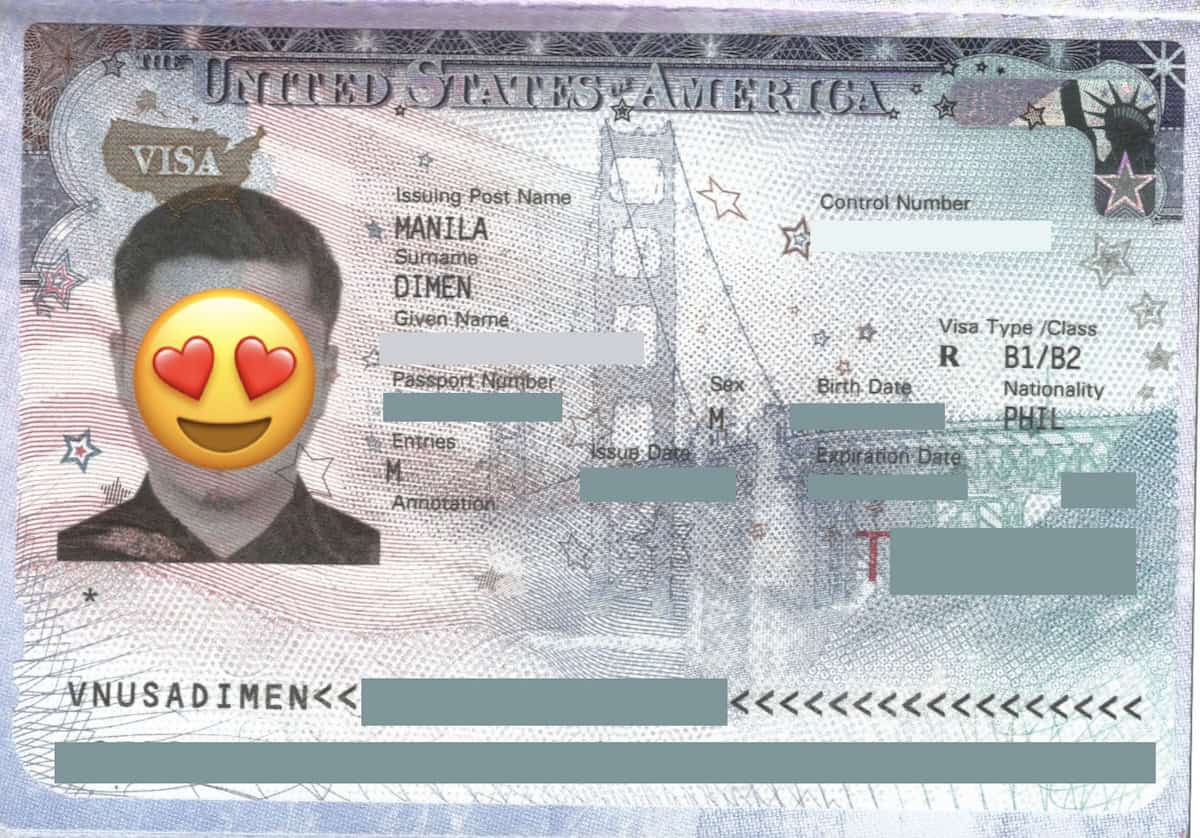
A B1/B2 visa is a non-immigrant short-term visa that will enable you to enter the United States for business (B1), for tourism (B2) or BOTH.
You can use it to do any of the following:
BUSINESS (B1) Meeting with business associates Attending a conference, seminar or convention Negotiating a contract or agreement Settling an estate
TOURISM (B2) Vacation (leisure/holiday) Visiting relatives or friends Attending social events (concerts, festivals, shows) Medical treatment
You cannot use a B1/B2 visa to study, work, or stay for good in the United States.
A B1/B2 visa is usually:
multiple-entry
valid for 10 years
Yes, the 10-year validity is the best part. Once you’re granted a visa, you won’t need to renew or apply again for a long time.
I applied for a B1/B2 visa, so every thing you’ll read in this article is about that specific type of visa. If you’re applying for a work visa, student visa or green card, we won’t be of any help because they’re outside our personal experiences.
HOW TO APPLY FOR A U.S. VISA?
Here’s the full application process when applying for a US B1/B2 visa.
Note that Steps 1 to 3 are actually interchangeable. But I believe that how I arranged it below is the order that makes the most sense.
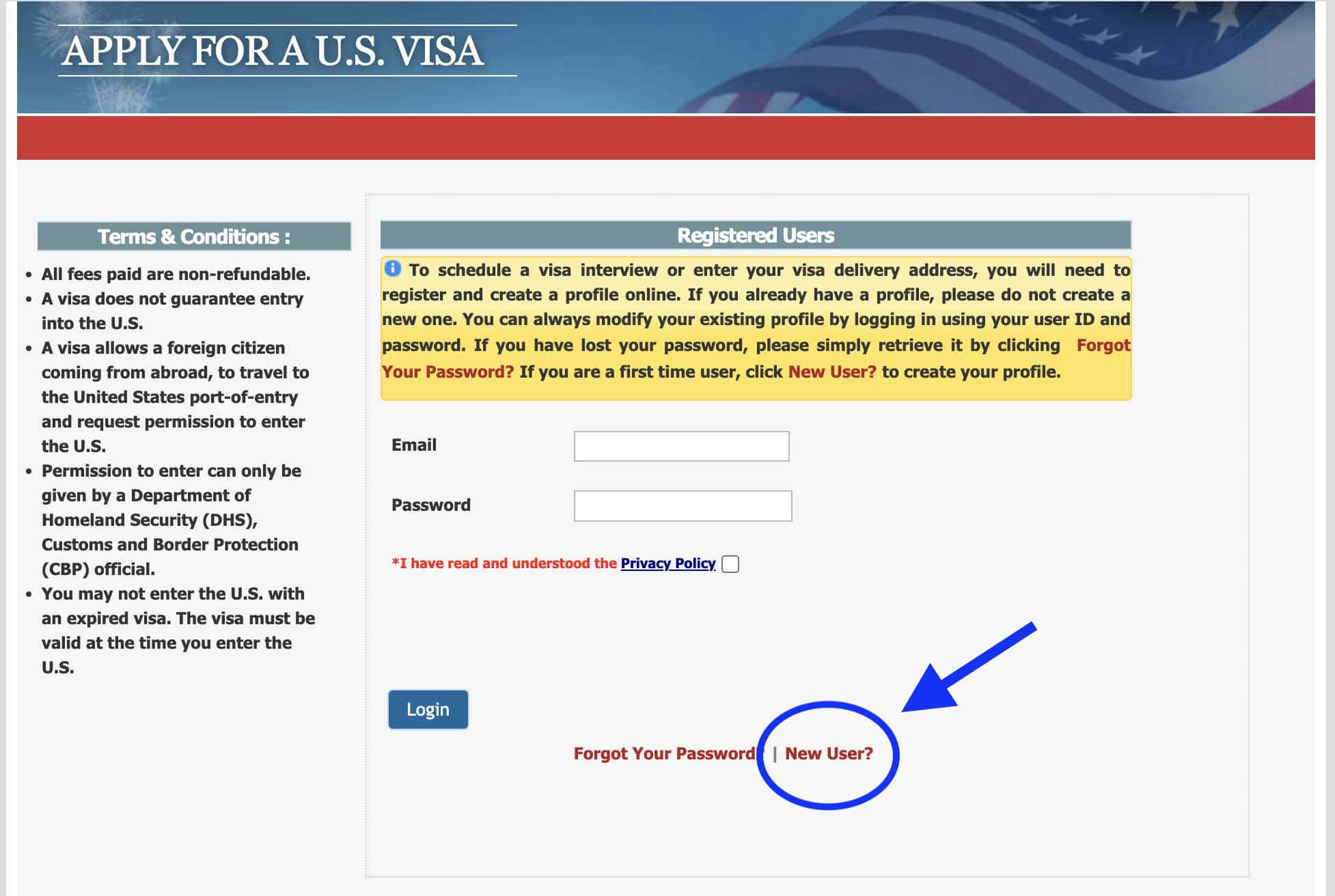
Enter your email address and full name on the next page.
Set a password.
Click SUBMIT.
USTravelDocs.com is the official visa appointment service portal of the U.S. State Department. This is the website where you’ll book an appointment, but you don’t need to do that this early. You won’t be able to secure a slot until you’ve paid the visa fee. For now, all you need to do is create an account.
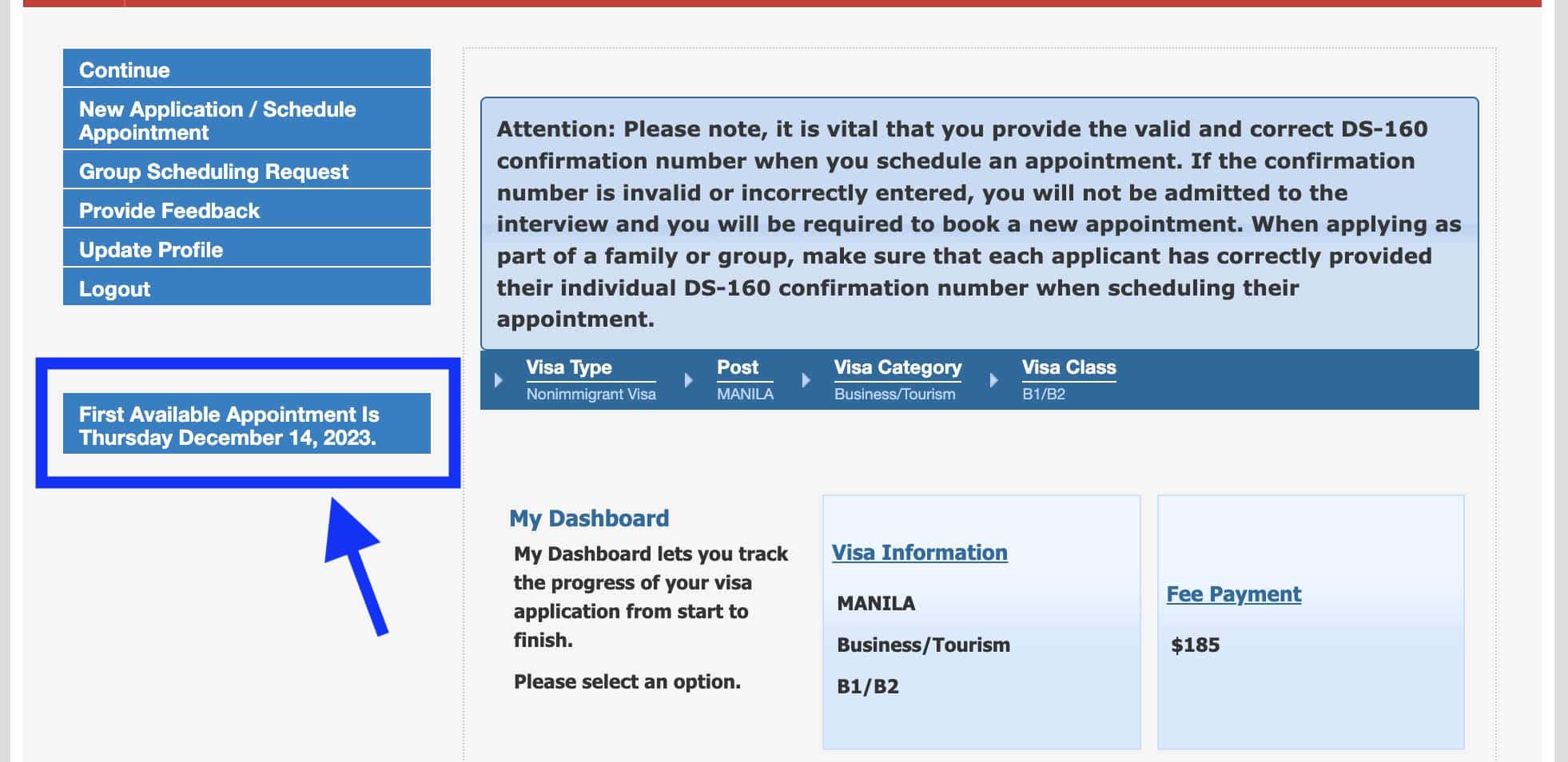
Why? Because as soon as you have an account, you’ll be able to see the EARLIEST AVAILABLE APPOINTMENT DATE.
This is especially important if your travel dates are not flexible: say, you’re attending a wedding, a concert, or a conference. Having visibility on the earliest available date will allow you to gauge if you’ll be able to get a visa in time for your trip and decide appropriately.
The last thing you want is to pay the hefty visa fee only to find that there are no more appointment slots before your intended travel date.
Note: The earliest appointment date changes from time to time, when applicants book, move or cancel their reserved slots. So just because there are no slots in your target month doesn’t mean there won’t be in the future.
If everything looks good, then proceed to Step 2.
Step 2: Accomplish the DS-160 Form.
The DS-160 form serves as your application form. To fill it out, visit to this page.
Every visa applicant must complete a DS-160 form. If you’re traveling as a group, each one of you must fill it out individually.
Follow these steps:
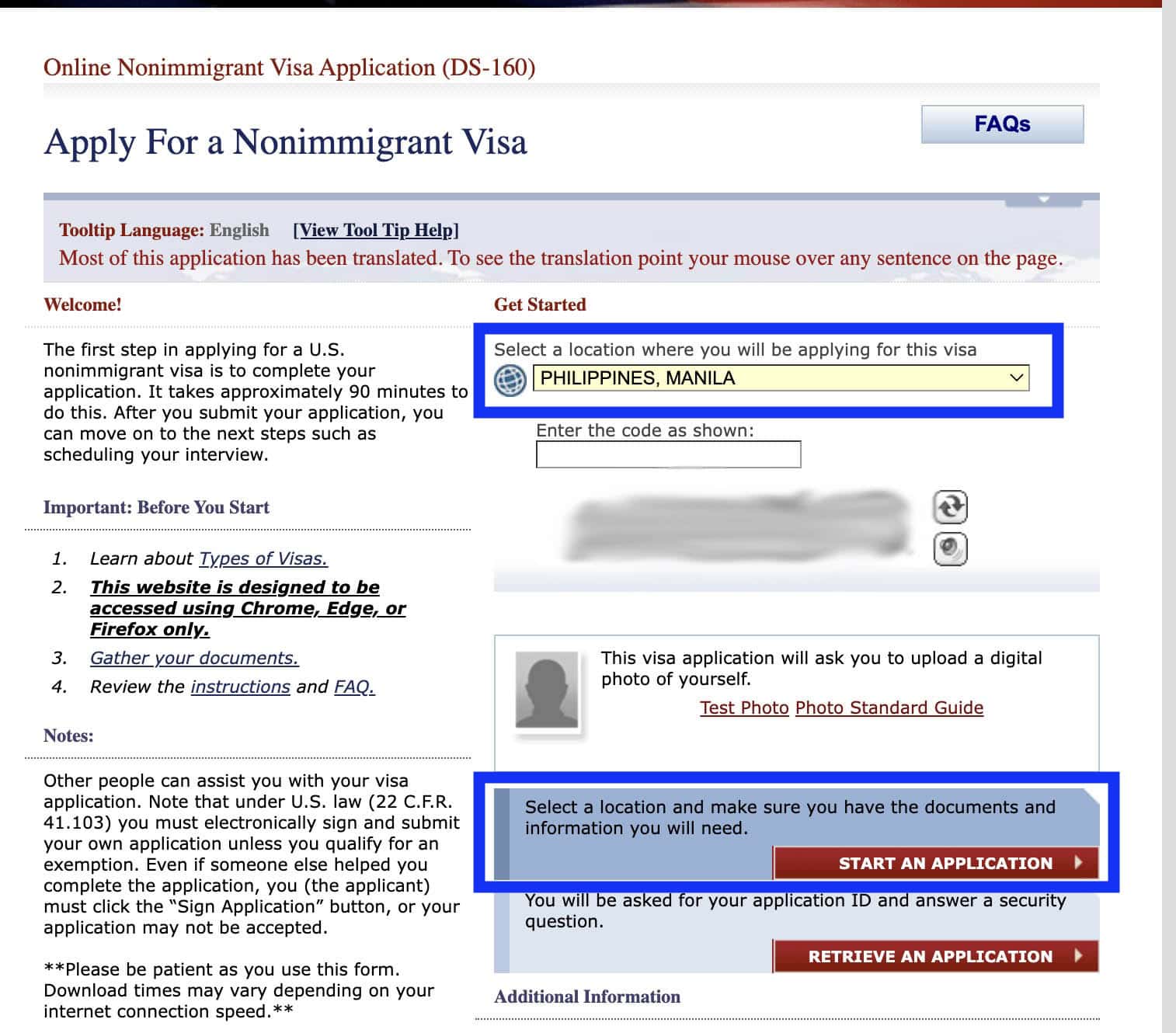
Under LOCATION WHERE YOU’LL BE APPLYING, choose PHILIPPINES, MANILA. Enter the CAPTCHA code below it. Then click on the red START AN APPLICATION button.
On the next page, you’ll be assigned an APPLICATION ID.
Select a security question and enter an answer. DO NOT forget your answer to this to avoid getting locked out of your account.
Then it’s time to finally fill out the DS-160 form. It’s a very lengthy form — with 10 pages — so allot plenty of time. If you feel like you won’t be able to finish, just save your progress. Don’t rush it. And make sure every answer is accurate. These are the details you need to prepare:
PERSONAL DETAILS. Name, birth date, birth place, etc.
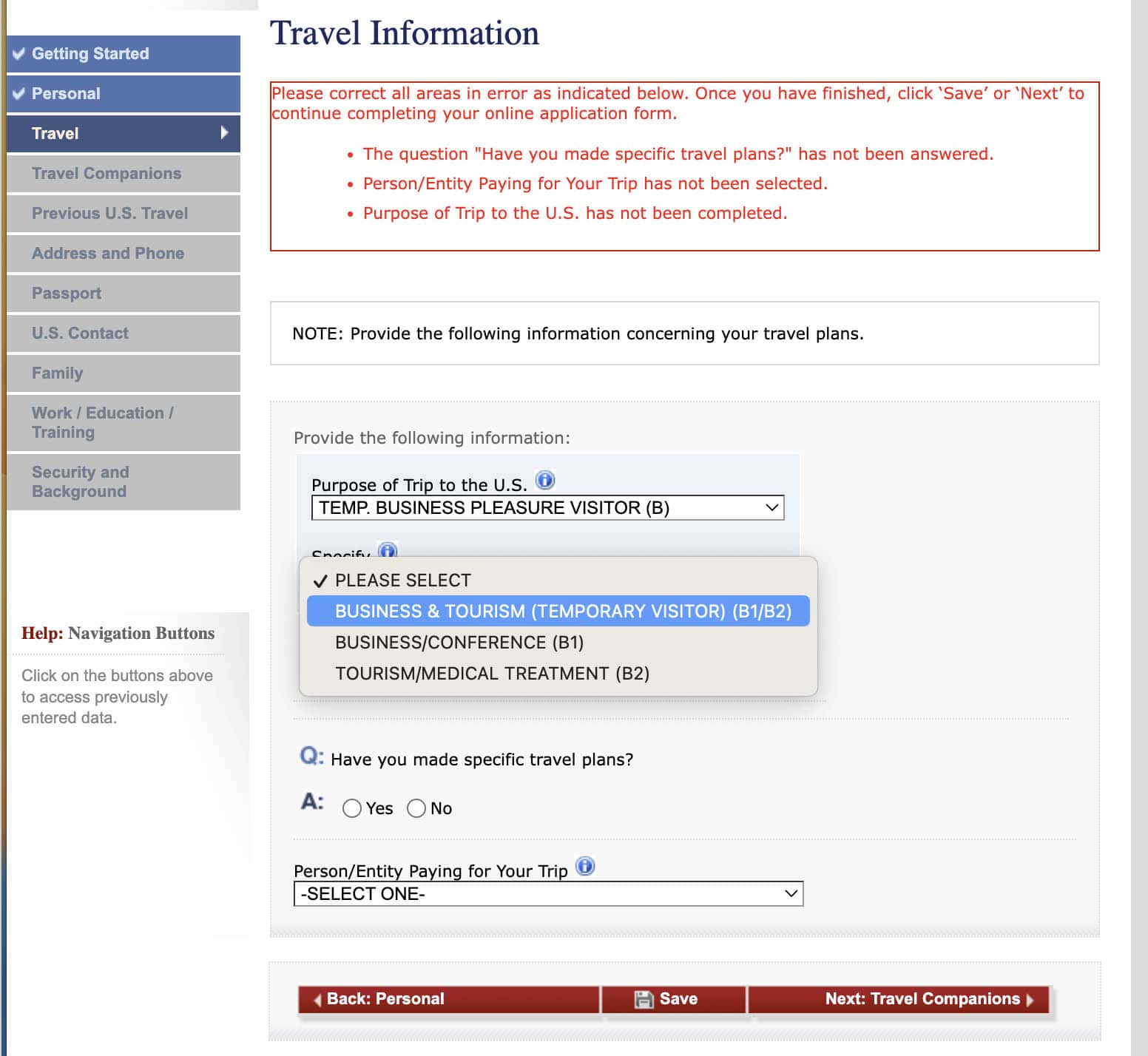
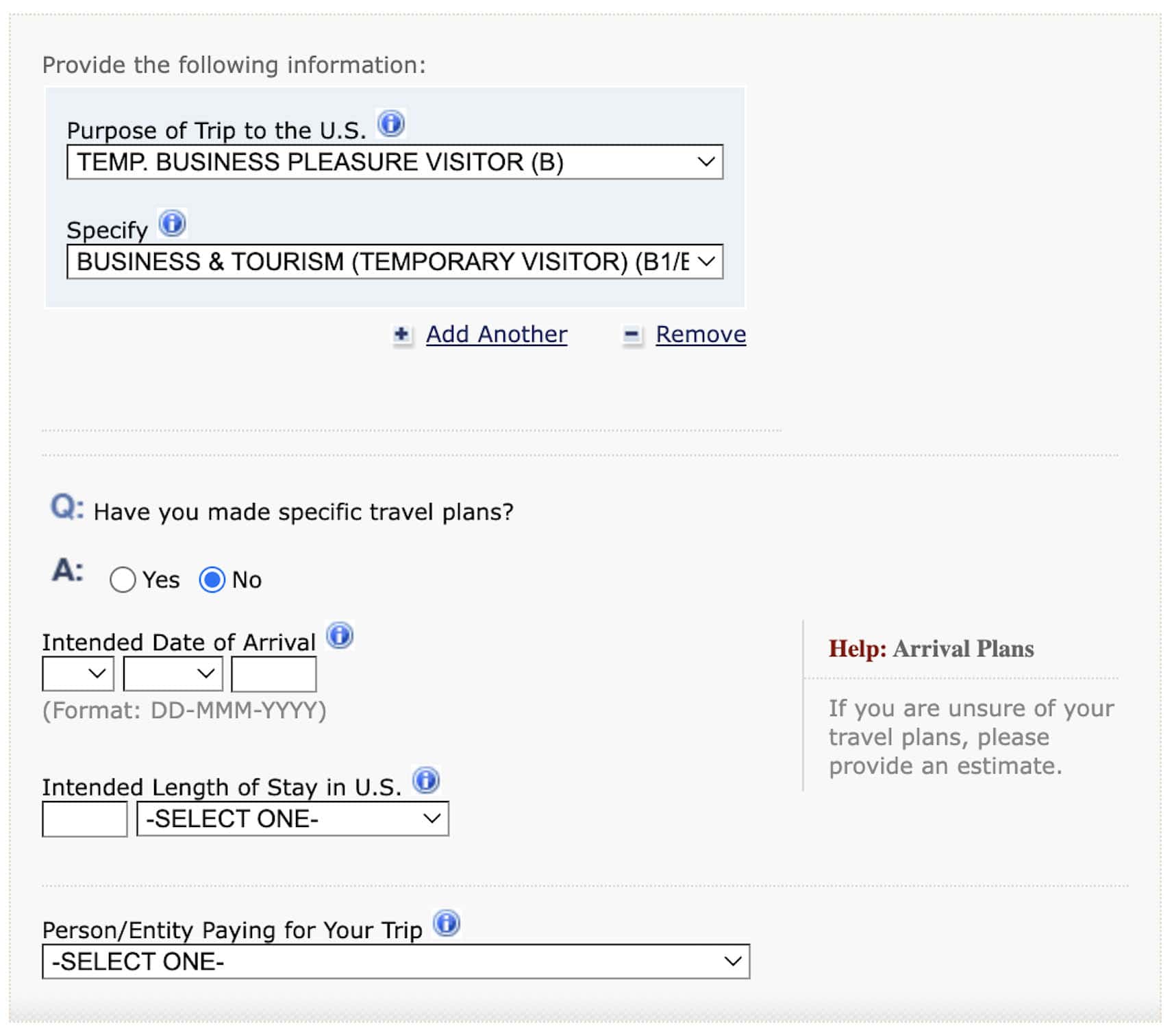
TRAVEL DETAILS. You’ll be asked to select the purpose of your trip. Since you’re applying for a B1/B2 visa, choose Temporary Business Pleasure Visitor. Under SPECIFY, select Business & Tourism (Temperoary Visitor).
Under it, supply the details of your trip. If you have a concrete travel plan, enter your travel dates. If you haven’t finalized those yet, just pick an intended date of arrival in the US and intended duration of your stay.
Please take a screenshot of this part so you won’t forget the details you entered. The consul/visa officer will be asking you about your travel details when it’s time for interview.
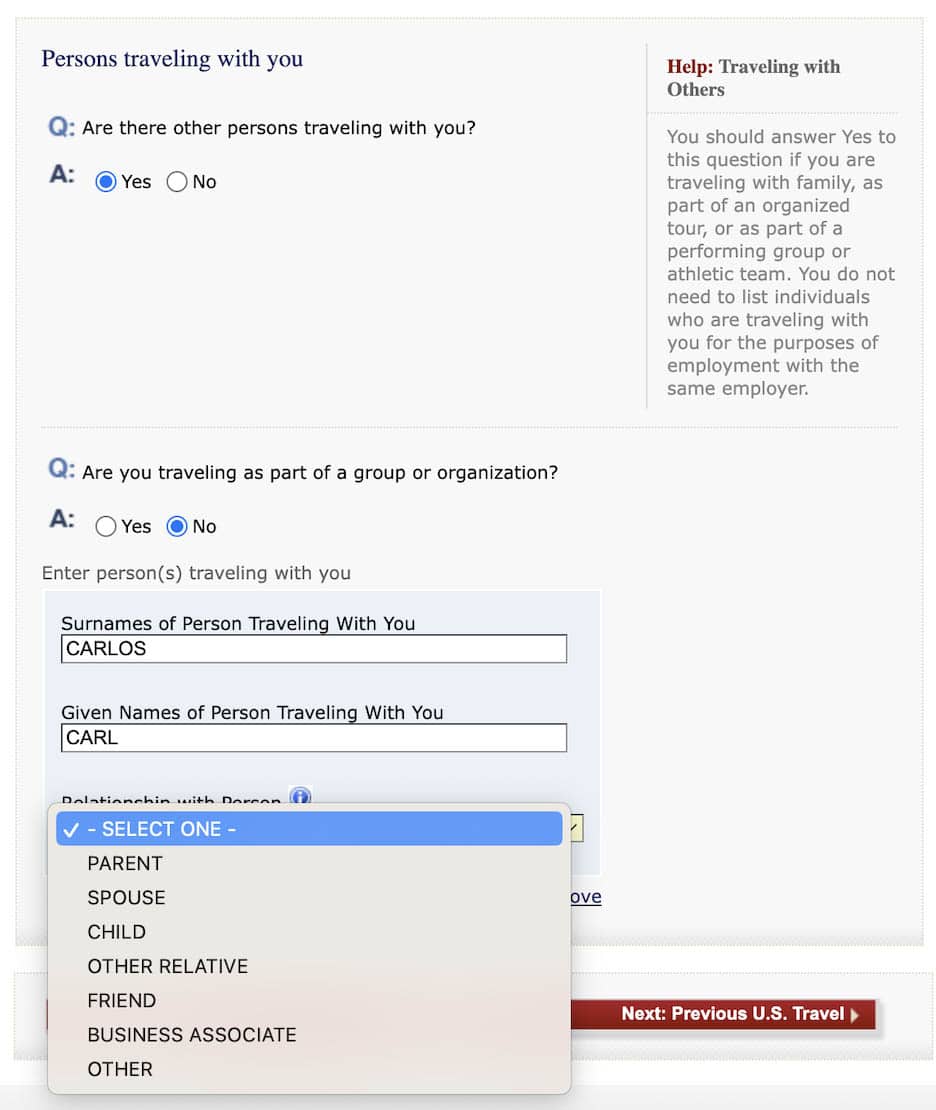
TRAVEL COMPANIONS. Declare the persons with whom you will be traveling to the United States.
PREVIOUS US TRAVELS. If it’s your first time traveling to the US, just answer NO. You’ll also be asked if you’ve been denied a US visa before or denied entry into the country. Answer truthfully because they have a record of it anyway.
ADDRESS. Enter your current address.
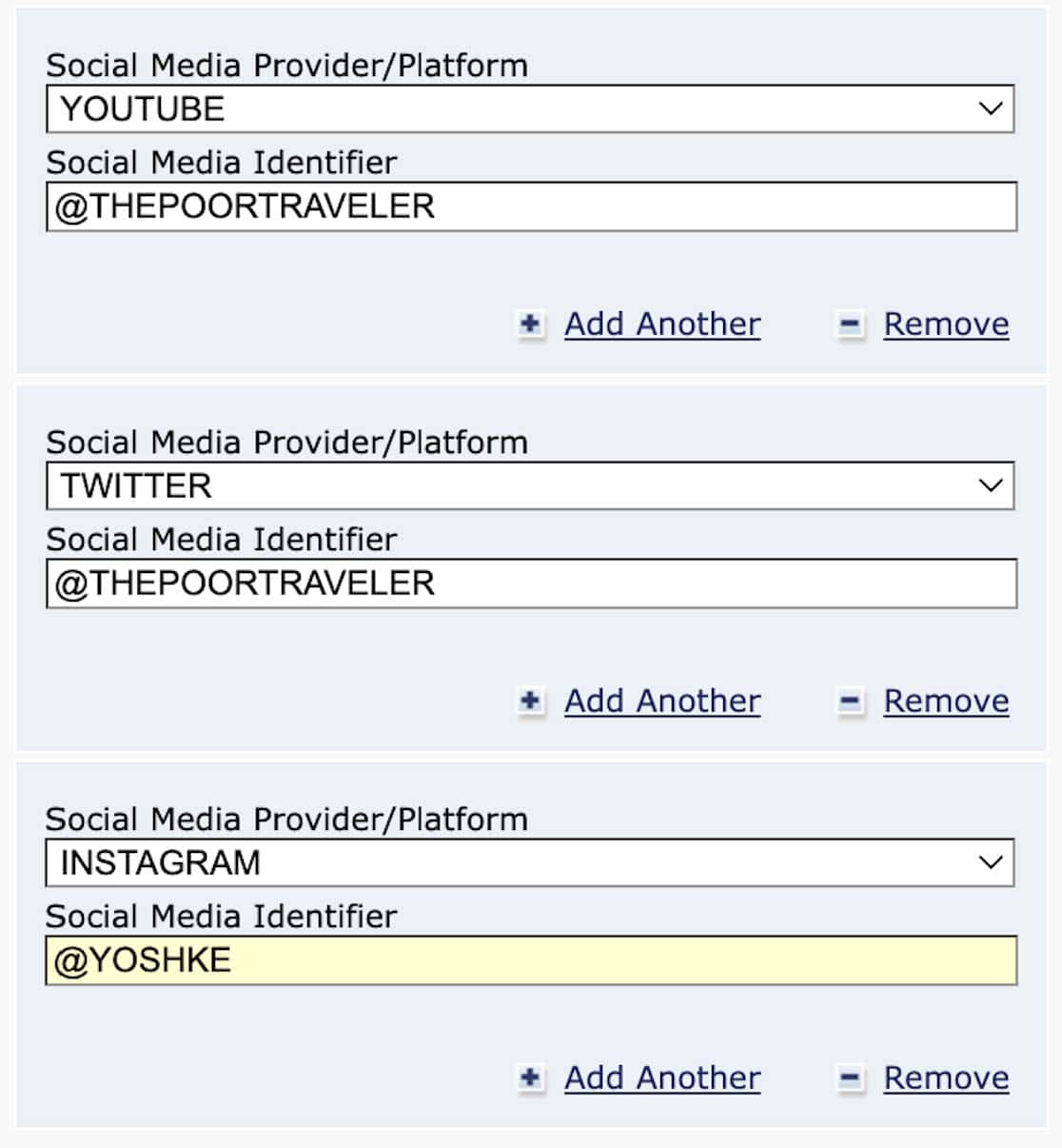
CONTACT INFORMATION. Aside from your contact numbers, you’ll also need to provide your social media account handles/usernames including Facebook, X (Twitter), YouTube, and Instagram. You’ll also enter your passport details here.
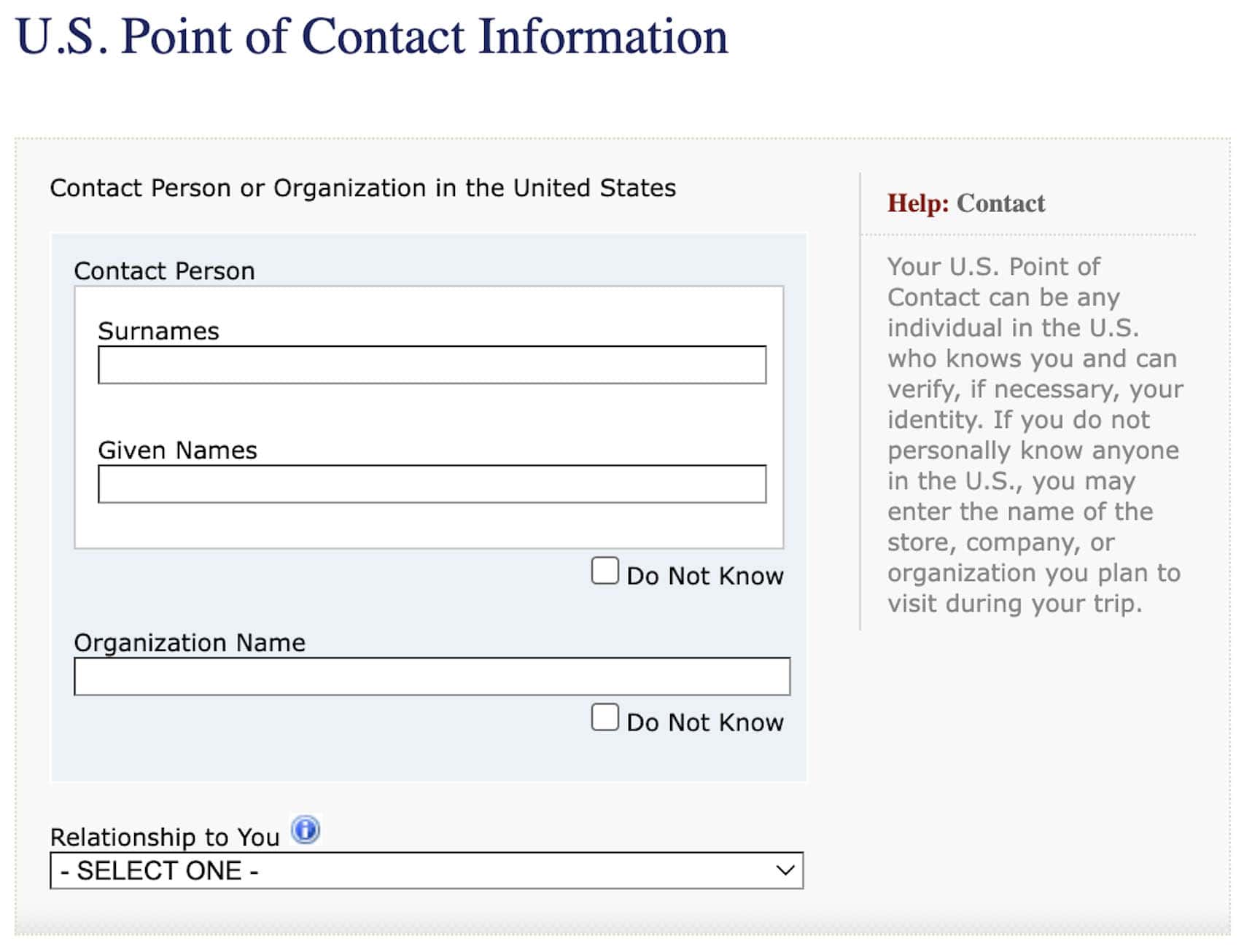
U.S. CONTACT. If you know someone in the US, provide their name and your relationship with them. Ideally, this person should be able to verify your identity if deemed necessary.
FAMILY. Enter the names and birth dates if your parents. If you have relatives in the United States, you should also provide their details here.
If you don’t know anyone in the US, just enter the name and address of an establishment that you plan to visit as part of your trip. It can be a museum, a theater, or a theme park, as long as it’s part of your itinerary.
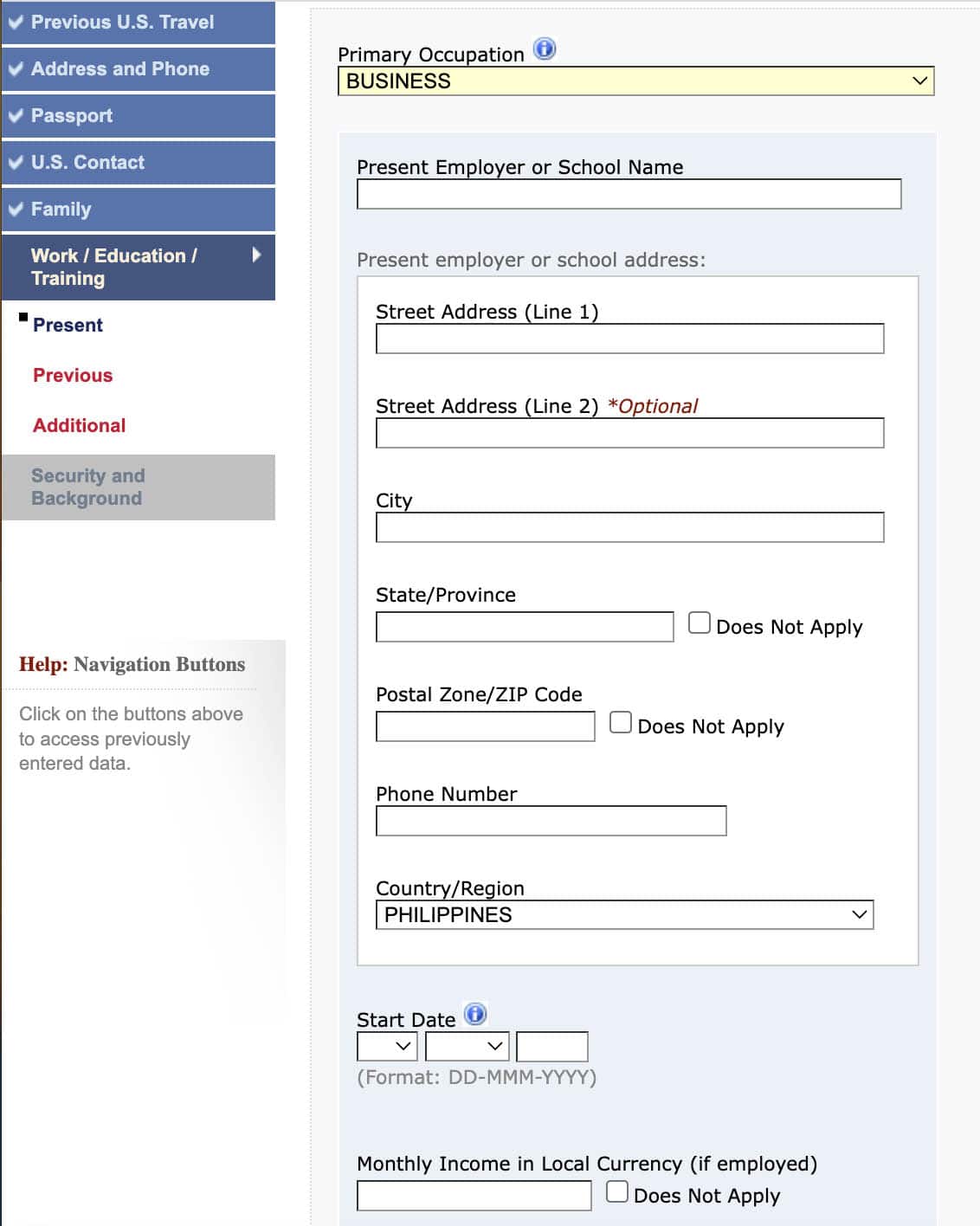
WORK AND EDUCATION BACKGROUND. List down your current and previous employers and work experiences (including job descriptions) and universities/schools you attended. Yes, this part feel like you’re building a CV.
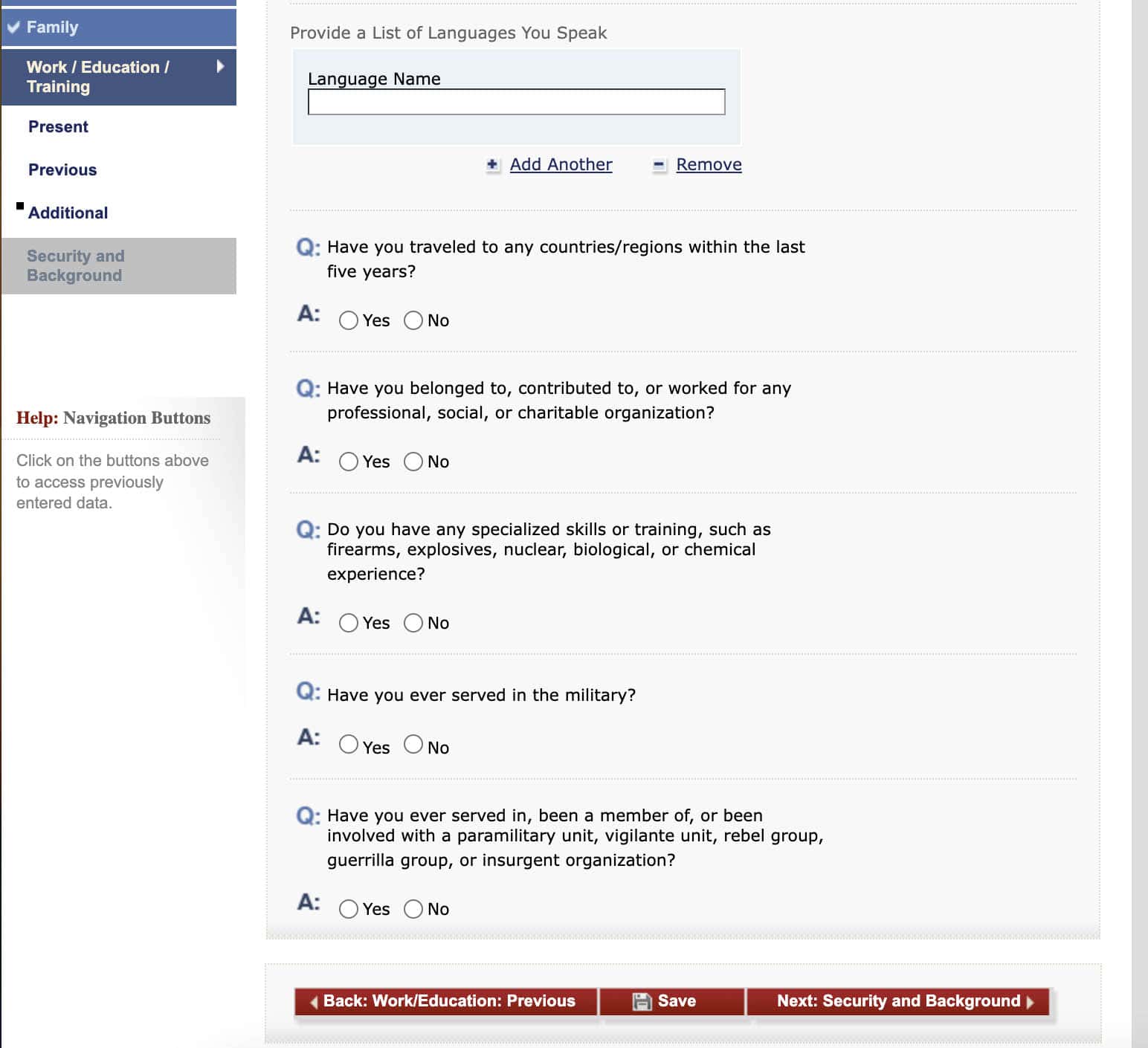
SECURITY AND BACKGROUND. Last page! Answer a series of questions about the countries you visited, organizations you are affiliated with, and military connections, if any. You’ll also answer health-related questions.
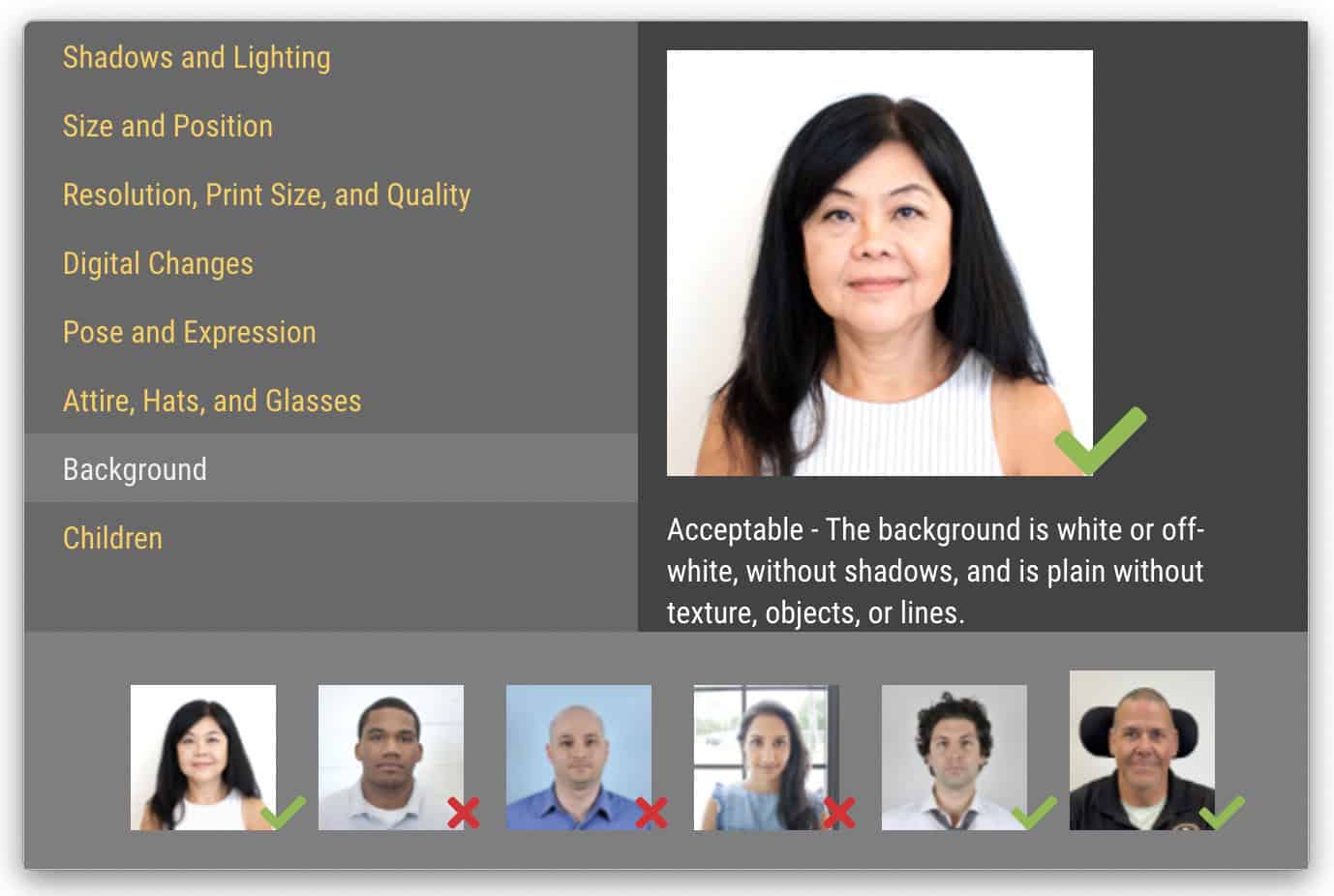
After this, you’ll be prompted to UPLOAD A PHOTO. It has to be in color and taken within the past six (6) months. No eyeglasses, hats, or head cover (except for religion or medical reasons). The links below can guide you:
After uploading a photo, review all the information you supplied. Make sure every single thing is correct. If so, submit your application.
⚠️ IMPORTANT! The moment you hit SUBMIT, you won’t be able to make any changes to the form, so ensure every bit of information is correct. If there are still details that you need to double-check or confirm, you can just save your application in the meantime and just return to it when you already have the correct data.
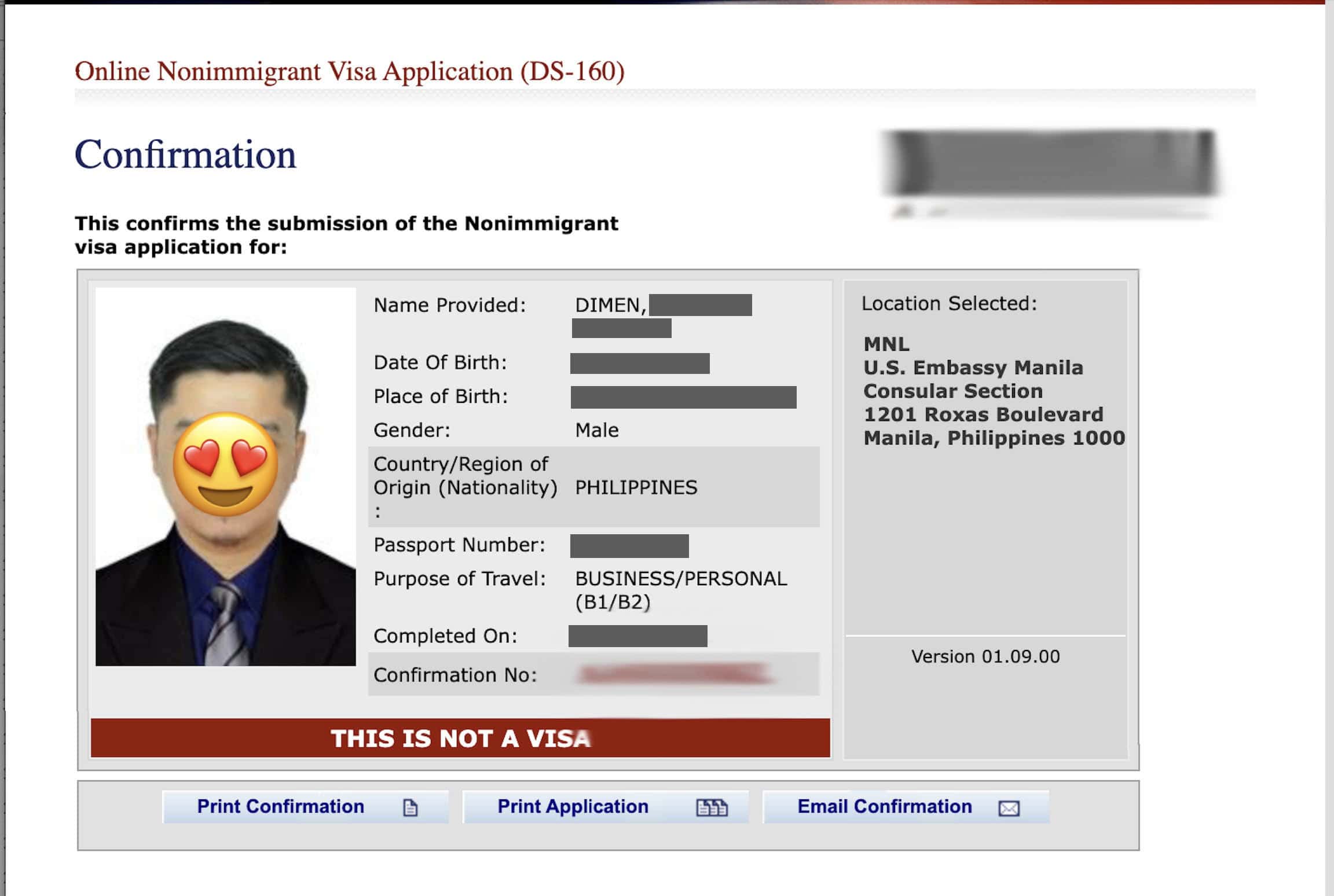
After submitting the form, the next page will display your DS-160 CONFIRMATION PAGE, which contains your confirmation number and barcode. You have the option to print it out or email to yourself. (I chose to email it to myself so I could get back to it anytime in the future.)
You’ll need to present this DS-160 Confirmation Page at the U.S. Embassy when it is time for your interview.
Step 3: PAY THE VISA FEE.
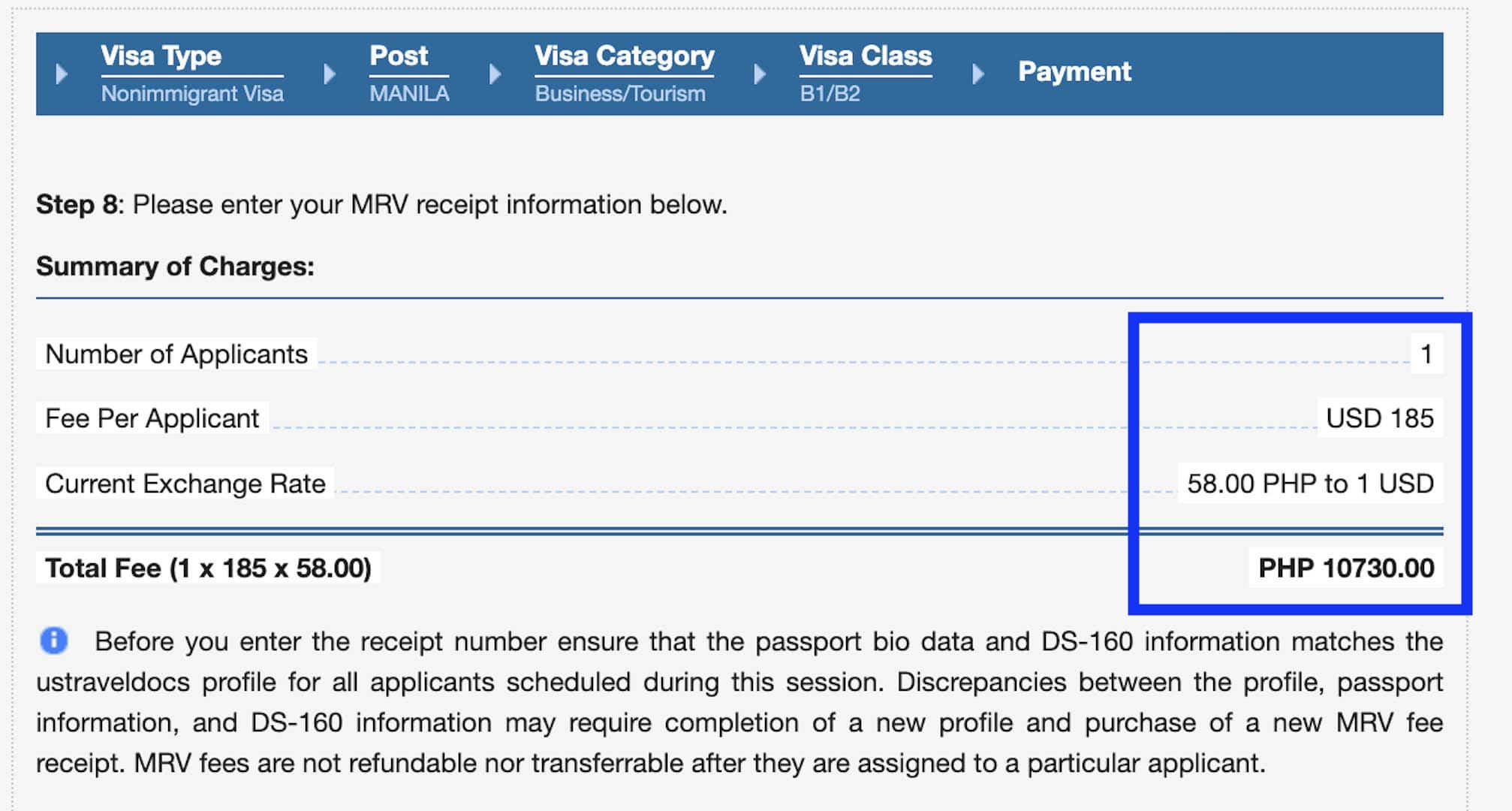
The U.S. Visa fee costs USD 185 (roughly PHP 10,800 at the time of this writing).
There a few ways to settle this fee but I chose to pay via PesoNet.
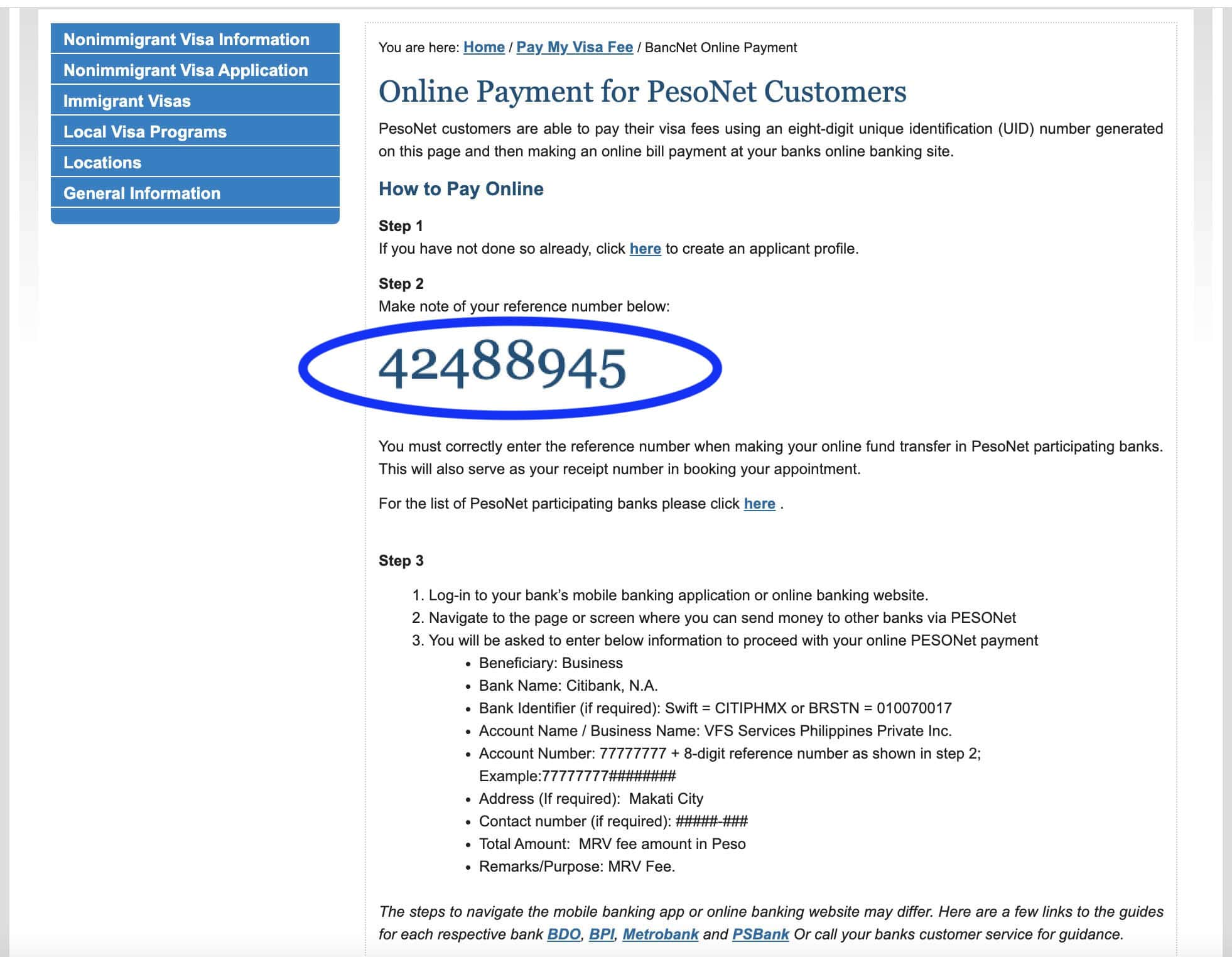
Log on to this USTravelDocs page. As soon as the page loads, it will generate a reference number.
Save the reference number. You can take a screenshot of it or copy-paste it somewhere. You’ll need this number when it’s time to send the payment.
Follow the step-by-step payment instructions at the bottom of the page. Because we’re talking about paying a big amount here, no need for me to repost the steps here as some details might change in the future. Just follow the steps on the page to a tee, making sure that you’re entering the correct reference number.
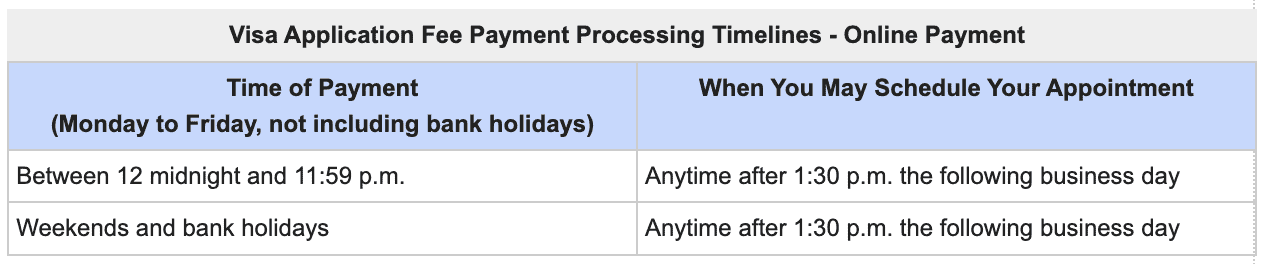
That’s it! It might take a while for the payment to reflect in the system. According to the website, it should register on the next business day, after 1:30 PM.
But in my case, I had to wait a couple more days before I could move on to the next step.
Step 4: BOOK AN APPOINTMENT.
Assuming your payment is already in the system, you may now book an interview appointment. Log into your USTravelDocs.com account on this page. This is the same portal on Step 1.
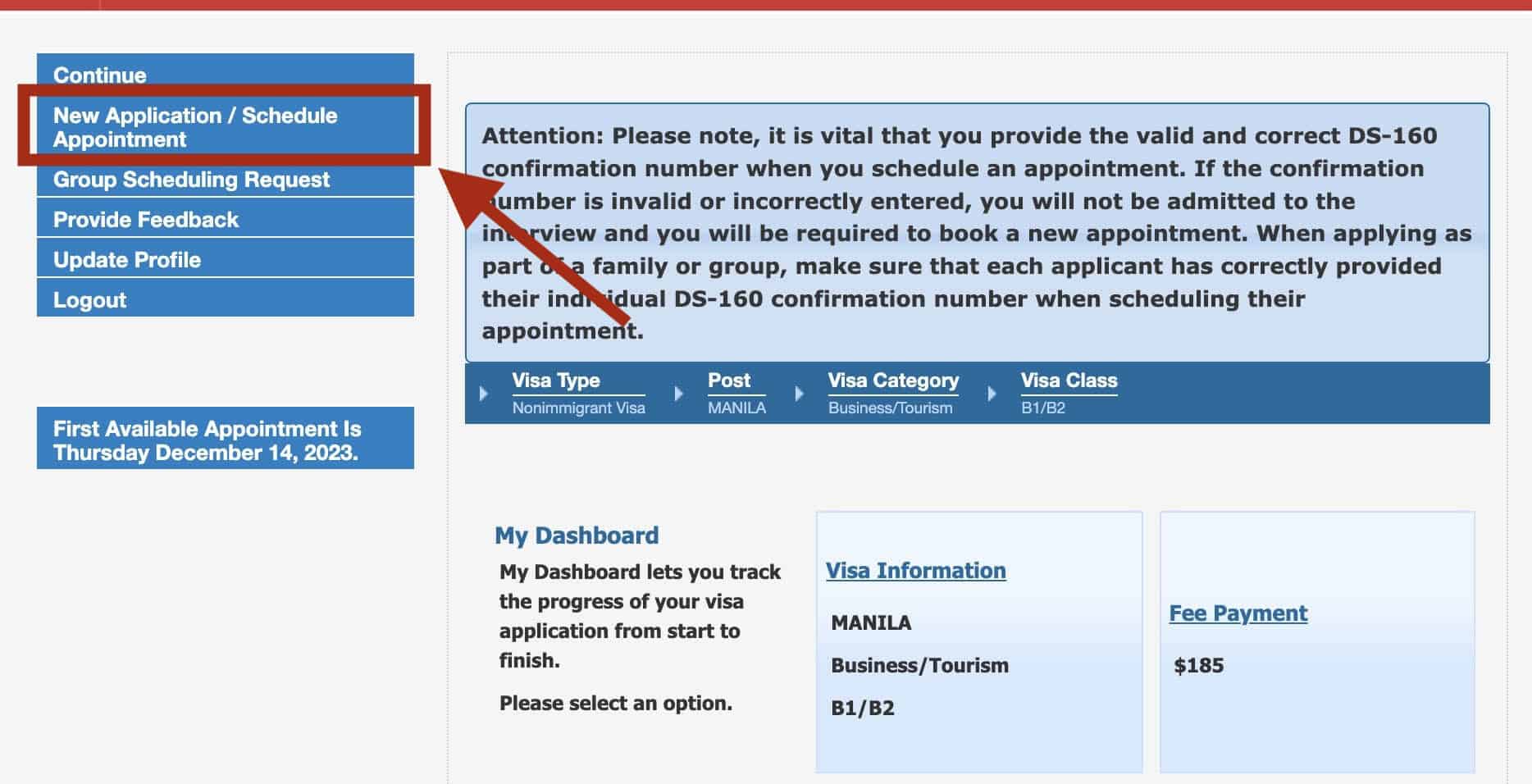
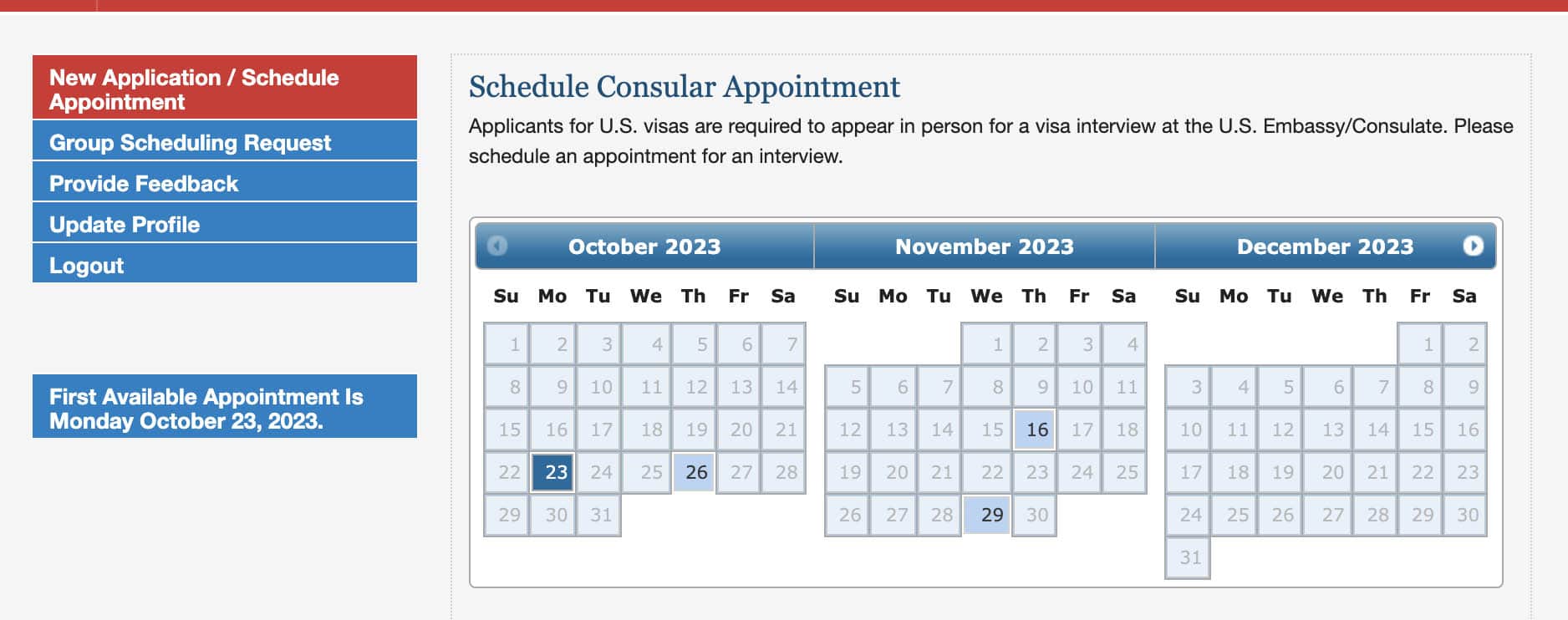
On the left sidebar, it will display the earliest available appointment date. This can be months from now. In my case, I applied in September but the earliest available schedule was in January of the next year. But don’t lose hope. Every now and then, some applicants cancel their appointments and new slots open up. We found that this usually happens in the wee hours of the night. True enough, after staying up at night, we were able to snag an appointment in October, which was just a month away.
Anyway, if you’re finally ready to book an appointment, just follow these steps:
Click on NEW APPLICATION/SCHEDULE APPOINTMENT on the left sidebar. On the next page, select NONIMMIGRANT VISA and then select BUSINESS/TOURISM.
Fill out the next form with your personal details and your DS-160 Confirmation Number. Make sure you’re entering the correct number because the system will use it to link your appointment to the right DS-160 form. If you have dependents who will be with you at the interview, enter their details and their own DS-160 confirmation numbers.
Choose how you want to receive your passport back: FREE PICK UP or DELIVERY. The latter entails a separate fee, to be paid cash upon delivery.
On the PAYMENT page, enter your RECEIPT NUMBER. If your visa fee payment is already in the system, you should be able to book an appointment. Otherwise, just come back to this page another time. Don’t worry, you can save all the info you entered so you won’t need to fill out the form again when you log in again.
Select the date lang that best works for you. You can change or reschedule it later if you find a better date.
That’s it! You already have an appointment.
USEFUL TIPS:
You can reschedule your appointment. Just click on the RESCHEDULE APPOINTMENT button on the left sidebar and select an earlier or later date. Yes, it is possible to chance upon an earlier schedule. That’s what happened to me.
GROUP APPOINTMENT option is available, but I haven’t tried it yet, so I have no idea how it works. But if you’re applying with a group, try clicking the GROUP SCHEDULING REQUEST button on the left sidebar.
Step 5: GATHER THE U.S. VISA REQUIREMENTS.
While waiting for your interview appointment date, gather all the required documents.
Valid passport
Appointment confirmation page
DS-160 confirmation number
your MRV fee payment receipt number
Recent ID photo (2×2)
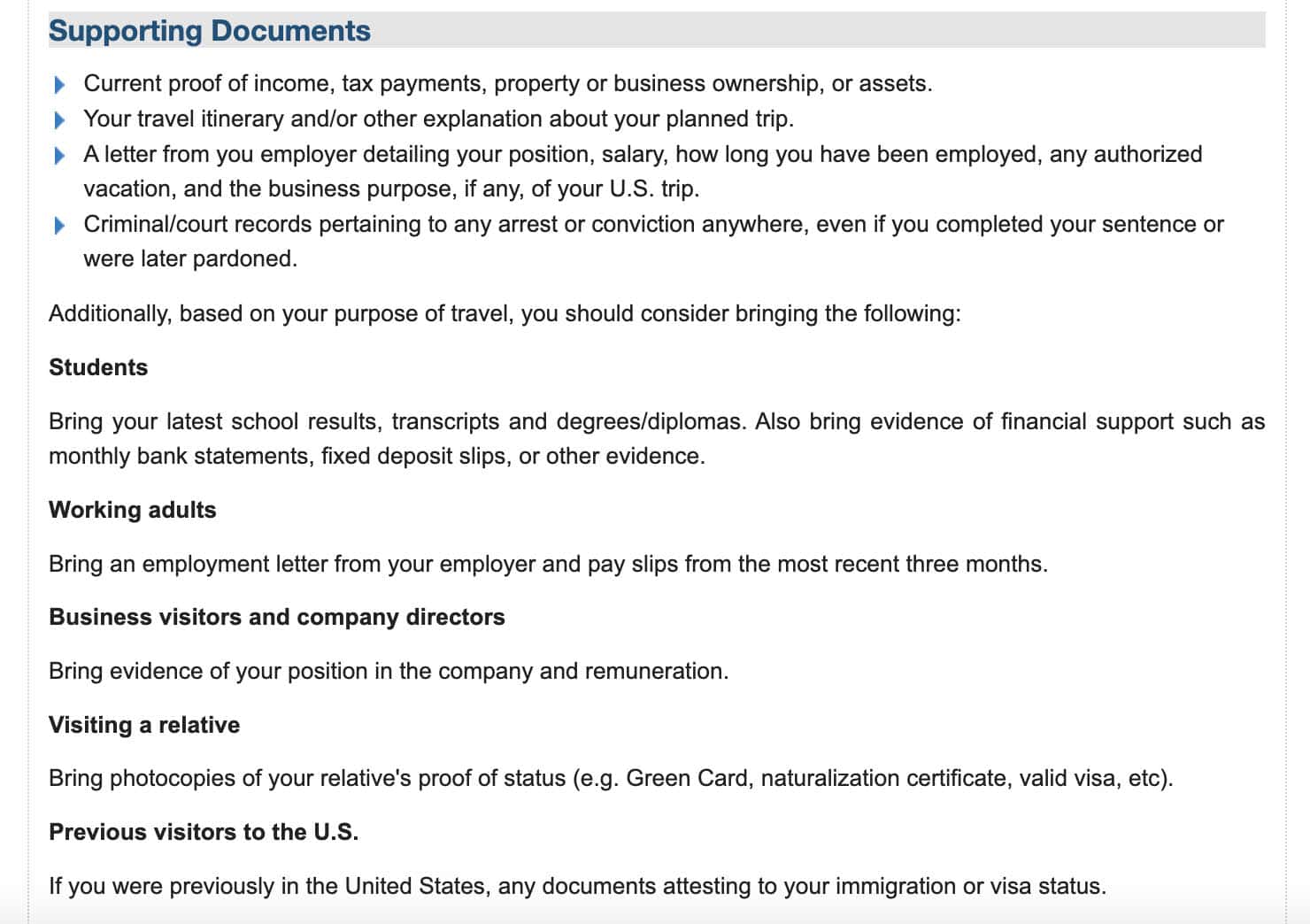
Those are the basic requirements. In many cases, those three are all you need. BUT — and it’s a big but — it’s best to have all the other possible supporting documents listed on the embassy’s website:
All your old passports
Proof of income, property ownership, ITR
Letter from your employer detailing your position, salary, etc.
Travel itinerary
And others, depending on your purpose of travel. See screenshot of the official website below:
I indicated “possible” supporting documents because in some instances, they don’t ask to see these docs. In fact, I completed and brought all of these but they didn’t check any of these, other than my passport and appointment confirmation. In Vins’s case, the only other thing they checked was his 2×2 photo.
But it doesn’t mean that you’ll experience the same. Some of the applicants next to me on the line were asked to present some of these supporting documents. It’s really best to be prepared.
By the way, if you notice: the US Embassy does not require bank certificates, bank statements, or any proof of funds. They’re not on the list, so don’t bother. It’s not needed at all.
Step 6: INTERVIEW
On the day of your appointment, show up at the U.S. Embassy for the interview. Here’s the address:
Embassy of the United States of America 1201 Roxas Blvd, Ermita, Manila, 1000 Metro Manila
Arrive at least 15 minutes before your schedule. Actually, they start letting applicants in an hour before the indicated schedule.
Traffic is horrible in Manila, so allot plenty of lead time. If you’re coming from far away — especially if you’re flying in from the province — and you’re looking for a place to stay, consider a hotel that is close to the U.S. Embassy. There are a lot of good choices in the surrounding area. SEARCH FOR MANILA HOTELS HERE! ✅
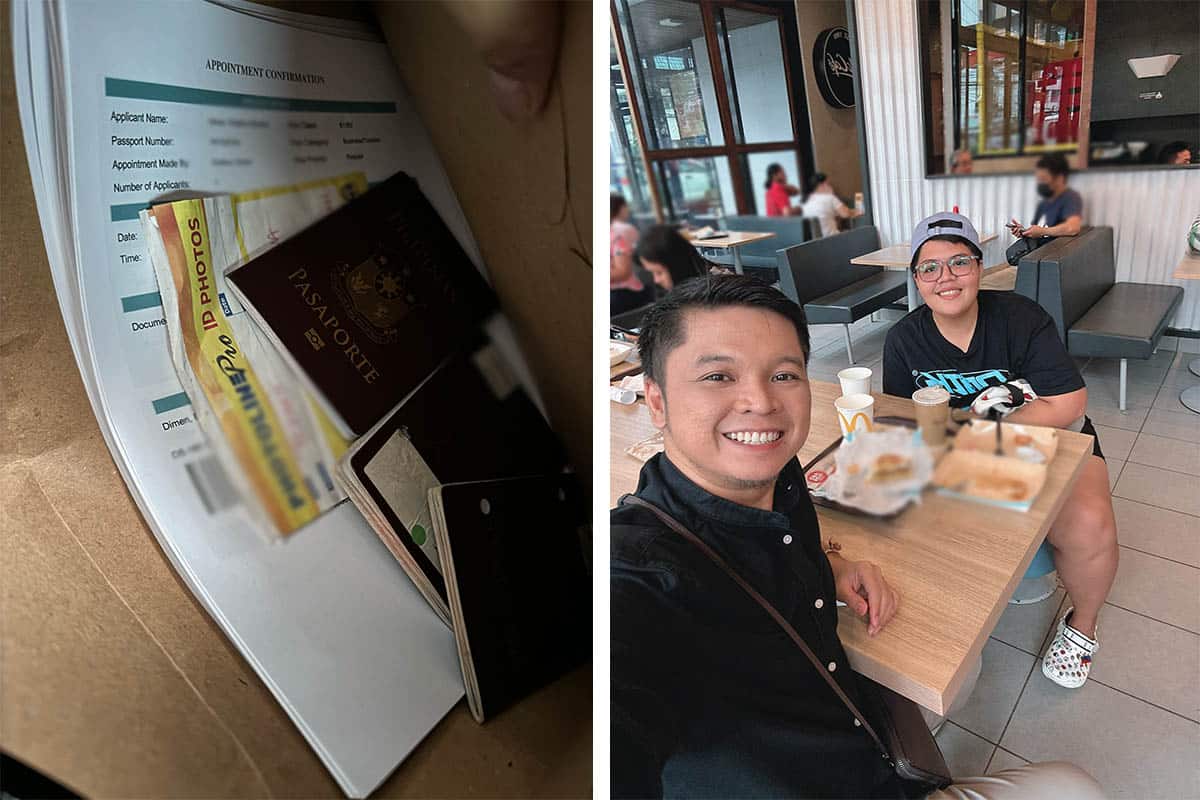
Left: All the requirements that I brought with me to the interview; Right: Meeting my cousin Pycan who kept my gadgets and waited for me at a nearby McDonald’s while I was at the interview.
But remember these:
Gadgets or items with batteries and ON-OFF switch are NOT ALLOWED inside. Yes, that includes mobile phones, tablets, laptops, and even digital watches (Apple watch, etc.).
Food, sharp objects, crayons, and markers are also prohibited. You may be refused entry and your account may be locked for 30 days if you’re caught sneaking any of these in.
No lockers or baggage counters in the vicinity. The best thing to do is to go with a companion and ask them to wait for you somewhere close. There’s a Starbucks cafe and McDonald’s on the other side of the road. Just agree to meet at a certain time, old-school-style.
Once you’re gadget-free, you may now go inside. You’ll need to fall in line every step of the way. Here are the steps:
Present your printed appointment confirmation page at the staff outside. They will affix a sticker with a QR code on the back cover of your passport.
Enter the building for the security check. They are very thorough, so don’t attempt to sneak in anything prohibited.
Follow the signs and the staff to the next building. You may be asked here to present your passport and some of your requirements. In my case, they only checked my passport. In Vins’s case, passport and 2×2 ID photo.
Undergo biometrics scan. They will take your fingerprints at one of the counters. After that, you’ll be assigned another counter for the interview proper. Queue up at that counter and wait for your turn.
Interview proper. This usually just takes around 5 minutes. It’s very quick because most probably, applications have been evaluated even before the interview. It’s very likely that they already have a tentative decision prior to your appointment and the interview is just for validation or to settle any doubts, if any. It is also an opportunity to check supporting documents should they feel the need to. In my case, they didn’t check anything. But some of the other applicants in the area were asked to present supporting docs. I’ll share all the questions in the next section below. – If your application is approved, they will take your passport so they could affix the visa sticker. – If your application is rejected or denied, they will tell you right then and there. (Yes, within hearing range of other applicants on the queue.)
Step 7: WAIT FOR YOUR VISA!
You should receive your passport with a visa just a few days after your interview.
In my case, I got mine through LBC Padala just 2 days later. If I was interviewed on Monday, I got the visa on Wednesday morning. I paid PHP 440 upon delivery.
If you chose PICKUP when you booked an appointment, you may claim your passport/visa at LBC Mall of Asia.
U.S. VISA INTERVIEW QUESTIONS
Here’s a rundown of all the questions the consul/visa officer asked me during the interview.
Where in the US are you going?
What’s the purpose of the trip?
How long is the trip?
Are you married? Do you have kids?
With whom are you traveling?
What do you do for a living?
How long have I been doing this job?
What’s the name of your employer?
That was it. Eight questions. Or nine. Vins got even fewer questions: six.
The officer’s tone was very casual and friendly, so I responded in the same fashion.
After the last question, the officer typed something on the computer, faced me again, and said, “OK, your visa is approved. We’ll just mail the passport to you.”
But because the interview is conducted in an open area, while I was in line, I could actually hear the questions that the other applicants were getting. These include:
Will you be visiting someone in the US?
Have you visited other countries before?
Where in (state) are you going?
⚠️ IMPORTANT! These questions that the officers/consuls are asking are the same questions on the DS-160 form, so it is crucial that you know and remember the answers you entered when you were accomplishing it online. They’re not asking because they want to know — they already know — but they probably are just trying for confirm or test if your answers are consistent.
The problem is, when a lot of time has passed between the day you accomplished the DS-160 form and the day of your interview, it’s easy to forget the details. So keep a copy of your answers on the DS-160 form.
There you have it. That’s the entire U.S. visa application process as I experienced it.
Before I end this article, I just have to commend the people working at the U.S. Embassy for the smooth process and pleasant experience. From the Filipino staff and the American interviewers, every one was friendly, gentle, and respectful. Even when they were delivering rejections, they did it in a way that were not condescending or belittling. At other embassies, I have seen pretty high horses when applying for a visa, so this was really a breath of fresh air. Kudos to all the workers at the US Embassy!
Where to Stay Near the U.S. Embassy Manila
If you’re coming from the province and you want to spend the night at a hotel close to the U.S. Embassy, here are some properties around the area.
Matt Smith, star of House of the Dragon and The Crown, has doubled down on his criticism of trigger warnings.
In an interview with The Times of London, the actor, who shot to fame in Doctor Who, said that flagging potentially upsetting content was dumbing down storytelling for audiences.
“Too much policing of stories and being afraid to bring them out because a climate is a certain way is a shame. I’m not sure I’m on board with trigger warnings,” Smith said.
“It’s OK to feel uncomfortable or provoked while looking at a painting or watching a play, but I worry everything’s being dialed and dumbed down. We’re telling audiences they’re going to be scared before they’ve watched something.”
Smith, who is starring in British horror film Starve Acre, recalled renting Slither, Basic Instinct, Disclosure, and Friday the 13th when he was “too young.” He joked that the latter “absolutely ruined me.”
Smith previously commented on trigger warnings in the context of Doctor Who, the BBC and Disney+ sci-fi franchise in which he starred for four years.
“I always thought that was one of the great things of doing Doctor Who,” he told the BBC in February. “That you scared children, in a controlled way, but you did scare them. Imagine you go to kids watching Doctor Who, ‘By the way, this might scare you.’ No, I’m not into it.”
Several British actors have spoken out about trigger warnings this year. Judi Dench said she was surprised to learn that theater audiences were routinely being warned about potentially distressing content, including abuse, violence, and loud noises.
Ralph Fiennes said theatergoers had “gone soft” in an interview with the BBC. “The impact of theatre should be that you’re shocked, and should be that you’re disturbed, I don’t think you should be prepared for these things,” Fiennes said. “It’s the shock, it’s the unexpected, that’s what makes an act of theatre so exciting.”
Meghan Markle has become a minority stakeholder in Cesta Collective, a brand known for its handwoven bags.
What Happened: Markle, the Duchess of Sussex, discovered Cesta Collective while browsing online, “I spend a lot of time just Googling, looking for brands,” she said. She recently invested in the brand, which employs women in Rwanda to create its products. The bags are finished in Italy, Meghan said in an interview with The New York Times.
Markle’s investment follows a surge in interest in Cesta Collective after she was photographed with one of their bags during a dinner date in May 2023. The brand’s founders, Erin Ryder and Courtney Weinblatt Fasciano, noted a significant increase in sales following the event.
Markle’s involvement aims to support female-run companies and promote responsible production practices. The founders of Cesta Collective confirmed that Markle’s stake is a minority one, but did not disclose the financial details.
Markle’s investment portfolio includes several female-run companies, aligning with her mission to support emerging designers and ethical brands. Her approach to investing is described as a “dolphin tank” as opposed to “Shark Tank,” emphasizing friendly and supportive business practices.
See Also: Trump’s Cannabis Endorsement – Marijuana Industry Responds: ‘We Have Two Candidates’ Who Are Pro-Marijuana
Why It Matters: Markle’s latest investment in Cesta Collective is part of a broader strategy to support her ongoing efforts to champion social causes and responsible business practices.
In April, Markle and Prince Harry announced new projects with Netflix, continuing their partnership with the streaming giant. These projects are expected to further their influence and provide a platform for their advocacy work.
Earlier in March, former U.S. President Donald Trump hinted that a re-election could lead to “appropriate action” against Prince Harry due to his drug use admission. This potential political tension adds another layer to the couple’s public and private endeavors.
In September 2023, Trump expressed his willingness to debate Markle, criticizing her treatment of the Queen. This public scrutiny has been a recurring theme in Meghan’s life, influencing her public image and business decisions.
Additionally, in June 2023, pop star Taylor Swift declined an invitation to appear on Markle’s now-canceled podcast, even after receiving a letter from the Duchess of Sussex herself.
Read Next:
Photo courtesy: Northern Ireland Office on Flickr
This story was generated using Benzinga Neuro and edited by Kaustubh Bagalkote
This section was produced by the editorial department. The client was not given the opportunity to put restrictions on the content or review it prior to publication.
It’s smart to ask the question, but be careful whatever you do doesn’t wind up costing more money in the long run
Published Aug 30, 2024 • Last updated 3 days ago • 5 minute read
You can save this article by registering for free here. Or sign-in if you have an account.
This reader is worried about losing some of his Old Age Security payment to clawbacks.Photo by Getty Images
Reviews and recommendations are unbiased and products are independently selected. Postmedia may earn an affiliate commission from purchases made through links on this page.
Article content
By Julie Cazzin with Allan Norman
Q: My wife and I are 83 and 80, respectively, and I am losing my Old Age Security (OAS) due to dividends and my registered retirement income fund (RRIF) withdrawals. I wish when I was younger that someone had told me dividends could be a problem as a retiree. I am thinking of cashing out my RRIF this year and cashing in my stocks for index funds so I can collect my OAS pension. Does this make sense? Our tax-free savings accounts (TFSAs) are maximized, I have $600,000 in RRIFs as well as a pension of $45,000 per year, and my wife has $490,000 in a RIFF. We have non-registered investments of about $3.5 million with a dividend yield of about 3.2 per cent, and a small rental in my wife’s name with an income of $9,000 per year. — Tim
Advertisement 2
This advertisement has not loaded yet, but your article continues below.
THIS CONTENT IS RESERVED FOR SUBSCRIBERS ONLY
Subscribe now to read the latest news in your city and across Canada.
Exclusive articles from Barbara Shecter, Joe O’Connor, Gabriel Friedman, and others.
Daily content from Financial Times, the world’s leading global business publication.
Unlimited online access to read articles from Financial Post, National Post and 15 news sites across Canada with one account.
National Post ePaper, an electronic replica of the print edition to view on any device, share and comment on.
Daily puzzles, including the New York Times Crossword.
SUBSCRIBE TO UNLOCK MORE ARTICLES
Subscribe now to read the latest news in your city and across Canada.
Exclusive articles from Barbara Shecter, Joe O’Connor, Gabriel Friedman and others.
Daily content from Financial Times, the world’s leading global business publication.
Unlimited online access to read articles from Financial Post, National Post and 15 news sites across Canada with one account.
National Post ePaper, an electronic replica of the print edition to view on any device, share and comment on.
Daily puzzles, including the New York Times Crossword.
REGISTER / SIGN IN TO UNLOCK MORE ARTICLES
Create an account or sign in to continue with your reading experience.
Access articles from across Canada with one account.
Share your thoughts and join the conversation in the comments.
Enjoy additional articles per month.
Get email updates from your favourite authors.
Sign In or Create an Account
or
Article content
FP Answers: You are in a good spot, Tim, and it is smart to think about how to minimize your taxable income to reduce OAS clawbacks, which apply if your net income exceeds $90,997 in 2024. And you will have to repay 15 per cent of the excess over this amount to a maximum of the total amount of OAS received. Just be careful that you don’t do something that will cost you more money in the long run.
Article content
Don’t beat yourself up about dividend investing. If, when you were young, you were advised that future dividends may result in OAS clawbacks, you may not have the money you have today. Dividend investing is a comparatively easy stock selection strategy, making it popular with DIY investors. That, plus the fact that value stocks — often dividend payers — have historically outperformed growth stocks.
Today, your stocks are producing a steady flow of taxable dividends that you are reporting on your tax return. However, you must report the grossed-up (38 per cent) dividends, not the actual amount of dividends received. For example, if you receive $100,000 in dividends, you report $138,000, which is the number used to assess OAS clawbacks. After the clawback assessment, the dividend tax credit is applied, bringing down your taxable income.
Top Stories
Get the latest headlines, breaking news and columns.
By signing up you consent to receive the above newsletter from Postmedia Network Inc.
Thanks for signing up!
A welcome email is on its way. If you don’t see it, please check your junk folder.
The next issue of Top Stories will soon be in your inbox.
We encountered an issue signing you up. Please try again
Article content
Advertisement 3
This advertisement has not loaded yet, but your article continues below.
Article content
Dividends are one tax issue in a non-registered account. Capital gains, which are the difference between the book and market value of an asset such as stocks or investment real estate, are the other tax issue, and they will also impact your OAS eligibility.
The challenge with holding individual stocks in a non-registered account is the tax drag (the reduction in potential income or growth due to taxes on investment gains) created by dividends and capital gains when trading stocks.
My guess is you are thinking of switching to index funds because they tend to be more tax efficient, are longer-term holds and, according to the SPIVA reports — which compare returns from active equity and fixed-income mutual funds and their benchmarks — are more likely to outperform managed portfolios.
When it comes to RRIFs, I often suggest to people starting retirement not to draw more than needed unless the excess is going into another tax shelter such as a TFSA. The reason for this is because of the tax drag I described above.
If you draw excess money from your RRIF, you pay tax and have less money to reinvest. In your case, Tim, that amounts to about 40 per cent less or even more, depending on the amount you draw from your RRIF. You are also subject to the tax drag of dividends and capital gains when you invest in a non-registered account.
Advertisement 4
This advertisement has not loaded yet, but your article continues below.
Article content
Having said that, as you draw closer to the end of your life, there is a tipping point when it begins to make sense to draw from your RRIF and invest in a non-registered account. In the year of your death, your marginal tax rate (in Ontario) will be 53.53 per cent. If you can draw money from your RRIF at a lower tax rate in the year prior to your death, that is better than leaving it all to the end when it is taxed at a higher rate.
Just like the younger retiree withdrawing excess from their RRIF, you are still faced with less money to invest and a tax drag. The difference, using the example above, is that there is only one year of the tax drag, and if you had left the money in the RRIF, only one year for the tax-deferred growth to make up for the larger tax rate in the final year.
I was curious to see what would happen if you withdrew all your RRIF money now at age 83, or enough each year to deplete it by age 90, compared to leaving it all until age 90. I found that in both cases, using age 83 as your tipping point, you are better off not withdrawing excess money from your RRIF.
There is, however, an advantage if you withdraw money from your RRIF and gift it to your children. I found the biggest gain, as measured by the total wealth transfer to your children, came when you withdrew everything from your RRIF in one shot rather than depleting it over seven years. Of course, the total gain will depend on what and how your children invest the money.
Advertisement 5
This advertisement has not loaded yet, but your article continues below.
Article content
Have you thought about charitable contributions? In combination with excess RRIF withdrawals, or on its own, you could donate some of your stocks with large capital gains to a charity. By doing this, you avoid the capital gains tax, thereby giving you more money to invest and a larger charitable tax credit.
Recommended from Editorial
FP Answers: How does emotional intelligence affect retirement planning?
FP Answers: Is there any way to reduce probate costs?
FP Answers: Should I delay CPP even if it means working?
Tim, with the assets you have, I don’t see you escaping the OAS clawback unless you perhaps withdraw everything from your RRIF now and donate all your non-registered investments to a charity. If it makes you feel any better, it is the after-tax OAS amount you are not receiving.
Allan Norman, M.Sc., CFP, CIM, provides fee-only certified financial planning services and insurance products through Atlantis Financial Inc. and provides investment advisory services through Aligned Capital Partners Inc., which is regulated by the Canadian Investment Regulatory Organization. Allan can be reached at alnorman@atlantisfinancial.ca.
Bookmark our website and support our journalism: Don’t miss the business news you need to know — add financialpost.com to your bookmarks and sign up for our newsletters here.