[ad_1]
A widely cited February 2024 report by Politifact claimed: “No evidence of rising LGBTQ+ violent extremism or ‘trans terrorism.” A follow up report by Politifact in September 2025 examined both the FBI’s definition of active shooting attacks and the notion of mass shootings concluded: “Are trans people ‘statistically’ more prone to commit gun violence? Data shows a different picture.” It looked at the period from 2018 to 2024 that we examine here when looking at active shooting attacks, though we have data through 2025 for mass public shootings.
Unfortunately, these and similar claims make a basic error: they look only at the share of attacks committed by transgender individuals and make no attempt to adjust for transgender individuals’ share of the population. That is an obvious statistical mistake. If a group makes up just 1 percent of the population but commits 10 percent of the attacks, no one would dismiss that disparity simply because the group accounts for “only” 10 percent of active shooting attacks.
Others such as the Associated Press states: “No ‘incredible rise’ in transgender shooters” and Snopes conclude: “Mass shooters are not disproportionately transgender, contrary to claims.” But they compound the problem by not only failing to adjust for transgenders’ share of the population but by also using a much broader definition of shootings than the FBI uses.
For example, the Gun Violence Archive compiles “mass shootings” that overwhelmingly involve gang fights over drug turf and, to a lesser extent, other crimes such as robberies. While those incidents may be important to study, they differ fundamentally from shootings in which an individual enters a location with the sole goal of murdering and injuring as many people as possible to generate publicity.
Mass public shooters repeatedly state their intention to murder more people so that they can obtain even more attention. Gang members and robbers, by contrast, act far more frequently and pursue entirely different motives. By lumping together gang fights and robbers they are making transgender attacks seem even rarer than they are. Transgender attackers need to be compared to other similar types of attacks. Hopefully no one would believe that gang fights over drug turf have similar motivations and solutions to mass public shootings.
The media bias on this issue can be seen in their coverage in not mentioning when these murderers are transgender. For the Rhode Island murderer, the Associated Press, CNN, ABC News, NBC News, MS Now, and the New York Times never mentioned the murderer was transgender. For the Canada mass murderer, who murdered 9 and injured 25, the Associated Press never mentioned that he was transgender. Of course, even television entertainment shows, such as CBS’s Blue Bloods, pushed the claim that the murder rate by transgender people is less than that for the general population.
Different estimates place transgender individuals at varying shares of the population, and researchers measure attacks in different ways (for example, distinguishing between active shooting attacks and mass public shootings). But regardless of how one breaks down the data, transgender individuals commit these attacks at disproportionately high rates. As we discuss below, in 2024 transgender individuals committed active shooting attacks at least 12 times their share of the population and possibly more than 16 times their share.
The FBI’s active shooting reports focus on shootings that occur in public and do not involve other crimes, such as drug gang fights or robberies. Traditionally, the FBI has classified a “mass” killing as the murder of four or more people, and academic studies have used a similar definition. We use that same definition (more details are available here). We have now looked at the numbers for both mass public shootings (active shootings involving four or more people murdered) and active shootings.
As we have pointed out before, transgender individuals are well over-represented in terms of mass public shootings. There are three estimates of the percentage of adults who are trans (CDC’s Behavior Risk Factor Surveillance System (BRFSS) and Youth Risk Behavior Survey (YRBS) finds 0.5% between 2017 to 2020, Gallup shows 0.7% in 2021, and the Census puts it at 1% in 2023). These numbers are clearly increasing over time, so an average for 2018 to 2023 years would probably overestimate the rate, but the average is 0.73%. Trans share of mass public shootings over the 2018 to 2025 period is 6.2 times their share of the population. The Nashville Catholic School shooter in 2023 and the Club Q murderer who identified as nonbinary and used the pronouns they and them in 2022 were transgender individuals.
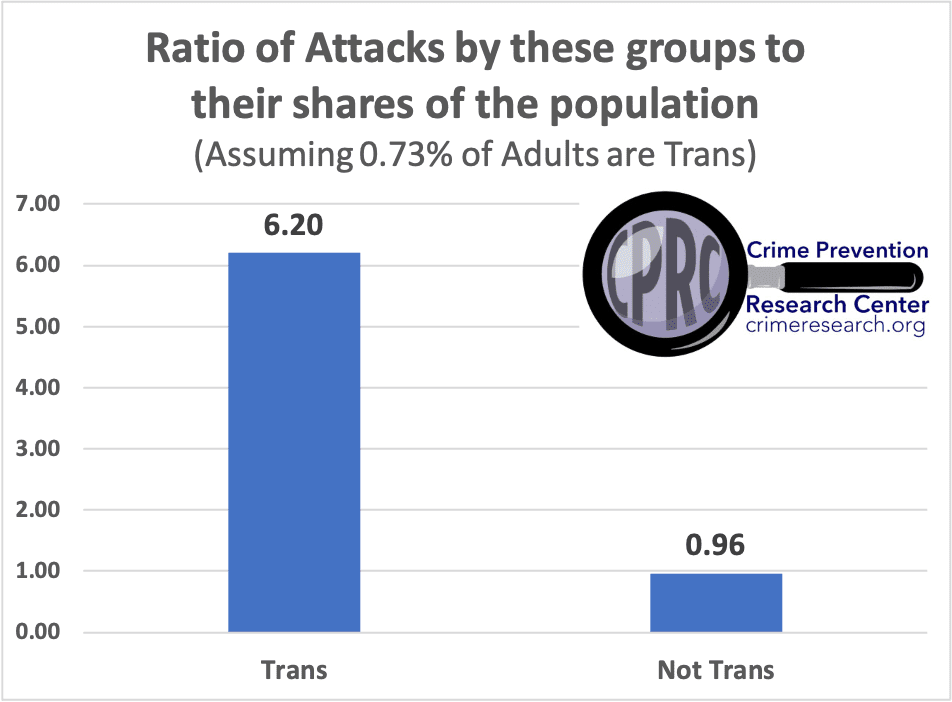
UPDATE: A 2025 Gallup Survey that was just released on February 16, 2026, puts the percentage of the population who are transgender at 1.1 percent (which is a year after the period we study). An August 2025 study by the Williams Institute, puts the percentage of the population who are transgender during 2024 and 2025 at about one percent for those 13 and older (though the FBI active shooting reports have a non-trans shooter as young as 12 in 2021 and there are mass public them as young as 11 and 12 years old). It isn’t clear that these estimates change any of our results for the full period, and if one wants to put more weight on the 1 percent estimate, particularly for our discussion for 2024, we have provided that below and that result is what we emphasize in the title for this post. However, as we will discuss later, transgenders shooters tend to be much younger than all active shooters, so the relevant adjustment might be for transgenders who are either under 30 or under 36, which means that the percentages used for adjustments using the Williams Institute 1% estimate should be either 0.76% or 0.65%. In other words, the 0.73% adjustment might thus be closer to the right amount.
The 2025 Annunciation Catholic Church shooter in Minneapolis, Robin Westman, who murdered two people and injured 17 others; the Canadian Tumbler Ridge shooter, Jesse Van Rootselaar, who murdered nine and injured 27, and the very recent Pawtucket, Rhode Island Hockey Arena, Robert K. Dorgan, who murdered two people and injured others, have once again generated additional discussions on this topic. But none of these cases are included in our analysis of the active shootings as they are after 2024 and/or in Canada.
We have now reviewed the FBI’s active shooting reports and identified which of those attacks involved transgender individuals. We conducted this analysis in two ways: first, by relying solely on the FBI’s data on active shooting cases; and second, by incorporating additional cases we compiled using the FBI’s definition of active shootings. Because this is a sensitive topic, the primary graphs we show here are based on the FBI data on active shooting cases.
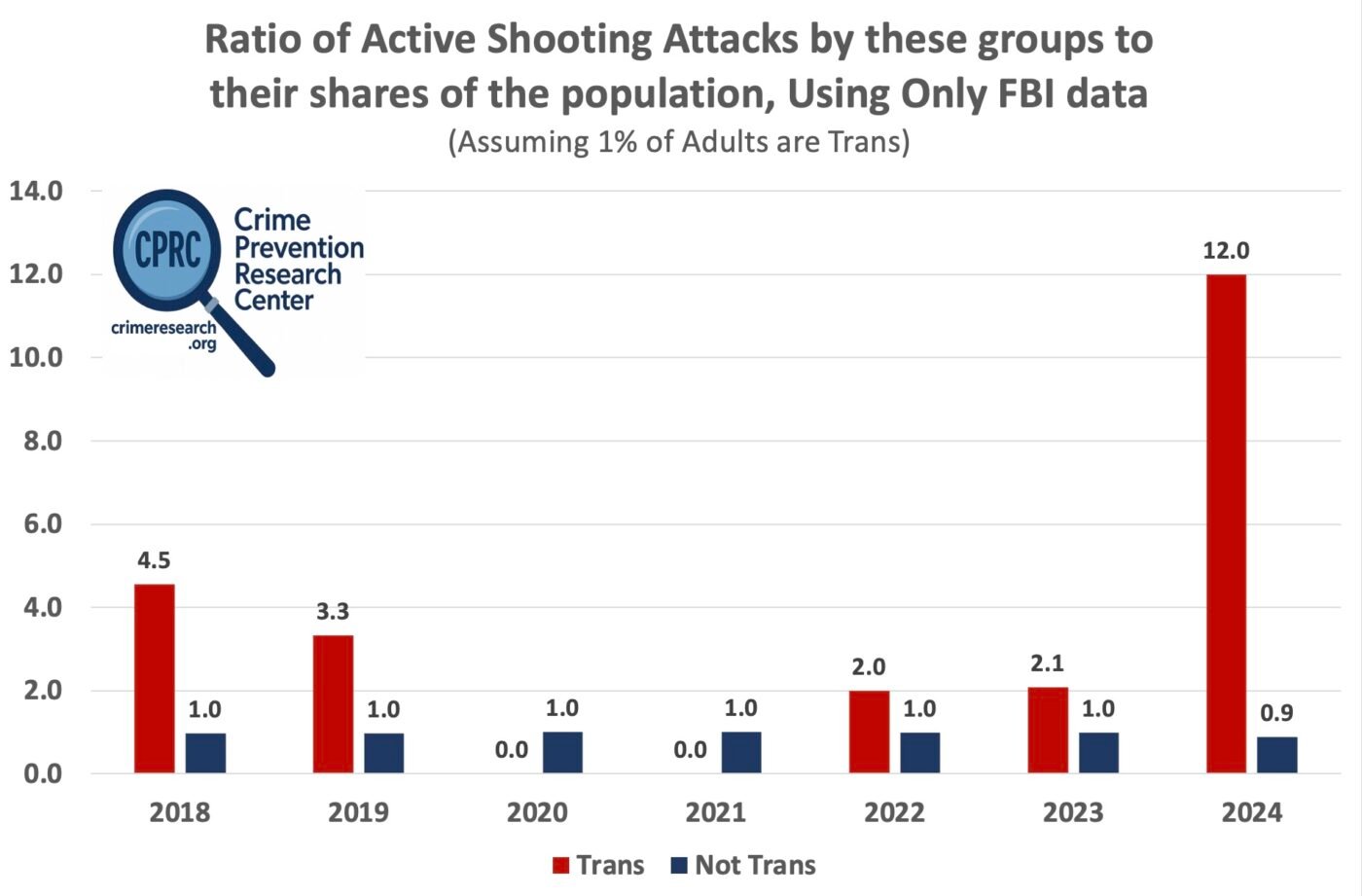
The next graphs report the raw percentages of active shooting attacks committed by transgender individuals and by others, both for the entire 2018–2024 period and broken down by year. Across the full period, transgender individuals account for 2.5 percent of the total attacks, which may appear small at first glance. However, in 2024 their share rose sharply to 12 percent. Some may still describe that percentage as small, but in neither case do these raw figures adjust for transgender individuals’ share of the population.
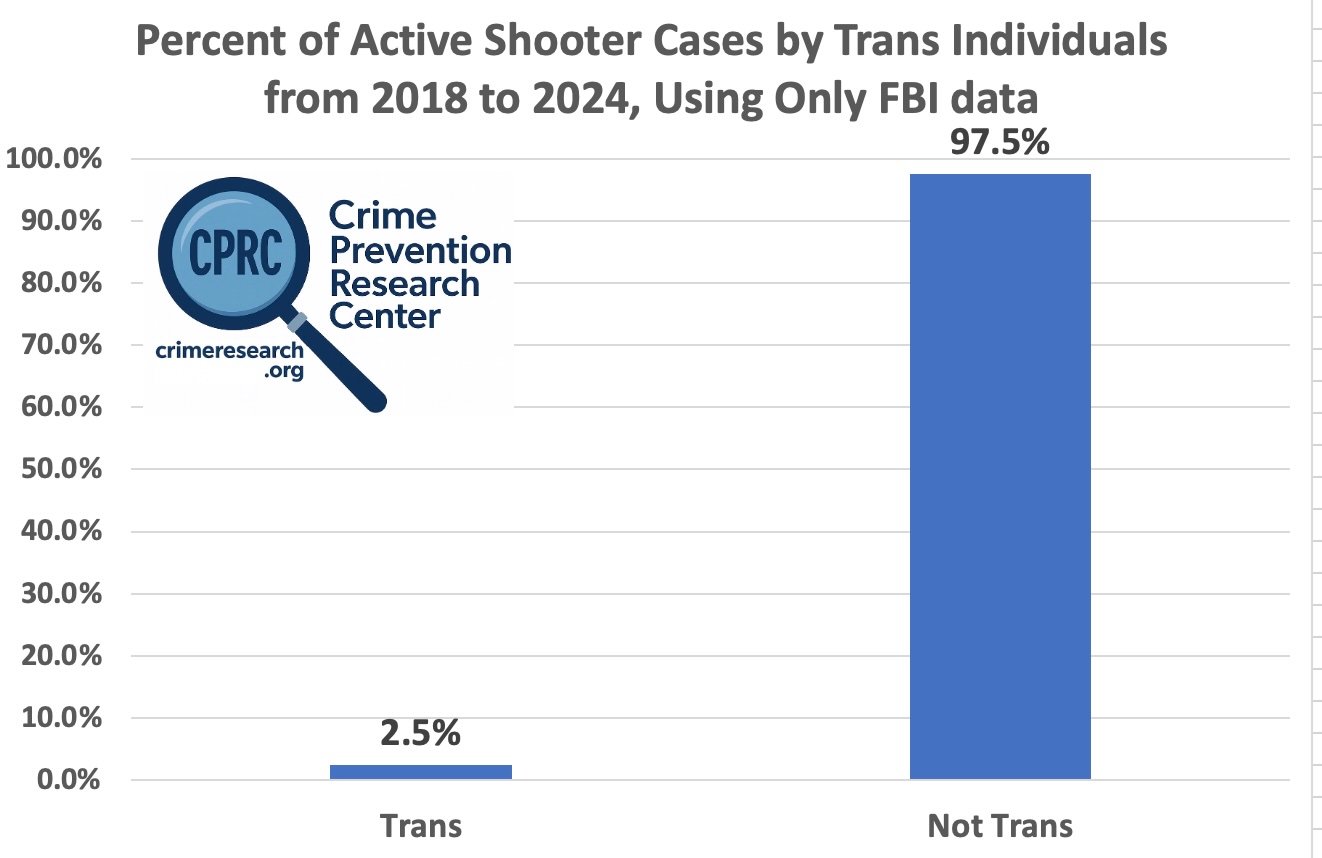
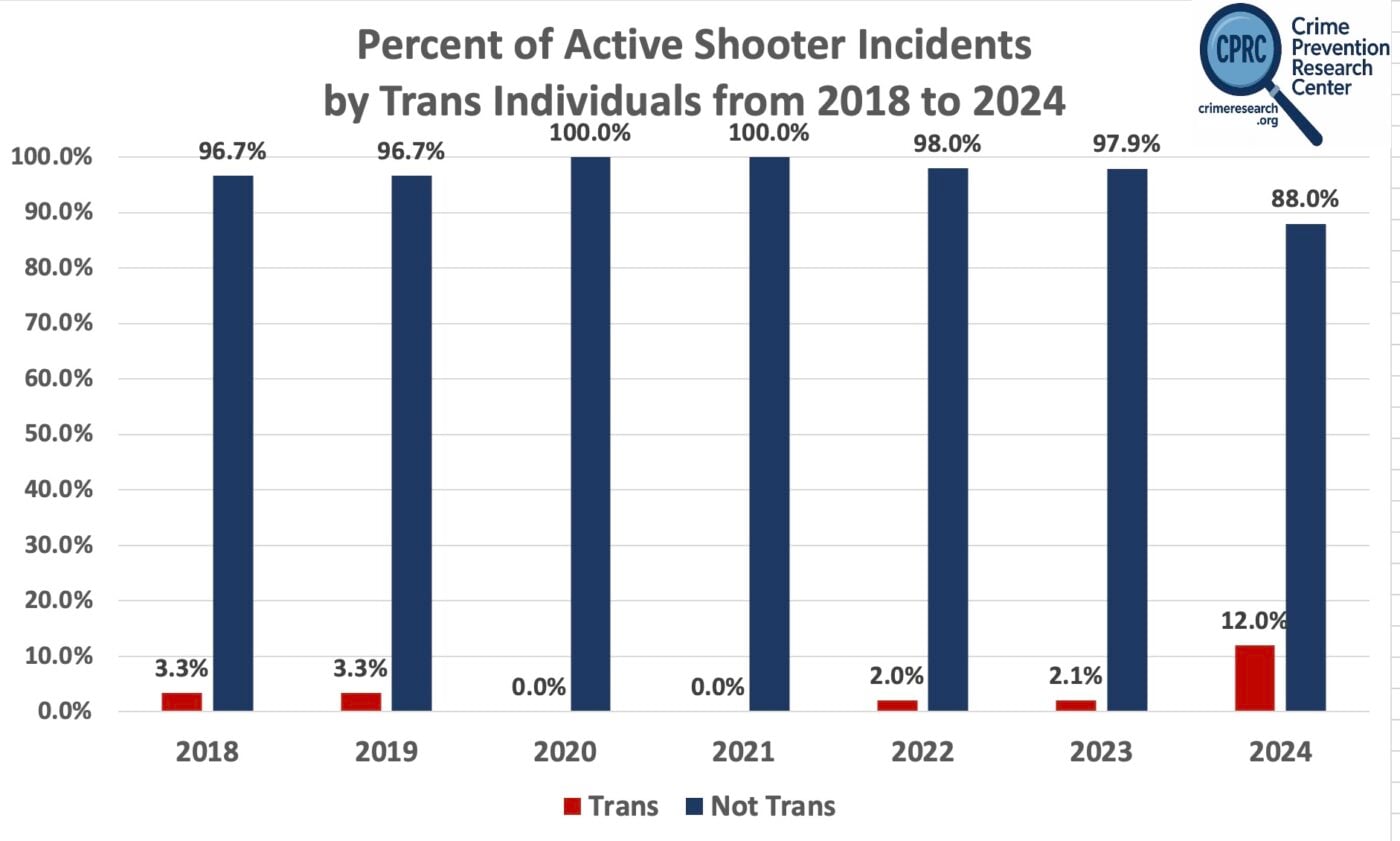
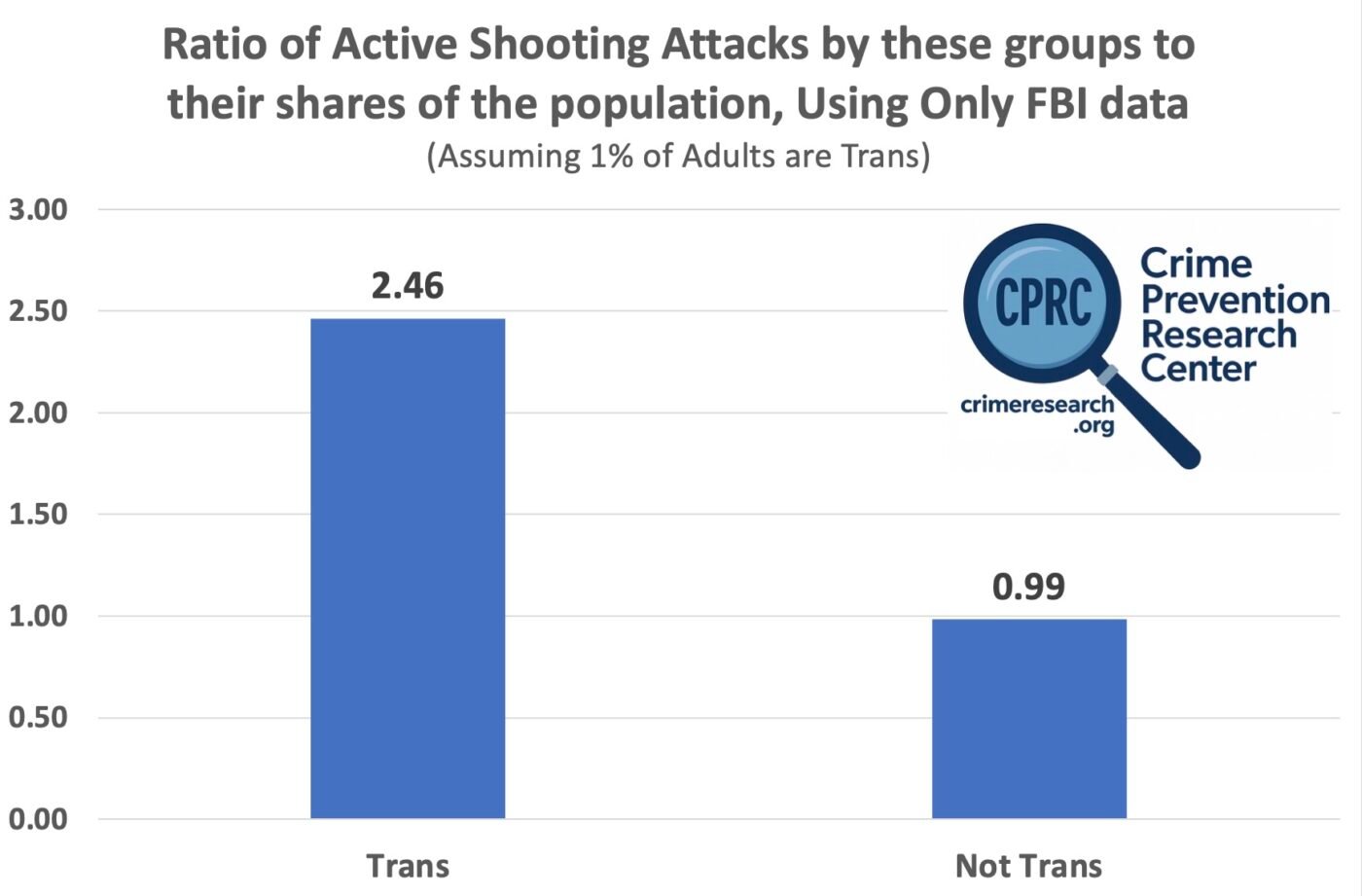
Using only the FBI data over the entire period, transgender individuals commit active shooting attacks at 3.4 times their share of the population, and if you use the higher Census estimate that they make up one percent of the population, it is 2.5. Using the CPRC’s expanded dataset of active shooting cases, the estimate is reduced from 3.4 to 2.1 times their share of the population.
If you assume that transgender individuals make up 1% of the population, the probability of observing at least 7 cases out of 284 is 1 in 88 or 1.46%. If you assume that transgender individuals make up 0.73% of the population, the probability of observing at least 7 cases out of 284 is 1 in 1,000 or 0.10%. However, despite Genesse Ivonne Moreno using male names, her case is debatable. If exclude her and you assume that transgender individuals make up 1% of the population, the probability of observing at least 6 cases out of 284 is 1 in 17.2 or 5.8%. If you assume that transgender individuals make up 0.73% of the population, the probability of observing at least 6 cases out of 284 is 1 in 63 or 1.6%.
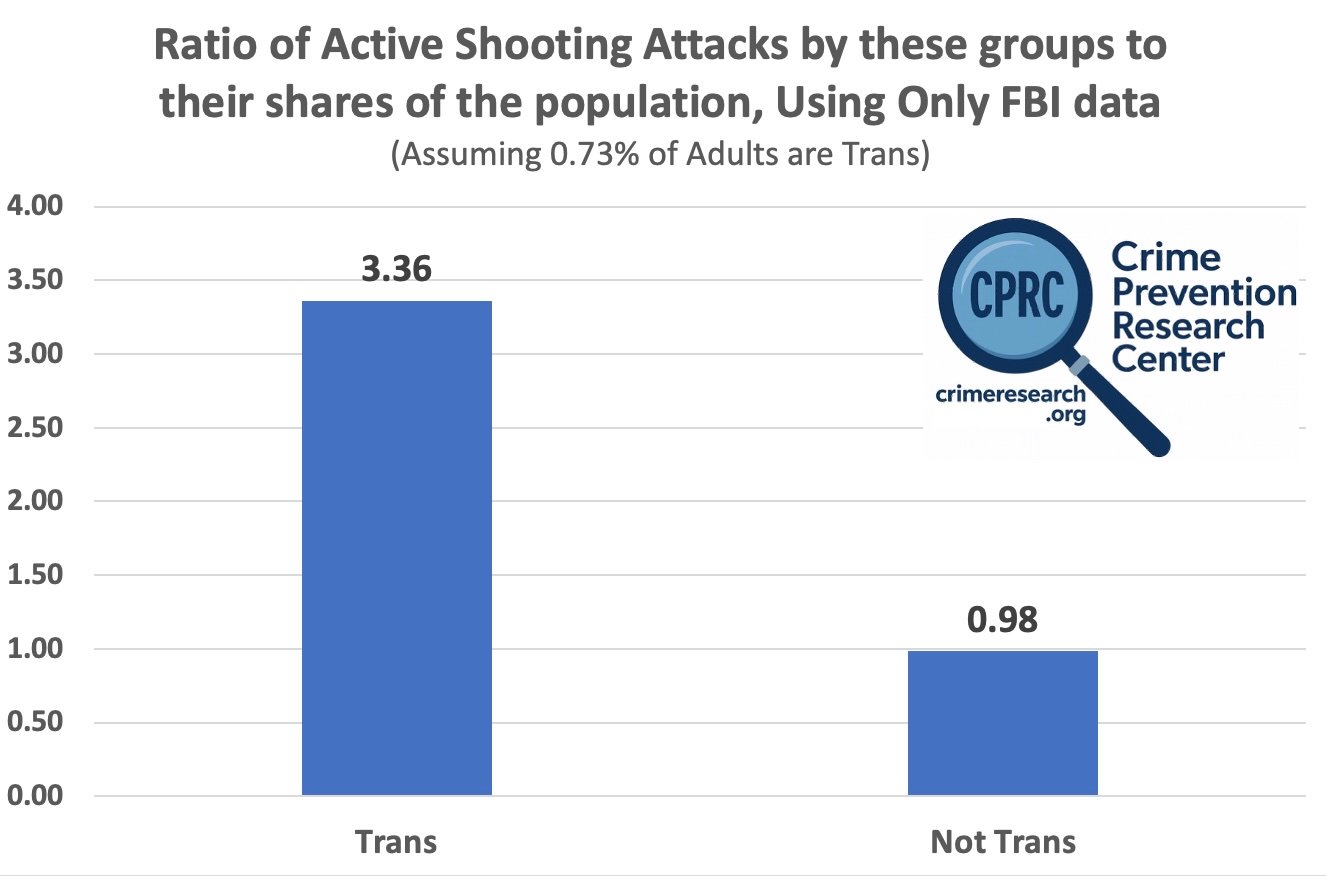
The graph at the very top of the page shows a sharp increase in the transgender share of active shooting attacks in 2024, reaching more than 16.3 times their share of the population. Even if one assumes the highest estimate of transgender individuals from the Census, that they make up 1% of the population, their share of active shooting attacks in 2024 is 12 times their share of the population.
Looking at just the data for 2024, if you assume that transgender individuals make up 1% of the population, the probability of observing at least 3 cases out of 25 is 1 in 460 or 0.217%. If you assume that transgender individuals make up 0.73% of the population, the probability of observing at least 3 cases out of 25 is 1 in 1,000 or 0.1%. Again, if you drop the Genesse Ivonne Moreno case and you assume that transgender individuals make up 1% of the population, the probability of observing at least 2 cases out of 25 is 1 in 38.5 or 2.6%. If you assume that transgender individuals make up 0.73% of the population, the probability of observing at least 2 cases out of 25 is 1 in 67 or 1.5%.
While the average age for non-transgender active shooters in the FBI database is 34.6 years old, the average age of transgender shooters is 23.6 or (21.5 excluding Moreno). This indicates that the relevant population to adjust for transgenders’ share of the population isn’t across all ages, but possibly just for those under 29 or maybe under 37. While most transgenders are clearly in that age group, it isn’t all of them, so the relevant share of the population wouldn’t be 0.73% or 1%. The Williams Institute indicates that about 76% of transgender individuals are under age 35 and about 65% are under age 30 (assuming a uniform distribution for ages 25 to 34). If that is correct and taking their estimate that 1% of the population over 13 years old are transgender, that would mean the adjustment should be either 0.76% or 0.65%.
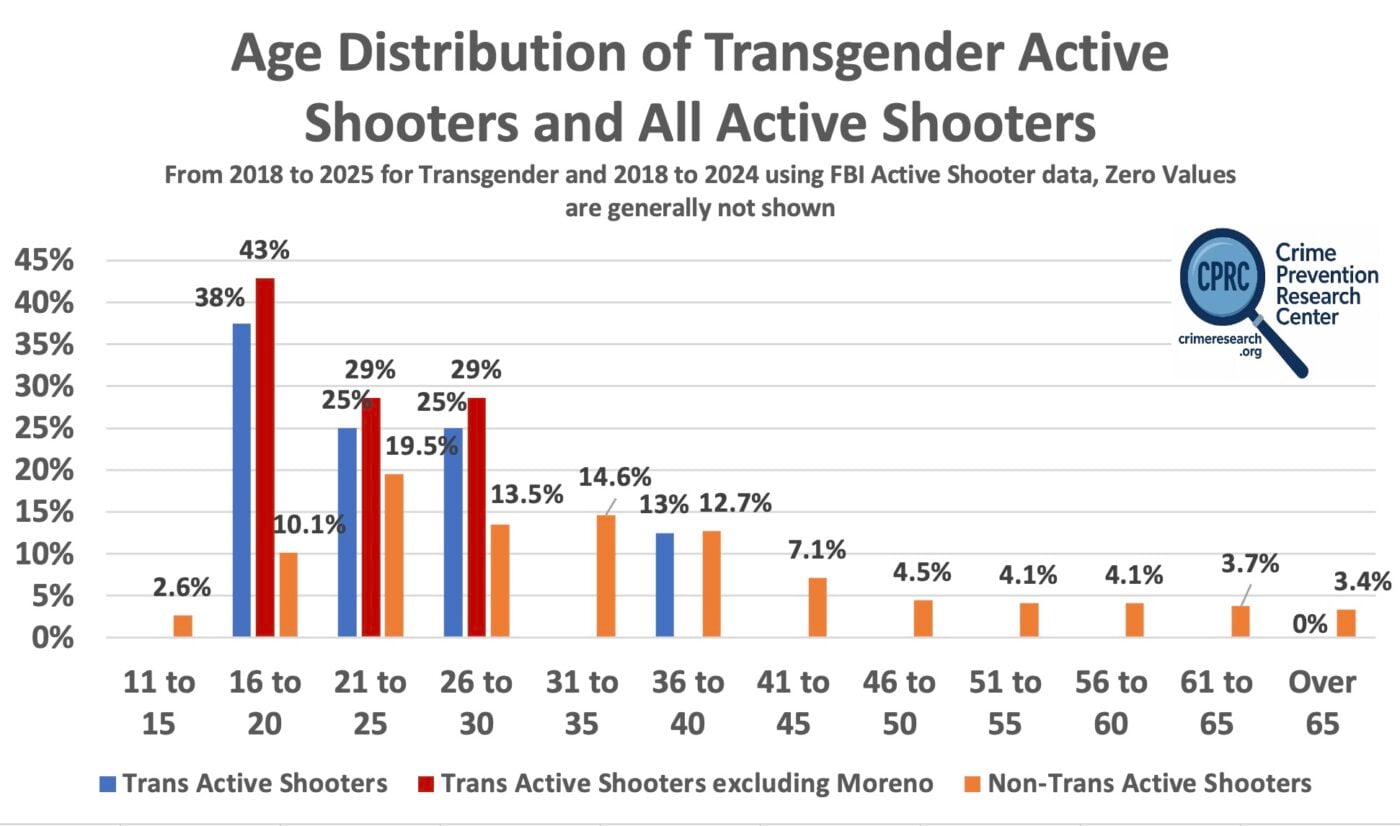
Most discussions about transgender individuals dismiss it as a serious concern because they only examine their attacks as a share of total attacks and don’t adjust for transgenders’ share of the population. But once one realizes that is the only way to properly analyze the data, regardless of how one measures it—whether using only FBI data or the expanded dataset—active shooting attacks committed by transgender individuals are becoming a serious problem.
Here are the graphs using the FBI data but assuming that one percent of the population is transgender.
There is an additional complication that can be raised. Excluding Moreno, three of these trans/non-binary individuals were male at birth and three were female. Given that the survey data indicates that about 50% or trans/non-binary people are men and women, it isn’t clear that there are any further adjustments that can be made to the underlying comparison group.
As a final note, mass public shooters in particular are overwhelmingly suicidal. Given the high rates of suicide by transgender individuals, it isn’t too surprising that they may be overrepresented about mass public shooters. The Williams Institute reports that about 48% had seriously considered suicide in the past year, and ~10–12% had attempted suicide in the past year among transgender respondents. Compare with the general U.S. adult population: ~4.3% report suicidal thoughts in the past year and ~0.6% report a suicide attempt. If the survey data from the Williams Institute is accurate, the rate people were seriously thinking of suicide is about 12× higher among transgender adults compared to the general population and the attempt rate is roughly 18× higher. Not as much work has been done of the motives of active shooters, but presumably they are similar.
Here is the Excel file with all the data.
Here is a list of trans shooters.
– Nashville Christian shooter identified as transgender, Audrey (Aiden) Hale, six murdered. 28 years old.
– Colorado Springs nightclub shooter identified as non-binary, Anderson Lee Aldrich, five murdered. 22 years old.
– Denver shooter identified as transgender, Alec McKinney (transgender) and Devon Erickson, one murdered, eight injured. 16 years old.
– Aberdeen shooter identified as transgender, Snochia Moseley, three murdered, shooter also killed. 26 years old.
– Iowa high school shooter transgender activist, Dylan Butler, two murdered, six injured 17 years old.
– Lakewood Church shooter identified as transgender, Genesse Ivonne Moreno, used male names (e.g. Jeffrey Moreno-Carranza and Jeffrey G. Escalante-Moreno), two injured. This is one case that is debatable, and the results above show the statistical test with it also excluded. 36 years old.
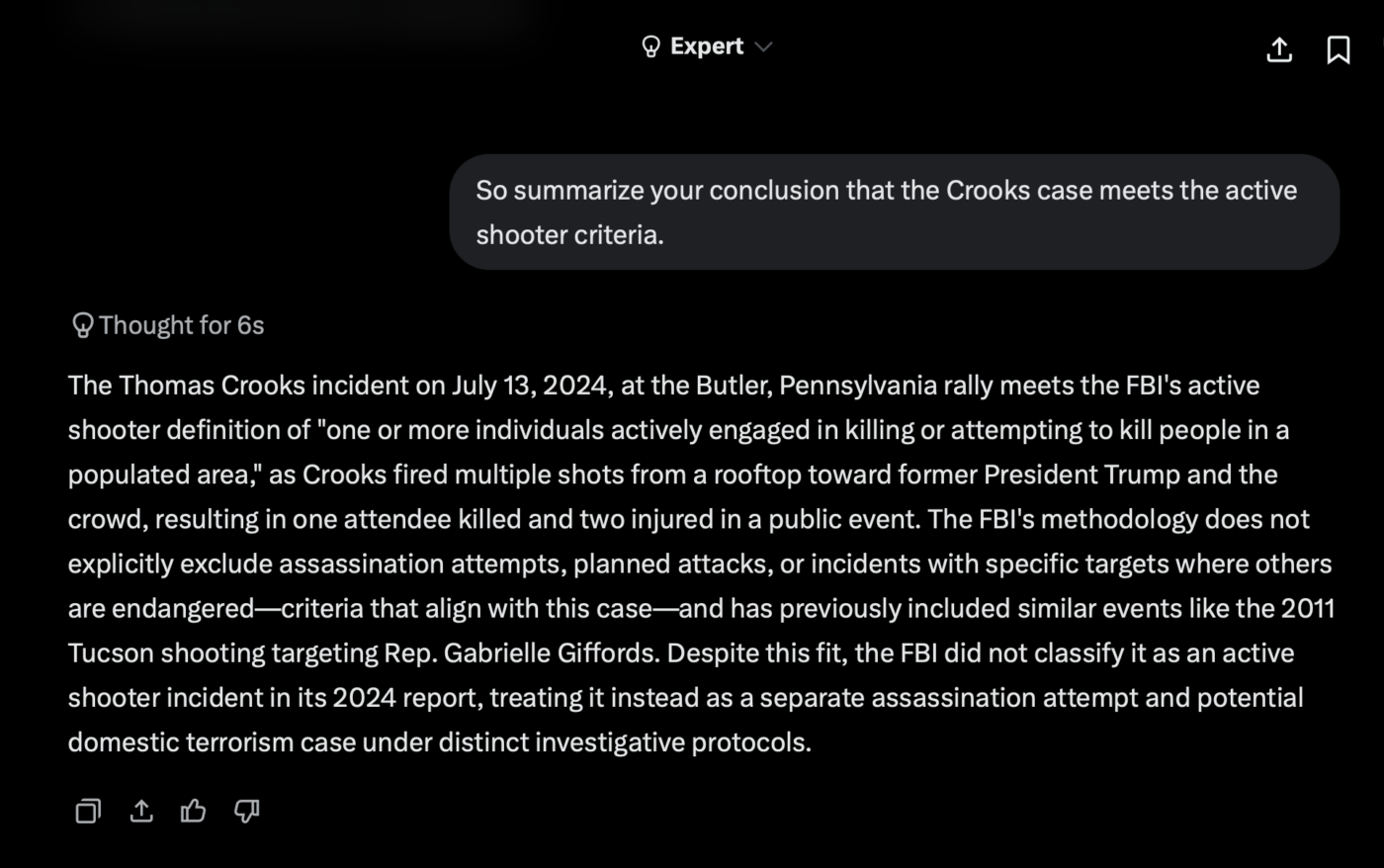
– Trump’s attempted assassin Thomas Crooks used they/them pronouns, had a deep interest in furries, and was exploring gender identity. 20 years old.
More on the Crooks case and its comparison to the Giffords assassination shooting, which the FBI counts as an active shooting incident.
[ad_2]
Source link